
| Page Created |
| March 28th, 2026 |
| Last Updated |
| April 15th, 2026 |
| France |
 |
| Related Pages |
| Special Air Service Operation Jedburgh Operation Amherst Operation Amherst, Zone A Operation Amherst, Zone B Operation Amherst, Zone C Operation Amherst, Zone D Operation Amherst, Zone E Operation Amherst, Zone F |
| April 7th, 1945 – April 11th, 1945 |
| Operation Amherst, Zone B |
| Objectives |
- To secure the bridges south and north of the village of Beilen, specifically the crossings over the Beilerstroom and the Linthorst-Homan Kanaal at Terhorst, Smalbroek, and Holthe, as well as the bridges over the Oranjekanaal at Halerbrug and the railway bridge nearby.
- Interdict the main north to south road to Assen, which the Germans are using intensively for their withdrawal.
| Operational Area |
| Zone B |
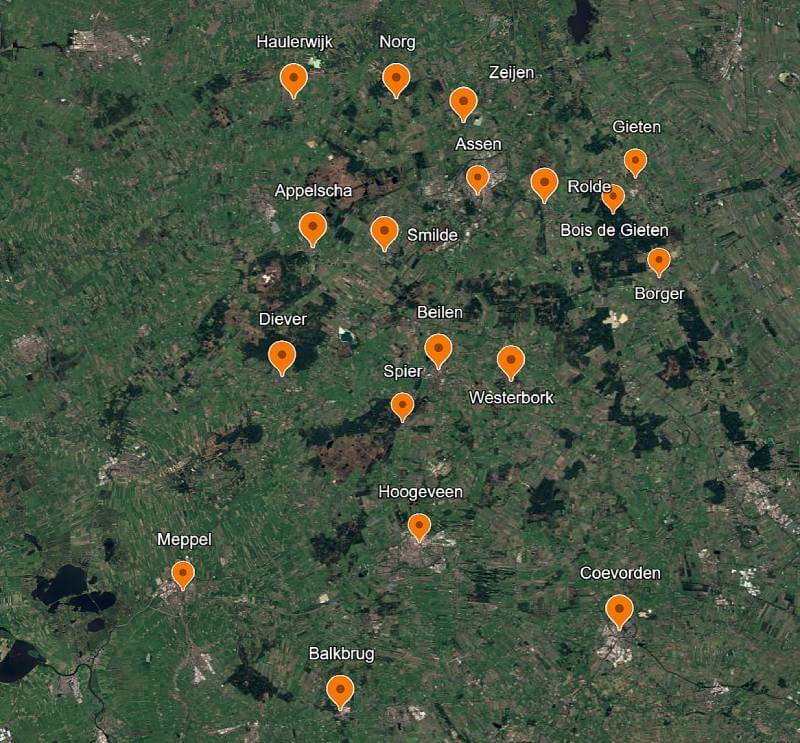
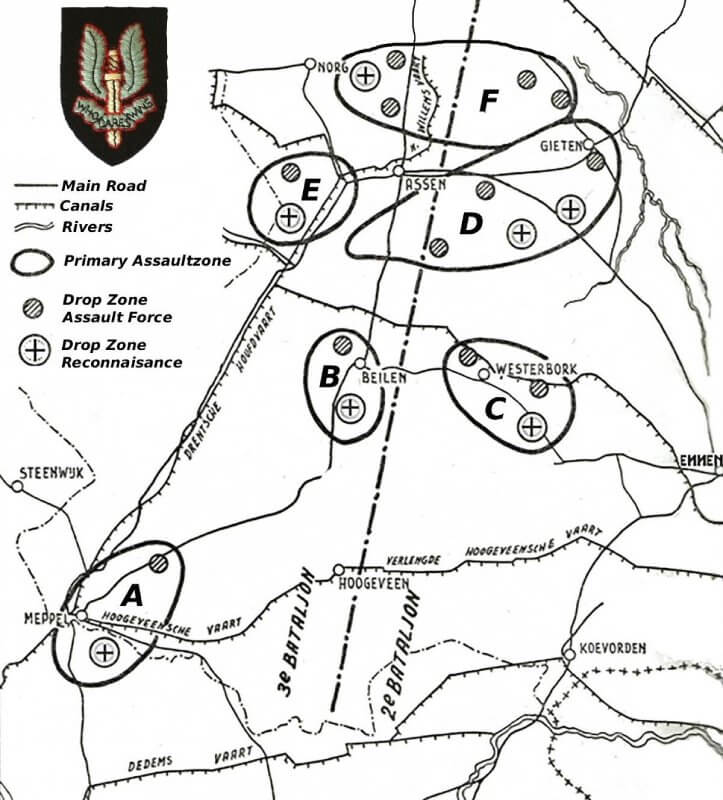
Zone B occupies the centre of the Operatie Amherst sector. Drop Zone 19 is assigned to the sticks of De Bollardière with chalk number 60, Paumier with chalk number 61, and Vallières with chalk number 62, all belonging to the staff company of the 3e Régiment de Chasseurs Parachutistes. Drop Zone 20 is assigned to the sticks of Dreyfus with chalk number 63, Grumbach with chalk number 64, and Lecomte with chalk number 65. All six sticks fly from Shepherds Grove airfield and drop between 23:00 and 23:30 on April 7th, 1945. Each aircraft carries four supply containers and ten paradummies in addition to its stick.
The mission of the Zone B sticks is to secure the bridges south and north of the village of Beilen, specifically the crossings over the Beilerstroom and the Linthorst-Homan Kanaal at Terhorst, Smalbroek, and Holthe, as well as the bridges over the Oranjekanaal at Halerbrug and the railway bridge nearby. The sticks are also to interdict the main north to south road to Assen, which the Germans are using intensively for their withdrawal. The Germans are simultaneously rushing Fallschirmjäger recruits of the Fallschirmjäger Ersatz und Ausbildungs Regiment at Assen forward to the Oranjekanaal and toward Beilen, attempting to establish a second defensive line behind the Hoogeveensche Vaart.
The landings in Zone B are seriously disrupted from the outset. The sticks are widely scattered. Two come down directly on top of retreating German convoys on the main road from Hoogeveen to Assen and immediately break apart in firefights. Regrouping is further hampered by a strong German concentration at Beilen. The bridges and sluice gates along the Linthorst-Homan Kanaal near Holthe are permanently guarded by detachments of German soldiers and Landwacht auxiliaries. Shortly after the landings, large numbers of enemy patrols, comprising soldiers, Feldgendarmerie, and Landwachters, begin combing the area for French paratroopers.
Lieutenant-Colonel Jacques Pâris de Bollardière, commanding officer of the 3e Régiment de Chasseurs Parachutistes, takes several days to gather his sticks in the wooded area southwest of Spier, and even then his force is far from complete. His first radio message to main Special Air Service Headquarters does not go out until the late afternoon of April 8th, 1945, at 16:30. This delay alone illustrates the severity of the difficulties his force encounters. Most other stick commanders have already reported in that morning. De Bollardière signals his position in the wooded area west of the Kibbelhoek fen, a small forest pool southwest of the village of Spier, and reports that he is still out of contact with his sticks, who appear to be engaged in light skirmishes in the vicinity. Civilians he has spoken to report that the enemy has been using the main road day and night for its withdrawal until April 7th, with ten light vehicles observed by the French during the night and a few more during the day. Rail traffic continues east of the main road. Ten minutes after his first message, at 16:40, De Bollardière transmits a second signal requesting that Main SAS Headquarters relay coordinates of his rendezvous point at the Kibbelhoek fen to the sticks of Simon, Paumier, Dreyfus, and Vallières by BBC broadcast. The fact that he names his own demi-stick leader Simon separately suggests that his own stick is not yet fully assembled at this point.
The Lecomte stick comes down north of Beilen, scattered across both sides of the Oranjekanaal. The bridges over the canal are closely guarded by enemy detachments, making regrouping impossible. Paratroopers are reported by local civilians near the hamlets of Klatering and Eursing, along the railway line and the main road to Hooghalem south of the canal, and north of the canal along the Hijkerweg between Hijken and Laaghalen. Two men land in the canal itself but manage to get out of the water. One lands on a henhouse beside the canal. These three, assisted by Dutch civilians, conceal themselves in a ditch near Halerbrug and remain hidden until Canadian forces arrive. The leader of the second demi-stick, Sergeant Armand Frédérique Suin, lands near Eursing, separated from his men from the moment of touchdown. He reaches his objective during the first night despite enemy patrols, but finding no trace of his men, changes into civilian clothes and goes into hiding. He continues to patrol and gather intelligence until he is relieved by ground forces on April 12th, 1945. Whether any member of the Lecomte stick reaches De Bollardière’s rendezvous point is unknown. In all practical terms, the Lecomte stick is rendered combat-ineffective from the moment it lands.
The Grumbach stick lands near Beilen, south of the Oranjekanaal, and is able to regroup at a nearby farm. Finding themselves approximately 1,500 metres from a forest edge, the men decide to move to the trees for cover. To reach the forest quickly, part of the supply containers are left at the farm concealed in a haystack, to be collected that night. An enemy patrol discovers the containers before the men can return. Two paratroopers sent back to retrieve them, Corporal Jacques Begallo and Private Pierre Fiorini, both radio operators, are captured. The rest of the stick moves on. They surprise a group of German soldiers and shortly afterwards intercept an enemy horse-drawn supply cart, capturing twelve men in total. The prisoners escape when the stick runs into a strong German bicycle patrol that refuses to surrender and fights. Having lost their supply containers and running low on ammunition, the stick splits into two groups and disengages. Both groups eventually find each other at a farmhouse, where local residents tell them of more paratroopers in nearby woods to the south. Within an hour they reach De Bollardière’s position in the forest near Spier.
The Dreyfus stick drops north of its assigned drop zone, landing astride the Beilervaart canal directly on top of a retreating German column of horse-drawn vehicles on the main road to Beilen. The firefight that follows scatters the group completely. The stick commander, 2nd Lieutenant Jacques Dreyfus, becomes separated from his men and wanders alone until he encounters the Paumier stick. His second-in-command, 2nd Lieutenant Philippe Akar, and Private Jacques Edin come down north of the Beilervaart but cannot cross the canal due to heavy enemy security. They spend the night moving through water-filled ditches and undergrowth in an attempt to evade capture. They are taken prisoner at dawn on April 8th, 1945. Local residents witness two captured paratroopers being taken to Smalbroek that morning. Private Yago Ragnacci is missing from the outset. His body is recovered later near Terhorst. He has been cornered by German soldiers and two Dutch Landwachters. In the firefight that follows he kills one German soldier and wounds a Landwachter before being shot through the eye.
At dawn only eight men have regrouped, under Private André Benoît, who assumes command in the absence of both stick leaders. They ambush a small enemy convoy and after further wandering make contact with De Bollardière in the woods near Spier. Nine men of the Dreyfus stick reach the battalion rendezvous. The number eventually rises to eleven with the arrival of Lieutenant Dreyfus, brought in by the Paumier stick, and Private Graziani, collected by the Vallières stick. Two members of the stick, Privates Claude Karoubi and Jules Margarit, are later wounded in the fighting at Spier. Lieutenant Dreyfus himself is struck by a Canadian bullet in the thigh during the same action. On April 11th, 1945, after the arrival of Canadian forces at Spier, armoured cars pick up another stray member of the stick, Corporal Eugène Meyer, who has been hiding in the forest for several days.
The stick of Captain Claude Vallières, whose real name is Benno Bentoin Grebelsky, lands four to five kilometres from Drop Zone 20, coming down near Spier astride the main road over which numerous German horse-drawn vehicles are moving. The stick is split in two by the road. Captain Vallières can only gather the men who land on his side. A Landwacht member encountered on the road identifies himself as such and is shot. Two men are wounded during the landing: Corporal Jeanne Cote and Sergeant Paul Pasquet, the latter with a broken fibula. After being carried by his comrades for a time, Pasquet is left concealed in a dry ditch. Sergeant Paul Mingucci is captured. On the morning of April 9th, 1945, Vallières receives the BBC broadcast carrying De Bollardière’s rendezvous coordinates and moves immediately toward Spier. On the way the stick encounters Private Jean Graziani of the Dreyfus stick, who has lost contact with his unit, and takes him along. The last men of the Vallières stick are not found until April 10th, 1945, when De Bollardière sends out a search party. On April 11th, after the arrival of Canadian forces, the injured Pasquet is finally rescued from the ditch where he has lain alone for nearly three days.
Information on the Decours stick is limited. The stick lands far from its assigned Drop Zone 18 in Zone A, coming down in an area east of the farming settlement of Nuil, approximately ten kilometres northeast of the intended drop zone. One man, Corporal Emile A.G. Bertau, is captured by the enemy. Over the following days the stick moves cautiously westward toward Ruinen. On the afternoon of April 8th, 1945, a farmer’s son named Lefert Kuik, travelling between Kraloo and Nuil, spots three soldiers moving west through the Holtsveen toward the Kralooër Heide. That evening, walking with two friends along the main road to Dwingeloo, Kuik encounters the soldiers again at close range. Three men emerge from the bushes and reassure the startled Dutch civilians that they are Allied troops, identifying themselves in broken German as French paratroopers. They are not alone. A full stick of paratroopers is concealed in the trees nearby. The French follow Kuik into the village of Kraloo and spend the night at his family’s farmhouse, numbering sixteen men. The following morning they move south from Kraloo toward Eurzinge, a small crossroads settlement on the main Hoogeveen to Beilen road held by a German detachment. After a brief exchange of fire the French disengage, take a dirt road westward, and disappear into an area of low-lying pastures surrounded by hedges. They are subsequently spotted by civilian witnesses near Anholt and eventually reach Ruinen, where they liberate the village. On the afternoon of April 11th, 1945, the Royal Canadian Dragoons enter Ruinen and make contact with the French. A message in the 2nd Canadian Infantry Division headquarters log, transmitted by the Royal Canadian Dragoons at 18:00 on April 11th, 1945, records the encounter with a group of fifteen paratroopers, a full stick, in the village that afternoon. The French report having patrolled to within three kilometres of Meppel, which they confirm is still strongly held by the enemy.
The stick of Captain Gilbert Paumier lands near the small settlement of Oostering, approximately five kilometres south of Drop Zone 19. Paumier encounters fewer immediate difficulties than the other Zone B sticks. In the darkness he assembles his men near three farmhouses on the edge of Pesse, close to the drop zone, and recovers all supply containers. Among those who turn up is the air dispatcher from the transport aircraft, André Phillips, a New Zealander and former member of the 6th Airborne Division, who is unable to resist the temptation and jumps after the French paratroopers armed with nothing but his Colt .45. The leader of the second demi-stick, Sergeant Leca, is initially missing, having landed in a forest fen and finding no trace of his men. Soaking wet, he knocks on the door of a farmhouse at the edge of Oostering and is guided back to the stick by a local civilian later that morning.
On April 8th, 1945, the Paumier stick lays ambushes along the main road between Hoogeveen and Beilen, which is busy with retreating German columns, before taking refuge that evening at the Heidehof farm north of Oostering. On April 9th, 1945, Lieutenant Jacques Dreyfus joins the stick after wandering alone since the landing. At approximately 09:00, Sergeant Leca picks up the BBC broadcast carrying De Bollardière’s rendezvous coordinates. The stick moves immediately toward Spier in good spirits, confident that their numbers will grow on arrival. At the rendezvous point they find elements of the Vallières stick already present. Post-war accounts contain a contradiction on this point. Paumier states after the war that he meets De Bollardière by chance near Spier, placing the encounter on approximately April 11th. However, De Bollardière’s radio message of April 9th, 1945, at 12:20, explicitly mentions the presence of the unauthorised dispatcher Phillips, who according to Flamand has joined the Paumier stick. The contemporary radio record is the more reliable source and places the arrival of the Paumier stick at Spier on April 9th, 1945.
| Multimedia |
| Zone B, Gathering at Spier |
Over the first days of the operation, De Bollardière’s force at the rendezvous point in the woodland southwest of Spier grows slowly as paratroopers arrive individually or in small groups. Some are guided by helpful civilians. Others navigate by the BBC broadcasts carrying the rendezvous coordinates, each demi-stick commander carrying a receiver. Despite the setbacks, the French do not remain idle. On the afternoon of April 8th, 1945, enemy soldiers moving on bicycles and on foot are attacked on the main road south of Spier. During the night of April 8th to 9th the French lay in ambush at the same point and engage heavy traffic of horse-drawn vehicles and infantry. A small Flak post is discovered at Spier. The railway line to the east is cut.
The strong German presence at Beilen makes any move against the bridges over the Beilerstroom and the Linthorst-Homan Kanaal impossible. On the afternoon of April 10th, 1945, at 14:30, two bridges across the Beilerstroom south of Beilen are blown by the enemy. That evening the railway bridge across the Linthorst-Homan Kanaal is destroyed.
By the morning of April 10th, 1945, De Bollardière reports to main Special Air Service Headquarters that he has gathered elements of the sticks Vallières, Dreyfus, Paumier, and his own stick, and probably elements of the Grumbach stick as a late arrival. His force numbers 43 men. This is slightly more than half of the 75 men who jump near Beilen, demonstrating how severely the scattered landing has disrupted his battalion. Of the known losses among these sticks, totalling ten men, this means that approximately 22 men remain unaccounted for at the time of the message. The Lecomte stick is not included in these figures. Its fifteen men are so widely dispersed as to be effectively removed from the operation from the moment of landing.
The 2nd Canadian Infantry Division, meanwhile, is still well south of the Amherst area during the early days of the operation. On the night of April 7th to 8th, 1945, the division is consolidating a bridgehead across the Schipbeek canal near Deventer. It crosses the River Vecht and reaches the southern outskirts of Ommen on April 10th. By April 11th, 1945, at 18:00, the Calgary Highlanders reach Balkbrug and leading elements of the 8th Canadian Reconnaissance Regiment penetrate to a position approximately eighteen kilometres south-southwest of Assen. Near Spier, these elements link up with French Special Air Service paratroopers and together engage a small German pocket in the area.
| Zone B, occupation of Spier |
By late afternoon of April 10th, 1945, Lieutenant-Colonel Jacques Pâris de Bollardière makes his move. With his force of 43 men, exhausted after three nights and two days of continuous operations, he occupies the village of Spier and blocks the main road between Hoogeveen and Beilen. It is a bold decision for such a small, isolated, and lightly armed force. De Bollardière judges the risk acceptable. He knows Canadian ground forces are close and that contact is imminent. That morning he has already informed main Special Air Service Headquarters of his intention and has requested an air strike against the village for the afternoon in support of his advance. The request is refused on the grounds that it would unnecessarily endanger civilian lives.
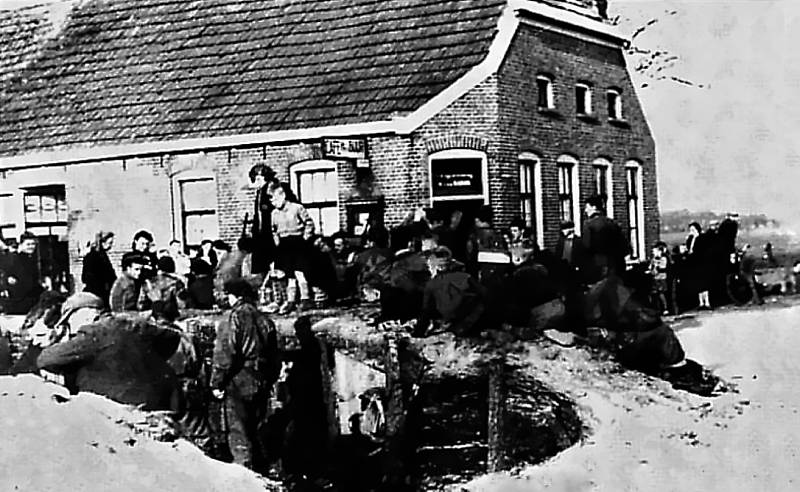
The French paratroopers take up position at the crossroads at the northern end of Spier, beside the café Ten Buur. Their single Bren gun is installed in a large German dugout next to the café, most likely the Flak position identified during earlier reconnaissance. The dugout is a circular pit approximately four metres in diameter, surrounded by a mound of wood and earth rising one and a half metres, intended to protect an anti-tank weapon. To fire from the position a man must climb onto the top of the mound, exposing himself completely. That night the road remains quiet. The enemy does not use it. In the early hours of April 11th, 1945, minor skirmishes result in five prisoners taken. Two Special Air Service men are wounded. There is still no sign of the Canadians.
At 09:00 on April 11th, 1945, De Bollardière signals main Special Air Service Headquarters that his men have seized Spier during the night. By mid-morning the situation changes sharply. A number of trucks approach from the north along the main road from Beilen, carrying German Fallschirmjäger. At some distance from the village the Germans dismount and advance on foot toward the French positions, moving upright along the road without tactical precautions. Sergeant Campan mans the Bren gun. De Bollardière orders him to hold fire until the Germans are close. When the leading Germans are approximately fifty metres away, De Bollardière gives the order. The weapon malfunctions. Campan clears the stoppage, but the Germans have seen the movement and return fire immediately. They are Fallschirmjäger armed with Maschinenpistolen, weapons with an extremely high rate of fire. Campan is shot in the head and killed. Major Jean Simon, second-in-command of the 3e Régiment de Chasseurs Parachutistes, takes over the Bren gun and is immediately hit. He is mortally wounded.
Despite being outnumbered and reduced to a single malfunctioning heavy weapon, the French hold their position. A sharp firefight develops and lasts for approximately one and a half hours. At approximately 14:00 on April 11th, 1945, at the critical moment of the battle, a German force emerges from the forest edge west of Spier in an outflanking movement to close on the village from the rear. At that same moment, armoured cars of the 8th Canadian Reconnaissance Regiment, the 14th Canadian Hussars, arrive at Spier. They have left Hoogeveen that morning as soon as a crossing is completed across the Hoogeveensche Vaart, tasked with reconnoitring north ahead of the infantry of the 2nd Canadian Infantry Division. The armoured cars engage the German force immediately and drive it off. De Bollardière’s men are rescued at the last possible moment. Their ammunition is almost entirely expended.
In the immediate confusion following the German withdrawal, the Canadian armoured cars open fire on the French positions. The friendly fire does not stop until the paratroopers vigorously wave their yellow identification scarves, in some cases tied to the muzzles of their weapons. It is during this phase that Lieutenant Dreyfus is wounded in the thigh by a Canadian bullet after climbing onto the edge of his dugout to signal with his scarf.
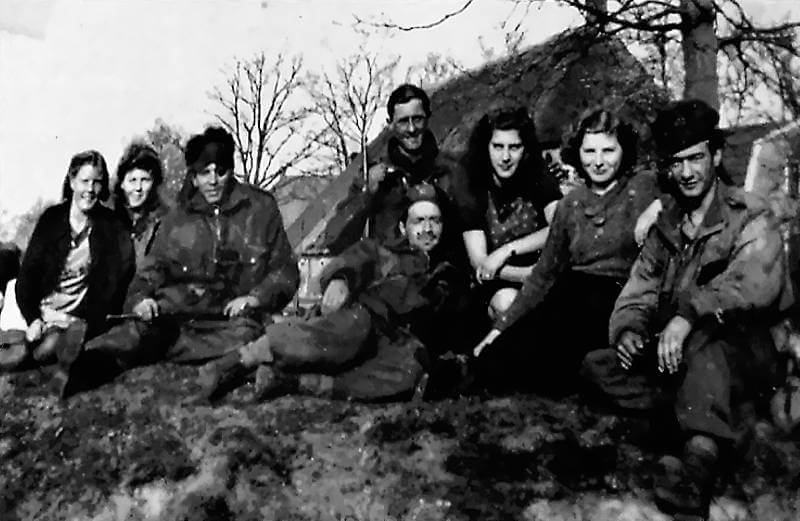
Canadian reports describe the French as being in a very poor condition. The men are exhausted, short of food and ammunition, and have sustained several casualties. Sergeant Campan is dead. Seven paratroopers are wounded, among them Major Simon, whose wounds are beyond treatment. He dies that night in a hospital in Hoogeveen. The coincidence surrounding Campan’s death is striking. On the same day that Claudius Campan is killed at Spier, his brother Marcel Campan, fighting with French forces on the Alpine frontier in southern France, is also killed. In the early evening of April 11th, 1945, transport of the 2nd Canadian Infantry Division arrives at Spier and evacuates the French paratroopers to Coevorden.
| Multimedia |
| Sources |