
| Page Created |
| March 28th, 2026 |
| Last Updated |
| April 20th, 2026 |
| France |
 |
| Related Pages |
| Special Air Service Operation Jedburgh Operation Amherst Operation Amherst, Zone A Operation Amherst, Zone B Operation Amherst, Zone C Operation Amherst, Zone D Operation Amherst, Zone E Operation Amherst, Zone F |
| April 7th, 1945 – April 11th, 1945 |
| Operation Amherst, Zone A |
| Objectives |
- Secure crossings over the Dedemsvaart canal
- Interdict the railway line and main road between Meppel and Zwolle.
| Operational Area |
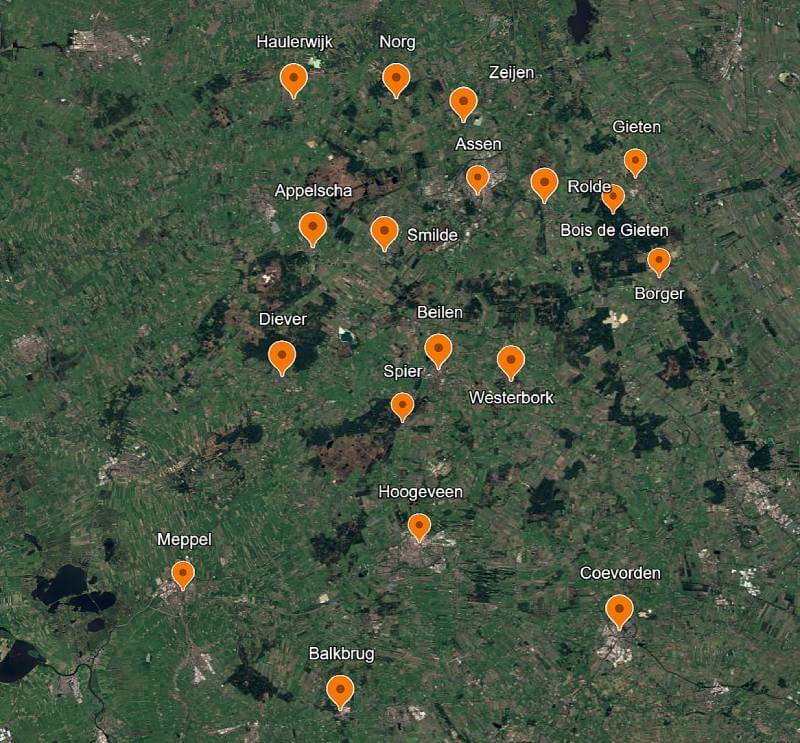
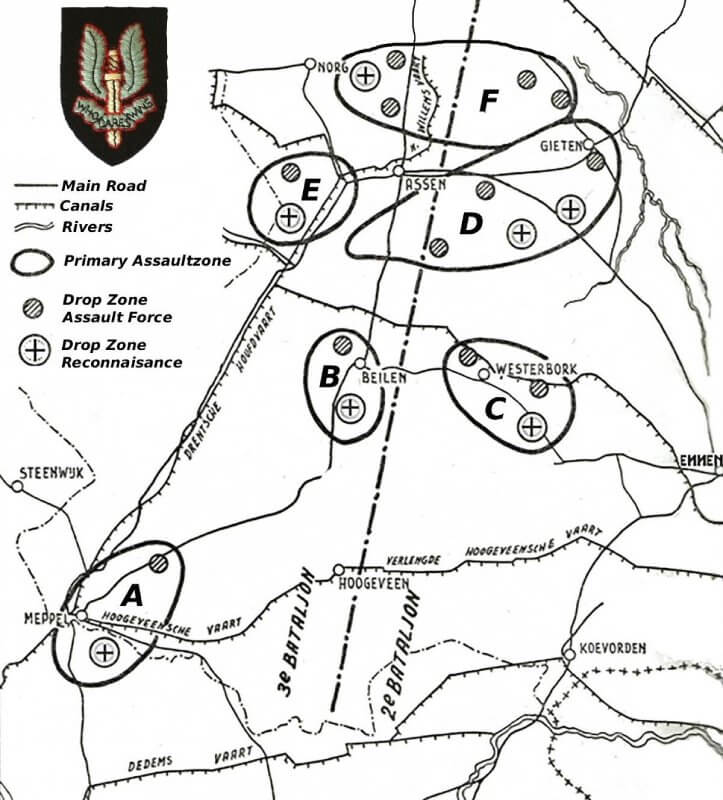
| Zone A: Southern half, area Zwolle, Meppel, Coevorden |
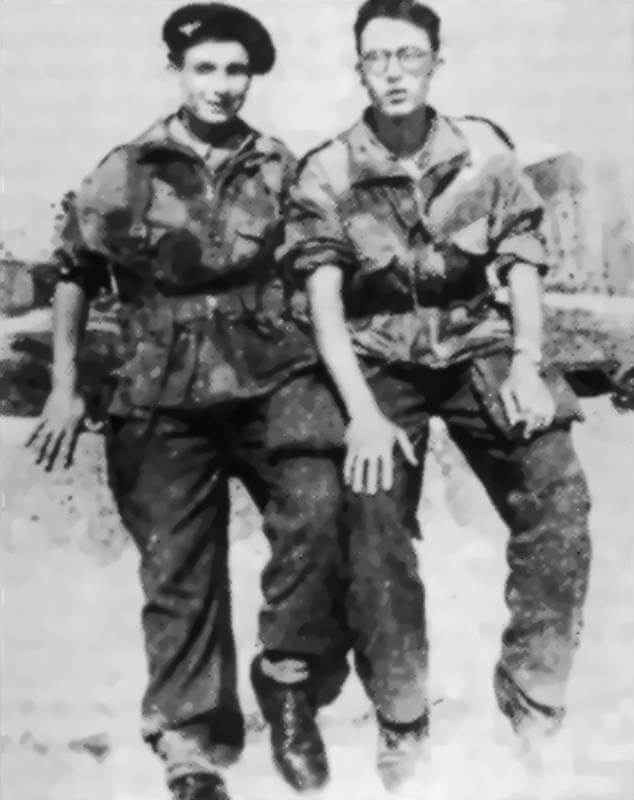
The southern half of the Amherst operation area, designated Zone A, covers the region around Zwolle, Meppel, and Coevorden. Drop Zone 17, in the southern part of this zone, is assigned to the 3e Compagnie of the 3e Régiment de Chasseurs Parachutistes. Three sticks are designated for this drop zone: the stick of Lieutenant Jean Paul Baratin, commanding officer of 3e Compagnie, with chalk number 55, the stick of 2nd Lieutenant Jacques Bouffartigue with chalk number 56, and the stick of Aspirant Gérard Lagallarde with chalk number 57. Their mission is to secure crossings over the Dedemsvaart canal and interdict the railway line and main road between Meppel and Zwolle. A fourth stick, that of Sriber with chalk number 15, lands in this area by error, coming down near Dedemsvaart, more than 45 kilometres from its assigned Drop Zone 10 near Gieten.
The three designated sticks are carried by Short Stirling aircraft from Shepherds Grove airfield and drop between 23:00 and 23:30 on April 7th, 1945. Each aircraft also carries four containers, two holding weapons, ammunition, and communications equipment, and two holding food supplies. The Sriber stick, flying from Rivenhall airfield, drops between 23:30 and 23:59 on the same night, far off its intended target.
Low cloud over the drop zone forces the aircraft to release their loads at 300 to 460 metres rather than the standard 180 to 200 metres. The additional time spent in the air, combined with a moderate wind, scatters the men widely on landing. Injuries are common. Many paratroopers land with their legs apart rather than together, resulting in ankle injuries, some serious. The dispersion on landing is such that much of the night passes in regrouping. At a jump altitude of 500 metres, the spacing between men of the same stick on landing can reach 100 to 200 metres. In the most extreme cases men from the same aircraft come down on opposite sides of a wood or a river.
Once on the ground, standard procedure requires the paratroopers to regroup, recover their supply containers, orient themselves, establish a secure base camp, make contact with the local resistance, gather intelligence, and identify their objectives. The containers, dropped mid-stick from the bomb bays of the Stirlings, land in the centre of the stick’s dispersal area. Men who jump first walk in the direction of the aircraft’s flight to find the containers. Men who jump last walk against it. The first and last men to land zigzag through the terrain to cover a wider search area and increase the chance of finding their comrades. In the darkness, torch signals, small reflective plates carried on helmets, and red signal lights on the containers assist the regrouping process.
The language barrier presents an immediate problem. French is not widely spoken in Drenthe. To address this, a German-speaking soldier, usually an Alsatian, is attached to each stick. German is better understood by the Dutch population than French, but its use causes an immediate problem of a different kind. Civilians opening their doors in the middle of the night to find soldiers in unfamiliar uniforms speaking German react with fear and suspicion. In most cases the French paratroopers carry a small leaflet explaining in Dutch that they are Allied troops who have come to liberate the country and asking for assistance. The leaflet is composed by a Dutch refugee of German descent and contains numerous errors and Germanisms. Despite its imperfections, the document works on most occasions. The official stamp it carries appears to be its most convincing feature.
The sticks of Bouffartigue and Lagallarde come down close together near the Staatsbos van Staphorst, a small woodland area approximately five kilometres south of their intended drop zone. The balance of the Bouffartigue stick lands in open fields immediately south of the forest. Some men come down inside the woodland itself, which consists of young plantations. One member of the stick, Paul Roux, does not jump. A problem with his static line prevents his exit from the aircraft. He returns to England and arrives later in Coevorden with the jeeps driven in overland. The forest does not appear on the outdated maps carried by the French, having been planted as part of a reforestation programme for the unemployed in the mid-1930s. The paratroopers name it the Bois de Staphorst.
Inside the forest is a secret encampment of the local resistance group under Jos Bonvanie. The group, numbering approximately 25 to 30 fighters, is well armed with Bren guns, Sten guns, an anti-tank weapon, and mines, all delivered by air drop at the end of March 1945. The Dutch resistance has not been informed of Operatie Amherst before the drop. In the darkness, a brief skirmish breaks out inside the Staatsbos when several resistance fighters are mistaken for enemy soldiers by the French paratroopers. Two Dutch resistance fighters are wounded in the exchange.
Bouffartigue and the men who land in the open fields to the south of the forest assemble quickly in the barn of a farm on the Kanlaan. The farming family speaks no French, but Bouffartigue succeeds in establishing his location from the information they provide. At dawn on April 8th, 1945, he moves into the forest and makes contact with the stick of Lagallarde near the forester’s house.
The Lagallarde stick lands further south still, around the hamlet of Den Hulst, which stretches along both sides of the Dedemsvaart canal. The men who land north of the canal make their way to the forest during the night, guided by a local civilian, Wiep van Werven, an assistant veterinarian who has worked in Belgium and speaks fluent French. They gather in the barn of the forester’s house in the southern part of the forest. Approximately ten men of the Lagallarde stick land south of the canal, in and around the village of Nieuwleusen. One para lands on the local football field. Another, Henri Godet, becomes entangled in electricity wires and lands upside down, sustaining a minor wound to his chin. The current is switched off and he is unharmed beyond the injury. With the help of local civilians, the men south of the canal gather at a nearby farm. Both bridges in the immediate area have been demolished. The men cross the Dedemsvaart by barge during the night and are escorted by civilians to the Staatsbos, where they join the rest of the stick at the forester’s house. Most residents of Nieuwleusen are unaware of the drop until dawn, when they discover parachutes scattered across the area, some hanging from fruit trees.
The Baratin stick lands furthest from the intended drop zone, coming down near Balkbrug, approximately eleven kilometres southeast of Drop Zone 17. With the help of a civilian guide, the stick reaches the Bois de Staphorst the following morning and joins the other two sticks.
By the morning of April 8th, 1945, the combined sticks in the Bois de Staphorst number approximately 44 men. A division of tasks is agreed with the resistance group of Bonvanie. The Dutch fighters take responsibility for the security of the bivouac area while the French paratroopers conduct their combat missions. Roads in the area are blocked and the railway line between Staphorst and Zwolle is cut. Baratin, as company commander, sends reconnaissance parties to the nearest bridges across the Dedemsvaart. Bouffartigue reconnoitres toward Lichtmis, on the main road between Zwolle and Meppel. Lagallarde moves toward Balkbrug. All bridges across the Dedemsvaart are found demolished. The enemy has destroyed them several days earlier. Reconnaissance toward Meppel confirms that the town is strongly held by German forces, who also control the main road running south to Zwolle. Several dikes have been destroyed, flooding approximately fifty square kilometres of land between the two towns.
At 08:20 on April 8th, 1945, Lieutenant Baratin transmits the first message from the combined sticks to main Special Air Service Headquarters, using radio call sign Amherst 304. The message contains intelligence gathered by his men, much of it obtained from the local resistance network.
While the reconnaissance missions proceed, the resistance group of Bonvanie, in consultation with the French, moves to round up collaborator families known to live in the immediate neighbourhood, an area known locally as Punthorst. The Nationaal-Socialistische Beweging, the Dutch National Socialist Movement, has a strong following in the area. Among the most committed local collaborators are the Santing family. The elder Santing, born at Ruinen, and his wife Annigje Santing-Poepe are fanatical Nationaal-Socialistische Beweging members. Their sons Harm, Jakob, and Willem are all present at the family farm that night. Also in the area are the sixteen-year-old Alex Duif and Geert Duif from Punthorst, and two older Nationaal-Socialistische Beweging members from Nieuwleusen, Klaas Prins and Rutger Prins. The Landwacht is a German-organised auxiliary police force recruited from Dutch collaborators. Its members are feared and despised by the local population for their role in hunting down resistance fighters and people in hiding.
Several paratroopers of the Bouffartigue stick assist the resistance in the operation. Resistance fighter Kees de Roos and French para Yves Loichot move toward the farms of the Sterken, Prins, and Santing families, known collaborators. At the farm of the Prins family, three people are arrested and taken to the Staatsbos. De Roos and Loichot then move to the Santing farm on the Dekkersweg. Taking up position in a ditch in front of the farm, they observe two men leaving the building. De Roos orders them to surrender. Both men run back inside. De Roos and Loichot open fire, wounding Harm Santing in the arm. Inside the farmhouse, the three Santing brothers make for the attic. One of them, probably Jakob, fires from an attic window and kills both De Roos and Loichot with aimed shots to the head.
A witness alerts the neighbouring Spijkerman family. Their daughter Lenie is sent to the Staatsbos to inform the French and the resistance fighters. The combined force is preparing to move out for an attack on the Lichtmisbrug. The attack is postponed. Raoul Loichot, twin brother of the slain Yves, moves immediately to the Santing farm with two paratroopers and several resistance fighters. They enter the farmhouse through a side door. Suspecting concealment, they fire into a haystack in the farmyard. Four men emerge, covered in blood. When para Jacques Noël, an Alsatian who speaks German, asks who shot the paratroopers, Jakob Santing states that it was them. The brothers Jakob, Willem, and Harm Santing and their father are shot dead on the spot.
Events deteriorate further. Back at the Staatsbos, one of the prisoners, the young Derk Jan Prins, escapes from the forest hideout, compromising the security of the bivouac. The decision is taken to move the camp. The remaining prisoners, who have become a liability, are shot that same evening. They are Klaas Prins and Rutger Prins from Nieuwleusen, arrested that morning, Annigje Santing-Poepe, the wife of the elder Santing, Alex Duif and Geert Duif from Punthorst, detained earlier that day from a family of collaborators. April 8th, 1945, a Sunday, leaves ten dead in the Punthorst area. It is remembered locally as Black Sunday.
After completing these actions, the French paratroopers under Bouffartigue move with the local resistance fighters toward the Lichtmisbrug, a modern viaduct opened in 1939 carrying the main Zwolle to Meppel road across the Dedemsvaart canal. The bridge is held by a German detachment with several machine-gun posts covering all approaches. An observation post is established in a water tower more than fifty metres high standing beside the bridge, offering clear visibility for kilometres across the surrounding flat landscape. The lightly armed French paratroopers have no realistic prospect of taking the position. The open terrain provides little cover. The advancing paratroopers are spotted and pinned down by long-range machine-gun fire. One para, Maurice Gelot, is wounded. At approximately 16:30 on April 8th, 1945, the French disengage and withdraw to the Bois de Staphorst, where they learn that the security of the base camp has been compromised by the escape of Derk Jan Prins.
That afternoon, contact is made with the 12th Manitoba Dragoons, the reconnaissance regiment of the 2nd Canadian Infantry Division, which is conducting a reconnaissance mission toward Meppel from the direction of Hardenberg. Lieutenant Baratin confirms the link-up in a wireless message to main Special Air Service Headquarters at 15:45 on April 8th, 1945. The Canadian ground troops are still fighting for Zutphen at this time. The Manitobas are well ahead of the main force. While the armoured cars continue their reconnaissance, one scout car remains with the French paratroopers under Baratin to provide a wireless link.
That night, as a precaution, the French paratroopers move to a new camp at a farmhouse on the IJhorsterveldweg, on the far side of the Bois de Staphorst. On the morning of April 9th, 1945, Baratin decides to leave the area and move east toward Balkbrug to assist the 12th Manitoba Dragoons in securing the village ahead of the approaching ground troops. At Balkbrug, a wounded para and the two resistance fighters injured in the initial confusion on the night of the drop are handed over to the Manitobas and evacuated toward Coevorden.
Balkbrug lies on the main axis of advance of the 2nd Canadian Infantry Division. The local bridge across the Dedemsvaart has been destroyed by the Germans, but holding the village is essential. The French paratroopers take up a blocking position at the site of the destroyed bridge. The town of Ommen, on the River Vecht to the south of Balkbrug, is held by a German force estimated at between 200 and 400 men, with orders to block the northward advance of the 2nd Canadian Infantry Division by denying access to the bridge across the Vecht. This force is now hemmed in between the advancing Canadians from the south and the 12th Manitoba Dragoons and French Special Air Service paratroopers at Balkbrug to the north.
On the night of April 9th to 10th, 1945, the threat materialises. A German column consisting of an armoured car and three trucks approaches the French position at Balkbrug. A short firefight drives the column off. The Germans make no further attempt to push through Balkbrug, though the situation remains tense for the lightly armed French paratroopers. On April 10th, 1945, contact is established with the 2nd Canadian Infantry Division, which crosses the River Vecht and advances north from Ommen. Finding the route to the north blocked, the German force at Ommen escapes westward in the direction of Zwolle.
| Multimedia |
| Zone A: Northern half, Hoogeveen |
Drop Zone 18, east of Meppel, is assigned to two sticks of the 3e Compagnie, 3e Régiment de Chasseurs Parachutistes: the stick of Gayard with chalk number 58 and the stick of Decours with chalk number 59. Their task is to secure the bridges across the Hoogeveense Vaart, the canal running between Meppel and Hoogeveen. Both sticks are carried by Stirling aircraft from Shepherds Grove airfield and drop between 23:00 and 23:30 on April 7th, 1945. Each aircraft drops four containers and ten paradummies alongside its stick. Neither stick lands anywhere near its intended drop zone. The Decours stick comes down nearly ten kilometres north of the village of Pesse, in Operation Zone B. Its story is told in the account of that zone. A third stick, that of 2nd Lieutenant Francis Gilbert Nicol with chalk number 6, lands near Hoogeveen by error, eighteen kilometres from its assigned Drop Zone 3 northwest of Westerbork.
The Gayard stick experiences difficulty regrouping after the drop. Two men are missing and one, Private Maurice Legay, breaks his ankle on landing. His comrades leave him concealed in a haystack and alert a nearby farmer. The farmer recognises that the injury requires medical attention. He dresses Legay in civilian clothing and takes him by bicycle to a doctor in the nearby village of Ruinen. While the doctor treats the ankle, two German soldiers arrive at the surgery, slightly wounded in a skirmish elsewhere in the village, and demand treatment. Legay sits in the same room, hidden behind a folding screen with his Colt .45 ready. The German soldiers notice nothing and are seen off by the doctor. The doctor then completes the treatment of Legay’s ankle. The farmer accompanies Legay back to the farm, where he remains in hiding until Canadian ground forces arrive.
The remaining men of the Gayard stick spend the night recovering their supply containers. What happens on April 8th, 1945, is disputed in the sources. Calvert’s report states that the men ambush a German staff car near Ruinen and destroy it, killing all four occupants, described as Wehrmacht officers believed to be from the Gestapo. Flamand’s account gives a different version, describing an attempted ambush of a German bicycle patrol of five men that fails when the Bren gun malfunctions. The weapon, like many of those delivered by container, comes directly from an arms depot and is heavily greased. It has not been cleaned and test-fired before the operation. Disassembling and cleaning a Bren gun is a time-consuming process, and the short preparation time means many sticks begin operations with weapons that are not yet serviceable. Which version of events on April 8th is accurate cannot be established from the available sources.
After dark on April 8th, 1945, the Gayard stick leaves Ruinen and moves westward toward the Drentsche Hoofdvaart canal near Havelte. In the early hours of April 9th, 1945, the men reach an unguarded bridge and lock across the canal, later identified as the Havelterbrug and its associated lock. The bridge has been prepared for demolition with aerial bombs. The French carefully remove the detonators and explosive charges and throw them into the canal. The bridge is saved.
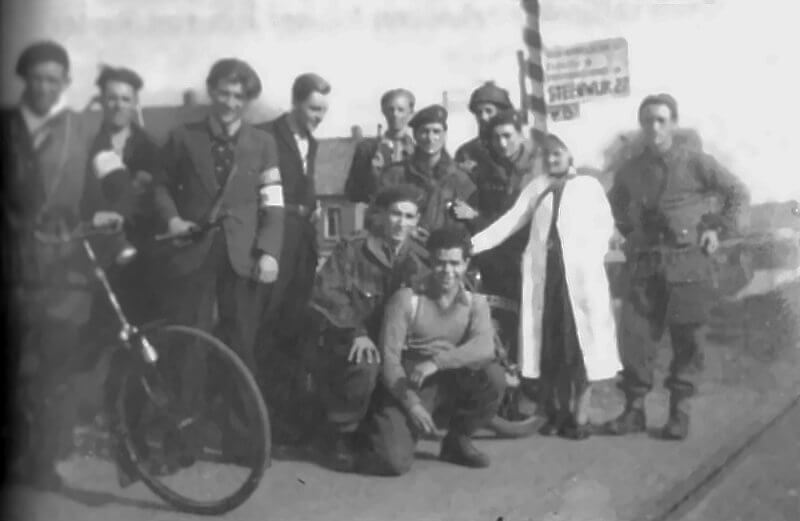
The stick’s assigned mission includes reconnoitring the German military airfield at Havelte, known to the Germans as Fliegerhorst Havelte and referred to in Allied operational documents as Steenwijk Airfield, constructed north of the village during the occupation as a base for night fighters. The men decide to wait until evening before moving toward the airfield. In the late afternoon, Dutch civilians bring news that Canadian forces are approaching. The French send a civilian with a message for the Canadians and two armoured cars of the 12th Manitoba Dragoons arrive at the bridge shortly afterwards. As it is already late in the day, the French and Canadians agree to hold the bridge jointly through the night. The Canadians return on the morning of April 10th, 1945, and together with the French paratroopers advance to the airfield. They reach it and take approximately fourteen prisoners, but find the facility already abandoned and thoroughly destroyed. Allied air raids have cratered every runway. What the bombs have not destroyed, the retreating Germans have demolished themselves. Flamand later concludes that the reconnaissance is unnecessary. A review of aerial photographs taken before the operation would have established that the airfield was completely unusable.
By the evening of April 10th, 1945, the 12th Manitoba Dragoons are redirected to the right flank of the 2nd Canadian Corps. Their role passes to the Royal Canadian Dragoons, reconnaissance regiment of the 1st Canadian Corps, who take a more easterly route through Hoogeveen and Eursinge to Dwingeloo, reaching the Drentsche Hoofdvaart at Dieverbrug, approximately twelve kilometres north of the Havelterbrug. In the early hours of April 12th, 1945, the bulk of the Royal Canadian Dragoons cross at Dieverbrug on an improvised bridge built with the assistance of local civilians and advance west and southwest. That day they reach Steenwijk, from where reconnaissance elements move to the Havelte airfield. The regimental war diary and history contain no reference to contact with the French paratroopers at the Havelterbrug, though the intact bridge is noted on staff maps. B Squadron of the Royal Canadian Dragoons, moving up from a reserve position south of Hoogeveen to rejoin regimental headquarters at Frederiksoord, crosses the canal at the Havelterbrug and passes by the airfield, by that time already reached by the other elements of the regiment. Whether the French paratroopers of the Gayard stick are still holding the bridge at that point, and when they are evacuated to Coevorden, is not recorded in the available sources.
The Nicol stick lands approximately eighteen kilometres from its intended drop zone, coming down east of the Spaarbankbos, a small woodland north of Hoogeveen planted in 1890 by the Hoogeveen Savings Bank as a timber investment, near a hamlet of eight farms along the Wijsterseweg. The men regroup quickly. One man is missing: the stick commander, Lieutenant Francis Gilbert Nicol, who becomes separated during the drop and finds his way back to his men several hours later with the help of local civilians.
Realising they are far from their intended area, the paratroopers make contact with the residents of the Wijsterseweg and establish a base at the Vos farm at number 21. When daylight comes they recover the supply containers. Some hang by parachute from trees in the Spaarbankbos. Two others, filled with weapons and ammunition, have come down in the Boereveense lake northeast of the forest. With the help of a horse and chain borrowed from a local farmer, the containers are pulled from the water. The weapons are transported to the Vos farm, where they are dried and cleaned. In the course of this work the French capture two German soldiers passing along the main Hoogeveen to Beilen road in a commandeered truck loaded with military clothing and uniform parts. Some of the clothing is distributed to local people. The truck is set on fire. The prisoners are taken to the Vos farm and tied up in the barn.
Lieutenant Nicol decides to remain in the area and wait for the arrival of Allied ground forces rather than attempt to reach the assigned drop zone. His men lay out recognition panels on the heath for the Typhoon fighter-bombers of No. 84 Group, Royal Air Force, patrolling the area. That afternoon they set several ambushes along the main road through the Spaarbankbos. A German lorry is destroyed with a bazooka obtained from the local resistance. A passenger car is knocked out with a Bren gun. Two bicycle patrols are engaged and dispersed. Several German soldiers are killed and four more taken prisoner. The prisoners join the earlier two in the barn at the Vos farm, guarded by resistance fighters.
News of the French presence spreads rapidly through the surrounding area. Civilians arrive in numbers to see the paratroopers, overjoyed at what they take to be the imminent arrival of liberation. The French distribute food, chocolate, and cigarettes. Several people who have no prior connection to the resistance arm themselves from a local weapons depot and parade openly with weapons in the streets. Some put on Allied uniform parts. Leaders of the local resistance who come to assess the situation urge the French to move to a more secure location without delay. Their advice goes unheeded. The situation becomes increasingly difficult to control.
On April 9th, 1945, the quiet ends. A patrol by 2nd Lieutenant Loïc Raufast and Sergeant François Krysic toward Hoogeveen runs into German opposition and is forced to disengage after a short firefight. This skirmish, combined with other reports reaching the German garrison of Hoogeveen, alerts the enemy. With Canadian ground forces approaching, the Germans need their line of retreat to the north clear. At 16:30 on April 9th, 1945, a coordinated attack is launched against the French position. A mortar barrage opens the assault. A substantial German force advances from the Spaarbankbos toward the Wijsterseweg. The French paratroopers defend from the Vos farm. A Bren gun engages the attackers from a large pit near the building. At least a dozen Dutch resistance fighters fight alongside the French with Sten guns, machine guns, and grenades. When the Vos farm is set on fire, the French create a smokescreen and withdraw under its cover across a dirt road and a railway line to the southeast. After the French withdraw, the Germans clear the farmhouses. Believing paratroopers may still be inside, they take the home of the Scholing family under fire. Arend Scholing, 55, and his sons Dirk, 26, Arend Jan, 17, and Gezinus, 14, are killed. His wife, Dam Margje Scholing-Dunkirk, 55, is seriously wounded. She dies in hospital on April 14th, 1945.
Lieutenant Nicol and his men escape. With resistance assistance they are brought to safety to the southeast. On April 10th, 1945, Nicol makes contact with Polish ground forces near Dalen. Six German prisoners taken during the fighting are handed over to the Poles. Confirmed German losses inflicted by the Nicol stick amount to three killed and six taken prisoner, with a further four to five men possibly killed or wounded.
The aftermath of the Nicol stick’s operations at Wijsterseweg is brutal. After reoccupying the area, the Germans round up local residents. Twenty-one people are assembled in a dugout air-raid shelter known locally as a Splitter-box, located along the main road at the entrance to the Spaarbankbos. The German commander attempts to separate the guilty from the innocent with the assistance of an eighteen-year-old student nurse of National Socialist sympathies who is staying temporarily in the area. She identifies those she believes have actively taken part in the fighting. Six are judged innocent and released. Six are accused of having taken up arms against the Germans: Hayo Wubs, 27, and Roelof Veldman, 24, from Hoogeveen; Gerrit Coelingh, 26, from Baarn; Pieter Strijker, 24, from Meppel; Matthijs Erkens, 24, from The Hague; and Hendrik Markveld, 27, also from The Hague. A third group of nine, about whom the nurse cannot give a definite opinion, is held on the assumption of guilt: Reinder Lunenborg, 52; Egbert Lunenborg, 16; Johannes Lunenborg, 49; Willem Lunenborg, 17; Ate le Duc, 26, from Pijnacker; Marinus Voerman, 39; Jan Rotmensen, 25; Mintinus Pol, 28; and Arend Jan Scholing, 17. Fifteen men in total are accused of assisting the enemy. Later investigation confirms that several did in fact help the French.
The fifteen men are marched northward along the main road toward the prisoner camp at Westerbork. That night they are held in the barn of farmer Geert Moes in the hamlet of Eursinge. Shortly after the group arrives, shots are heard from the direction of the barn. One prisoner, Hayo Wubs, is killed attempting to escape. His body is found the following morning in a shallow grave near the building.
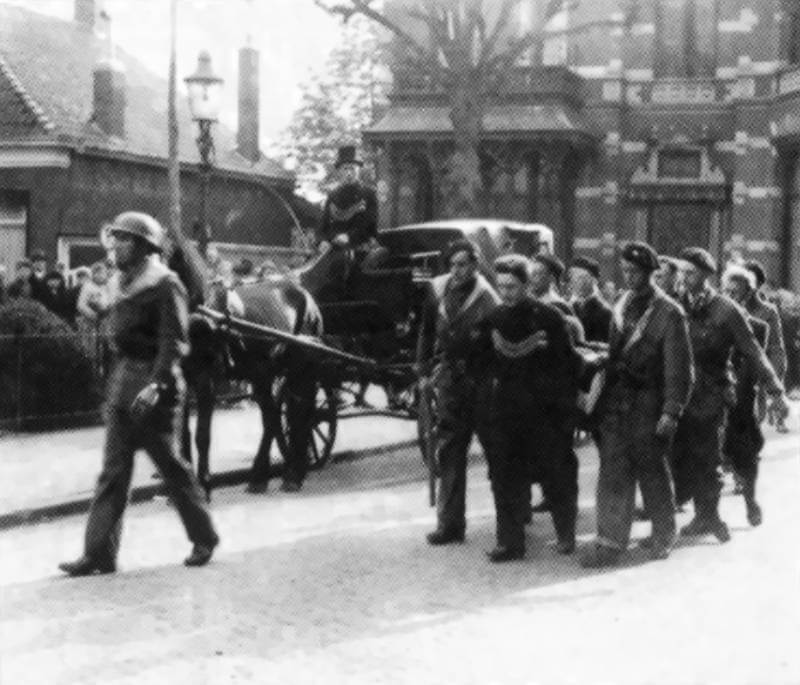
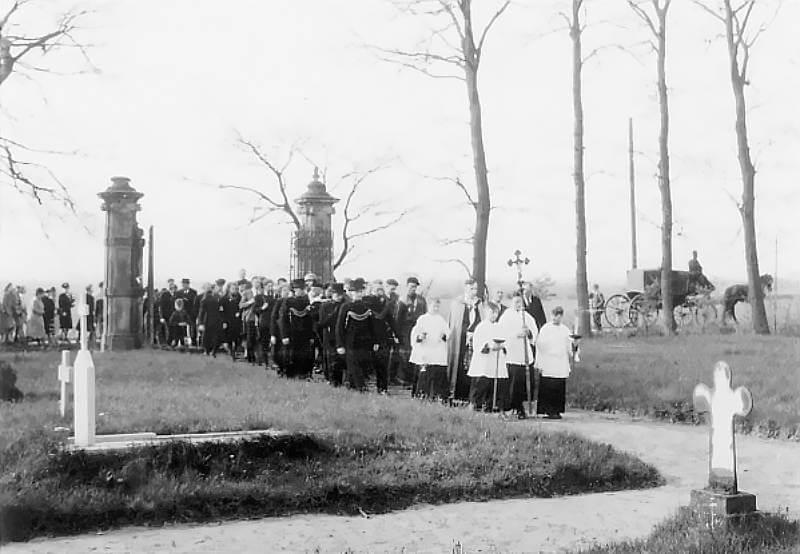
On April 10th, 1945, with the sound of Allied artillery already audible in the distance, the remaining fourteen men enter the small settlement of Spier on the main road between Hoogeveen and Beilen. Many local residents witness the scene. Then, at the far end of the village, a truck arrives from the direction of Beilen carrying six men of the Grüne Polizei (Gestapo) under the command of an officer named Jung. The guards hand the prisoners over to Jung. The men are marched back into the village centre and made to stand facing a wall outside the café Ten Buur. Villagers ask whether the prisoners might be given something to eat. The request is refused. The Germans go inside the café for rest and consultation. Inside, the decision is made. The road to Westerbork is too long and too exposed. Jung wants to move quickly. The fourteen prisoners are marched out of the village again. Just north of Spier, an unpaved track branches into the forest along the Eerste Lange Maatseweg, leading to wet pastureland along the Beilerstroom. One of the prisoners calls out a final declaration of loyalty to the Dutch crown as the group is driven at gunpoint into the trees. Approximately fifty metres from the road, all fourteen men are killed by a shot to the back of the neck. Jung and his six men carry out the executions. Some of the bodies show evidence of further violence inflicted after death. Local men from Spier collect the bodies as soon as conditions allow. They are transported on a flat horse-drawn farm cart to a barn near the Oude Postweg. The actual site of the execution now lies beneath the central reservation of the A28 motorway.
Retreating from Hoogeveen, the Germans also execute three more men near the Spaarbankbos: Johan Dhont, Sybrand Jan van der Linde, and Albert Eggen. All three have been arrested by the Germans in the preceding days for reasons not directly connected to the operations of the French paratroopers. Their bodies are found on April 11th, 1945, in a ditch at the edge of the forest.
The 2nd Canadian Infantry Division, advancing along the central axis of the 2nd Canadian Corps through Ommen and Hoogeveen toward Assen, reaches the southern outskirts of Hoogeveen late on April 10th, 1945, to find all bridges across the Hoogeveense Vaart demolished. The right flank of the Canadian advance is covered by jeep patrols of the 5 Special Air Service, the Belgian squadron. Hoogeveen is seized early on April 11th, 1945. Once a bridge is completed across the Hoogeveense Vaart, armoured reconnaissance cars of the 8th Canadian Reconnaissance Regiment, the 14th Canadian Hussars, advance from Hoogeveen and reach Spier in the early afternoon, arriving just in time to relieve a seriously endangered party of French Special Air Service paratroopers operating in Zone B.
| Multimedia |
| Sources |