
| Page Created |
| March 28th, 2026 |
| Last Updated |
| April 18th, 2026 |
| France |
 |
| Related Pages |
| Special Air Service Operation Jedburgh Operation Amherst Operation Amherst, Zone A Operation Amherst, Zone B Operation Amherst, Zone C Operation Amherst, Zone D Operation Amherst, Zone E Operation Amherst, Zone F |
| April 7th, 1945 – April 15th, 1945 |
| Operation Amherst |
| Objectives |
- To cause the maximum confusion throughout the area by continually harassing the enemy and thus preventing him from taking up any fixed positions or forming any sort of line.
- To prevent the demolition of bridges over the canals by removing the demolition charges. Where routes were impassable with bridges already blown, to reconnoitre alternative routes for the advance of the main force.
- To preserve Steenwijk airfield for the use of the Royal Air Force.
- To pass all available information regarding enemy dispositions etc., to First Canadian Army and subordinate formations concerned.
- To provide guides for the advance of the ground forces.
- To raise resistance in the area.
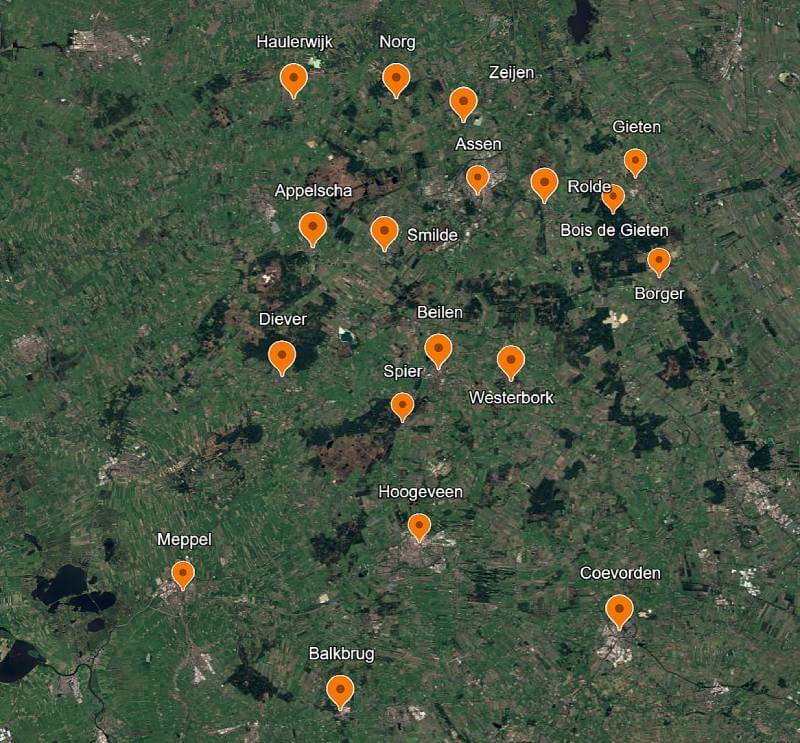
| Operational Area |
| Allied Forces |
- 2e Régiment de Chasseurs Parachutistes, 4 Special Air Service
- 3e Régiment de Chasseurs Parachutistes, 3 Special Air Service
- Jedburgh Team Dicing
| Axis Forces |
- 2. Fallschirmjäger-Division
- 6. Fallschirmjäger-Regiment
- Landesschützen Einheiten
- Sicherungs Einheiten Kriegsmarine
- Ordnungspolizei
- Geheime Staatspolizei
- Feldgendarmerie
- Landwacht
| Multimedia |
| Operation |
On March 23rd, 1945, Field Marshal Montgomery launches Operation Plunder, the main Allied crossing of the Rhine. Operation Archway commits the 1 and 2 Special Air Service to a ground operation in support of the 2nd British Army and the Airborne Landings. The operation succeeds rapidly. Within five days Montgomery declares the battle of the Rhine won, opening the way for the long-anticipated Allied thrust toward Germany’s industrial heartlands. The crossing has strategic consequences that extend well beyond Germany’s borders. The still-occupied regions of the Netherlands are directly affected by what follows.
At the end of March 1945, the First Canadian Army receives orders to protect the eastern flank of the main Allied advance, open the supply route north through Arnhem, and clear northeast Holland, the coastal belt eastward to the River Elbe, and western Holland. This logistical artery on the Allied left flank is essential to sustaining the main offensive eastward into Germany. In practical terms it means the Canadians must establish a supply line crossing the Rhine at Arnhem and then the IJssel to the latitude of Zutphen.
Lieutenant General Crerar, commanding the First Canadian Army, plans the task from two directions. The 2nd Canadian Corps is to advance through the Achterhoek region of Gelderland into southern Overijssel, then move westward to cross the IJssel at Deventer and clear the area east of Apeldoorn before pushing north to liberate the northern provinces of the Netherlands. Simultaneously, the 1st Canadian Corps is to secure the Over-Betuwe, cross the Rhine, and enter the Veluwe from the south.
The Allied advance generally goes according to plan. The eastern Achterhoek and the Twente region of Overijssel are liberated by units of the 30th British Corps, which advances from Ruurlo to Lochem before reaching Enschede on April 1st, 1945, and Hengelo two days later. Canadian forces then take over the British positions in the front line.
Throughout Twente and other parts of Overijssel the resistance plays an active role in smoothing the Allied advance. From the last week of March 1945 the Overijssel underground begins a sustained sabotage campaign targeting German troop movements and supply transports, attacks isolated enemy positions, and provides the Canadians with valuable intelligence on enemy strength and locations. In the Salland area, resistance cooperation with the Canadian advance is particularly effective. A Canadian battalion involved in the liberation of Deventer specifically acknowledges the contribution of the local underground, though the Deventer resistance is unable to prevent the Germans from destroying the IJssel bridges before withdrawing.
Planning for the deployment of Special Air Service and Jedburgh teams begins in England in February 1945. Their purpose is to quicken the Allied advance through the central and northern Netherlands. In the middle of March 1945, leadership of the Special Air Service Brigade changes. Brigadier McLeod, who has guided the brigade through its formative operational period, departs to take up the post of Director of Military Operations in India. Command passes to his successor on March 14th, 1945. He is Brigadier Michael Calvert, a veteran of special operations. Calvert has commanded the 77th Indian Infantry Brigade of the Chindits through lengthy long range penetration campaigns behind Japanese lines in Burma.
On March 28th, 1945, Calvert meets with the staff of the 21st Army Group headquarters. The discussion centres on how Special Air Service forces can be used in support of the First Canadian Army in the Netherlands. Calvert puts forward a plan. Small parties will project influence across broad stretches of ground. They will stop the retreating enemy from establishing fresh defensive lines. They will be overrun by friendly ground forces within about three days of their insertion. The plan is accepted with only minor amendments. Calvert then returns to his headquarters in Essex. On arrival he briefs his deputy, Colonel Guy Prendergast, formerly the commanding officer of the Long Range Desert Group in North Africa.
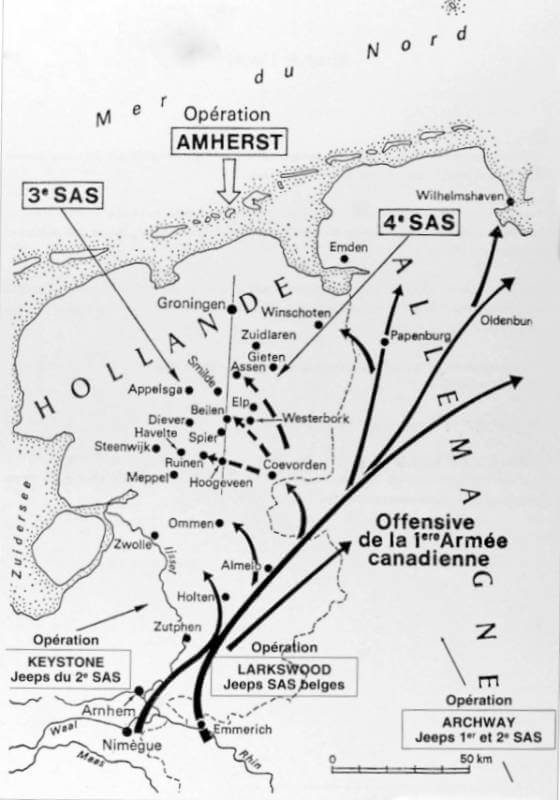
On April 1st, 1945, the 2nd Canadian Corps under Lieutenant General Guy Simonds returns from the Second British Army to the First Canadian Army. From this point, three Special Air Service operations begin to take shape. Operation Keystone will insert a squadron of the 2 Special Air Service Regiment into the Apeldoorn area. Operation Amherst will despatch the French 3 and 4 Special Air Service Regiments to the province of Drenthe. Operation Larkswood will bring the Belgian Special Air Service Regiment under the command of the 2nd Canadian Corps. The Belgians are to function as a mounted reconnaissance unit, break through the enemy lines, harass the rear areas, and make contact with the French Special Air Service parties dropped by parachute at the first opportunity.
| Operation Amherst |
The largest of these actions is Operatie Amherst, conducted by the French paratroopers of the 3 and 4 Special Air Service in northeast Holland in April 1945. 3 and 4 Special Air Service are British designations. The French units retain their original names throughout: the 3e Régiment de Chasseurs Parachutistes and the 2e Régiment de Chasseurs Parachutistes.
When Calvert begins planning Operatie Amherst, the assumption is that the drop will not take place before April 14th, 1945. The pace of the Canadian advance from Overijssel northward changes that calculation rapidly. By April 5th, 1945, the 4th Canadian Armoured Division reaches the southern edge of the planned Amherst landing area. The 2nd and 3rd Canadian Infantry Divisions are still approximately fifty kilometres behind on the western flank, but the rate of advance makes it clear that the operation cannot wait. The decision is taken to accelerate Amherst and launch it on the night of April 7th to 8th, 1945, a full week earlier than originally anticipated.
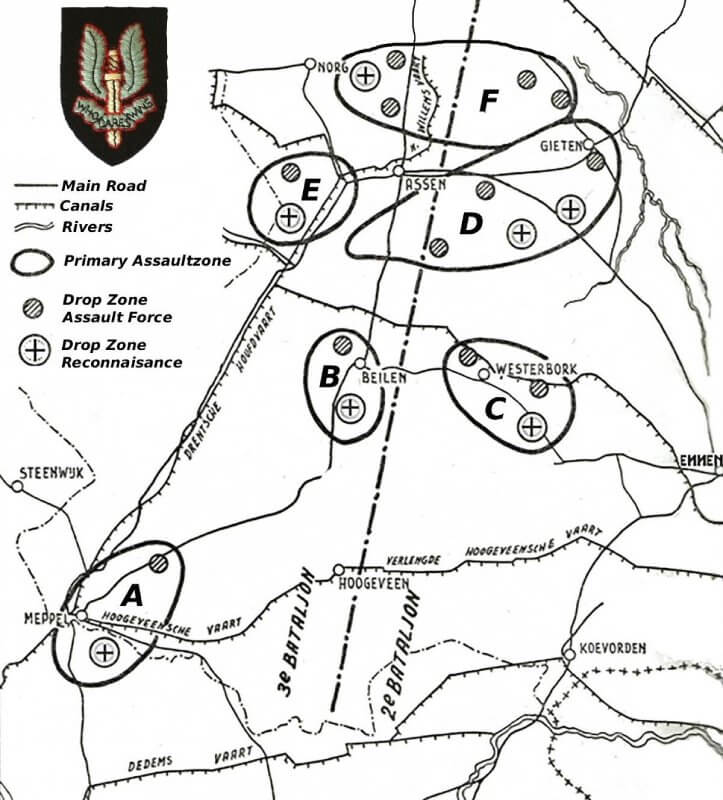
The men from the 3e and 2e Régiment de Chasseurs Parachutistes, are to be dropped across Drenthe, broadly along the axis between Zwolle and Groningen. Eighteen armoured jeeps, equipped with machine guns and intended to provide mobility and shock effect against the enemy, are to be dropped with them.
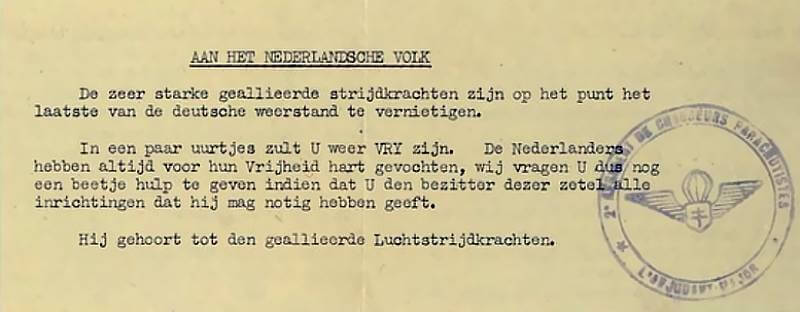
The operation is designed to appear larger than it actually is. The paratroopers are spread across a wide area deliberately, and their parachutes are to be left in the open on the drop zones rather than buried, the volume of canopies visible on the ground being assessed as deeply unsettling to the enemy. Paradummies are to be dropped across Drenthe alongside the paratroopers. The BBC is to announce that Allied paratroopers have landed across the northern Netherlands. The Dutch resistance in Drenthe is to be informed only after all paratroopers are on the ground, both to prevent premature disclosure of the operation and to stop the resistance from acting independently before coordination with the French can be established.
Calvert’s own assessment of the Amherst operational area is not entirely optimistic. He considers the terrain of Drenthe fundamentally unsuitable for sustained guerrilla-type operations of the kind the Special Air Service conducts most effectively. The planning assumption that partially compensates for this is the expectation that German resistance will be limited and that Canadian ground forces will reach the French paratroopers within approximately seventy-two hours. That assumption proves optimistic in practice.
The German defensive position in the northern Netherlands is anchored on the Assener-Stellungen, a defensive line running past several canals and connecting the cities of Meppel, Assen, Groningen, and Delfzijl. The Oranjekanaal, approximately 48 kilometres long and running diagonally through a large part of Drenthe before flowing into the Drentsche Hoofdvaart, forms a significant component of this line and is recognised in Allied planning as a potential major obstacle.
Jedburgh team Dicing is assigned to Operatie Amherst by the Special Forces Headquarters at relatively short notice, following the cancellation of a planned mission to the Veluwe. The team’s own assessment of the assignment is sceptical from the outset. After several briefings, the Jedburghs conclude that Amherst is not well suited to Jedburgh-type operations and that the state of the resistance in Drenthe does not offer the opportunities that their previous cancelled mission, Operation Keystone, would have provided. Despite these reservations, the team members acknowledge that if anything is to be achieved with the resistance in the area, Jedburgh personnel are better placed to achieve it than any liaison officers the Special Air Service itself can provide.
Team Dicing’s assigned mission is to make contact with local resistance groups in Drenthe, make their services available to the Special Air Service on the ground, supply the Binnenlandse Strijdkrachten, the Dutch interior forces, with weapons brought in with the team, and send resistance couriers forward to meet the advancing Allied troops and provide their intelligence officers with tactical information. The team is also tasked with making its wireless telegraphy capability available to the commander of the Special Air Service should he require it. Like the men of the Special Air Service, the Jedburghs are to drop blind in military uniform and begin searching for resistance contacts immediately on landing.
A significant difference from the Keystone concept is that team Dicing drops simultaneously with the Special Air Service rather than ahead of them. This removes the possibility of establishing advance contact with the resistance before the Special Air Service arrives, which is the arrangement that makes Jedburgh operations most effective. Team Dicing therefore enters the operation with limited time, an unfamiliar area, a resistance network it has not previously contacted, and a set of circumstances that its own members regard as difficult from the beginning.
| Multimedia |
| Germans In the Operation Amherst Area |
Responsibility for the defence of northeast Holland rests with Generaloberst Johannes Blaskowitz, former commander of Heeresgruppe H, who on April 6th, 1945, is appointed Oberbefehlshaber für den Niederlanden, or OB Niederlanden. In this role Blaskowitz retains command of the 25. Armee and the security forces of the Wehrmachtsbefehlshaber Niederlande under General der Flieger Friedrich Christiansen, but loses command of the 1. Fallschirmarmee, formerly part of Heeresgruppe H. The 25. Armee is a weakened formation. Most of its fighting strength has been stripped away in preceding months to reinforce the 1. Fallschirmarmee during the Rhineland battles. Blaskowitz is now subordinate to the hastily formed OB NordWest under Generalfeldmarschall Ernst Busch, who in turn answers directly to the Oberkommando der Wehrmacht.
Christiansen moves his headquarters to Delfzijl, in the northeastern tip of Holland. On April 7th, 1945, he meets Blaskowitz there for a final time, during which formal authority over all troops in Holland passes to the latter. Christiansen plays no further formal role. On the night of April 7th to 8th, the night of the Amherst landings, Blaskowitz leaves Delfzijl by car with his driver. Taking the northern route across the Afsluitdijk to western Holland, he reaches Hilversum and assumes command of the 25. Armee and the area that becomes known as Festung Holland.
The German military position is critical. All the 25. Armee can realistically attempt is to delay the Allied advance and maintain some coherence in the front line. Even this proves beyond its capacity. The two armies that formerly comprised Heeresgruppe H are driven apart by the relentless advance of British and Canadian forces. Most of the 25. Armee is pushed northwest to and beyond the River IJssel. The right wing of the 1. Fallschirmarmee, comprising II. Fallschirmjäger-Korps, is pushed in the opposite direction, northeast toward Lingen on the River Ems. The 6. Fallschirmjäger-Division, the right flank formation of II. Fallschirmjäger-Korps, initially attempts to maintain a link with the 25. Armee by retreating northward ahead of the Canadians. It then receives orders to fall back northeast toward Coevorden. When Coevorden falls to the 4th Canadian Armoured Division, the division changes direction and withdraws westward across the River IJssel, detaching itself from the 1. Fallschirmarmee in the process. A growing gap opens between the 25. Armee and the 1. Fallschirmarmee. In the area between the IJssel and the Ems, organised resistance effectively ceases to exist. It is into this gap that the 2nd Canadian Corps thrusts.
In the first week of April 1945, the Germans frantically attempt to organise a defence of sorts to plug the gap between the two armies. The new defensive lines, in reality little more than delaying positions, follow the waterways lying across the path of the Canadian advance. From south to north, successive lines are established along the Twente Kanaal, the Schipbeek, the Overijssels Zijkanaal, the River Vecht, and the Dedemsvaart canal. The town of Meppel is designated a defensive bastion. A final defensive line is established along the Hoogeveensche Vaart, a canal running east from Meppel through Hoogeveen toward Emmen.
Responsibility for the defence of the Hoogeveensche Vaart falls to Generalmajor D. Böttger of Feldkommandantur 674, the former territorial commander of Groningen since March 1944. At the start of April, Böttger receives instructions from Christiansen’s headquarters to organise the defence of Midden-Drenthe. His task is to hold a 26-kilometre line along the Hoogeveensche Vaart with four companies of combat troops, each numbering between 100 and 130 men. These companies are a mixed collection drawn from different branches of the regular army and Luftwaffe personnel, with the exception of one company of Fallschirmjäger from the 8. Fallschirmjäger-Division. The force has no heavy infantry weapons, no anti-tank guns, and no artillery. Anti-tank defence relies entirely on the Panzerfaust. Böttger’s only reserve is a 28-man motorised Feldgendarmerie detachment. One company deploys west of Hoogeveen, one occupies Hoogeveen itself, one positions at Nieuweroord, and the last, the Fallschirmjäger company, holds south of Gees. Troops concentrate at canal crossing points. The stretches between are screened by small posts and occasional patrols. Most bridges are already demolished. Those at Hoogeveen are prepared for destruction.
North of this thin defensive line, rearward area troops falling under various commands are organised into Alarmeinheiten, emergency units, for use in the event of an airborne assault, all under the Wehrmachtskommandant Assen. These include Luftwaffe reserve and training units at Assen, army service corps units at Gieten, and a war economy inspectorate at Beilen.
On April 7th, 1945, the day before the Amherst landings begin, two newly formed Luftwaffe field replacement battalions arrive at Assen as reinforcements. Böttger assesses them as too inexperienced and too poorly equipped to deploy in the forward line. They are instead positioned along the Oranjekanaal between Smilde and Schoonoord as a second defensive line behind the Hoogeveensche Vaart, under the Wehrmachtskommandant Assen. These troops begin arriving at the canal in the afternoon and evening of April 7th, almost simultaneously with the start of Operatie Amherst.
Allied estimates place approximately 11,000 enemy troops in northern Holland at this time, of whom approximately 3,000 are assessed as combat-worthy. Most are in the process of retreating. The initial Allied assessment that the 25. Armee might attempt to break out of western Holland toward Germany does not materialise.
| Dutch resistance before Operation Amherst |
The resistance in Drenthe operates under exceptionally difficult conditions throughout the occupation. The province has a disproportionately high concentration of NSB members, Landwacht auxiliaries, SD informers, and other collaborators among its civilian population, earning it the informal description among many Dutch as Little Germany. This hostile environment shapes every aspect of resistance activity in the province and, as the Amherst accounts throughout this article demonstrate, has direct and often fatal consequences for the French paratroopers who depend on civilian support after landing.
The principal armed resistance organisation in Drenthe is the Knokploeg, or KP. Two KP squads are established in the southern Drenthe cities of Meppel and Hoogeveen in late 1942 and early 1943. Three further groups emerge during the spring of 1944, in Noord-Drenthe, Kerkenveld, and Smilde. The initial provincial KP leader is Johannes Post, who conducts numerous successful raids on coupon distribution offices before being forced by German pursuit to move elsewhere in the Netherlands. Post is captured and executed in July 1944. Following the establishment of the Binnenlandse Strijdkrachten in September 1944, Reserve Captain Harm Ketelaar is appointed regional commander for Drenthe. Throughout 1944 Ketelaar delegates many of his responsibilities to Kees Veldman, a member of KP Noord-Drenthe, who by the end of the war has assumed effective command of most of the armed resistance groups in the province. It is Veldman’s Knokploeg Noord-Drenthe that the French paratroopers of the Sicaud stick encounter sleeping in the forest near Appelscha on the morning of April 8th, 1945.
From the summer and autumn of 1944 onwards the Allies send weapons, supplies, special forces, and agents into Drenthe. An Special Air Service team designated Gobbo is sent to the province at the end of September 1944. A week later, two Bureau Inlichtingen radio operators are dropped: Gerard Kouwenhoven and Cornelis van Bemmel. Kouwenhoven moves to the city of Groningen while Van Bemmel begins work in Assen.
In the second week of October 1944, at team Gobbo’s request, a four-man instructor team drops into Drenthe. This team consists of three Dutch commandos seconded to the Bureau voor Bijzondere Opdrachten, the Dutch special operations organisation known as BBO, and one Belgian Special Air Service adjutant. The Dutch commandos are Sergeant Major Willem van der Veer, Sergeant Bob Michels, and Sergeant Niek de Koning. The Belgian is Adjutant Raymond Groenewout. Michels leaves Drenthe to join the resistance in Groningen. De Koning and Groenewout become instructors for the resistance in the neighbouring province of Friesland. Van der Veer is the only member of the team to remain almost permanently in Drenthe. De Koning returns to the province in the final months of the war.
Team Gobbo is forced to leave Drenthe in October 1944, following the failure of Operation Market Garden and a German raid on the team’s hiding place. Van der Veer, now facing a similarly dangerous situation, goes into hiding and temporarily suspends his instruction activities. The Drenthe resistance also reduces its operations in the final months of 1944, with one significant exception. The KP carries out a spectacular raid on the Assen prison, freeing twenty-nine prisoners including a large number of resistance fighters. This is the same action already mentioned in the Appelscha section of this account in connection with Veldman’s group. After this success, the resistance cuts back its activities and waits for the Allied advance to resume.
In the weeks before Operatie Amherst, the situation deteriorates further. Bureau Inlichtingen radio operator Van Bemmel is discovered by the Germans and killed in the resulting firefight. A series of arrests within the Drenthe resistance follows. Around February 1945, Van der Veer, resumes his instruction activities, preparing the underground networks for the arrival of the Allies. It is in this role that he is present in Drenthe when the French paratroopers drop on the night of April 7th to 8th, 1945, and it is this preparation that enables the resistance contacts made by the Amherst sticks to function as effectively as they do, despite the compressed timescale and the absence of prior coordination.
| The 12th Manitoba Dragoons, Dedemsvaart to Meppel |
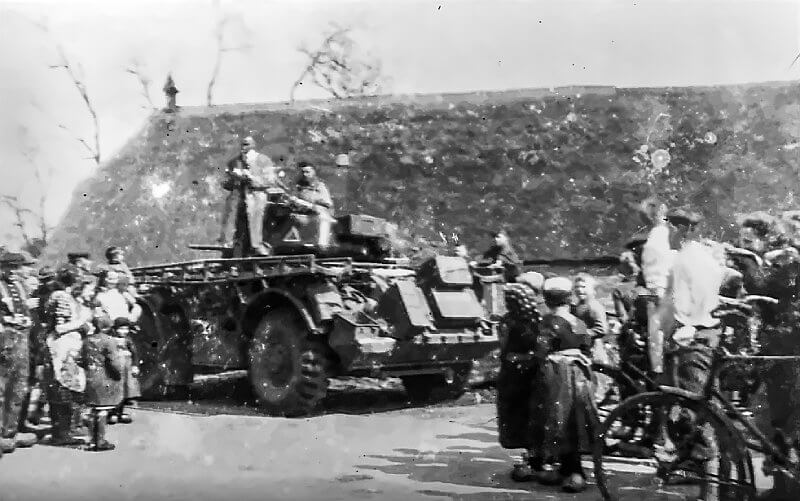
While the French Special Air Service of Operatie Amherst drop into Drenthe on the night of April 7th to 8th, 1945, the armoured reconnaissance cars of the 12th Manitoba Dragoons, officially the 18th Canadian Armoured Car Regiment, are already operating deep in the German rear south of the Hoogeveensche Vaart. Tasked with covering the left flank of the 4th Canadian Armoured Division, the Manitobas turn westward from the Hardenberg area on April 6th, 1945, driving into the exposed German flank and cutting deep into the rear of enemy forces still opposing the left wing of the 2nd Canadian Corps. The advance of the 2nd Canadian Corps is uneven at this stage. Stubborn German resistance around the IJssel towns of Zutphen and Deventer slows the left and centre of the corps, while the right flank advances rapidly. The Manitobas exploit this gap with considerable effect. Between April 6th and 11th, 1945, they take 765 prisoners.
Initially only A Squadron is available for the westward thrust. The regiment reconnoitres as far as Meppel. D Squadron, previously guarding the Twente Kanaal at Lochem, joins the operation several days later and establishes a base at De Wijk, approximately six kilometres southeast of Meppel, from where it patrols roads east, north, and south of the town. The Manitobas make contact with most of the French Special Air Service sticks in the area by the end of April 8th. Their own assessment of the French contribution to their operations is measured. By the time the paratroopers land, the regiment has already worked itself well into the area and the French presence adds comparatively little to what the Manitobas are already achieving independently. The situation continues until the evening of April 10th, 1945, when the Manitobas are redirected to the right flank of the 2nd Canadian Corps in Germany, to their considerable regret. They are replaced by the Royal Canadian Dragoons, the 1st Canadian Armoured Car Regiment, attached from the 1st Canadian Corps, who reach Dedemsvaart and Balkbrug in the early afternoon of April 11th, closely followed by the infantry of the 6th Canadian Infantry Brigade moving north from Ommen.
The fluid and dangerous nature of operations in this period is illustrated by events at Dedemsvaart on April 6th, 1945, the day before the Amherst drop. Three armoured reconnaissance cars of the 12th Manitoba Dragoons enter the town that afternoon. The reaction of the population is immediate and overwhelming. Flags appear from buildings. People in hiding emerge openly for the first time in months. The local resistance begins rounding up collaborators and National Socialist Movement members, transferring them to the village school near the tram station. A festive and chaotic scene develops around the Canadian vehicles.
At 19:00 the Canadians withdraw. They are a reconnaissance patrol, not an occupation force, and their task is to probe and protect the flank of the 4th Canadian Armoured Division. Most resistance fighters leave with them, riding on the armoured cars. Only two armed resistance members, Egberts and Oostenbrink, remain to guard the prisoners in the school. Within minutes of the Canadian departure, word reaches the tram station that German forces are approaching from the direction of Balkbrug. A patrol of approximately twenty Dutch SS men under a German commander advances carefully through the town, intending to take revenge and free the captured collaborators. They head directly for the school. Egberts and Oostenbrink attempt to resist with their Sten guns. When the SS respond with hand grenades, the two men are forced to abandon their post and escape. The SS patrol fires extensively at the school and the adjacent Huisman house, using hand grenades and a Panzerfaust. The building is extensively damaged.
After freeing the prisoners, the Germans turn on the civilian population. They randomly arrest thirty men who are marched under guard toward Balkbrug. At the café beside the bridge, fifteen of the group are selected and shot that evening. Miraculously, six of the fifteen survive. Four manage to escape in the darkness before the executions begin. Two more are wounded and feign death, escaping undetected later that night.
| Multimedia |
| Operation Order No. 3 from Liaison Headquarters No. 20 Drafted on 6 April by Colonel Prendergast, Deputy to Calvert |
Intelligence
1 — General — Our Forces
a) Changing situation on the Canadian Army front.
The 2nd Canadian Corps has crossed the Rhine at Rees, has swung toward Emmerich in the northwest direction, and toward Zutphen and Hengelo.
b) The 2nd Canadian Corps has the following missions:
— Clear the road Arnhem — Zutphen — Hengelo.
— Clear the southern sector of Apeldoorn, Otterloo, Ede, exploit westward to Utrecht and northward to the Zuiderzee.
— Subsequently, clear northwest Germany as far as Bremen.
2 — Enemy
All known information will be provided at the briefing.
With a view to causing alarm and confusion in the enemy rear areas and to facilitating the rapid advance of the First Canadian Army, it has been decided to conduct SAS operations behind enemy lines.
3 — SAS Operations
a) Larkswood:
A Belgian parachute battalion placed under command of the 2nd Canadian Corps will infiltrate by jeep into northeast Holland to carry out certain special reconnaissance and harassment missions.
b) Keystone:
The 2nd SAS Regiment with 130 men and 18 jeeps will operate in the vicinity of western Gelderland.
c) Amherst:
The 2nd and 3rd RCP (700 men) with 18 jeeps will operate in the Assen — Emmen — Meppel sector.
4 — Intentions for Amherst
To cause alarm and confusion in the enemy rear areas and to carry out the secondary missions indicated below.
5 — Method
a) The personnel of the 2nd and 3rd RCP will be parachuted into their sector on a night subsequent to that of 5 to 6 April.
b) 2nd RCP: 20 sticks in Stirling aircraft (15 men per stick), 2nd RCP: 3 sticks in Stirling aircraft (12 men per stick), 3rd RCP: 21 sticks in Stirling aircraft (15 men per stick), 3rd RCP: 3 sticks in Stirling aircraft (12 men per stick).
Each stick of 15 men will be divided into two independent demi-sticks for operations. Each stick of 12 men will be equipped with 3 jeeps (4 men per jeep).
c) Transport:
2nd RCP: 9 jeeps by Halifax aircraft 3rd RCP: 9 jeeps by Halifax aircraft
d) Drop Zones:
A maximum of 10 drop zones will be selected for each battalion. Details will be fixed subsequently (see map on page 10).
6 — Operational Boundaries
The boundary between the two battalion operational zones in the sector will be constituted by the Assen — Hoogeveen railway line and its extension to the north and south.
7 — Secondary Missions
a) Distribution of missions listed in order of importance:
3rd RCP: — Steenwijk airfield (2 parties) — Havelte airfield — 5 road bridges over canals — 9 road bridges over canals — Leeuwarden airfield
2nd RCP: — 9 road bridges over canals — 2 railway bridges
b) All these bridges and airfields are of vital importance to the advancing army, and every effort must be made to keep them intact. If a bridge has been destroyed or is found not to exist, stick commanders must take all necessary measures to secure another bridge on the same northward route in the sector. Rear units will be informed of this wherever possible.
8 — D-Day
a) Earliest date: the night of 6 to 7 April. The exact date will be given later.
b) The 2nd Canadian Corps will have cleared this area within 72 hours of the parachute drop.
9 — Rendezvous
a) It is extremely important that all personnel be assembled as quickly as possible after this operation with a view to their return to the United Kingdom and re-equipment for future operations already envisaged.
b) Personnel will assemble at Steenwijk airfield:
- When it has been passed by Allied troops.
- If this has not occurred 6 days after the drop date (unless ordered otherwise), assembly will take place at Coevorden.
10 — Recognition
All personnel will use yellow Ceylon triangles. Jeeps will carry fluorescent panels. The RAF and forward troops have been informed of these arrangements. The RAF has however pointed out that if jeeps are moving in daylight they must accept the risk of being strafed.
11 — Deception
a) We intend to give a certain amount of publicity to this operation and make it appear larger than it actually is. Two RAF groups will participate in these plans by strafing and bombing selected objectives before the drop.
b) Dummies will be parachuted by the RAF into suitable locations.
Communications
12 — Radio
a) Four transmitter and receiver sets per battalion. Each demi-stick commander will receive a receiver set.
b) Captain McDevitt will be responsible for briefing all stick commanders on radio arrangements for the operation, including the system for requesting air support and designating targets for bombing.
c) All messages transmitted by the sticks will be intercepted and exploited by First Canadian Army.
13 — At the end of its mission,
Personnel will contact Liaison Headquarters No. 20 at Steenwijk airfield.
14 — Acknowledge receipt.
| Special Air Service Brigade |
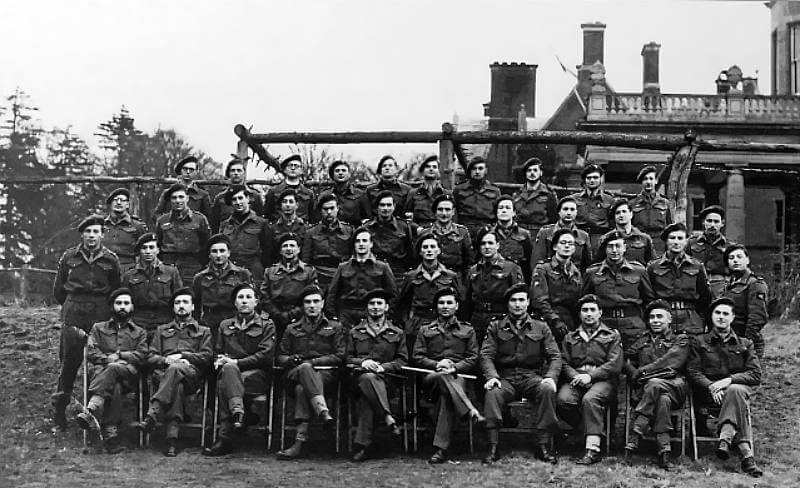
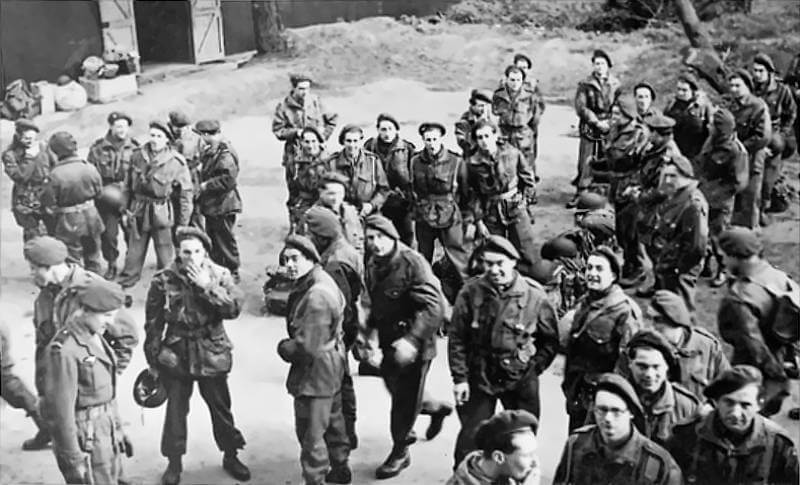
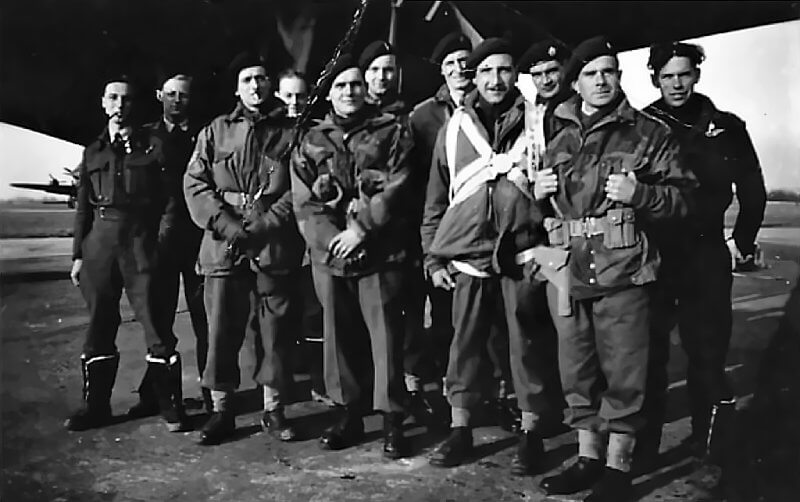
The Special Air Service Brigade that conducts operations in northwest Europe in 1945 comprises five regiments. The 1 and 2 Special Air Service are British. The 3 and 4 Special Air Service are French. The 5 Special Air Service is Belgian. In theory each regiment numbers approximately 600 men, organised into one headquarters company, one motorised company with four platoons of four jeeps each, and three combat companies. Each combat company comprises a command section and two combat sections of four groups each. The headquarters company includes a twelve-team radio section, a support section, a protection section, and service troops.
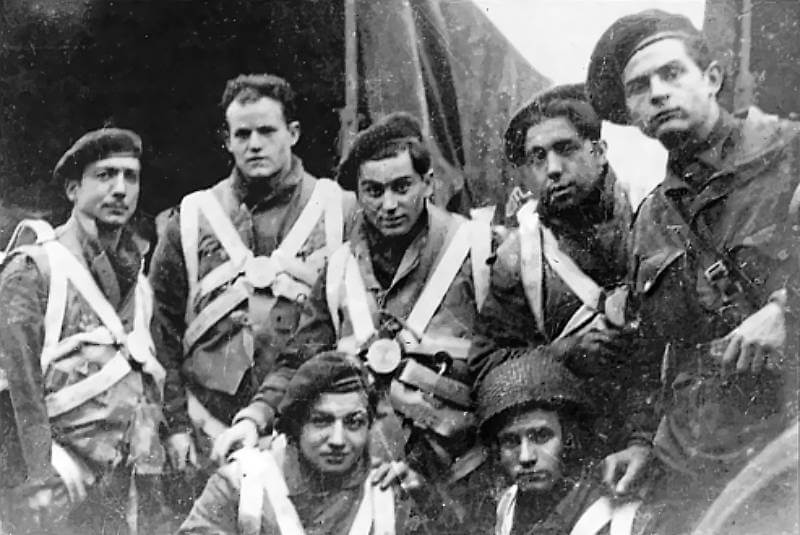
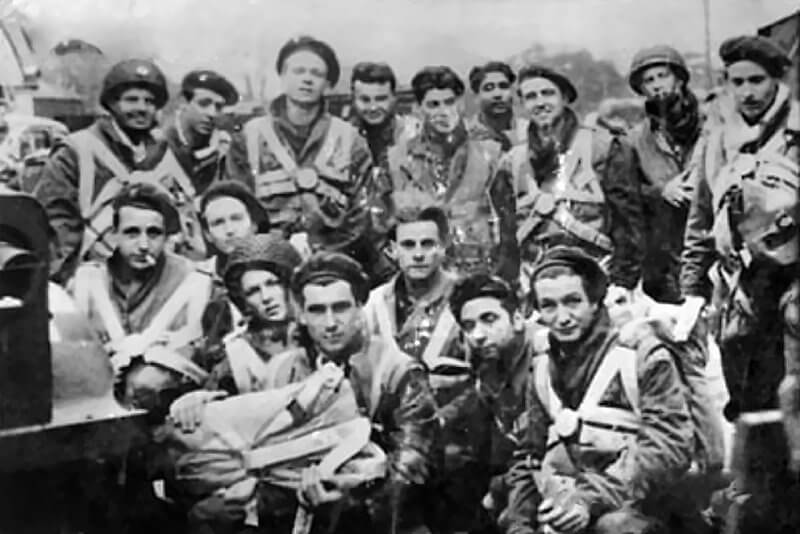
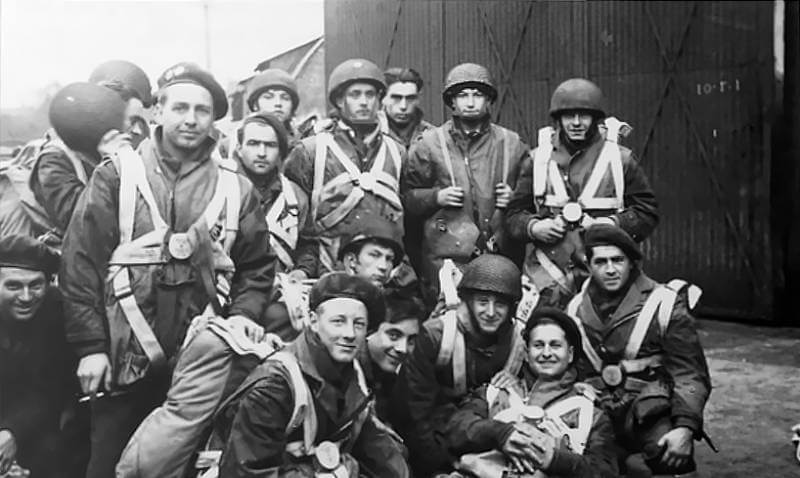
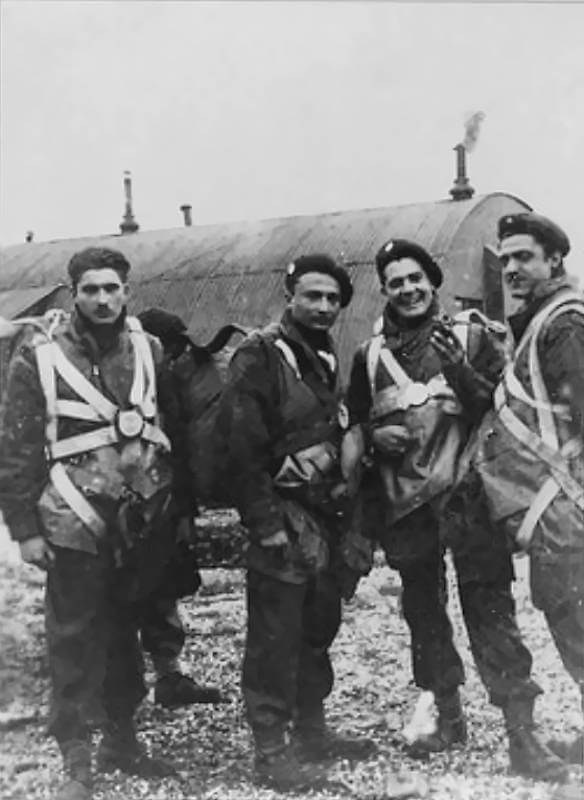
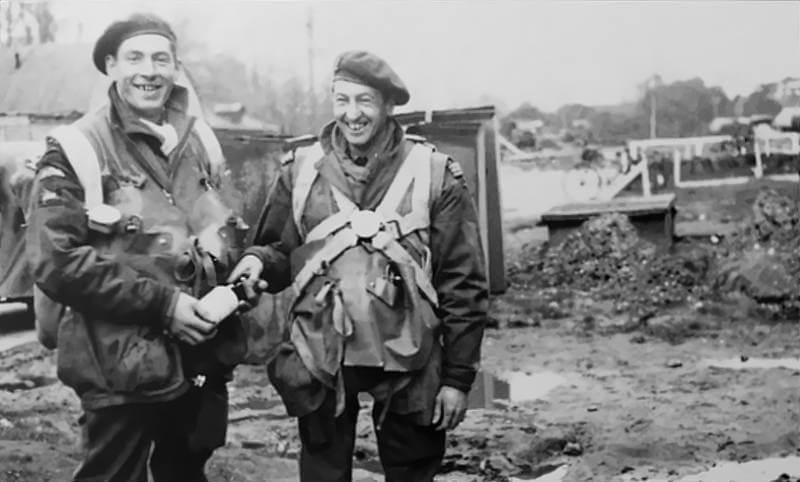
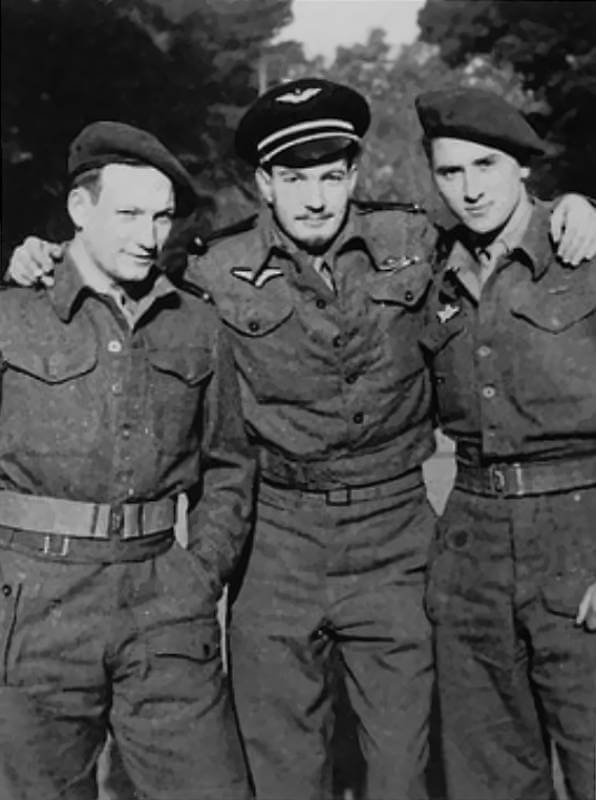
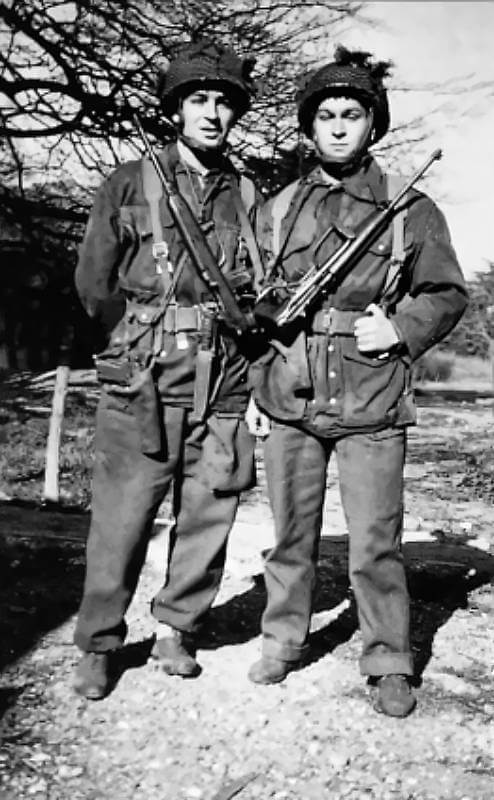
The two French parachute battalions have a long operational history before Amherst. They form originally in North Africa and arrive in England in the months before the Normandy landings. Their ranks draw on troops from all parts of General de Gaulle’s army. After successful operations in Bretagne and central France alongside the Maquis, conducted together with the 1st and 2nd British SAS Regiments, and after commitment in the Ardennes, the battalions return to England for further training and reorganisation. New recruits from the Maquis bring the units back up to strength. These men are enthusiastic but inexperienced. Most have received little or no formal military training. Delays mean that the majority cannot complete their parachute courses before the operation. A minimum of eight qualifying jumps is required to earn a paratrooper certificate. As a result, only two reduced-strength battalions, each of approximately 350 men, take part in Operatie Amherst.
The mission is fundamentally different from that of conventional parachute troops. The Special Air Service does not seek full-scale combat or long-term control of territory. Its role is to wage a guerrilla campaign, disrupting enemy forces, sowing confusion behind the lines, destroying installations, and gathering intelligence. The units operate with hit-and-run tactics, relying on speed and surprise rather than firepower. Calvert acknowledges the offensive spirit of the French throughout the operation, though he notes that some of their attacks, particularly assaults on enemy-held villages in daylight without fire support beyond their own light weapons, push beyond what their resources can sustain.
Although organised into battalions and companies, sometimes also referred to as squadrons, the Special Air Service operates in practice through small teams called sticks. Each stick consists of 15 men, two officers, two non-commissioned officers, and eleven corporals and soldiers. This size allows a stick to carry out assignments independently while remaining small enough to avoid immediate detection. On average each company fields six sticks. A stick can be divided into two independent half-sticks, known in French as demi-sticks, each commanded by one officer and one non-commissioned officer. Sticks and demi-sticks manoeuvre and operate independently. Flexibility is essential. Sticks regroup frequently, band together for specific missions, and split apart again as circumstances demand. Mobility is the primary guarantee of safety. Speed of action is the best guarantee of success.
The Special Air Service paratroopers are lightly armed. Each man carries a Colt .45 pistol, an American dagger, a carbine with folding stock, and a Sten submachine gun, replaced in some cases by the Patchett submachine gun, a compact British weapon developed as a more reliable alternative to the Sten. Some men carry the Thompson submachine gun. Hand grenades and Gammon bombs, also known as the No. 82 grenade, complete the personal load. The Gammon bomb is a fabric bag filled with plastic explosive, fitted with a simple inertia fuze. The paratroopers refer to it as hand artillery. Heavy weapons consist of two Bren light machine guns per stick and an occasional PIAT anti-tank projector. Heavy weapons are delivered by parachute container rather than carried by the men.
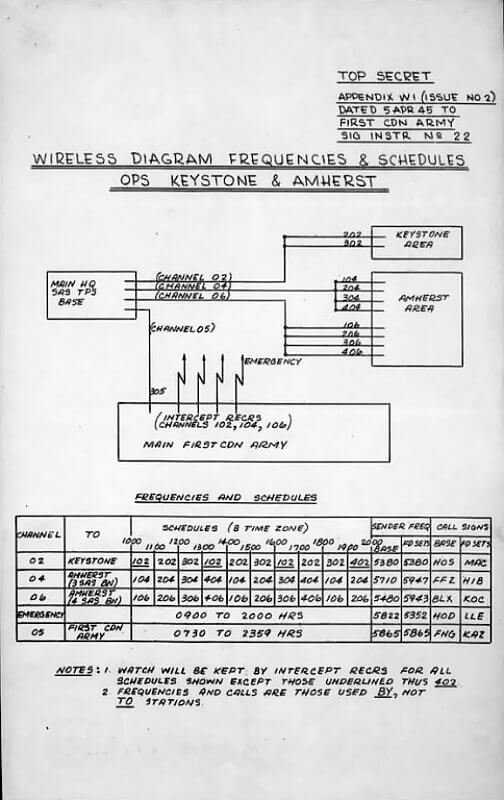
Signal communications in Operatie Amherst rely on two separate systems. Eight wireless sets drop with the force, four per battalion, one per combat company and one at battalion headquarters. These sets transmit in Morse code to the main Special Air Service headquarters in England, which relays the messages to First Canadian Army. The radio logs maintained by both headquarters represent one of the most valuable surviving sources for the operation. Each stick also carries a small receiving set for incoming broadcasts. At set times, the BBC transmits information to the sticks in the field covering the progress of Allied ground forces, the locations of other Special Air Service parties, and special instructions. Each stick operates under its own codename. In Operatie Amherst, the 3 Special Air Service uses the call sign Corbeau, and the 4 Special Air Service uses Archivistes, each combined with a number that allows instructions to be directed to individual sticks.
The 3e Régiment de Chasseurs Parachutistes, designated the 3 Special Air Service within the British Special Air Service Brigade, is commanded by Lieutenant-colonel Jacques Pâris de Bollardière. For Operatie Amherst the regiment, comprising 42 officers and 315 men, is divided into 24 sticks of approximately 15 men each.
- 1e Compagnie, Lieutenant Picard
- Stick 1, Lieutenant Rouan
- Stick 2, Lieutenant Ferchaud
- Stick 3, 2nd Lieutenant Valay
- Stick 4, 2nd Lieutenant Poli-Marchetti
- Stick 5, Lieutenant De Sablet
- Stick 6, 2nd Lieutenant Boiteux
- Stick 7, Lieutenant Boulon
- 2e Compagnie, Captain P. Sicaud
- Stick 8, Lieutenant Thomé
- Stick 9, Lieutenant Hubler
- Stick 10, Captain Sicaud
- Stick 11, Lieutenant Collery
- Stick 12, Lieutenant Duno
- Stick 13, 2nd Lieutenant Vidoni
- 3e Compagnie, Lieutenant Baratin
- Stick 14, Lieutenant Baratin
- Stick 15, 2nd Lieutenant Bouffartigue
- Stick 16, 2nd Lieutenant de Lagallard
- Stick 17, Lieutenant Gayard
- Stick 18, Aspirant Marschal
- Compagnie de Commandement
- Stick 19, Lieutenant-colonel De Bollardière
- Stick 20, Captain Paumier
- Stick 21, Lieutenant Dreyfus
- Stick 22, Captain Vallières
- Stick 23, 2nd Lieutenant Grumbach
- Stick 24, 2nd Lieutenant Lecomte
The 2e Régiment de Chasseurs Parachutistes, designated the 4 Special Air Service within the British Special Air Service Brigade, is commanded by Commandant Pierre Puech-Samson. Numerically slightly weaker than the 3rd RCP, the regiment comprises 21 officers and 298 men and is divided into 20 sticks of approximately 15 men each, plus three jeep groups.
- 1e Compagnie, Lieutenant Appriou
- Stick 2, Aspirant Forgeat
- Stick 3, Lieutenant Appriou
- Stick 4, Lieutenant Sriber
- Stick 5, Lieutenant Simon
- Stick 6, 2nd Lieutenant Stéphan
- 2e Compagnie, Lieutenant De Camaret
- Stick 7, Lieutenant Legrand
- Stick 8, Lieutenant De Camaret
- Stick 9, Lieutenant Gabaudan
- Stick 10, 2nd Lieutenant Corta
- Stick 11, Aspirant Edmé
- 3e Compagnie, Captain Alexis Betbèze
- Stick 12, Captain Betbèze
- Stick 13, Lieutenant Leblond
- Stick 14, 2nd Lieutenant Nicol
- Stick 15, 2nd Lieutenant Taylor
- Compagnie de Commandement
- Stick 1, Commandant Puech-Samson
- Stick 16, Captain Gramond
- Stick 17, Captain Berr
- Stick 18, Lieutenant Lasserre
- Stick 19, Adjudant Bourrel
- Stick 20, Lieutenant Varnier
- Jeep Groups
- Jeep Group 21, Captain Larralde (with four-man Jedburgh team Dicing)
- Jeep Group 22, Lieutenant Cochin
- Jeep Group 23, Aspirant Pierre Henri Lagèze
Stick numbers are the internal unit designations of each regiment and differ from chalk numbers, which identify the specific aircraft carrying each stick on the night of the drop. Both numbering systems appear in the sources and are used as appropriate throughout this account.
The earlier general description of the Special Air Service Brigade as fielding battalions of approximately 350 men reflects a rounded planning figure. The specific after-action figures of 357 men for the 3e Régiment de Chasseurs Parachutistes and 319 men for the 2e Régiment de Chasseurs Parachutistes, including jeep group personnel, confirm that both battalions are at reduced strength for Operatie Amherst, the result of the training shortfalls and recruitment delays described above.
| Multimedia |
| Preperations |
The forward headquarters that coordinates the relief of the French sticks is established by Colonel Guy Prendergast, deputy commander of the Special Air Service Brigade. On April 8th, 1945, Prendergast leaves Great Britain accompanied by a small staff comprising Major Neilson, Major Wallis, Lieutenant McDevitt of Special Air Service signals, a Company Quartermaster Sergeant, three drivers, and a radio operator. The party travels to Brussels, where three jeeps are collected from the 21st Army Group. They then proceed to the Tactical Special Air Service Brigade headquarters at First Canadian Army headquarters at Grave. On April 9th, 1945, Prendergast drives to Coevorden to establish a forward headquarters in readiness to receive French personnel as Canadian ground forces overrun their positions. The armoured jeeps flown from the United Kingdom arrive at Coevorden on April 10th, 1945, brought forward by Majors Neilson and Wallis.
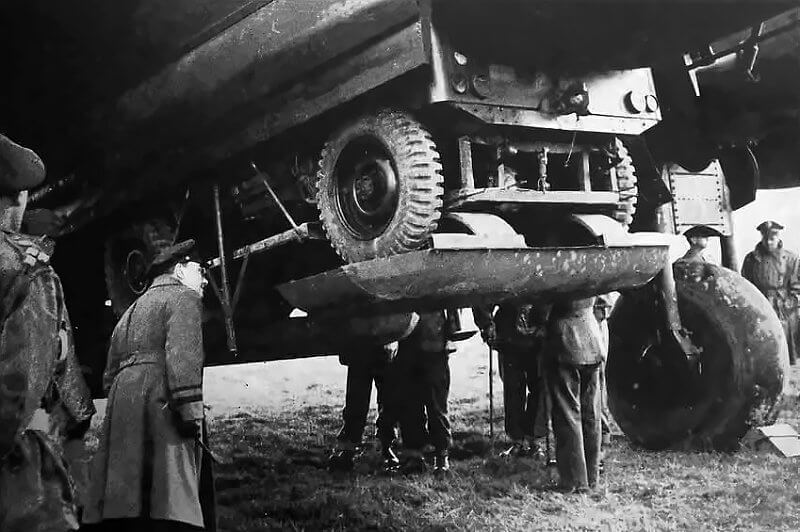
The eighteen armoured jeeps intended to support Operatie Amherst are to be delivered by Handley Page Halifax aircraft of No. 297 Squadron, Royal Air Force, operating from Earls Colne airfield. Each Halifax carries its vehicle in a specially fitted crate mounted under the bomb bay, allowing the jeep to be dropped by parachute. The jeep crews cannot travel on the same aircraft as the vehicles. The plan requires the crews to drop on the first night with the rest of the paratroopers and lay out reception lights on the ground to guide the Halifaxes in one hour later. Each drop zone is to be marked with three white reception lights and one flashing letter on the downwind side. The aircraft are to search for the lights for no longer than five minutes before abandoning the run.
Brigadier Calvert considers the jeeps essential to the operation. Beyond their direct combat value against the enemy, he believes their sudden appearance behind German lines will create significant confusion, as the Germans may mistake them for the advance elements of Allied ground forces already arrived. Both battalion commanders later confirm that the vehicles would have been of great value to their operations.
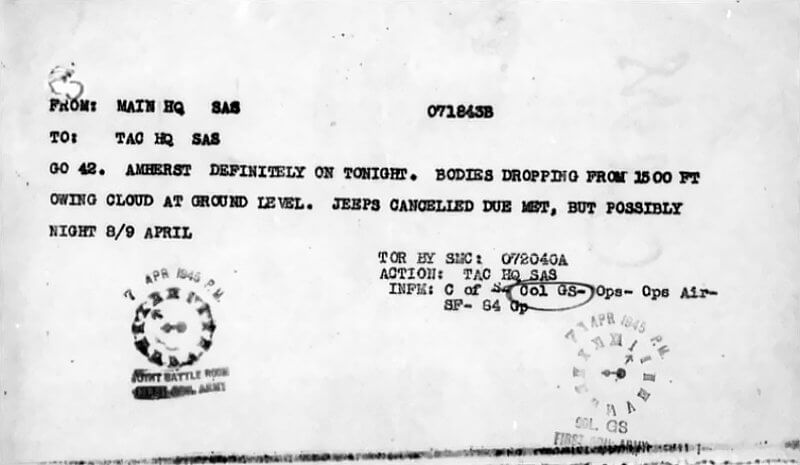
The jeep drop is cancelled at the last minute. Dense cloud cover over the drop zones makes the reception lights invisible from the air. When weather conditions show signs of further deterioration at 19:00 on April 7th, 1945, the decision is taken not to drop the vehicles. A blind drop is assessed as almost certain to result in the total loss of all eighteen jeeps. The Halifaxes at Earls Colne remain on the ground. All jeep crews drop on the first night with their sticks as planned. Because the cancellation decision is taken so late, the message does not reach all jeep teams in time. Some wait in vain for their vehicles on the first night. One team, under the codename Cochin, waits until the second night before accepting that the jeeps will not arrive.
The vehicle drop is postponed by 24 hours to the night of April 8th to 9th, 1945. Continuing unfavourable weather makes a drop on the 9th impossible and the postponement becomes a permanent cancellation. A brief consideration is given to dropping the jeeps into the Belgian Special Air Service zone near Coevorden and driving them overland into the Amherst area. When it becomes clear that all jeep crews have already dropped on the first night and are dispersed across Drenthe, this plan is abandoned.
The final solution is to fly the jeeps to airfield Gilze-Rijen, codenamed B77, in the Canadian sector in Holland, from where they are to travel overland to Coevorden. On April 9th, 1945, six of seven scheduled Halifaxes of No. 297 Squadron, Royal Air Force fly from Earls Colne to Gilze-Rijen, each carrying a jeep. One aircraft fails to take off due to technical problems and delivers its load the following day. Only part of the intended jeep complement reaches Holland by this route.
The jeeps delivered to Gilze-Rijen are driven overland to the town of Coevorden. There, on April 9th, 1945, Colonel Prendergast, Deputy Commanding Officer of the Special Air Service Brigade, establishes a forward Tactical Special Forces headquarters. Three ad hoc jeep groups are formed at Coevorden, each consisting of two or three vehicles. They are manned by volunteers from Prendergast’s headquarters and by French Special Air Service paratroopers already relieved by advancing ground forces.
The jeep groups have a clear task. They are to infiltrate enemy territory, make contact with French Special Air Service sticks still operating in the field, and arrange their evacuation. From April 10th, 1945, the French jeep groups operate north and west of Coevorden in conjunction with the 5 Special Air Service, the Belgian squadron. On April 11th, 1945, they cross the Oranjekanaal at the lock gate near Orvelte. From there they fan out to relieve French Special Air Service sticks fighting north of the canal. In the days that follow, the jeep groups operate successfully against the enemy and evacuate a large number of French paratroopers still in the field.
| Multimedia |
| The Way in. |
Six of the ten squadrons of No. 38 Group, Royal Air Force participate in the airlift. Each contributes seven to eight Short Stirling aircraft, bringing the total to 47 planes. No. 299 and No. 196 Squadrons operate from Shepherds Grove airfield. No. 295 and No. 570 Squadrons fly from Rivenhall. No. 190 and No. 620 Squadrons depart from Great Dunmow. The 18 Halifaxes of No. 297 Squadron, loaded with armoured jeeps and standing ready at Earls Colne, remain grounded.
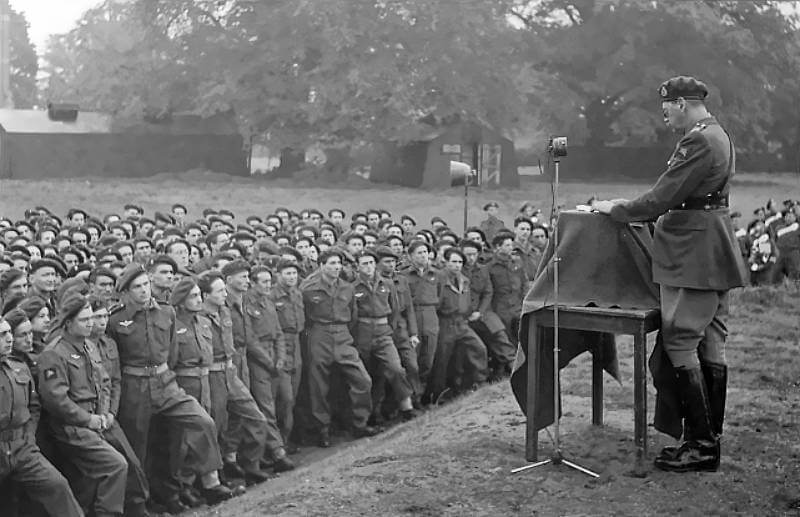
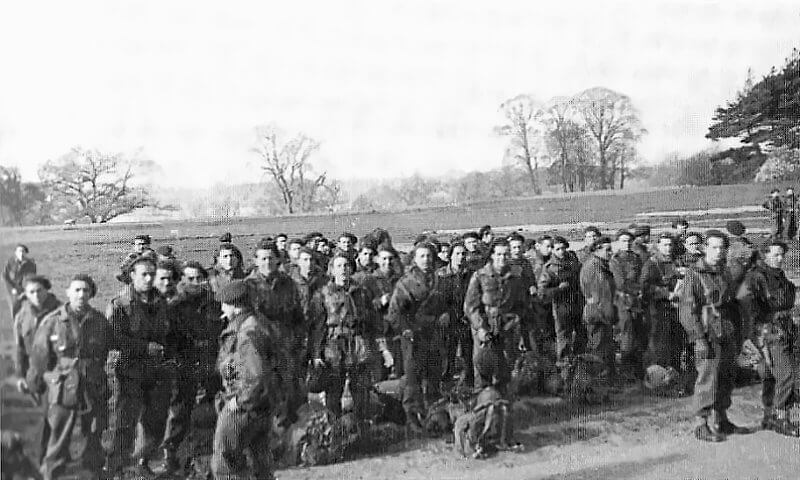
At 14:00 on April 7th, 1945, with all preparations complete, Brigadier Calvert wishes his men good luck. Stick by stick, the paratroopers are led to their aircraft. Parachute harnesses are drawn, adjusted, and checked. There is a brief interval before boarding, time enough to exchange a few words with the crew and accept a quick meal and the inevitable cup of tea from the Women’s Auxiliary Air Force working the airfields, who are generous with their smiles. Boarding takes place before nightfall. The crews run through their engine checks in sequence, one motor at a time and then all four together, the vibration travelling through the fuselage before the aircraft tax to the runway.
After nightfall, the Stirlings take off from their respective airfields at two-minute intervals, each carrying one stick of French paratroopers and four supply containers, and individually set course for northeast Holland. From Shepherds Grove, 17 aircraft take off. From Rivenhall, 16. From Great Dunmow, 14 of the 15 scheduled aircraft depart, one failing to take off due to technical problems.
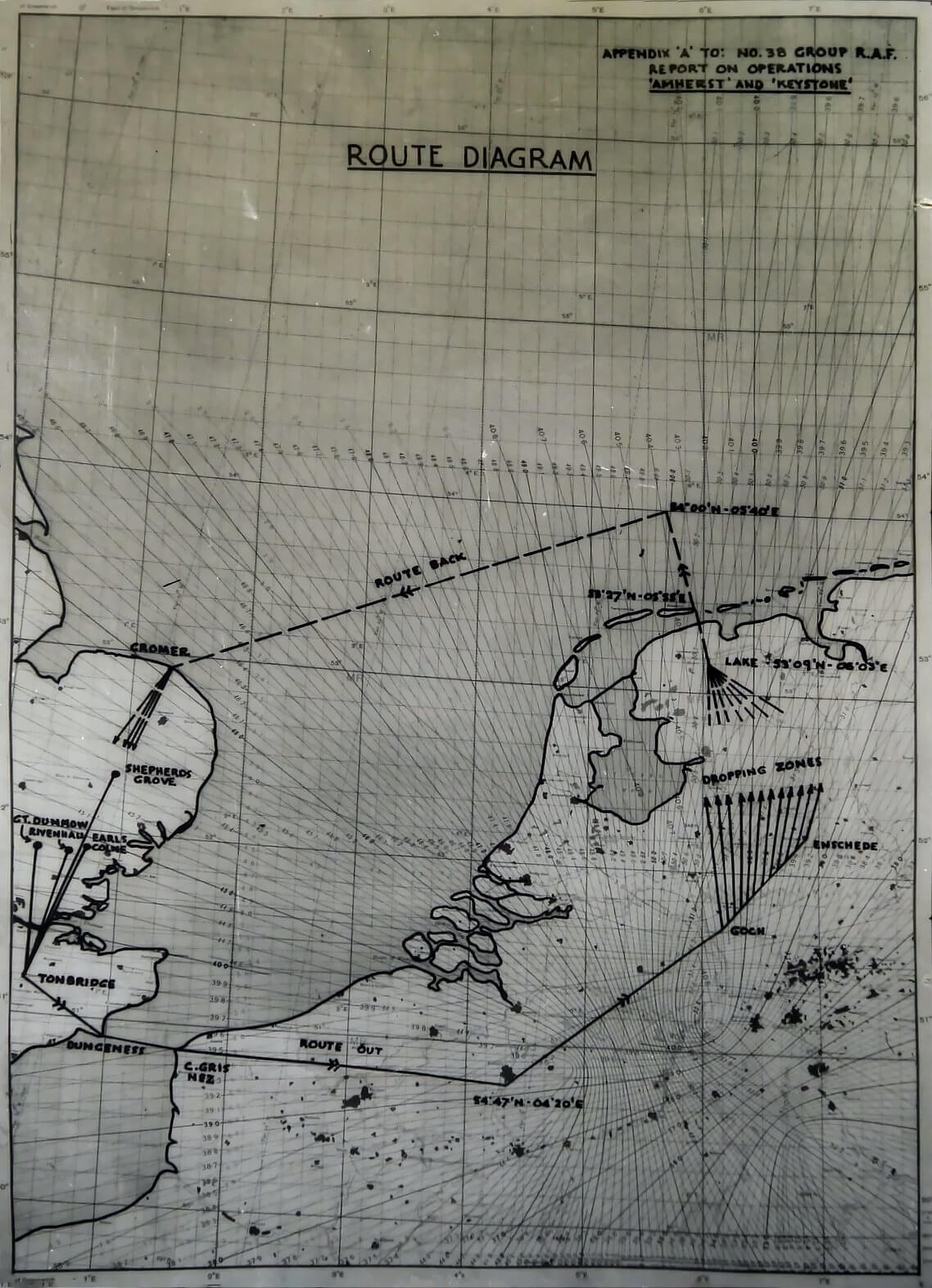
The Stirlings are routed overland from the south, crossing northern France and Belgium before entering Dutch airspace. They return to their bases over the North Sea, flying directly from northern Holland. Mobile radar guides them onto their targets. Special arrangements are made for Allied anti-aircraft artillery along the entire flight route. Between 21:00 on April 7th and 06:00 on April 8th, 1945, no anti-aircraft guns fire along the axis Brussels to Goch to Enschede to Emmen.
The flight route takes the aircraft across Cap Gris-Nez into liberated territory. They turn northeast over La Louvière in Belgium, approximately forty kilometres south-southwest of Brussels, and fly toward Goch and then Enschede. At intervals, each aircraft turns sharply northward toward its assigned drop zone. After completing the drops, all aircraft converge on the small lake of De Leien, north of the town of Drachten, before flying east along the island of Ameland. Over the North Sea the aircraft turn sharply left and head for England via the British town of Cromer.
Drop zones are allocated arrival times in sequence. Aircraft from Great Dunmow arrive over the target area between 22:30 and 23:00. Those from Shepherds Grove follow between 23:00 and 23:30. Rivenhall aircraft arrive between 23:30 and 23:59. Each stick drops in a single run. The airlift completes without serious incident. One Stirling sustains minor damage to its port tail when a paradummy becomes entangled on exit. No enemy opposition is encountered. All aircraft return safely to their bases.
The gunners test their weapons over the sea as standard procedure. The formation sets course for Belgium, turning above a brilliantly lit Brussels before heading due north. At twenty minutes to the drop, darkness is total. No anti-aircraft fire and no night fighters are encountered, though some pilots return with paradummies snagged on their tail assemblies, having spent an uncomfortable few minutes attempting to shake off what they briefly mistake for pursuing aircraft.
The conditions aboard the Stirlings are cramped. Fifteen men and their equipment, including a bulky kitbag strapped to one leg by a quick-release fastening, are squeezed into the fuselage interior, sitting on the floor. Approximately twenty minutes before the drop, a preliminary warning is given. Each parachutist stands, forms a line, checks the parachute pack of the man in front, and then checks his own static line, the cord that pulls the parachute open automatically on exit. A red light signals five minutes to the drop. The stick shuffles forward toward the dispatcher standing at the jump aperture at the tail of the aircraft. The green light signals the jump. The drop takes place in zero visibility, between 500 and 600 metres above a thick layer of cloud, along a south to north axis. A moderately strong wind is blowing from west to east at approximately 25 kilometres per hour. Navigation across the cloud cover is difficult.
Each Stirling drops four supply containers alongside its stick. The containers are Container Light Equipment, or CLE, type, designed to fit the bomb bays of the aircraft. Their dimensions conform to those of a 250-kilogram bomb, which dictates the design of the bomb bays of the bombers used for airborne operations. Standard procedure requires the containers to be released mid-stick. The mid-stick man’s static line is fitted with a lanyard that trips a switch initiating container release. The remaining members of the stick pause their exits briefly to allow the containers to clear the aircraft. This ensures the containers land in the centre of the stick’s landing pattern, reducing the time needed to recover equipment on the ground. In Operatie Amherst, two containers per stick carry food. The other two carry a Bren gun, ammunition, and communications equipment.
The airlift is accompanied by an elaborate deception plan designed to exaggerate the scale of the operation in the mind of the German command. The intention is to induce confusion, encourage surrender by creating the impression that resistance is futile, and provoke false dispositions by the enemy. Four methods are employed. First, 147 paradummies are dropped alongside the French paratroopers. These devices, known as Ruperts, are dummy parachutists constructed from sandbags, approximately one third the size of a man, fitted with timing mechanisms triggered on exit from the aircraft. On landing, each Rupert activates and simulates machine-gun or rifle fire for approximately five minutes. The same devices are used during the Normandy landings in June 1944. Second, Bomber Command and No. 100 Group, Royal Air Force are tasked with activity that night in areas close to the drop zones, simulating the pattern of a conventional large-scale airborne landing. No. 100 Group simulates a large dropping force in the area between Groningen and Leeuwarden. Small bombing attacks by No. 84 Group strike Emden, Papenburg, and Leer between 23:00 and 02:00, simulating the isolation of drop zones that would accompany a major airborne operation. Third, the BBC and the press announce that large airborne landings have taken place in northern Holland. Fourth, the paratroopers are ordered not to conceal their parachutes after landing. The canopies are left in the open, visible to German forces. The volume of parachutes on the ground, it is estimated, will be deeply unsettling to enemy soldiers. The French describe the intended psychological effect as a psychose du parachutiste, a parachutist psychosis, among the enemy.
The Dutch resistance is deliberately kept uninformed until the operation is already under way. To prevent premature disclosure and avoid endangering resistance networks given the uncertain start date, Radio Oranje broadcasts the coded activation message only half a day after the drops begin. The message is “De boot is omgeslagen”, meaning the boat has capsized. The late notification means that resistance support cannot be coordinated in advance and must be organised locally on an improvised basis during the operation itself. The contrast with the Special Air Service operations in France in the summer of 1944, when the French paratroopers work closely with the Maquis, is stark. In Drenthe, the Dutch resistance plays a far more modest role than either the Special Air Service or the resistance had hoped.
| Multimedia |
| Sources |