

| Widerstandsnest 72 |
 |
| Garrison |
| Unit |
| 11. Kompanie, Grenadier-Regiment 726, 716. Infanterie-Division (bodenständig) under operational control of 352. Infanterie-Division, with Pak crew |
| Armament |
| * 88-millimetre Pak 43/41 * 50-millimetre KwK L/ 42 * Granatwerfer 36 * MG.311(f) * Maschinengewehr 34 * Maschinengewehr 42 |
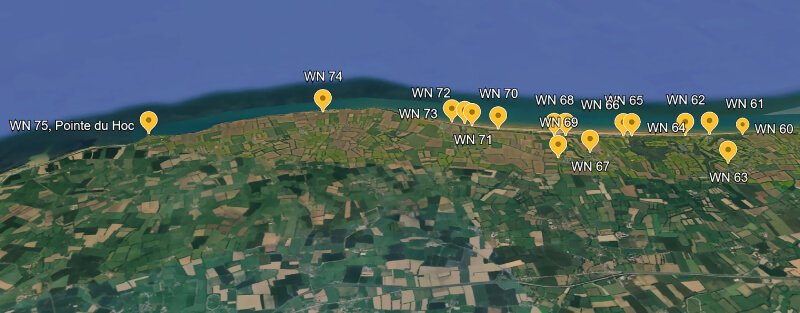
Widerstandsnest 72 is a German defensive strongpoint on Omaha Beach in Normandy, positioned on the western side of the D-1 draw at Vierville-sur-Mer. The draw contains the only paved road off the beach in this sector, running between two steep coastal bluffs, and is one of the most important exit points on the entire landing front. Widerstandsnest 72’s primary task is to block this route and prevent Allied forces from breaking inland.
Constructed during 1943–44 as part of the Atlantikwall, Widerstandsnest 72 is among the most heavily fortified positions on Omaha Beach. It consists of thick reinforced-concrete bunkers, an interconnected trench network, multiple weapons emplacements, and an extensive system of beach and landward obstacles. The strongpoint is positioned to deliver overlapping and interlocking fields of fire, both with its own weapons and in coordination with neighbouring Widerstandsnester.
The position covers Dog Green sector directly in front of the draw and works in concert with Widerstandsnest 71 on the eastern bluff and Widerstandsnest 73 on the next headland to the west. Together, these positions form a defensive complex designed to turn the Vierville exit into a kill zone. Widerstandsnest 72’s siting allows it to fire directly onto the beach approaches, enfilade the shoreline, and support its neighbours by sweeping their sectors with flanking fire.
By early June 1944, Widerstandsnest 72 stands as a key node in the German coastal defence system. Its integration into the wider defences around Vierville, the strength of its fortifications, and the density of its armament make it one of the most formidable resistance nests on Omaha Beach. It is intended not only to repel a direct assault on the D-1 draw but also to support the broader defensive network by preventing any lateral movement along the beach and by tying down attacking forces under sustained fire.
| Construction and Layout of Widerstandsnest 72 |
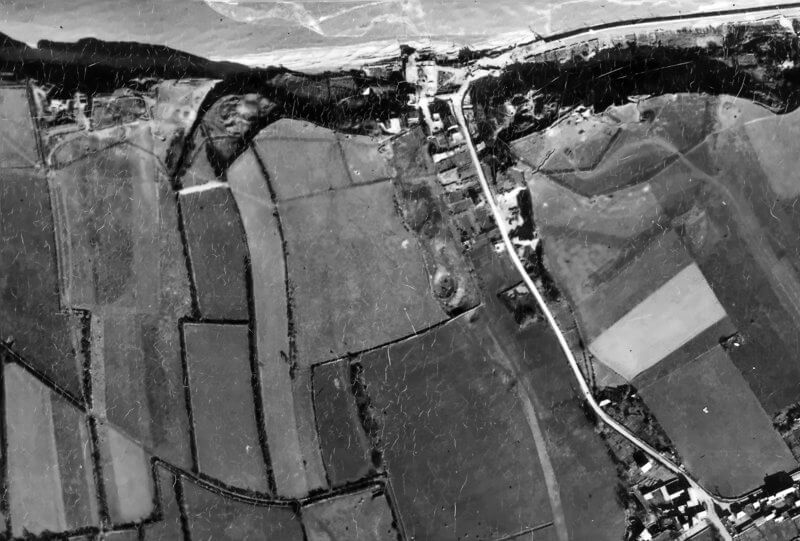
Widerstandsnest 72 occupies the western side of the D-1 draw at Vierville-sur-Mer, in Dog Green sector of Omaha Beach. It sits between two steep coastal bluffs, directly in front of the Vierville exit road, and only a few metres above the high-water line. Unlike many coastal gun positions placed on cliff tops, Widerstandsnest 72’s principal bunkers are built almost at sea level, making use of the natural hollow of the draw for concealment. This low profile reduces its visibility from offshore and allows it to blend into the terrain when camouflaged.
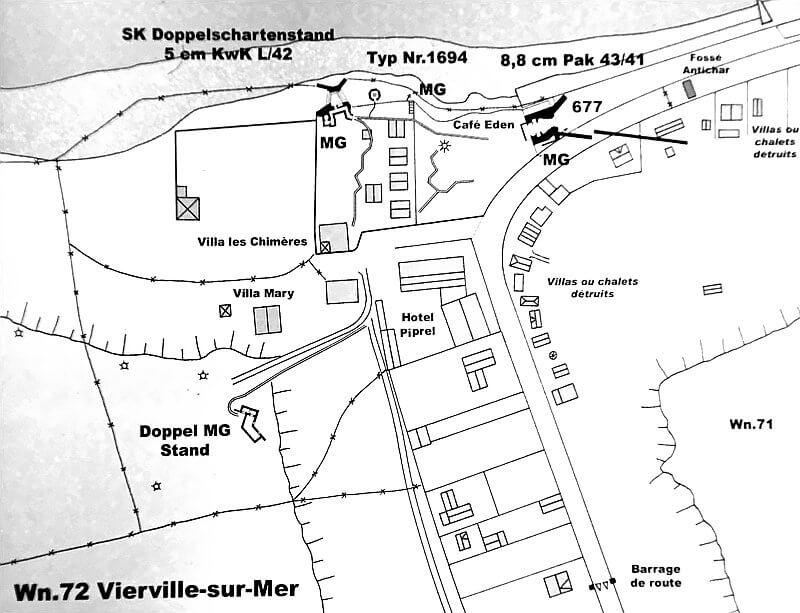
The strongpoint is built as a compact cluster of reinforced concrete bunkers and field fortifications linked by protected infantry routes. The layout allows for internal communication and mutual support among all components, ensuring the garrison can shift positions under cover and defend against assault from multiple directions.
The easternmost position is the Main Gun Casemate, a Regelbau H/677 type, housing the strongpoint’s principal weapon: an 8,8-centimetre Panzerabwehrkanone 43. The casemate’s embrasure is angled eastwards along the shoreline rather than directly out to sea, allowing enfilade fire down the length of Omaha Beach. The seaward side is protected by a heavy blast wall, while the roof and walls consist of over a metre of steel-reinforced concrete, built to resist heavy naval bombardment. This gun’s orientation means its muzzle flash is difficult to detect from the invasion fleet, and its field of fire overlaps with weapons in neighbouring positions to the east. The casemate remains in place today, still containing the 8.8-centimetre gun, and forms the foundation for the National Guard memorial at Vierville.
West of the 8.8-centimetre bunker is the Secondary Gun Bunker, a Doppelschartenstand (double-embrasure casemate) built to mount a 5-centimetre KwK L/60 anti-tank gun. This special construction allows the weapon to fire through two separate embrasures, covering both eastern and western approaches. In practice, the gun could be swung east to fire along the beach in conjunction with the 8.8-centimetre, or west towards the next bluff to engage targets approaching from that direction. The concrete walls are thick and angled to suit the dual fields of fire, with the position slightly set back from the beach to improve protection.
Linking these two principal gun bunkers is a network of zig-zag infantry trenches. These are dug into the sandy soil, in places revetted with timber or sandbags, and provide protected movement between positions. The trenches are designed with parapets to allow riflemen and machine-gunners to fire from relative cover. They also tie in several smaller fighting positions, creating a single cohesive defensive system. Along the trench lines are small field shelters, either earth-and-log dugouts or concrete niches, used for storing ammunition and providing cover for personnel during bombardment. Most of Widerstandsnest 72’s positions are open fighting sites rather than large underground bunkers, reflecting the need for rapid access to weapons and observation points.
Two Tobruk bunker form part of the layout. These are set into the ground so that the operator stands on a firing platform with only head and shoulders above ground level. One Tobruk is likely armed with an MG 42, covering approaches to the strongpoint and sweeping sections of the beach. The second may be configured for a 5-centimetre leichter Granatwerfer 36 or a grenade launcher, enabling indirect fire onto the sand or into dead ground near the shingle. In addition to the Tobruks, other Machine Gun positions, either sandbagged field emplacements or embrasures in the main bunkers, are positioned to ensure that every approach to the draw is covered. An MG 42 post on the adjacent bluff is able to fire over the shingle and sand flats in front of Widerstandsnest 72, ensuring that no ground between the surf line and the base of the bluffs is safe from observation and fire.
Widerstandsnest 72 does not have a separate, purpose-built command bunker. Instead, one of its reinforced positions, possibly an elevated Tobruk or the roof of the 5.0-centimetre casemate, likely serves as a simple observation and command post. From here, a non-commissioned officer can direct fire, observe the approaches, and communicate by Feldfernsprecher with higher headquarters or neighbouring strongpoints. Widerstandsnest 72 is connected by landline to the Stützpunktgruppe Vierville’s command network, allowing quick transmission of fire requests and situation reports. German battle reports from June 6th, 1944, note that some strongpoints “ceased firing; they do not answer any longer when rung up on the telephone,” evidence that Widerstandsnest 72 and its neighbours were tied into this communications system until cables were cut during combat.
The entire strongpoint is constructed according to standard Atlantikwall principles: heavy use of steel-and-concrete fortifications, low-profile gun bunkers sited for lateral fire along the beach, and integration with a network of trenches and obstacles. The position takes full advantage of the natural terrain, nestling between high cliffs for flank protection, while its layout supports all-round defence of the D-1 draw. In 1944, every position was camouflaged with earth, grass, and netting to blend into the bluffside, making Widerstandsnest 72 a formidable and difficult-to-detect resistance nest in one of the most critical sectors of Omaha Beach.
| Defensive Systems and Infrastructure of Widerstandsnest 72 |
By early June 1944, Widerstandsnest 72 is enclosed within a network of layered obstacles and supporting works extending from the low-water line to the rear of the strongpoint. These defences are designed to slow, channel, and destroy attacking forces before they can reach the bunkers.
The tidal flats in front of Widerstandsnest 72 stretch 270 to 370 metres at low tide. Across this open ground, several staggered lines of obstacles are emplaced, all pre-sighted by the strongpoint’s weapons. Belgian gates, large steel-framed anti-tank barriers, stand in rows alongside Czech hedgehogs made from crossed steel beams. Wooden stakes, angled seaward and topped with mines, form additional lines known as Rommel’s asparagus. The tidewater flats contain anti-personnel mines and barbed wire entanglements to catch infantry once they leave the surf. Landing craft are forced to slow or turn in full view of the strongpoint’s gunners, and infantry are channelled through killing zones swept by machine-gun and mortar fire.
At the high-tide mark, a concrete seawall about 6.5 metres high runs across this sector. Built originally to prevent erosion, it is now crowned with coils of barbed wire. Immediately behind it, triple-strand wire fences and concertina coils ring Widerstandsnest 72 on its flanks and rear. These barriers restrict movement and drive attackers into pre-sighted fire lanes.
Anti-tank mines are buried along the D-1 road and at likely vehicle exit points. S-mines and other anti-personnel devices are laid across grassy slopes and in front of trench lines. German maps mark minefield Mf.22 in front of Widerstandsnest 72 and Widerstandsnest 73, and minefield Mf.23 along the cliff-top to the west, creating a continuous mined area. Local accounts describe the entire beach, road, and forward slopes as seeded with explosives.
Two reinforced concrete anti-tank walls block the D-1 draw. Each measures about 38 metres in length, 2.7 metres in height, and 1.8 metres in thickness. One is near the beach edge, close to the 8.8-centimetre casemate; the other is further inland. They are positioned so that any halted vehicle remains in the line of sight of Widerstandsnest 72’s guns.
The D-1 draw is a steep-sided ravine flanked by cliffs rising 30 to 40 metres. Widerstandsnest 72 and Widerstandsnest 71 occupy opposite slopes of the valley entrance. Fire from both sides can be directed into the draw, and the bluffs allow observation of all movement on the open approaches. A shingle bank at the high-tide line offers only shallow cover and is ranged for mortar fire. Sheer cliffs to the west allow Widerstandsnest 72’s bunkers to focus on the more probable eastern attack route.
A buried field telephone line links Widerstandsnest 72 with adjacent Widerstandsnester and the Stützpunktgruppe Vierville command post inland. This enables the garrison to report enemy movements and request supporting fire. The line runs up the draw to Vierville-sur-Mer. It is vulnerable to bombardment, and once cut, communication must rely on runners or signal flares.
| Armament and Weapons Emplacements of Widerstandsnest 72 |
By early June 1944, Widerstandsnest 72 contains a wide variety of weapons, from heavy anti-tank guns to automatic arms, arranged so that their fields of fire overlap and leave no approach uncovered. Every emplacement is sited to maximise the kill zones around the Vierville draw and to integrate with the neighbouring Widerstandsnester.
The core of Widerstandsnest 72’s firepower is an 8.8-centimetre Panzerabwehrkanone 43/41, a high-velocity anti-tank gun installed in a Regelbau H677 casemate. This weapon, one of the most powerful of the war, combines a long range with a flat trajectory, capable of destroying tanks, landing craft, or fortified positions at over 2,000 to 3,000 metres. In Widerstandsnest 72 it is mounted to fire along the beach from west to east, delivering enfilade fire across the Dog Green sector and directly onto the D-1 exit road. The gun is housed behind a thick, steel-reinforced concrete wall over a metre thick, with only a narrow embrasure exposed to the seaward side. This makes it difficult to detect from offshore and highly resistant to naval and tank fire. The position is served by a crew of about eight to ten men, trained to switch between armour-piercing and high-explosive rounds. On D-Day, the gun’s impact on approaching armour is such that American troops later nickname its casemate the “concrete King Tiger,” likening it to a Tiger tank turret embedded in concrete.
Immediately to the west of the main casemate is a double-embrasure Doppelschartenstand bunker containing a 5-centimetre Kampfwagenkanone L/60. This is likely a weapon salvaged from a Panzer III turret or adapted from a 5-centimetre Pak 38, mounted to fire through two separate embrasures. One covers the eastern beach approaches, overlapping the 8.8-centimetre’s field of fire, while the other covers the western side towards the cliffs. This rare arrangement enables the five to seven-man crew to engage targets from either flank, including lighter vehicles, landing craft, or infantry formations. It is intended to ensure that no side of the beach front is left undefended and reflects the strategic importance of the Vierville draw.
Although not within Widerstandsnest 72’s perimeter, an additional 7.5-centimetre field gun, the Pak 97/38, is positioned in Widerstandsnest 73 only a few hundred metres to the west on the bluff. This is a French Canon de 75 modèle 1897 adapted by the Germans and mounted in a small casemate. It fires from an elevated and camouflaged position onto the same sector as Widerstandsnest 72, creating an interlocking field of fire from the opposite side of the draw. This flanking capability ensures that any attacker facing Widerstandsnest 72 is also under direct fire from Widerstandsnest 73.
Mortar support is also integrated into the plan. Widerstandsnest 72 may include a light 5-centimetre Granatwerfer 36 in one of its Tobruk pits or trenches, providing close-range indirect fire. Its main mortar support, however, comes from Widerstandsnest 73’s two 8.14-centimetre Granatwerfer 34 of French origin, mounted in Tobruk pits with a dedicated observation post. With a range of several hundred metres, these mortars can drop shells onto the beach, the shingle, and the base of the seawall. Pre-registered target data allows Widerstandsnest 72’s observers to call in rapid and accurate fire on any troops gathering in cover or attempting to breach obstacles. German accounts describe “continuous shelling” hitting the beach on D-Day from unseen positions, reflecting the effectiveness of this arrangement.
Machine-gun defence is extensive. Widerstandsnest 72 employs several MG 34 and MG 42 Einheitsmaschinengewehr in fixed and mobile positions. Tobruk-mounted Machine Guns, such as an MG 42 on a pivot mount, provide low-profile cover over the western approaches or directly onto the sand in front of the strongpoint. Other Machine Guns are positioned in bunker embrasures, possibly alongside the 5-centimetre gun or atop the 8.8-centimetre casemate in a ring-mount Tobruk, and in sandbagged emplacements along the trenches. Tripod-mounted MG 42’s are sited to fire along barbed-wire entanglements and across the open beach, while other teams are positioned to target the base of the seawall where assault troops are likely to gather. Widerstandsnest 72’s machine guns are arranged for interlocking fields of fire and coordinate with Widerstandsnest 71 on the opposite side of the draw, ensuring mutual flanking fire. At least three Machine Gun positions on the bluff tops, part of Widerstandsnest 71 and Widerstandsnest 73, can fire down into the draw and onto the rear of the beach. With a rate of fire exceeding 1,200 rounds per minute, the MG 42’s reputation as “Hitler’s Buzzsaw” is well-earned in this defensive network. Each is crewed by two or three men, a gunner, loader, and assistant or ammunition bearer. Some MG 34s may also be mounted on anti-aircraft tripods to engage low-flying aircraft or to strafe troops from a higher angle.
Close-range defensive measures include flamethrowers and grenades. Static Flammenwerfer 41 installations may be positioned to cover trench lines or likely approach routes, ready to release sudden bursts of burning fuel at close range. The garrison is also equipped with Karabiner 98k rifles, Luger or Walther pistols, Stielhandgranate stick grenades, and rifle-mounted grenade launchers. These are used to repel attackers who manage to reach the trench network or bunker entrances, providing a last line of resistance in close-quarters combat.
The positioning and integration of these weapons follow standard Atlantikwall doctrine. Long-range anti-tank guns are used for enfilade fire; mortars and artillery hit troops in cover or at a distance; machine guns provide continuous sweeping fire over the open approaches; and grenades and flamethrowers guard against close assault. Most of the main weapons are aimed laterally along the beach rather than directly seaward, making them harder to detect from the water and maximising the effect of flanking fire. Every weapon position is sited to support the others, for example, a soldier taking cover from the 8.8-centimetre behind the seawall is exposed to mortar fire, while one attempting to bypass the 5-centimetre bunker can be caught by an Machine Gun in a Tobruk. Combined with the armament of Widerstandsnest 71 and Widerstandsnest 73, Widerstandsnest 72’s weapons form a dense and coordinated network capable of engaging targets from multiple angles and ranges, turning the Vierville draw into a lethal trap for any attacking force.
| Garrison and Organisation of Widerstandsnest 72 |
By June 1944, the garrison of Widerstandsnest 72 consists primarily of German Army personnel from the 352. Infanterie-Division, which has taken over the defence of Omaha Beach in the spring of that year. The coastal fortifications in this sector were originally manned by troops of the static 716. Infanterie-Division, but these have been replaced or reinforced by the 352. Infanterie-Division, a veteran formation containing men with Eastern Front combat experience. Widerstandsnest 72, like other Widerstandsnester, is roughly equivalent to a reinforced platoon position. It is held by around two infantry squads, twenty to thirty men, supported by specialist crews for the heavy weapons.
Two squads of Grenadiere from the division’s infantry regiment man the trenches, Tobruks, and light weapon posts. Each squad is commanded by an Non-Commissioned Officer and includes riflemen and machine-gunners, responsible for operating the MG 42’s, maintaining wire and mine obstacles, and defending the position in close combat. These men are the strongpoint’s primary anti-personnel force, engaging infantry at all ranges and protecting the heavy guns from assault.
The 8.8-centimetre Pak 43 in the main casemate is served by a crew of about eight, probably drawn from the division’s Panzerjäger-Abteilung. These men are trained in direct-fire anti-tank gunnery and operate under the supervision of a junior Non-Commissioned Officer or officer. The 5-centimetre KwK in the double-embrasure bunker has a smaller crew of about five, working in close coordination with the infantry. Ammunition handlers keep both guns supplied from storage recesses or nearby shelters, and each crew is expected to fight on even if cut off from the rest of the position.
Overall command of Widerstandsnest 72 is in the hands of a Leutnant or Oberfeldwebel, who directs fire, controls the defence, and maintains contact with higher command. Communication is by field telephone, linked to company or battalion headquarters in Vierville-sur-Mer. Widerstandsnest 72, Widerstandsnest 71, and Widerstandsnest 73 together form Stützpunkt Vierville, under the sector control of III. Bataillon, Grenadier-Regiment 726 or 916, with 11. Kompanie of Grenadier-Regiment 726 noted for manning Widerstandsnest 73. One or two signals troops maintain the telephone lines and act as runners.
Specialists within the garrison include a medic operating a first-aid post, and possibly an artillery forward observer to direct supporting fire from inland batteries such as 10.5-centimetre howitzers or Nebelwerfer rocket launchers located a few kilometres to the rear. This observer uses field glasses, maps, and the telephone link to call in pre-registered defensive fire missions onto the beach and draw.
The men of Widerstandsnest 72 are a mixture of seasoned veterans and younger, less experienced soldiers. Many Non-Commissioned Officers and officers have seen service on the Eastern Front, bringing discipline and combat knowledge. Others are teenage conscripts or recent transfers, indoctrinated but untested in battle. The valuable Pak 43 ensures that its crew is experienced, possibly drawn from Kriegsmarine coastal artillery or long-service Army gunners.
The command structure places the strongpoint leader at the top, with a deputy, two squad leaders for the infantry, and gun captains for each heavy weapon. Orders are given by voice or runner during action, and the expectation is that the position will resist to the last. Supplies of small-arms ammunition, machine-gun belts, and shells for the heavy guns are stocked for a protracted defence of at least six to twelve hours, in line with German doctrine that fixed defences delay the enemy for mobile reserves to counterattack.
By early June, the garrison is on full alert, well drilled in manning positions at short notice. They rehearse range cards for each weapon, practice target engagement, and are confident in their ability to hold the draw. Field Marshal Rommel’s inspection in the spring has reinforced the importance of their mission. In their minds, with interlocking fire from Widerstandsnest 71 and Widerstandsnest 73 and their own powerful armament, no seaborne assault can succeed without paying a heavy price.
| Widerstandsnest 72’s Role in the Omaha Beach Defence Strategy |
Widerstandsnest 72 is not an isolated fortification but a fully integrated component of the Atlantikwall, positioned to exploit the terrain and to operate in concert with adjacent strongpoints. Together with Widerstandsnest 71 on the eastern side of the draw and Widerstandsnest 73 on the western bluff, it forms Stützpunktgruppe Vierville. These three positions guard the D-1 exit, the most important and most heavily fortified draw on Omaha Beach. The Vierville draw is the only one in the sector with a paved road leading directly to the N13 coastal highway. In German planning, this makes it a decisive point; if the Allies breach here, they could push inland quickly and threaten the entire 352. Infanterie-Division sector. For that reason, Widerstandsnest 72 is built as one of the strongest defensive positions on the beach, described by Allied intelligence as the best constructed strongpoint at Omaha.
The position’s layout allows its weapons to interlock with those of neighbouring strongpoints. Widerstandsnest 71 across the draw provides flanking fire into Widerstandsnest 72’s frontage, and Widerstandsnest 72 can do the same into Widerstandsnest 71’s. On the western side, Widerstandsnest 73 supports the sector with its 7,5 cm gun, mortars, and Machine Guns, including fire from the fortified Maison Gambier. The terrain west of Widerstandsnest 73 drops into sheer cliffs at Pointe de la Percée, eliminating any need to guard against a landing from that direction. This allows Widerstandsnest 72 and Widerstandsnest 73 to focus their fire eastwards along the beach. In practice, most heavy weapons in this part of the Vierville sector are sited for enfilade fire, sweeping the beach lengthwise rather than firing directly out to sea. Widerstandsnest 72’s 5-centimetre gun can also pivot to assist Widerstandsnest 73 if needed, while Widerstandsnest 73’s mortars can strike targets in front of Widerstandsnest 72. To the east, the chain of Widerstandsnester continues, creating uninterrupted defensive coverage.
Widerstandsnest 72’s role is to deliver maximum firepower onto the beach at the water’s edge, in accordance with Generalfeldmarschall Rommel’s doctrine of defeating the invasion before a foothold can be established. Behind it, the draw is layered with additional defences. There are anti-tank walls, further minefields, and the high ground above remains in German hands even if the beach is crossed. Widerstandsnest 71 and Widerstandsnest 73 serve as backstops, pouring fire down on any troops attempting to move inland. Behind Vierville itself, elements of the 352. Infanterie-Division’s reserve companies and possibly units of Grenadier-Regiment 915 are positioned to counterattack if the front line is breached. Rommel’s orders also ensure that the approaches inland are obstructed with mines and that houses are prepared for defence. The Vierville draw thus becomes a multi-layered killing zone in which attackers are repeatedly halted and attrited.
From the German perspective, the D-1 draw is a Schwerpunkt, a focal point, in the defence of Omaha. Widerstandsnest 72’s mission is to hold this gateway shut for as long as possible. If it remains intact, artillery inland, such as Nebelwerfer at Widerstandsnest 67 and field batteries, can continue to enfilade the beach. If it falls, the western flank of Omaha is exposed and the 352. Infanterie-Division’s positions risk being rolled up from the flank. The position’s 8,8-centimetre gun has the range to reach into Dog White sector to the east, supporting the wider defence, while further east Widerstandsnest 68’s captured French turret and anti-tank gun can combine with Widerstandsnest 72’s fire to create crossfire zones.
Psychologically, Widerstandsnest 72 is intended as both a deterrent and a statement of the Atlantikwall’s strength. It is a miniature fortress, with mutually supporting bunkers, anti-tank obstacles, minefields, and interlocking weapons covering all approaches. Its existence is part of the German belief that a determined, well-prepared coastal defence can either prevent a landing entirely or inflict such heavy losses that any bridgehead will collapse.
Operationally, Widerstandsnest 72 is tied into the division’s alarm and reporting network. Observation posts, including radar at Widerstandsnest 74 Pointe de la Percée, provide early warning. Once the alarm is given, the garrison mans its battle stations and reports enemy activity to higher headquarters via field telephone. If Widerstandsnest 72 is overrun, artillery inland can be called to fire on its own former position to deny its use to the enemy. The 352. Infanterie-Division headquarters at Château de Bernesville relies on such strongpoints to delay the Allies until reserves, such as II. Battailon, Grenadier-Regiment 915 or the divisional Füsilier-Bataillon, can mount a counter-attack.
In June 1944, Widerstandsnest 72 stands as the cornerstone of the German defence on Omaha’s western flank, a position sited to dominate the D-1 exit, coordinated to deliver enfilade fire with its neighbours, and equipped to resist for many hours. Its destruction is recognised by Allied planners as essential for opening the Vierville draw, and they allocate substantial infantry and Ranger forces for the task. Until that moment, Widerstandsnest 72’s role is clear: to hold fast, to kill in the killing ground, and to keep the door to the western sector firmly shut.
| Sources |