

| Widerstandsnest 63 |
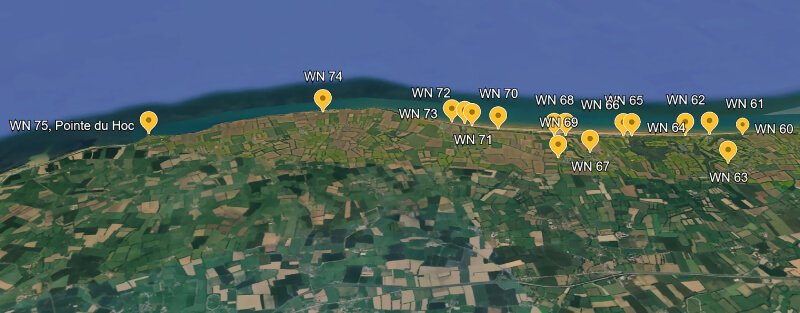 |
| Garrison |
| 20-25 men |
| Unit |
| Command post, Kompanie 3, Grenadier-Regiment 726, part of the 716. Infanterie-Division (bodenständig) Secondary command post, Grenadier-Regiment 915 of the 352. Infanterie-Division |
| Armament |
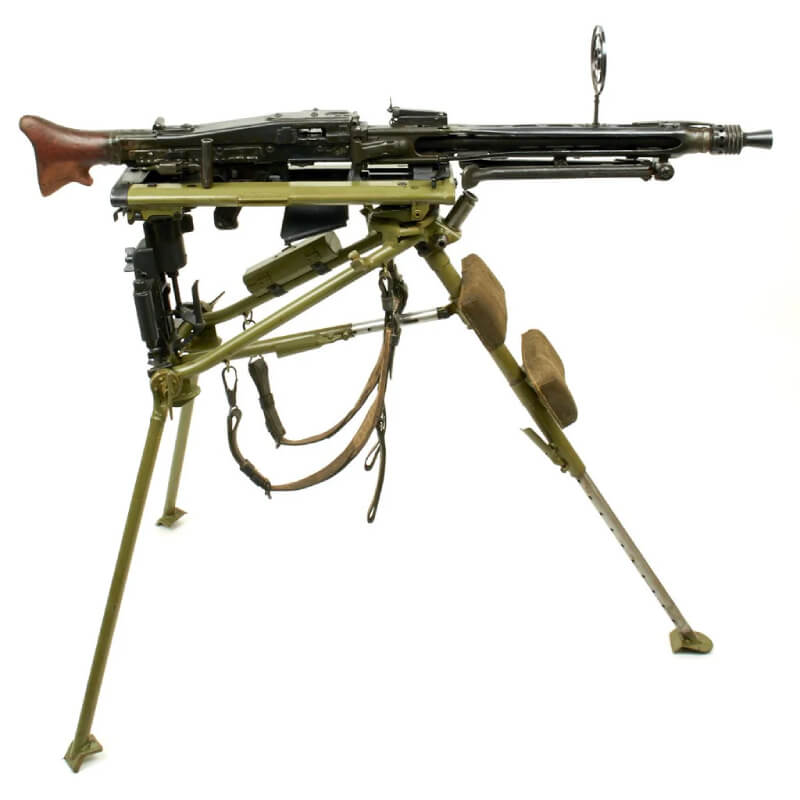
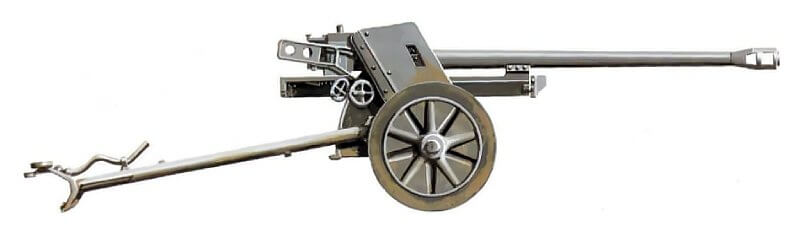
| * 1 x 5-centimetre PaK 38 * Maschinengewehr 34 * Maschinengewehr 42 |
Widerstandsnest 63 serves as the local command post for the German coastal defences around Colleville-sur-Mer. It is situated approximately 1.2 to 1.3 kilometres inland from the main beach positions, including Widerstandsnest 62 and Widerstandsnest 61. Unlike those strongpoints, which feature large reinforced concrete gun casemates, Widerstandsnest 63 is constructed as a compact, underground command facility.
The bunker at Widerstandsnest 63 is a field-constructed Vf-type position rather than a heavy Regelbau fortification. It is dug into a slope beside the Colleville–les Moulins road, offering natural concealment. The structure consists of three connected concrete rooms: two larger chambers and a smaller signals room. Earth and reinforced concrete form the bunker’s protective shell, though its thickness is modest compared to frontline positions.
The interior layout is functional. The first two rooms are used for command and coordination. The third, smaller room serves as the signals centre, containing radio and field telephone equipment. At the rear of the bunker, an emergency exit leads up to the plateau above. This rear hatch opens into a shallow trench system, offering a covered escape route or defensive fallback in case of attack.
Importantly, Widerstandsnest 63 does not house any heavy weapons. Its function is not direct defence of the coastline, but rather command, control, and communications. It serves as the headquarters for Kompanie 3, Grenadier-Regiment 726, 716. Infanterie-Division, and supports the Widerstandsnest 61–Widerstandsnest 62 cluster along the Colleville draw. It is linked to these positions by both telephone cables and an optical signal line.
In effect, Widerstandsnest 63 functions as the nerve centre of the Colleville defensive sector. Its protected location, hidden access, and integrated communications give it the ability to command the surrounding strongpoints while remaining shielded from initial bombardment. Though small and unarmed, its role in maintaining cohesion among the beach defences is essential to the overall Atlantic Wall strategy in this sector.
| Defensive Systems and Infrastructure of Widerstandsnest 63 |
Widerstandsnest 63 serves as a sector headquarters rather than a frontline strongpoint. As such, its focus lies in communication and command, not in mounting heavy weapons. Still, it is defended by field fortifications and protected by the broader defensive network surrounding Colleville-sur-Mer.
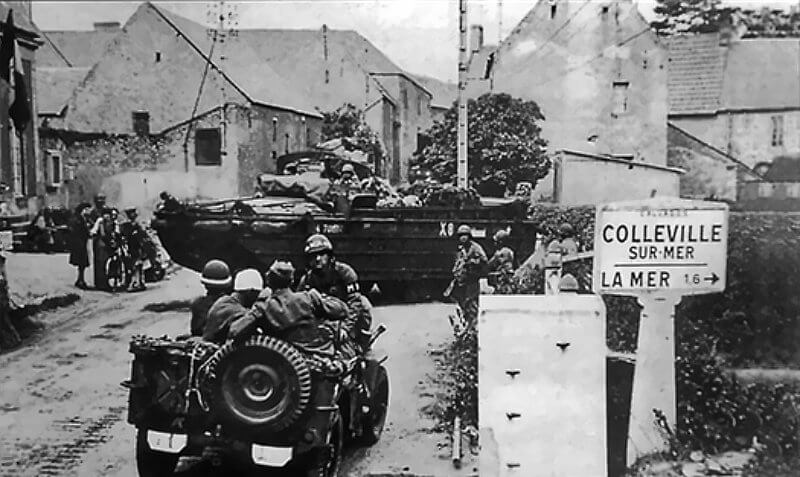
A key feature of Widerstandsnest 63 is its communications infrastructure. Behind the village school, on nearby farm grounds, the Germans bury a cable well. This concrete junction box anchors the field telephone network. Lines radiate out from this point to connect with Widerstandsnest 59, Widerstandsnest 60, Widerstandsnest 61, Widerstandsnest 62, and Widerstandsnest 64. These connections allow the command staff at Widerstandsnest 63 to direct the beach strongpoints and coordinate with higher command inland.
Halfway between Colleville-sur-Mer and the beach, the Germans position an anti-tank gun to cover the main approach road. This weapon is likely sited to engage vehicles attempting to move inland from the landing area. Slightly further uphill lies Widerstandsnest 63. The strongpoint is situated approximately 1,250 metres from the beach. From this elevated position, it overlooks the surrounding terrain and controls access to the village and inland routes. Its location provides both concealment and a clear line of communication with frontline positions and rear command structures.
The command post lies along the La Fontaine road, which runs from Colleville-sur-Mer to the beach. A small entrance leads into a Vf-type command post, partly dug into the slope for concealment and protection. The bunker consists of three rooms laid out in a row, one behind the other. At the rear, an emergency exit opens onto the plateau above. This exit leads directly into a rifle trench dug for defensive use.
The last room includes a smoke vent for a small field stove, indicating use for extended occupation. This position serves two key roles. First, it functions as the battalion command post of the Grenadier-Regiment 915, part of the 352. Infanterie-Division. Second, it acts as the command post and communications centre for the 3. Kompanie of the Grenadier-Regiment 726. The chamber is dedicated to signals work. It contains field telephone sets and a radio transceiver. The latter provides wireless contact with regimental command and artillery units, including batteries of Artillerie-Regiment 352. This dual system ensures redundancy, if one line is cut, another can still function. The bunker is small and lightly built, but it plays a vital role in coordinating both front-line and rear-area defence within the eastern sector of Omaha Beach.
At the site of the Chemineau Farm, behind or beside the former school building, the Germans construct a cable well. This structure serves as a junction point for field telephone lines. From here, cables run to various bases and command posts throughout the sector. The installation supports communications between frontline positions, artillery units, and rear-area headquarters. It plays a key role in maintaining coordination across the Colleville sector, linking Widerstandsnest 63 with neighbouring defences and regimental command.
In addition to these systems, Widerstandsnest 63 is equipped with an advanced optical device: the Lichtsprechgerät 80. This infrared voice transmission system is installed in the steeple of the village church, the Église Notre-Dame-de-l’Assomption. From this elevated point, a line-of-sight signal can be beamed to a receiver at Widerstandsnest 62 on the coast. This optical link is immune to cable cuts and cannot be intercepted by radio. It provides a silent and secure connection between Widerstandsnest 63 and the frontline observers.
The church tower also acts as an observation post. A seven-man team operates from the belfry, using optics to watch for Allied activity along Fox Green and Easy Red sectors. From this vantage point, they can see the draw, the surfline, and incoming landing craft. Using pre-calculated range tables, they relay coordinates to artillery units further inland.
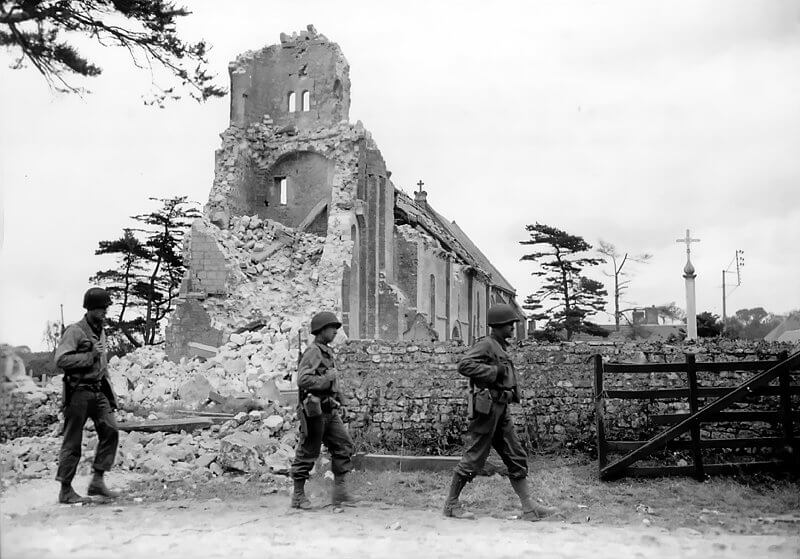
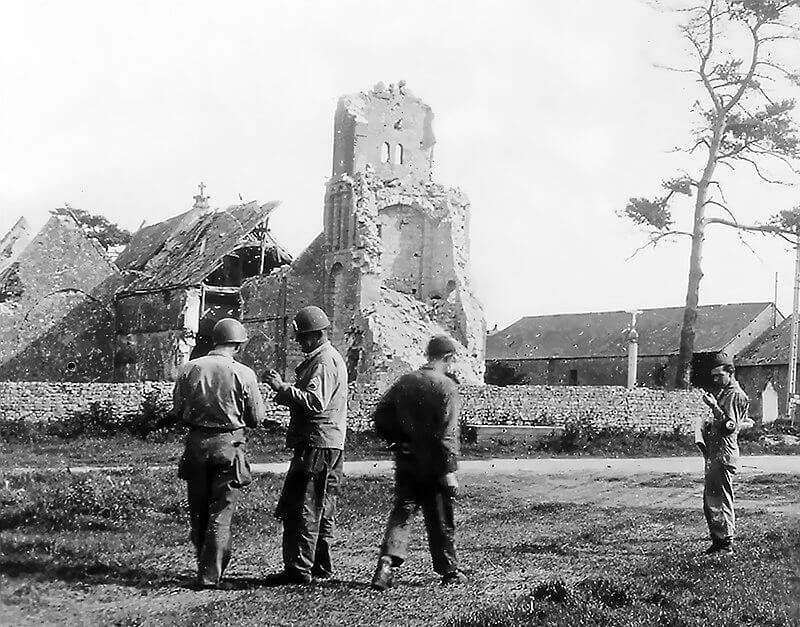
The church becomes a target during the battle. Its prominent stone steeple is used as a landmark by Allied forces and sustains significant damage. Post-war repairs are still visible in the upper masonry, where shellfire hit the structure.
Defensive measures around Widerstandsnest 63 focus on delaying enemy movement and denying access to the Colleville plateau. The main street of Colleville-sur-Mer is blocked by a roadblock constructed from two concrete tetrahedrons. These are secured to heavy concrete bases to prevent removal. The obstacle is designed to stop or delay wheeled and tracked vehicles moving inland from the beach. Positioned near the centre of the town, it forms part of the wider defensive network controlling access to key inland routes. The roadblock forces any advancing force to slow or divert, exposing them to defensive fire from nearby positions.
To prevent flanking by infantry, the surrounding fields and paths are likely protected with barbed wire entanglements. These are laid out in concertina coils and double-apron fences, forcing attackers to bunch up in exposed lanes. Zig-zag trenches around the command bunker provide covered movement and local firing positions. They are linked to the rear emergency exit and continue up the slope toward the village edge, forming a rough perimeter.
Although Widerstandsnest 63 lies behind the main minefields, it is shielded by them. The slopes below the draw are saturated with S-mines, Schützenmine 42s, and anti-tank charges placed by the defenders of Widerstandsnest 61 and Widerstandsnest 62. The E-3 draw itself contains an anti-tank ditch and is overlooked by multiple bunkers. Any force attempting to reach Colleville must first break through this layered obstacle system.
The garrison of Widerstandsnest 63 uses nearby buildings, hedgerows, and fieldworks to establish fallback and ambush positions. Infantry posted near the rear exit of the bunker cover the slope with rifles and automatic weapons. From these positions, they can hold off small probes or support a coordinated counterattack.
Though Widerstandsnest 63 lacks heavy guns, its role is essential. It ties the entire Colleville defensive cluster together, coordinating artillery strikes, managing frontline reports, and requesting reinforcements. The command post functions as a protected nerve centre, working in tandem with observation posts, communication lines, and field defences. Together, these systems ensure that Widerstandsnest 63 remains effective in battle, even while physically removed from the frontline bunkers.
| Multimedia |
| Armament and Weapons Emplacements of Widerstandsnest 63 |
Widerstandsnest 63 is not designed as a frontline combat position. Unlike neighbouring resistance nests such as Widerstandsnest 61 or Widerstandsnest 62, it lacks dedicated gun casemates and possesses no heavy-calibre artillery. Its function is command and coordination, not the direct delivery of firepower. Nevertheless, it is not entirely unarmed.
To protect the approach through the Colleville draw (E-3), the defenders emplace an anti-tank gun roughly halfway between the village and the beach. This weapon, likely a 5.0-centimetre PaK 38, covers the valley road leading inland from Fox Green sector. Its forward location suggests it falls under the control or oversight of Widerstandsnest 63, even if physically closer to Widerstandsnest 62. During the battle, this gun is credited with destroying at least one Sherman tank attempting to ascend the draw. It plays a critical role in denying armoured breakthrough via Exit F-1.
Within Widerstandsnest 63 itself, no fixed heavy weapons are installed. The bunker complex contains no reinforced gun embrasures or armoured firing ports. Instead, the garrison relies on infantry weapons for local defence. These include standard German small arms: 7.92-millimetre Karabiner 98k rifles, MP 40 submachine guns, and at least a few MG 34 or MG 42 machine guns.
These machine guns are mounted in field positions. Some are likely positioned in trench works surrounding the bunker, while others may be placed in nearby buildings or windows overlooking approach routes. No evidence indicates the presence of concrete machine gun pillboxes, Tobruks, or permanent mortar positions within Widerstandsnest 63 itself.
Mortar support is instead provided by other strongpoints. Widerstandsnest 62 and Widerstandsnest 64 both field light mortars mounted in Tobruk pits. If Widerstandsnest 63 requires indirect fire, it must call for it through the communications network. Likewise, Widerstandsnest 63 lacks dedicated anti-aircraft defences. Positions such as Widerstandsnest 60 and Widerstandsnest 64 mount 2.0-centimetre Flak guns on the bluff tops, but Widerstandsnest 63 does not share this capability.
There are also no flamethrower installations or explosive traps built into Widerstandsnest 63. Its defensive capacity lies primarily in early warning and coordination rather than repelling frontal assault through firepower. The garrison’s role is to secure the site and delay attackers long enough for reinforcements to arrive or for supporting fire to be called in from other positions.
| Multimedia |

| Garrison and Organisation of Widerstandsnest 63 |
Widerstandsnest 63 functions as the command post for German forces defending the Colleville sector. It is manned by elements of the Kompanie 3, Grenadier-Regiment 726, part of the 716. Infanterie-Division. This company is responsible for manning the series of strongpoints between Sainte-Honorine and St-Laurent, specifically, Widerstandsnest 59 through Widerstandsnest 64. Widerstandsnest 63 is designated as the company headquarters.
Leutnant Edmund Bauch commands Kompanie 3, Grenadier-Regiment 726 and establishes his command post within the three-room concrete bunker at Widerstandsnest 63. From this position, he directs operations across the sector, issuing orders and coordinating with his platoons deployed at each of the frontline Widerstandsnester. These forward positions, particularly Widerstandsnest 62, hold the bulk of the company’s fighting strength. Widerstandsnest 62 alone includes twenty-eight men from Kompanie 3 permanently assigned.
The core garrison at Widerstandsnest 63 is therefore relatively small. It consists mainly of the company command group, signals personnel, and a security detachment. This force likely numbers only a few squads, sufficient to secure the command post and maintain communications. On D-Day, Obergefreiter Bernhard Lehmkuhl serves as the radio operator within the signals room, assisted by Theo Brinkbäumer. Runners and telephone operators complete the communications team.
Leutnant Bauch himself is quartered in a large farmhouse only a few dozen metres from the bunker. Additional personnel are housed in nearby buildings throughout the village. The Colleville schoolhouse is converted into a field kitchen and support facility. Local French civilians, particularly young women, are employed to cook for the German troops. Ammunition and supplies are stored nearby in makeshift depots.
As the German High Command strengthens coastal defences in spring 1944, the role of Widerstandsnest 63 expands. Elements of the 352. Infanterie-Division, an active field unit with greater mobility and firepower, arrive to reinforce the 716. Infanterie-Division in the Omaha sector. By early June, Widerstandsnest 63 is being used jointly by troops of both formations.
Specifically, the bunker becomes a secondary command post for Grenadier-Regiment 915 of the 352. Infanterie-Division. It operates in parallel with its original role as company Command Post for Kompanie 3, Grenadier-Regiment 726. This dual function makes Widerstandsnest 63 a key node in the defence of Colleville. On the morning of June 6th, 1944, Major Werner Lohmann, commander of I Battalion, Grenadier-Regiment 726, is present at Colleville. His presence confirms that Widerstandsnest 63 has become a local command hub for higher-echelon staff.
Thus, by D-Day, Widerstandsnest 63 is garrisoned by a mixed force of command personnel from both the 716. Infanterie-Division and 352. Infanterie-Division. The immediate defensive strength remains limited, but the strategic importance of its function is considerable. The men stationed here operate the telephone and radio links, direct artillery support, relay reports from observers, and coordinate reinforcements.
Though not a frontline fighting position, Widerstandsnest 63 forms the leadership and communications backbone for the Colleville sector. Its garrison does not hold the beach, but it ensures that those who do are resupplied, supported, and under control. Without it, the German defence would lose cohesion and command, especially under sustained assault.
| Multimedia |
| Widerstandsnest 62’s Role in the Omaha Beach Defence Strategy |
Within the broader Atlantic Wall at Omaha Beach, Widerstandsnest 63 performs a critical coordination and command role. It lacks heavy weaponry but serves as the nerve centre for the German defensive network covering the Colleville sector. Its purpose is not to engage in direct combat, but to ensure that the strongpoints forward of it act in unison.
Widerstandsnest 63 is positioned on rising ground behind the coastal bluff, almost centrally behind the Easy Red sector. From this elevation, German commanders gain a clear inland view. Observation of the sea and shoreline is achieved via the nearby church tower, which serves as an observation post. The church’s steeple offers panoramic visibility across the Colleville draw and the beaches below. From a trench near the bunker’s emergency exit, one can see the rooftops of Widerstandsnest 62 and a glimpse of the ocean, though fields of fire from the bunker itself are limited.
The true strength of Widerstandsnest 63 lies in its communications capabilities. Through field telephones and an optical signalling system, the command post links the beach strongpoints, Widerstandsnest 61, Widerstandsnest 62, Widerstandsnest 60, and Widerstandsnest 64, to each other and to artillery units inland. Observers at Widerstandsnest 62, for example, can relay target sightings via an infrared light signal to the church steeple. From there, the information is passed to the bunker at Widerstandsnest 63 and transmitted by radio to artillery batteries several kilometres behind the line.
This system allows for precise and timely fire missions. Widerstandsnest 63 becomes the intermediary, receiving updates, transmitting coordinates, and issuing orders. It also manages communication between the strongpoints under its control. Since Widerstandsnest 59 through Widerstandsnest 64 all fall under the command of Leutnant Edmund Bauch and his Kompanie 3, Grenadier-Regiment 726, any tactical adjustments or reinforcements pass through Widerstandsnest 63.
Strategically, Widerstandsnest 63 commands the eastern portion of the Omaha sector. It is responsible for the Colleville draw (E-3) and adjacent beach exits. It controls the operation of key positions: Widerstandsnest 61 with its 8.8-centimetre gun and mortars, Widerstandsnest 62 with its artillery, machine guns, and anti-tank guns, Widerstandsnest 60 to the east with flak and machine-gun nests, and Widerstandsnest 64 to the west with additional anti-tank coverage.
The coordination of these positions is Widerstandsnest 63’s main task. Its staff ensures that the fields of fire between the nests overlap. Minefields, wire obstacles, and the anti-tank ditch in the draw are all brought under controlled fire. Mortar and artillery support is arranged so no gap exists in the killing zones. Infantry trying to cross from one strongpoint’s coverage to another are still within range of enfilading fire.
In the event of a breach, Widerstandsnest 63 holds the authority to redirect reserves. It communicates with higher command and local battalions, issuing orders to move troops to vulnerable points. On D-Day, this function becomes urgent. As U.S. forces penetrate the beach defences, the local reserve from Grenadier-Regiment 915 (352. Infanterie-Division) is ordered forward from Colleville. This counterattack, directed from Widerstandsnest 63, represents the command post’s role in managing crisis response.
Widerstandsnest 63 also becomes a fallback point. As frontline nests are overrun, German soldiers retreat inland. Many regroup at the bunker complex in Colleville. The site’s layout, with trench connections, emergency exits, and surrounding buildings, makes it a natural rallying point. The command group continues to issue orders and maintain what structure it can in the face of the Allied assault.
In the grand scheme of the Atlantic Wall, Widerstandsnest 63 is indispensable. It does not project force through firepower, but through control. Without it, the German defences at Colleville would become a series of isolated nests, each acting independently. With Widerstandsnest 63 in place, they fight as a single, unified defensive network, fields of fire aligned, reserves deployed as needed, and artillery brought down with coordination and purpose. Its role is quiet but essential, anchoring the eastern half of Omaha Beach and ensuring the German resistance remains organised and deadly.
| Sources |