

| Widerstandsnest 61 |
 |
| Garrison |
| 30–40 men |
| Unit |
| 3. Kompanie, Grenadier-Regiment 726, 716. Infanterie-Division (bodenständig) |
| Armament |
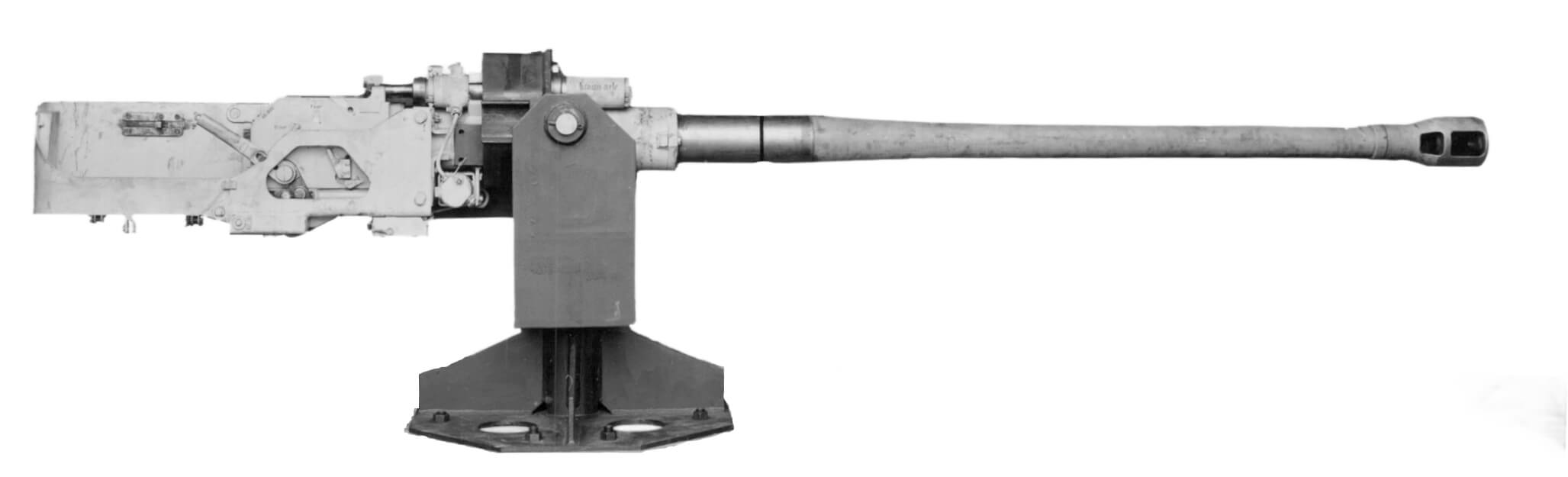
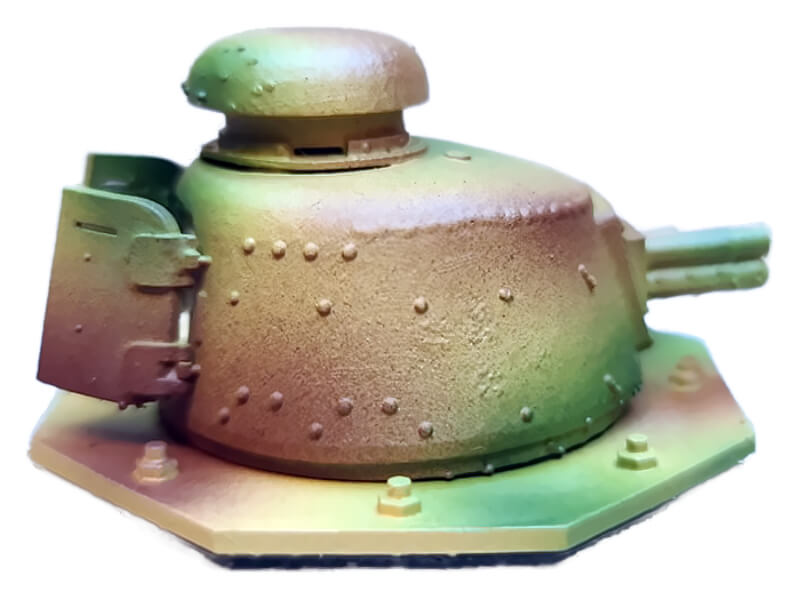
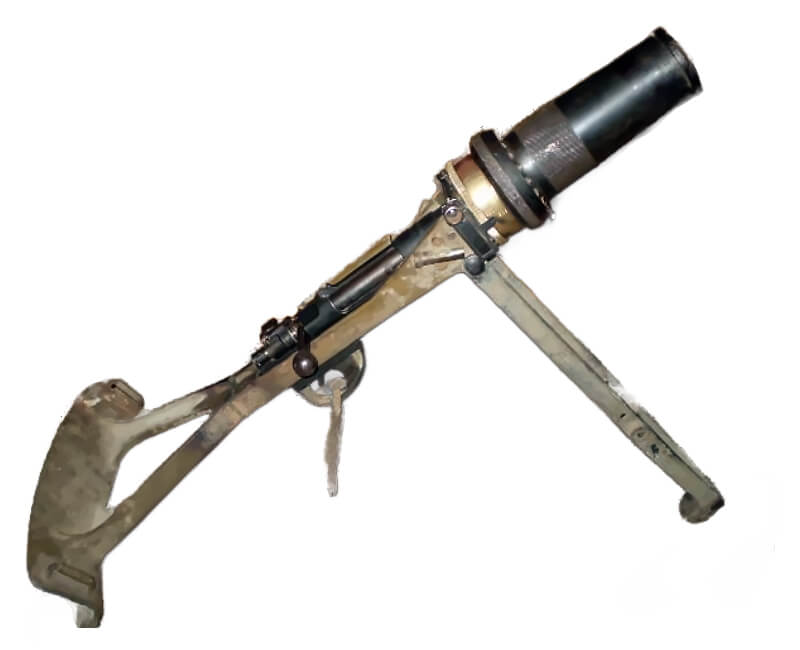
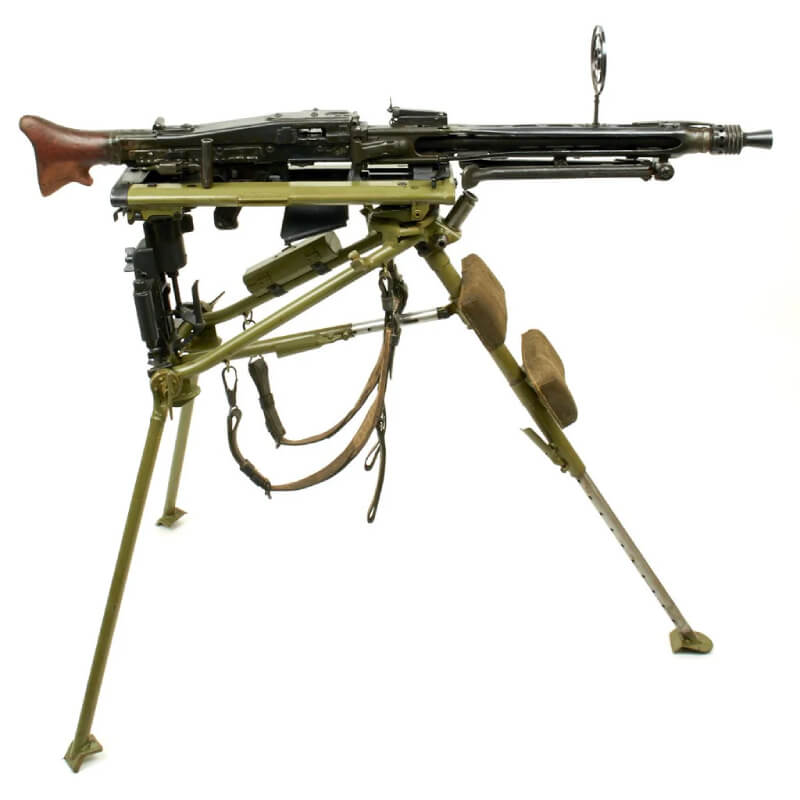
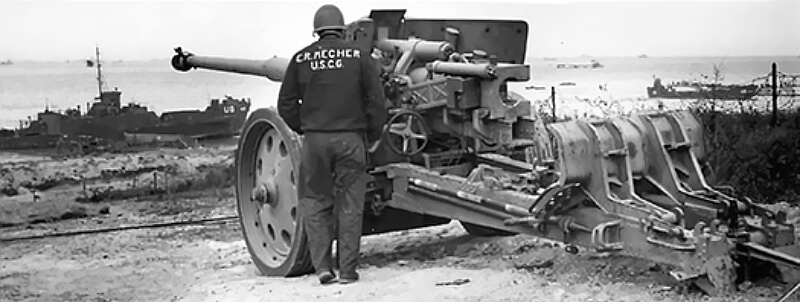
| * 1 x 8.8-centimetre Pak 43/41 * 1 x 5-centimetre Granatwerfer 201(b) * 1 x 5-centimetre KwK L/60 Pak * 1 x Panzerturret R35 3.7-centimetre KwK 144(f) with coaxial MG.311(f) * 1 x Abwehrflammenwerfer 42 * Maschinengewehr 34 * Maschinengewehr 42 |
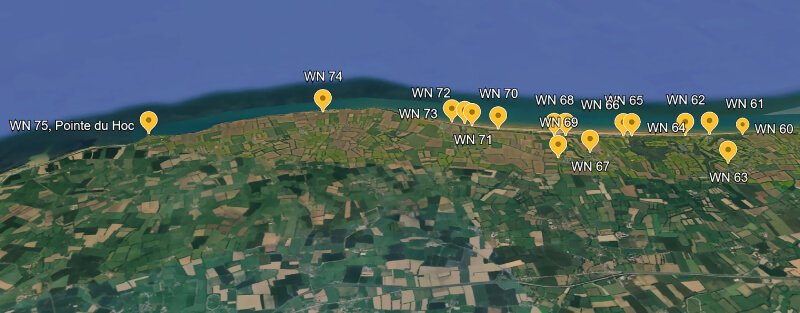
Widerstandsnest 61 is a German defensive strongpoint constructed into the coastal bluffs at the Colleville-sur-Mer draw. This draw, code-named Easy-3, lies at the eastern end of Fox Green sector on Omaha Beach. The site spans approximately 300 by 300 metres and sits 50 to 100 metres inland from the high-tide line. It occupies a low knoll that overlooks a rocky beach flat.
| Construction and Layout of Widerstandsnest 61 |
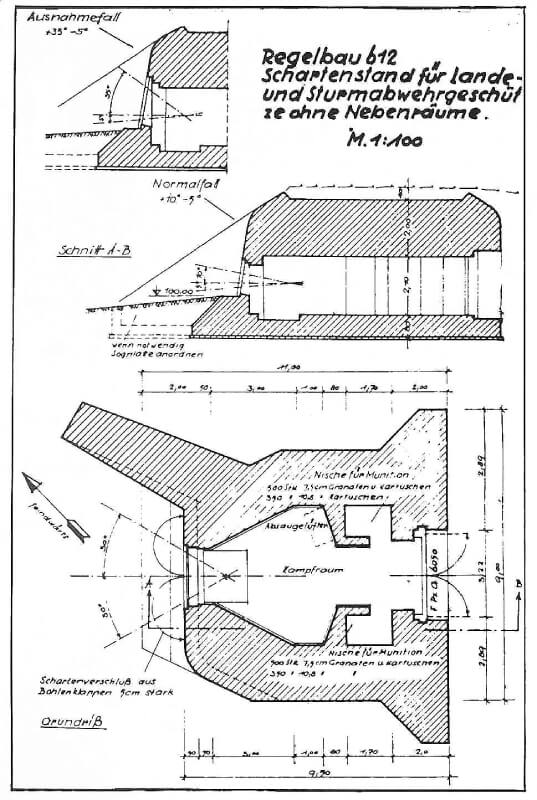
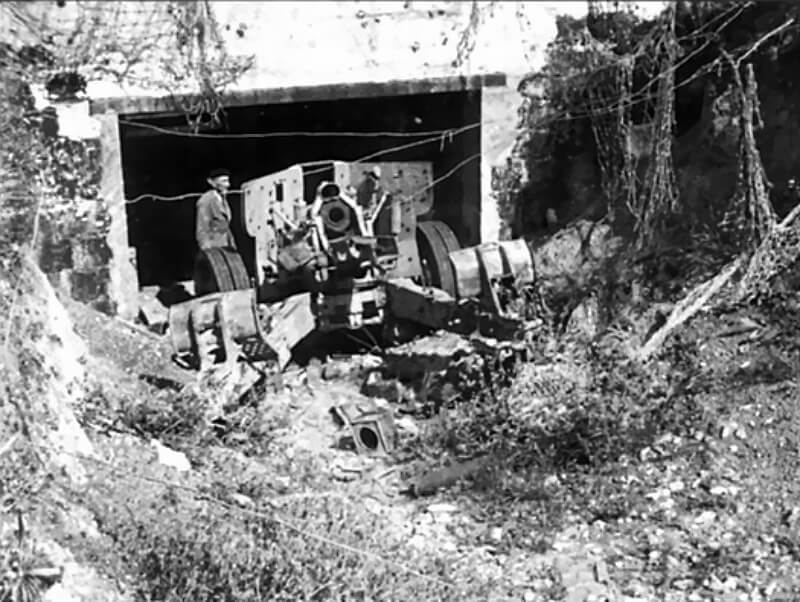
The defences incorporate both permanent and field-constructed elements. Extensive use is made of reinforced concrete, combining ferroconcrete and steel rebar. The focal point is a Regelbau R677 casemate. This heavy bunker houses an 88-millimetre anti-tank gun and is completed by April 25th, 1944. Its thick steel-reinforced walls and narrow frontal embrasure shield the crew from naval bombardment.
The embrasure also permits a broad arc of fire along the shoreline. Located ten meters above sea level, the position faced west and, together with its counterpart in Widerstandsnest 72, dominated the entire beach. The 88-millimetre Pak 43/41 L/71, also known as the “barn door,” had a crew of five men.
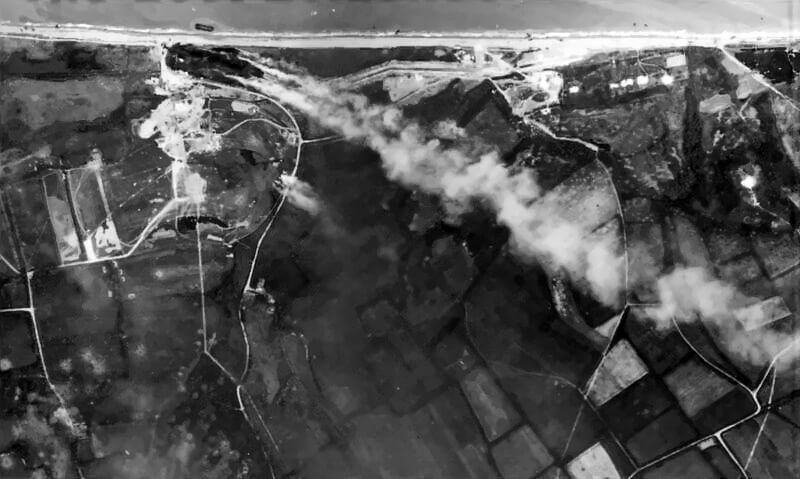
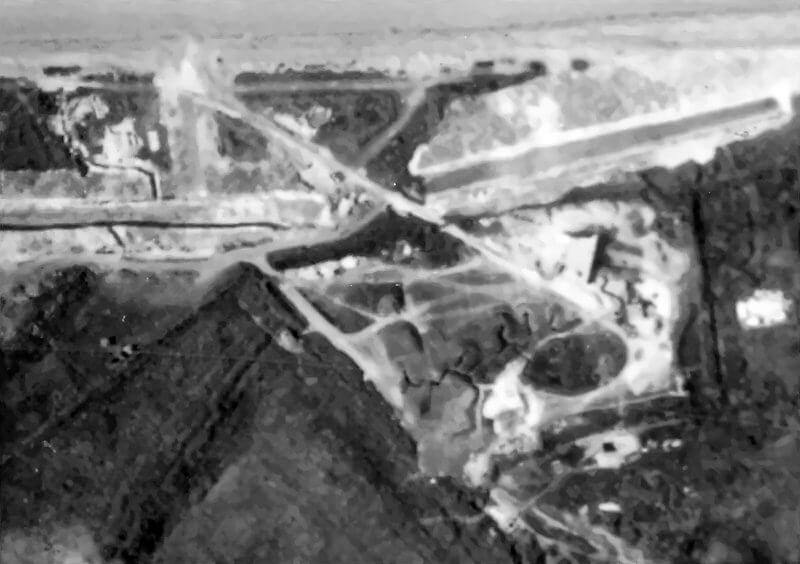
To support construction, narrow-gauge railway tracks are laid from the beach to the bunker site. These tracks transport cement and other materials. Aerial reconnaissance before D-Day shows both the railway and a long anti-tank ditch running in front of the casemate. This ditch stretches across the position’s seaward face.
Trenches and open firing pits interconnect the strongpoint’s key elements. These trenches follow a zigzag pattern to minimise blast effects and increase defensive depth. Many of them are revetted with sandbags or timber and contain niche recesses for ammunition and shelter. Overhead cover is partial but offers some protection against shrapnel and observation.
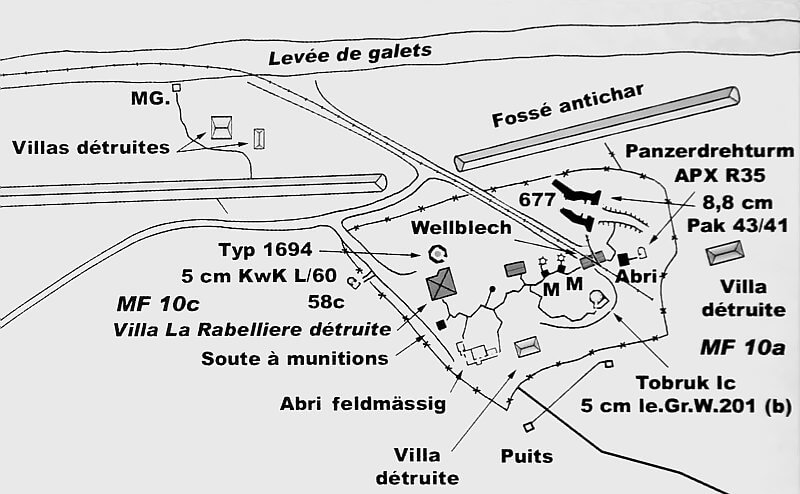
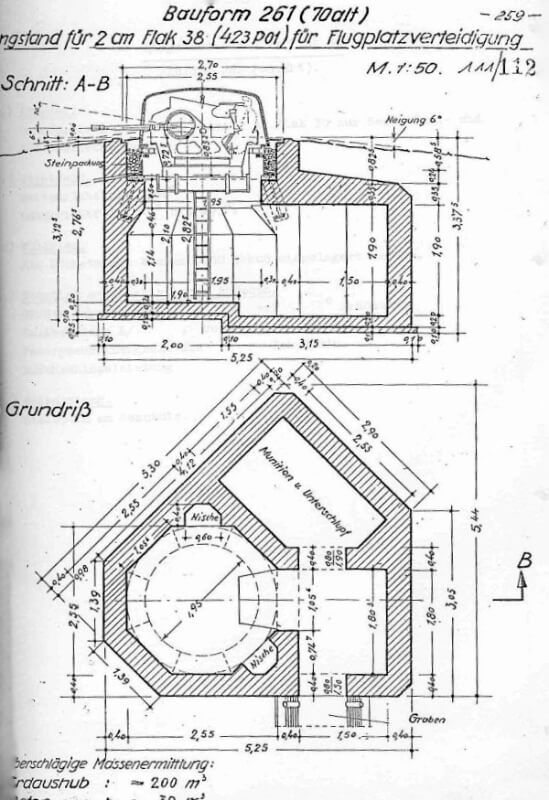
In addition to the 88-millimetre casemate, Widerstandsnest 61 contains several smaller fortified positions. Among them is a 5-centimetre KwK L/60 anti-tank gun. This weapon is installed in a Ringstand Nr. 1694, a circular concrete emplacement.
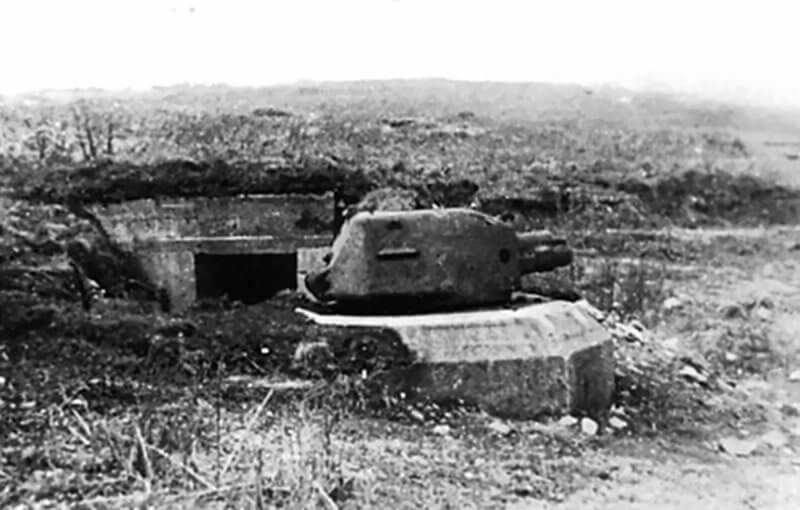
At least three concrete Tobruk pits are built. One holds a tank turret from a captured Renault R 35 tank, mounted on a Festungs-Pionier-Stab 11 Tobruk at Widerstandsnest 61. Set into the Tobruk ringstand, it provides armoured all-round fire in a compact position. This type of installation reuses French equipment for static defence.
A second serves as a mortar pit. This Tobruk designed for the Belgian 5-centimetre Granatwerfer 201(b) stands beside the large casemate in Widerstandsnest 61. Its construction roughly matches the Ic125 or Vf221/223 type. The position’s location next to the casemate suggests it supported the main gun with indirect fire against infantry targets.
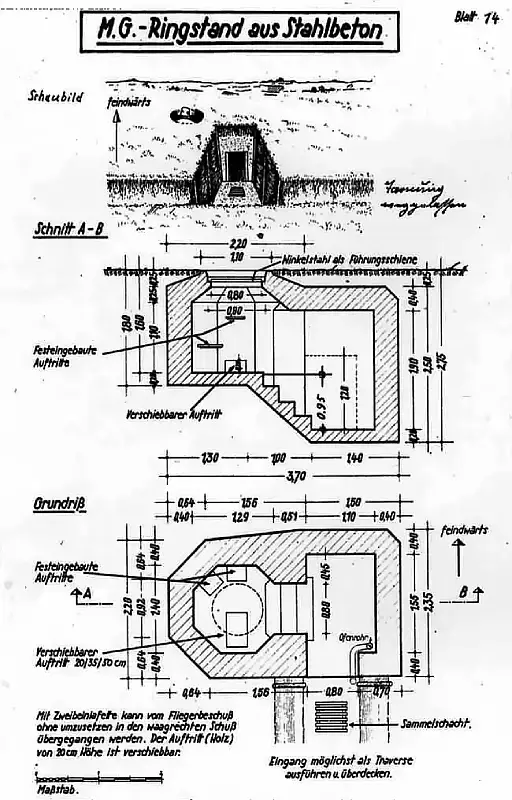
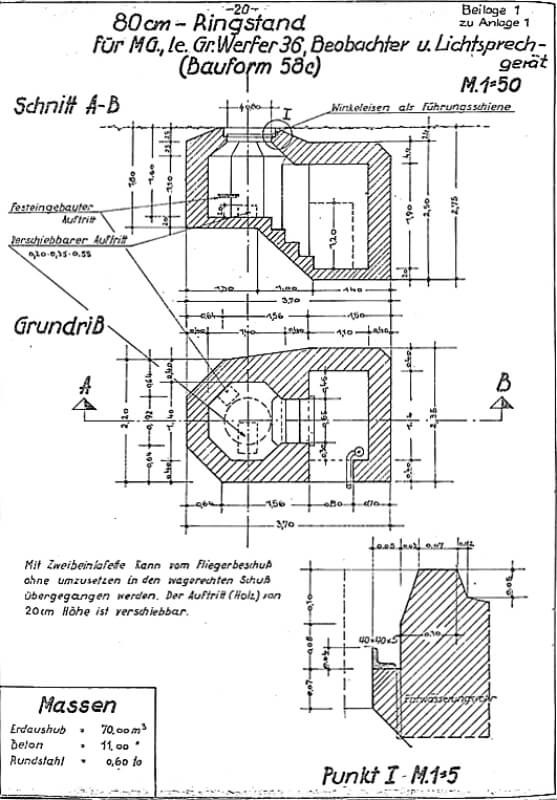
The third is an infantry position, 58c Tobruk model with a ring mount for an MG 34 was located on the western flank of the resistance nest. Today, the Tobruk is located on the grounds of a hotel complex, with a café terrace at its center.
Other shelters provide protection and accommodation for the garrison. A shelter covered with corrugated iron sheeting and buried under soil, likely served as sleeping quarters for the German garrison. It is partially buried and screened by vegetation. This type of improvised structure is known as an abri feldmäßig. It is designed to be concealed from air reconnaissance. The shelter provided basic protection from weather and shellfire. Though not a reinforced bunker, it offered rest space close to the fighting positions. Its location allowed rapid access to weapons and observation posts when needed.
In the southwest corner of Widerstandsnest 61 stands a large field-style shelter. It originally includes restrooms and ammunition storage rooms. A power generator is installed beside the structure. This shelter remains partially preserved today. After the war, it is remodelled with skylights and adapted for private use.
A second shelter lies further east. This field-constructed structure is simpler in design. Both shelters are built with earth-covered walls and low profiles to avoid detection.
In addition to these buildings, several small ammunition bunkers are scattered across the site. Two open machine-gun positions are also present, set to cover key approach routes and reinforce the wider defence line. These emplacements complete the layout of the strongpoint, combining fortified firepower with field-defensive construction.
The strongpoint is integrated carefully into the natural terrain. Earthen embankments and the bluff face reinforce the bunkers and trench lines. Existing seaside villas have been demolished to clear fields of fire and widen the arcs of observation.
In total, Widerstandsnest 61 forms a camouflaged, layered defensive position. Its interconnected bunkers, trenches, and weapon pits command the approach to Fox Green beach. Every feature is designed to delay and disrupt an amphibious assault from the sea.
| Multimedia |


| Defensive Systems and Obstacles of Widerstandsnest 61 |
Widerstandsnest 61 forms part of the Atlantic Wall’s layered defences. Its purpose is to delay and disrupt any Allied assault. The strongpoint is surrounded by barbed wire entanglements and minefields. These are designed to wound or kill attackers and funnel infantry into pre-sighted kill-zones.
Records show two designated minefield sectors around the position, labelled MF-10a and MF-10b/10c. These contain both anti-personnel and anti-tank mines. The mines are laid in the dunes leading up to the main defences.
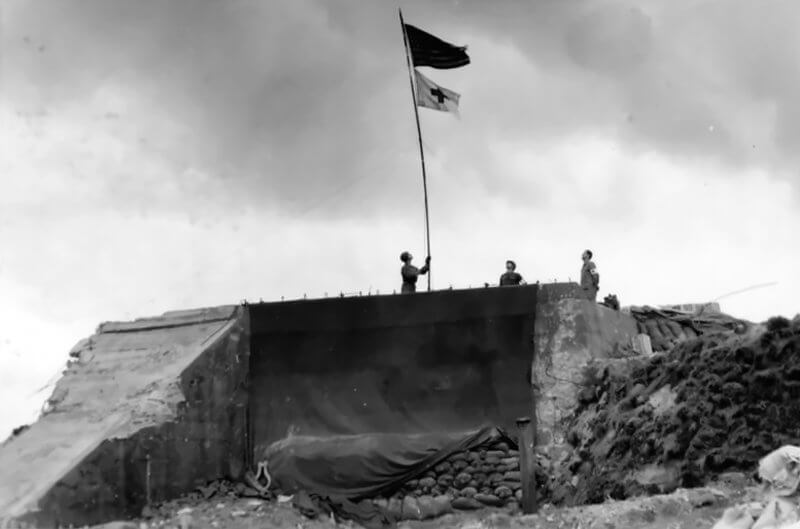
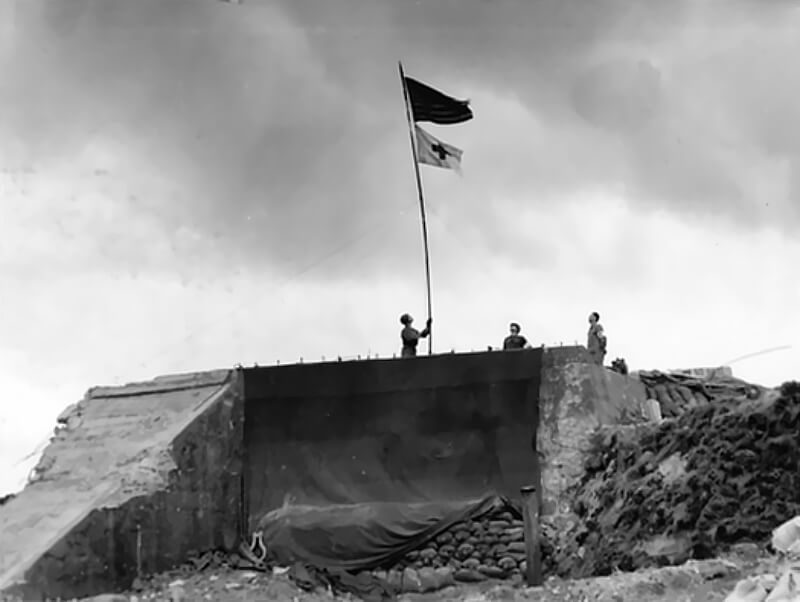
Directly in front of Widerstandsnest 61, the Germans dig a substantial anti-tank ditch across the Easy-3 draw. This trench is roughly 500 metres long and between four and five metres wide. It prevents tanks from advancing inland from the beach. German guns in Widerstandsnest 61 cover the trench with direct fire. After D-Day, the Allies convert this trench into a field aid station due to its depth and cover.
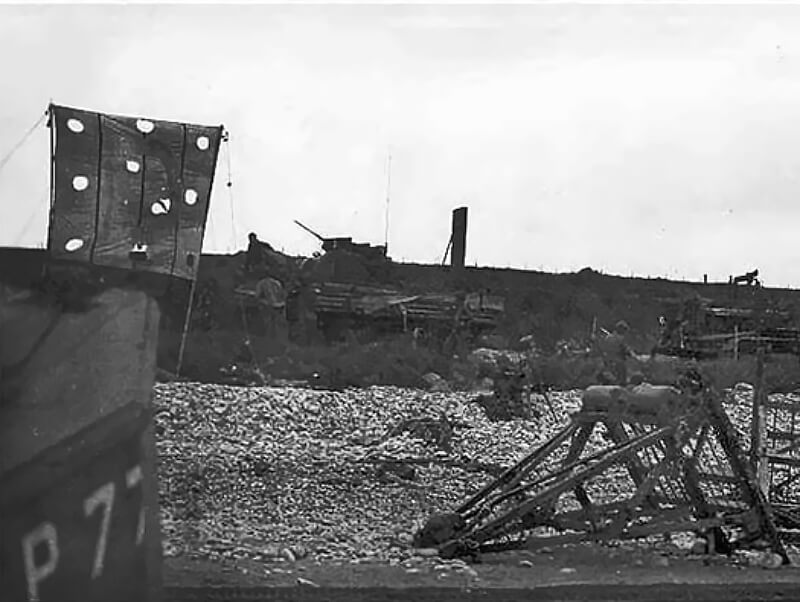
Beach obstacles below Widerstandsnest 61 add another layer of defence. Following Field Marshal Rommel’s orders, German engineers plant several lines of anti-landing obstacles in the tidal zone. These include mined stakes known as Rommel’s asparagus, Czech hedgehogs, timber ramps, and other anti-boat devices. While such obstacles are common across Omaha Beach, Widerstandsnest 61 is responsible for defending its own sector. Its machine guns and snipers can target Allied engineers clearing paths through the obstacles.
The trench system within Widerstandsnest 61 supports the defensive layout. Trenches are dug in a zigzag pattern to prevent enfilade fire. These link the 88-millimetre gun casemate, Tobruk pits, and infantry positions. Defenders can move under cover to reinforce threatened areas or launch counterattacks with grenades and close-quarter weapons.
Communication plays a vital role in the defence of Widerstandsnest 61. The position is likely connected to the wider German field telephone network. A landline would have linked it to nearby resistance nests or command bunkers inland. For example, Widerstandsnest 62 has telephone lines and an optical signalling device to Widerstandsnest 63. It is probable that Widerstandsnest 61 has a similar setup for reporting enemy activity or requesting artillery support.
Observation from Widerstandsnest 61 is limited due to its low elevation. The casemate stands only ten metres above sea level. Still, observers can watch the beach directly in front and slightly to the west. For more distant surveillance, the garrison depends on higher ground, such as Widerstandsnest 60 to the east, or on designated artillery observers further inland. A periscope or lookout position is likely integrated into the main bunker or trench, allowing for target acquisition and fire direction.
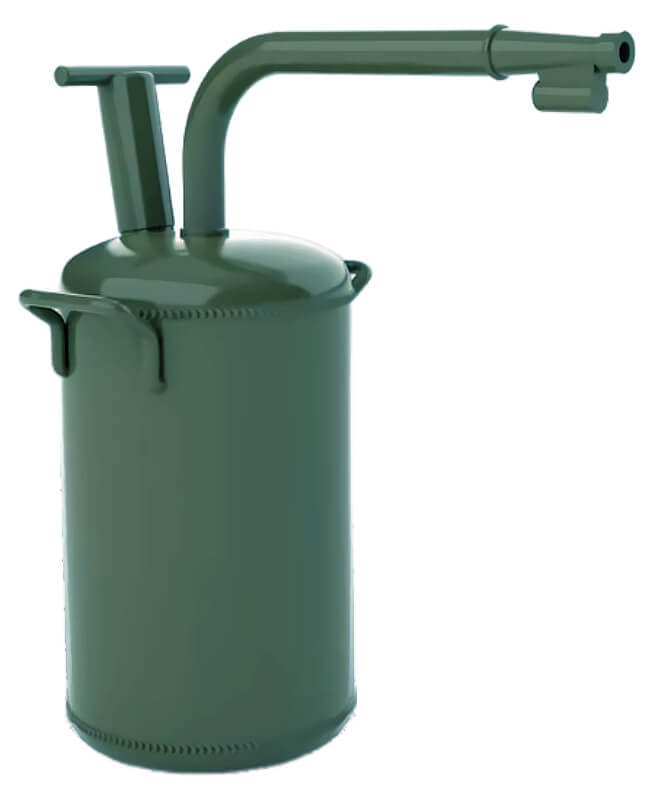
In close defence, Widerstandsnest 61 includes a concealed flamethrower trap. An Abwehrflammenwerfer 42, a static defensive flamethrower, is installed to cover wire obstacles or dead ground. This device can be triggered instantly to spray flames across approaching attackers.
Combined, the defensive elements of Widerstandsnest 61, including mines, wire, trenches, obstacles, and overlapping fire, make it a formidable position. Assaulting this strongpoint directly would require heavy losses and determined effort.
| Multimedia |
| Armament and Firepower at Widerstandsnest 61 |
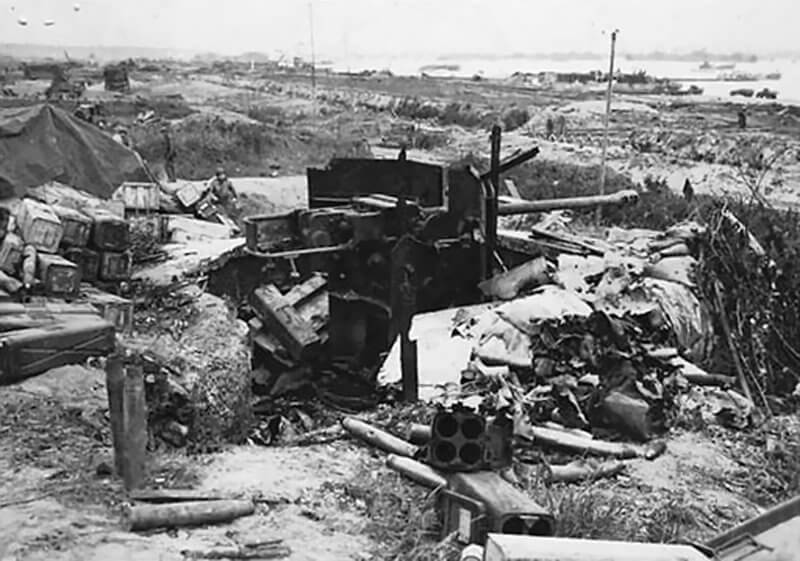
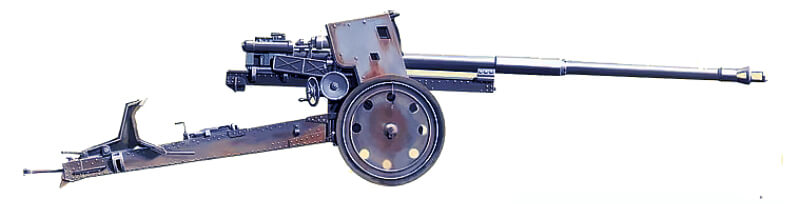
Widerstandsnest 61, though modest in manpower, possesses a powerful and diverse arsenal by mid-1944. Its primary weapon is a German 8.8-centimetre PaK 43/41 anti-tank gun. This high-velocity 88-millimetre cannon is renowned for its armour penetration and accuracy. It is installed within an R677 concrete casemate facing west along Omaha Beach.
The casemate has a thick frontal shield and an open rear. This design allows the gun to fire enfilade along the shoreline rather than out to sea. The field of fire spans across Fox Green and Easy Red sectors and even further west. Positioned on the eastern flank of Omaha, this gun can engage targets all along the beach. It is operated by a five-man crew. Some referred to it as the “concrete King Tiger” due to its destructive capability and heavy protection.
Only one other 88-millimetre gun of this type is installed at Omaha, at Widerstandsnest 72 on the western end. Together, these two form overlapping zones of fire that dominate the beachhead.
Supporting the main gun is a 5.0-centimetre anti-tank gun. This is identified as a KwK L/60, originally a tank-mounted cannon from a Panzer III or similar. The Germans mount it in a concrete open emplacement, designated Ringstand Nr. 1694. It covers sectors not visible to the 88-millimetre casemate and targets closer-range objectives along the Colleville draw and Fox Green sector. Despite its smaller calibre, the 50-millimetre gun proves deadly during the landings, reportedly destroying several Allied tanks on D-Day.
An unusual element at WN61 is a tank turret emplacement. A captured French Renault R35 turret is mounted on a Tobruk-type base. This APX-R turret houses a 3.7-centimetre SA18 cannon (designated 3.7 cm KwK 144(f) by the Germans) with a coaxial MG 311(f) machine gun. The turret provides 360-degree coverage and protects the inland approach. It is positioned to guard against attacks from Widerstandsnest 60’s direction or an inland advance.
For indirect fire, Widerstandsnest 61 fields a light mortar. The weapon is a captured Belgian 5.0-centimetre Model 1935 mortar, designated 5 cm Granatwerfer 201(b). It is installed in a dedicated Tobruk emplacement, likely based on the Vf 221 or Vf 223 pattern. Positioned near the 88-millimetre casemate, the mortar enables high-arc fire into dead ground or behind beach gradients where flat-trajectory weapons cannot reach.
The strongpoint also includes several machine-gun positions. At least one MG 34 is mounted in a concrete Type 58c Tobruk on the western flank. Two more MG 34’s are likely placed in open fighting pits behind earthen or sandbag parapets. These provide grazing fire across the beachfront and surf zone of Fox Green. The garrison also carries personal weapons, including rifles, pistols, and at least one or two light machine guns such as the MG 34 or MG 42, deployed within the trench system for close-range defence.
A concealed flamethrower adds to the perimeter’s protection. The Abwehrflammenwerfer 42 consists of a buried nozzle and fuel tank. Activated remotely, it ejects a short-range stream of flaming fuel across likely approach routes. This serves to break up infantry assaults or ignite wire entanglements.
Widerstandsnest 61’s firepower covers a wide spectrum. From long-range armour-piercing shells to short-range incendiary traps, it is built to repel any assault. Its mixture of heavy and light weapons, including an 88-millimetre gun, 50-millimetre cannon, tank turret, mortar, flamethrowers, and machine guns, reflects the non-standard, yet highly effective armament layout common in Atlantic Wall positions.
| Multimedia |

| Garrison and Personnel of Widerstandsnest 61 |
Widerstandsnest 61 is manned by troops from the German Army’s 716. Infanterie-Division, supported in part by the 352. Infantrie-Division. Specifically, the Kompanie 3 of Grenadier-Regiment 726 is tasked with defending both Widerstandsnest 61 and nearby Widerstandsnest 62, across the Easy-3 draw.
In early June 1944, the Widerstandsnest 61 garrison comprises a platoon-sized detachment. Exact numbers vary. One detailed account lists twelve soldiers under Oberfeldwebel Hermann Schnüll. Other sources suggest more than twenty men may be assigned, possibly including reserves or nearby support elements. During the critical hours of June 6th, 1944, it is likely that only a core of twelve to fifteen combatants is present inside the strongpoint.
Schnüll, an experienced non-commissioned officer, commands the position. He also serves as chief gunner on the 88-millimetre PaK 43/41 in the main casemate. The garrison’s personnel are divided according to weapon systems. A five-man crew operates the 88-millimetre gun, handling loading, aiming, firing, and breech operations. A smaller crew of three or four mans the 50-millimetre anti-tank gun in the ringstand.
The Renault R35 turret likely has a two-man team. One man operates the 37-millimetre gun and coaxial machine gun from inside the cramped turret, while another passes ammunition from below. Machine gun positions are staffed by two-man teams, gunner and assistant. The 50-millimetre mortar requires a two-man crew as well. Additional riflemen act as lookouts, operate the flamethrower switch, or serve as runners within the trench system.
This setup means around ten to fifteen men are actively manning all positions during the engagement. Others serve in support roles, such as communication, first aid, or ammunition supply. A field telephone operator may connect Widerstandsnest 61 to the company command post inland.
The soldiers of Widerstandsnest 61 reflect the broader composition of Omaha Beach’s defenders. Many are young conscripts from the 716. Infanterie-Division, mostly in their teens or early twenties. However, they are bolstered by experienced veterans, some transferred from the Eastern Front. By spring 1944, elements of the 352. Infantrie-Division have also moved into the sector. Though formally a reserve, parts of the division are embedded in coastal strongpoints. Widerstandsnest 62, for instance, includes Artillerie-Regiment 352 crews. It is probable that Widerstandsnest 61 also includes one or two men from the 352. Infantrie-Division assigned to the 88-millimetre gun crew.
Post-invasion intelligence identifies members of the kompanie 5, Grenadier-Regiment 916, 352. Infantrie-Division in the Colleville area. This suggests the Grenadier-Regiment 916 may have reinforced Widerstandsnest 61 or nearby draws. On D-Day, Widerstandsnest 61 falls under tactical control of the 352. Infantrie-Division, led by Generalleutnant Dietrich Kraiss. This division holds responsibility for the coastal sector between Vierville and Colleville.
Orders are clear: the garrison is to hold its ground at all costs. With strong fortifications and a commanding position, the defenders expect to inflict heavy losses. Each soldier knows his sector of fire. Machine gunners sweep the surf and beach. The mortar team targets troop clusters or cover. Anti-tank gunners focus on landing craft and armour.
Schnüll likely positions himself where he can direct fire effectively, either at the 50-millimetre position or moving between the trenches and casemate. Communication within the nest is mostly by voice or runner, as individual emplacements are not linked by phone. A landline may connect Widerstandsnest 61 to company headquarters for orders or artillery support.
Morale is reportedly high. The men have spent months fortifying the position and rehearsing firing drills. They understand their location is crucial. The draw at Colleville offers one of the main exits from the beach. They expect to face the brunt of the Allied assault.
German accounts later describe a determined defence. Widerstandsnest 61’s garrison continues fighting until many are killed or their weapons are destroyed. These events belong to the battle itself, but they demonstrate the garrison’s resolve. In summary, Widerstandsnest 61 is defended by a small but well-organised platoon. Led by an experienced Non-Commsioned Officer, its personnel combine infantry and artillery roles, using their position and firepower to full effect.
| Widerstandsnest 61’s Role in the Omaha Beach Defence Strategy |
Widerstandsnest 61 plays a vital role in the German Atlantic Wall defences at Omaha Beach. It anchors the eastern flank of the American landing zone and controls one of the beach’s most critical natural features, the E-3 draw at Colleville-sur-Mer. German planners recognise that these draws offer the only practical exit routes inland for large forces and vehicles. As such, each is heavily defended.
The E-3 draw is guarded on either side by two strongpoints: Widerstandsnest 61 to the east and Widerstandsnest 62 to the west. These are positioned roughly 500 metres apart on opposite bluffs. Their weapons are sited to create overlapping arcs of fire. Widerstandsnest 61’s 88-millimetre gun fires westward along the beach and into the mouth of the draw. It also provides enfilade fire across Fox Green and Easy Red sectors. In return, Widerstandsnest 62’s 75-millimetre gun and multiple machine guns can fire eastward across Widerstandsnest 61’s front.
This coordination forms a deadly crossfire zone. Assaulting troops moving into the draw or across the beach would come under fire from both directions. The layout of Widerstandsnest 61 and Widerstandsnest 62 reflects standard German doctrine: bunkers are built on either side of each draw to seal beach exits with interlocking fire, supported by anti-tank obstacles.
Within the eight-kilometre Omaha sector, Widerstandsnest 61 holds a unique fire mission. Along with Widerstandsnest 72 on the western end, it possesses one of only two 88-millimetre guns at Omaha. These two weapons effectively “bracket” the beachhead. From opposite ends, they fire nearly the full length of the shoreline, turning the sand into a killing ground.
German orders assign Widerstandsnest 61 a specific task: to seal off Omaha Beach from the east. Its mission is to block any attempt by Allied forces to outflank German positions from that direction. It not only defends the E-3 draw but also delays any advance toward the F-1 draw further east, near Cabourg. Widerstandsnest 60, sited on the heights above Cabourg, is protected from flanking attacks by Widerstandsnest 61’s position below. Any force attempting to bypass Widerstandsnest 60 along the shoreline must first fight through Widerstandsnest 61’s zone of fire.
Additionally, Widerstandsnest 61 covers the seam between Omaha Beach and the British sector at Gold Beach. Its presence ensures that no unguarded corridor exists between Allied landing zones.
Strategically, Widerstandsnest 61 forms part of the Atlantic Wall’s first line of resistance. Its role is to delay and disrupt any Allied landing long enough for German reserves to counterattack. On D-Day, it falls under the operational control of the 352. Infantrie-Division, commanded by Generalleutnant Dietrich Kraiss. The division keeps its reserve battalion, II Battalion, Grenadier-Regiment 915, at Formigny, a few kilometres inland. Widerstandsnest 61’s garrison is expected to hold until these reinforcements arrive.
Widerstandsnest 61 is also tied into the wider fire support network. The position can request pre-registered artillery strikes from the Artillerie-Regiment 352. German observers have already plotted target zones along Omaha Beach, including sectors in front of Widerstandsnest 61, using code names like “Ursula,” “Anna,” and “Frieda.” Observers at Widerstandsnest 61 or Widerstandsnest 62 can direct artillery fire onto these zones by telephone or radio.
The fire plan is coordinated with neighbouring resistance nests. Widerstandsnest 64 and Widerstandsnest 65, to the west, have 50-millimetre guns that also cover Easy Red sector. Widerstandsnest 60, to the east, sits on higher ground and mounts flak and artillery pieces. These weapons can fire westward over Widerstandsnest 61 if attackers attempt to skirt the strongpoint along the beach.
Fields of fire are carefully arranged. Widerstandsnest 61’s machine guns sweep the sand in front of Fox Green. Widerstandsnest 62’s bluff-top guns add crossfire from the west. Mortar fire from both positions blankets the draw and adjacent slopes. No approach route remains uncovered. Every metre of sand and bluff is subject to fire from multiple emplacements.
This arrangement embodies German Atlantic Wall doctrine. Defence in depth, overlapping fields of fire, and fortified chokepoints make Widerstandsnest 61 a textbook example. It functions not as an isolated pillbox but as a key node in a coordinated defensive network. On D-Day, it stands ready to repel a beach assault with infantry fire, anti-tank weapons, and artillery support, anchoring the eastern edge of the Omaha sector.

| Sources |