
| September 18th, 1944 |
| Operation Market Garden |
| Objectives |
- Land at Landing- and Drop Zones at Wolfheze, Oosterbeek, and Ede.
- Capture the road bridge in Arnhem and hold it for a minimum of 48 hours
- Link up with the advancing ground forces of the 30th Corps.
| Operational Area |
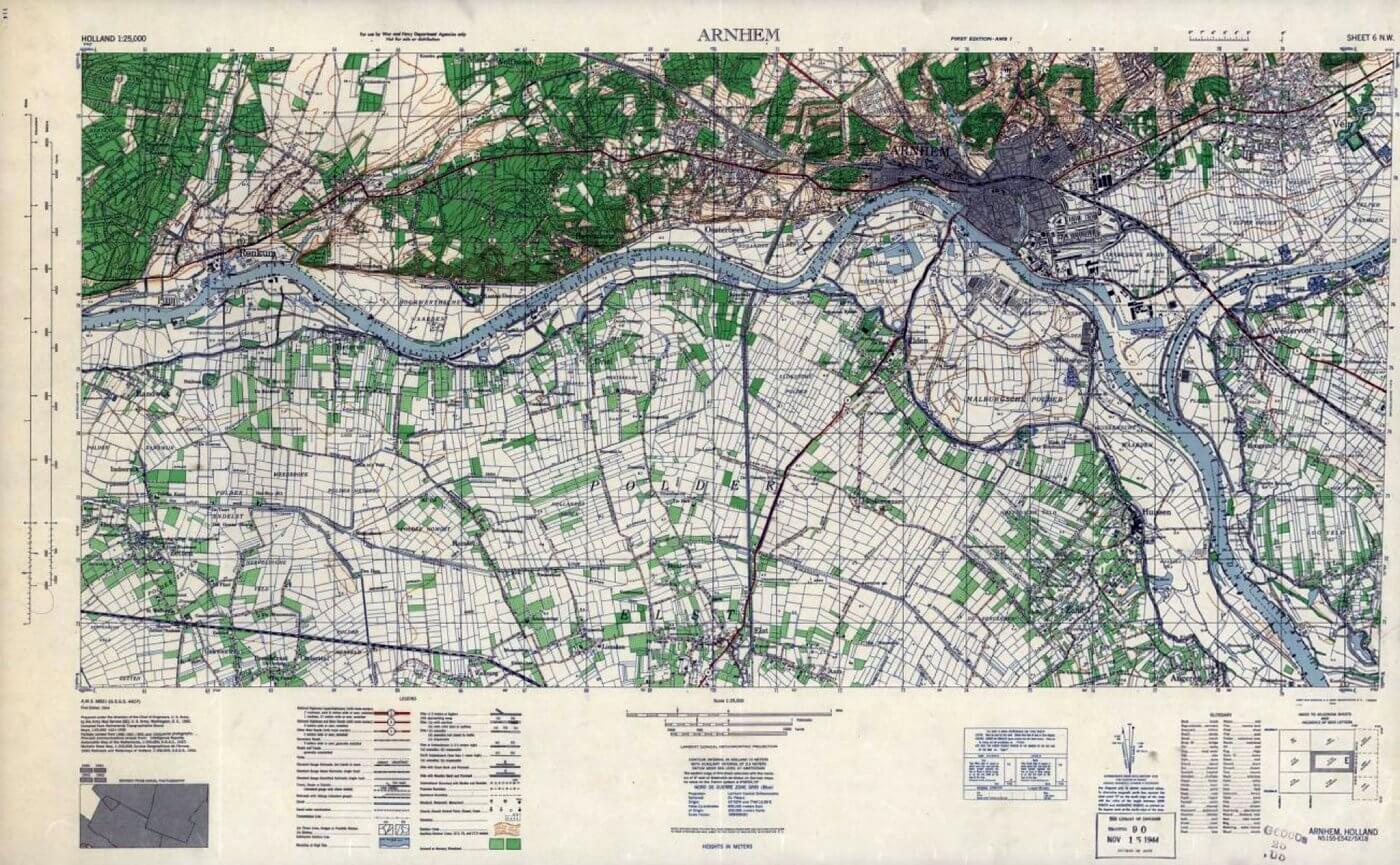
Arnhem Area, The Netherlands
| Allied Forces |
- 1st Airborne Division
- 1st Polish Independent Parachute Brigade
- 52nd, (Lowland) Airlanding Division
| Axis Forces |
- II SS-Panzer-Corps
- 9. SS-Panzerdivision “Hohenstaufen”
- 10. SS-Panzerdivision “Frundsberg”
- Kampfgruppe von Tettau
- Feldkommandantur 642
- SS-Unterführerschule Arnheim
- Bataillon I
- Bataillon II
- Bataillon III
- SS-Polizei Schule
- SS-Ausbildungs und Ersatz Bataillon 4
- Bataillon I
- Bataillon II
- SS-Wach Battalion 3
- Schiffsturm Abteilung 10
- Schiffsturm Abteilung 6/14
- Fliegerhorst Battalion 2
- Fliegerhorst Battalion 3
- Artillerie Regiment 184
- Sicherheit Regiment 42
- Kampfgruppe Knoche
- Sicherheit Regiment 26
- Bataillon I
- Bataillon II
- MG Bataillon 30
- FlaK Abteilung 688
- Bataillon I
- Bataillon II
- Hermann Göering Schule Regiment
- Hermann Göering Schule Regiment
- Bataillon I
- Panzer Abteilung 224
- SS Ersatz Abteilung 4
- Deelen Airfield FlaK Kompanie
- Wach Kompanie
- Reichs AD
- Hermann Göering Schule Regiment
- Sicherheit Regiment 26
- Kampfgruppe Kraft
- SS-Panzer Grenadier Ausbildungs und Ersatz Bataillon 16
- Schwerepanzer Abteilung 506
- Schwerepanzer Kompanie Hummel
- StuG Abteilung 280
- Artillerie Regiment 191
- Bataillon I
- Bataillon II
- Bataillon III
- SS-Werfer Abteilung 102, Hauptsturmfürer Nickmann
- Kampfgruppe Brinkmann
- Kampfgruppe Bruhn
- Kampfgruppe Harder
- Sperrverband Harzer
- MG Bataillon 47
- Marine Kampfgruppe 642
- Kampfgruppe Schörken
- Kampfgruppe Kauer
- SS-Abteilung “Landstrum Nederland”
- Kampfgruppe Knaust
- Ersatz Abteilung Bocholt
- Panzer Kompanie Mielke
- Kampfgruppe Spindler
- FlaK Abteilung Swoboda
- Kampfgruppe von Allworden
- Kampfgruppe Weber
| Preparations for the Second Lift |
The second lift is to deliver the second increment of units to all three Allied airborne divisions. It uses 1,676 parachute transports and glider tugs and 1,205 assorted gliders. The powered aircraft number some 300 fewer than the first lift, but the gliders are almost triple. The lift is therefore larger overall, at 2,501 machines, and the whole reinforcement effort for Operation Market Garden involves more than 2,500 aircraft.
In Great Britain the ground crews of the United States IX Troop Carrier Command and of Nos. 38 and 46 Groups, Royal Air Force, work tirelessly to prepare their aircraft. They achieve a turnaround within twenty-four hours of the first day’s success. Casualties among the transport squadrons over the Low Countries during the first lift were unexpectedly low, and battle damage minimal, which greatly eases the work.
The 1st Airborne Division’s share is 455 aircraft and 296 gliders. The gliders carry infantry of the 1st Airlanding Brigade, with guns, vehicles and supplies for various other units. Among them are the remaining elements of the brigade, notably the two rifle companies of the 2nd Battalion, South Staffordshire Regiment, and the guns of the 2nd (Oban) Airlanding Anti-Tank Battery, Royal Artillery. Fifteen are Hamilcars, three of them carrying trailers pre-loaded with ammunition as a resupply experiment. Twenty-five gliders, probably all Horsas, carry loads that aborted from the first lift. One account puts the number of tugs and gliders at 297, risen overnight from 270 as machines from aborted sorties and emergency landings were added back into the operation. The twenty-four hours since the first lift have in that sense worked to the planners’ advantage, allowing more resources to be mobilised.
Of the thirteen Horsas carrying elements of the 7th King’s Own Scottish Borderers, only the five with the battalion motor transport section, and one carrying a platoon of C Company, were originally slated for this lift. Ten Horsas carry an advance party of the 1st Polish Independent Parachute Brigade, mainly its anti-tank battery. Four more carry men and equipment of two Royal Air Force radar teams. The tugs are again a mixture of Albemarles, Halifaxes and Stirlings of No. 38 Group and Dakotas of No. 46 Group.
The radar men come from Royal Air Force Light Warning Units 6341 and 6080. They are airmen hastily assembled to operate Forward Director Posts for the radar guidance of Allied fighters over the landing zones. With limited military training, they find themselves unexpectedly part of an airborne operation. Their deployment was reinstated only after Wing Commander Brown appealed personally to General Browning. Their ground stations are split into transmitters and receivers, loaded into separate gliders. Once down, they are to coordinate fighter cover over Arnhem, a critical role given the increasing German opposition in the air and on the ground.
The parachute portion, principally Brigadier John Hackett’s 4th Parachute Brigade, is again carried entirely in United States Army Air Forces aircraft. These are 123 C-47’s and three visually identical C-53’s of the 314th and 315th Troop Carrier Groups, at Saltby in Lincolnshire and Spanhoe in Northamptonshire. Saltby launches two serials of thirty-six transports and Spanhoe two of twenty-seven, 126 aircraft in all. They are to carry 2,119 men of the brigade to Drop Zone Y, together with 51 tonnes of essential combat supplies. Thirty-three Stirlings of Nos. 295 and 570 Squadrons, from Harwell in Berkshire, are to make the first routine supply drop for the division. Their target is the as yet unused Landing Zone L, some 800 metres east of Landing Zone S.
Every aircraft appears loaded and ready by the evening of Sunday, September 17th, 1944. The 4th Parachute Squadron, Royal Engineers, sends working parties the ten kilometres or so from its billets at Glaston and Uppingham to Spanhoe at 17:30, to load containers onto the C-47s that will carry them to Drop Zone Y. Besides routine infantry stores, the containers hold engineer supplies and equipment, among them mines, mine detectors and explosives. The squadron commander, Major Æneas Perkins, later recalls the difficulty of deciding what to take, given how indefinite their tasks were.
At Blakehill Farm in Wiltshire, 5 Flight of D Squadron, No. 1 Wing, The Glider Pilot Regiment, spends part of the morning loading Horsas with 6-pounders and Jeeps of the 1st Airlanding Anti-Tank Battery. The flight commander, Captain Alexander Morrison, oversees the work. Each Jeep and gun must be driven or pushed up a ramp to the side door, then manhandled through ninety degrees into the fuselage and secured. It takes about thirty minutes a load. At Down Ampney in Gloucestershire, Private Albert Blockwell and the rest of the motor transport section watch the Dakotas of No. 46 Group take off towing the first lift. At about 14:00 they hear about the landings on the radio, before being set to clearing up the battalion’s tented camp.
The leading element is due over the landing area at 10:00 on Monday, September 18th, 1944, with departure from England set for 07:00. Take-offs must therefore begin soon after dawn, and aircrew and troops are roused at about 05:00. Morrison leaves his billet at Blakehill Farm at 05:00 to find the airfield blanketed in mist and low cloud, as many others are across southern England. First Allied Airborne Army Headquarters postpones take-off until conditions improve. The 4th Parachute Squadron therefore does not leave its billets for Spanhoe until 09:00, and B Squadron of the Glider Pilot Regiment at Manston in Kent begins its final briefing at the same hour. Early meteorological reports suggest the mist will lift, but word comes that take-off is put back to midday.
The skies over England clear sporadically through the morning, while troops and airmen wait impatiently by their aircraft. The mist clears about four hours after dawn, and the postponement is lifted at 11:00, leaving the timings roughly those of the previous day. The lift is thus delayed by four hours. This cannot be passed to the isolated division at Arnhem, which is out of radio contact. On the landing grounds near Wolfheze the troops wait with growing impatience for reinforcements that seem increasingly uncertain. The delay also gives the Germans around the landing and drop zones extra time to prepare.
At Down Ampney the first Dakota of No. 48 Squadron, flown by Squadron Leader Peter Duff-Mitchell, takes off at precisely 11:00. The rest follow at one- or two-minute intervals, and all twenty-six Dakotas and their Horsas of E Squadron, No. 2 Wing, are airborne by 11:36. When Morrison and No. 5 Flight leave Blakehill Farm is unclear. The rest of D Squadron, Nos. 8 and 22 Flights under Captain Barry Murdoch and Captain Iain Muir, begins taking off from Keevil at 11:26. The Stirlings of Nos. 190 and 620 Squadrons, towing G Squadron from Fairford, follow four minutes later. At Manston the Albemarles of Nos. 296 and 297 Squadrons, towing B Squadron’s gliders, begin at 12:15. Their start point in Kent is 160 kilometres or more closer to Holland than the other glider bases. All three units are normally at Brize Norton in Oxfordshire and have moved to Manston for the operation.
The parachute transports of the 52nd Troop Carrier Wing keep a similar timetable. The C-47’s of the 314th Troop Carrier Group carrying 156th Parachute Battalion begin taking off from Saltby at 11:00. Those of the 315th, carrying the parachute echelon of the 4th Parachute Squadron, begin from Spanhoe at 12:10. The squadron’s glider element has already left Keevil at 11:45.
The take-off phase again goes relatively well. One Horsa, probably from A Squadron, crashes on take-off after its tug loses power. Seven more Horsas and a single Hamilcar abort over England. The Hamilcar, from C Squadron at Tarrant Rushton, is carrying a 17-pounder of the 2nd Airlanding Anti-Tank Battery. It lands safely at Chilbolton in Hampshire after its Halifax tug develops engine trouble. Staff Sergeant Proctor’s Horsa from B Squadron lands safely at Ashford in Kent, shortly after leaving nearby Manston.
Another Horsa, from D Squadron, flown by a Staff Sergeant Stocker and Sergeant Allen, force-lands at the American fighter base at Martlesham Heath in Suffolk after the towline parts. By some accounts their Stirling tug of No. 299 Squadron, flown by a Flight Lieutenant Berridge or Barridge, also lands there, reattaches the towline and joins a Dakota stream. The squadron war diary instead has Stocker and Allen moved over to the third lift. The other aborts also appear to land safely, and all are reportedly carried over to the third lift.
The parachute transports get away without mishap, but for one aircraft leading a three-aircraft vic of the 314th Troop Carrier Group’s 50th Squadron, carrying men of 156th Parachute Battalion. A malfunction prematurely deploys a parachute attached to a container stowed in the cargo cells beneath the fuselage. The drag seriously affects the aircraft’s trim, and releasing the container leaves the canopy entangled with the tail wheel. The pilot lands at a convenient airfield in East Anglia with the container streaming behind like a drogue and has the canopy cut free. He fails to catch his original serial and resumes the flight to Holland with the glider stream.
| Defending the landing- and Drop Zones |
Back at the landing area, the rest of the 1st Airborne Division is either following the parachute battalions or holding ground for the second lift.
The 1st Airborne Reconnaissance Squadron leads. At 06:30 Allsop, commanding in Gough’s absence, is told to clear the Utrechtseweg towards Heelsum. He is then to follow the road east through Oosterbeek and scout a secure route for Divisional Headquarters to move into Arnhem behind the brigade. Hay’s understrength C Troop is excepted. After its losses against Bataillon Krafft the previous day, it is sent to help the 2nd South Staffords hold Landing Zone S around Reijers-Camp Farm.
The move east begins at 07:00 with Park’s D Troop leading. It proceeds without incident for the hour it takes to pass almost through Oosterbeek. D Troop then comes under machine-gun fire at the junction of the Utrechtseweg and Grindweg, some 640 metres short of the underpass beneath the railway spur to Oosterbeek Laag. There are no casualties, apart from a German motorcycle despatch rider who drives into the line of fire. The dismounted investigation and the clashes that follow north of the road go on until the afternoon. They draw in A Troop, cost the squadron two seriously wounded, and repeatedly fail to find a clear passage east. As the squadron adjutant, Captain Geoffrey Costeloe, puts it, everywhere they went they bumped the enemy. At 16:00 Lieutenant Collier establishes a rear headquarters near the Hotel Hartenstein. The squadron rallies there over the following hours, all present and digging in by 22:30.
While the squadron searches for a route, concerns mount at Divisional Headquarters. Nothing has been heard from the 1st Parachute Brigade, and it grows increasingly clear that the brigade is meeting significant resistance. Urquhart has now been absent for over twelve hours, and German radio broadcasts claim that he has been killed. Mackenzie decides to address the situation. Lathbury is also out of contact, so the appointment falls to Urquhart’s next choice, Brigadier Philip “Pip” Hicks.
Mackenzie sets off by Jeep to inform him at some point between 07:00 and 09:00. Hicks knows nothing of the arrangement. Urquhart settled it off the cuff on the steps of his Horsa, rather than during the administrative phase of planning. Hicks’s brigade is meanwhile tasked with protecting the zones for the second lift, due to begin at 10:00. Mackenzie persuades him to take command. Hicks hands over the 1st Airlanding Brigade to his deputy, Colonel Hilaro Barlow, and moves to Divisional Headquarters at approximately 09:15.
By this time Divisional Headquarters has moved from the abandoned gliders to wooded ground west of Oosterbeek, near the Utrechtseweg and close to the site of the Kussin ambush. The move prompts Iain Murray’s 1 Wing Headquarters to shift from Wolfheze to a position near the Arnhem–Utrecht road. Small-arms and support weapon fire from Arnhem is now a constant backdrop, and casualties flow steadily westward along the road.
Mackenzie also persuades Hicks to authorise reinforcements for the effort to reach the bridge, which he appears to have deduced has run into difficulty. Options are limited. The 1st Airlanding Brigade is the only front-line infantry available, and it is fully committed to defending the landing and drop zones. Despite the risk of weakening the landing area, Hicks’s first act is to send McCardie’s understrength 2nd South Staffords towards Arnhem, from their positions around Landing Zone S north of Wolfheze. The precise time of their departure is unclear, though one account gives 09:30 for their clearing their original positions and moving towards Wolfheze.
Major John Phillp’s intact D Company leads the column. Major John Buchanan’s depleted Support Company follows, then McCardie’s tactical headquarters and the equally depleted B Company under Captain Reginald Foot. Buchanan is short half his Vickers guns and all his mortars and anti-tank guns. B Company lacks its commander, Major Robert Cain, whose Horsa aborted after take-off and landed near Canterbury. It also lacks Lieutenant Roland Sharp’s No. 14 Platoon entire, its glider having force-landed behind German lines near Tilburg. Only half the battalion arrived on the first day. The remaining companies, A and C and half of Support Company, are expected with the second lift, due in a few hours, and are to follow McCardie into Arnhem as soon as they land. Major Ian Toler, commanding B Squadron, No. 1 Wing, The Glider Pilot Regiment, accompanies the column with Captain Angus Low’s forty-strong No. 20 Flight. Toler lost contact with his other flight after landing and judges that going with the Staffords offers the best prospect of reaching Divisional Headquarters. Hicks and Mackenzie also decide that the 11th Parachute Battalion will be redirected to reinforce Arnhem once the 4th Parachute Brigade lands.
Hicks’s brigade has problems of its own. The day begins quietly for Captain Hodgson and D Company of the 1st Border, in houses around the crossroads just west of Heelsum at the south-western corner of the perimeter, until German probes begin. Lieutenant Alan Green’s No. 20 Platoon is drawn into a long firefight after a German patrol is seen in front of its position. Lance-Sergeant Stanley Sears and Private Joe Walker are killed. Green and his runner, Private Len Powell, have to take cover in a hen house, part of which is shot away around them. Corporal Alan Fisher sees ten Germans moving on No. 21 Platoon and lets them close to within ninety metres before ordering his section to fire. A larger attack afterwards appears to penetrate the platoon perimeter, but Lieutenant Philip Holt rallies his men and drives it back. The battalion mortars at Johannahoeve Farm and artillery from 1 Battery help him do it.
These probes, interspersed with mortaring, do not develop further during the morning. They are only the northern fringe of von Tettau’s dawn attack by Schiffsstammabteilung 6/14 and elements of the SS-Unterführerschule Arnheim. The main effort falls on Renkum, some 1.6 kilometres south-west of Heelsum.
Major Tom Armstrong’s B Company, dug in just east of Renkum, therefore lies directly in its path. It holds the brickworks overlooking the Utrechtseweg, a likely route for enemy reinforcements, more than a kilometre from the rest of the battalion. His men have been in intermittent contact through the night, and daylight shows Germans occupying houses on the edge of the town about 180 metres from their positions. Armstrong and his second-in-command, Lieutenant Joe Hardy, establish that the German presence has cut the company off from the rest of the battalion. An enquiry over the field telephone line Hardy laid the previous night brings a curt instruction from Cousens to fight their way out.
The Germans are so far unaware of them. While Armstrong and Hardy consider their next move, a German motorcycle combination pulls into the yard of one of the occupied houses at about 07:00. A number of men from Schiffsstammabteilung 6/14 gather around it. Several Brens and a dozen rifles open fire, hitting a number of them and driving the rest into cover. At about the same time Private James Longson, manning a Vickers of 2 Machine Gun Platoon in the hayloft above the brickworks stables, sees a column of Germans led by an officer marching out of Renkum towards the works. He opens fire as they close to about 180 metres. Dead and wounded are left in the open while the survivors take cover in the houses along the road.
Opening fire reveals the company’s presence. The fighting that erupts around the perimeter shows the Kriegsmarine troops deployed in strength on all sides. The attached Vickers guns and mortars are instrumental in repelling an attack from a nearby paper mill. The Germans soon locate the support weapons, however, and reply with accurate suppressive fire. Longson’s gun is engaged by what is assumed to be a sniper. The round hits the tripod and ricochets, wounding Longson in the face and another crewman in the shoulder. Both return to duty after the company medical orderly patches them up. To avoid further casualties, the platoon commander, Lieutenant John McCartney, permits the gun to be moved to the riverbank. Getting it out means passing the weapon, ammunition and equipment through a back window and across the roof of an adjoining outhouse, German fire having made the front door unusable.
Pressure on the company mounts through the morning. German mortar fire destroys or badly damages all its Jeeps. Many of the occupied houses catch fire, and the telephone line to Battalion Headquarters is cut, leaving the company again dependent on radio messages relayed through D Company. Surrounded and under continuous mortar fire, B Company nonetheless withdraws unnoticed along the riverbank after 14:00. The damaged Jeeps oblige it to abandon its mortars and anti-tank guns.
The rest of the 1st Border has a quieter morning, though not an undisturbed one. At 11:00 a reported thirty German fighters strafe Landing Zone Z. Messerschmitt 109s among them kill seven men of A Company at the north-west corner and wound fourteen more, according to Lieutenant Patrick Baillie of No. 7 Platoon. The men had apparently taken the aircraft for friendly and moved into the open to lay out their yellow recognition panels. The damage elsewhere is minimal.
The other focus of action is Drop Zone Y on the Groote Heide, south of the Amsterdamseweg near the Zuid Ginkel café. British sources call it Ginkel Heath, and the thinly spread 7th King’s Own Scottish Borderers hold it. Dispersion and radio problems prevent Payton-Reid from monitoring German activity closely around his extensive perimeter, but he divines their presence at the unprotected northern end. At 06:00 he orders Major Charles Sherriff’s D Company to attack and clear a small wood overlooking the zone on the north side of the road. All but one platoon of that company is deployed along the southern and south-eastern sides as battalion reserve.
Sherriff means to use Lieutenant Peter Mason’s No. 16 Platoon as a firm base around which to manoeuvre the rest of the company. That platoon, with Captain George Gourlay, has passed an uneventful night dug in a few hundred metres east of the zone, around a hutted work camp that proves to be partly occupied by Dutch civilians. Obersturmführer Hermann Kuhne’s 5. Kompanie of SS-Wach-Bataillon 3, largely made up of Dutch volunteers, has surrounded the camp undetected during the night. It opens heavy fire during the dawn stand-to. The platoon’s radio links to company and battalion are down, so Gourlay can neither call for support nor give warning. Heavily outnumbered and hampered by the civilians, the glider soldiers hold out until mid-morning, when they are overwhelmed and the survivors taken prisoner. Seven men, including the platoon sergeant, are dead or dying, and six more are wounded, Gourlay and Mason among them. The Germans then hold the position, which gives them a clear view over the drop zone.
Sherriff’s first hint of trouble comes when he is fired on from the woods towards the camp, while moving forward to explain his plan to Gourlay. On hearing of it, Payton-Reid orders C Company on the south-western side to send a platoon onto the zone to engage the enemy near the camp. The long range and the rolling ground with its dead patches blunt the effect.
Dinwiddie’s men are not the only airborne troops on the zone. Lieutenant Hugh Ashmore and No. 3 Platoon of the 21st Independent Company left Reijers-Camp Farm early to mark it for the 4th Parachute Brigade, due at 10:00. German fire from the eastern side hampers the work of setting up the Eureka beacon, pegging the day-glo panels and placing coloured smoke for the brigade’s advance parties. The markers are later used as aiming points by the strafing German fighters.
At 07:00 the pressure of time obliges Sherriff to give up on No. 16 Platoon. He bypasses the camp and works north through the eastern woods and across the Amsterdamseweg, to attack his objective from the north-east. Moving into the woods cuts his radio link to Battalion Headquarters and brings him into contact with elements of SS-Wach-Bataillon 3. The confused fighting continues through the morning and into the afternoon. By 09:00 the sound of it suggests the Germans are advancing south, raising the prospect of their dominating the zone when the 4th Parachute Brigade arrives over it. After several attempts to reach Sherriff fail, Payton-Reid commits his last reserve, a composite platoon from Support Company under its commander, Major Henry Hill. Hill returns two hours later, reporting a number of German infiltrators killed and wounded, two of them by himself.
Payton-Reid must rely on Hill’s platoon because B and C Companies are also engaged, on the north-western and south-western sectors. The Germans are at first unaware of Forman’s B Company. An attached 6-pounder under Sergeant George Barton knocks out at least one half-track among vehicles heading back towards Ede on the Amsterdamseweg. A Vickers detachment finishes the SS who escape the wreck. When another group is seen digging mortar pits north of the road, Captain John Walker of the 1st Airlanding Light Regiment, acting as forward observer with the battalion, arranges a shoot by No. 1 Battery. The 75-millimetre salvoes prompt a hasty withdrawal, and nothing further is seen from that quarter.
Fire support also helps Lieutenant Donald Murray’s No. 5 Platoon. SS troops work close through the scrub, wound two men deepening their trench in the open, and launch an assault. An unnamed sergeant with a nearby 3-inch mortar detachment sees the situation and drops a score of bombs onto the attackers, who break off. The range is half the 450 metres usually considered the minimum for safety. Firing that close requires the bipod to be jacked up on sandbags to elevate the tube far enough.
B Company is a platoon understrength, the gliders carrying Lieutenant Charles Doig’s No. 7 Platoon having apparently aborted over Britain. Forman nonetheless sends a six-man patrol from 6 Platoon under Sergeant Edward Shaw, with the platoon 2-inch mortar, against a German machine gun firing from the direction of Ede, just over 1.6 kilometres west. After locating several likely positions, Shaw fires off all his bombs before withdrawing. The mortar gunner, Private Alexander McKay, is killed when his last bomb strikes an overhead branch and explodes prematurely.
Buchanan’s A Company, deployed along the Amsterdamseweg some three kilometres east of the main perimeter, is also engaged. During the night No. 4 Platoon ambushes two German patrols, inflicting heavy casualties, and this draws repeated attacks at dawn. At the eastern end the platoon comes under sustained pressure from German infantry with heavy weapons support, and Strang eventually withdraws to the company perimeter at the Planken Wambuis. There the company repels the pursuing Germans, inflicting heavy casualties as they make repeated attempts on the perimeter, and takes a number of prisoners. At some point the company second-in-command, Major John Coke, is sent to reconnoitre the route for the company’s scheduled move back to the main landing area. He returns from Brigade Headquarters with news that part of the 1st Parachute Brigade has secured the northern end of the Arnhem road bridge.
Elsewhere, No. 9 Flight of the Glider Pilot Regiment has spent the night defending the guns of No. 3 Battery, 1st Airlanding Light Regiment, Royal Artillery. For many of the troops around the landing zones the morning starts well, with clear skies and little enemy activity. Sergeant Tom Owen describes how his flight occupies a deserted Dutch house and breakfasts from a bucket of preserved eggs left behind by the fleeing residents. German shelling later destroys the house. The flight moves with the battery to its final gun position at Oosterbeek church, from which the battery supports the 2nd Parachute Battalion at the Arnhem road bridge. It engages Gräbner’s SS-Panzer-Aufklärungs-Abteilung 9 during the attack on Frost’s men, and the enemy mortar positions hindering the British advance.
By mid-morning the landing area is fairly stable, the defenders holding Landing Zones X and S and Drop Zone Y as ordered. The second lift is due at 10:00. As the 7th King’s Own Scottish Borderers war diary notes drily, the aircraft do not appear at their appointed time. Without communications to the airfields or to higher headquarters in Britain, the men on the ground cannot tell whether the lift has been delayed or abandoned. Since it might appear at any moment, they must hold on under steadily increasing pressure.
By early afternoon the balance is tipping. Helle has committed most of SS-Wach-Bataillon 3 against Ginkel Heath, keeping only Obersturmführer Johannes Bronkhorst’s 1. Kompanie and his heavy weapons element under a Hauptscharführer Einenkel in reserve. He has set up his headquarters in the Zuid Ginkel café at the northern edge. The SS have pressed south through the eastern woods from the work camp and hold the line of the Amsterdamseweg. They have pushed the glider soldiers back and overrun the north-eastern corner of the zone. Part of Forman’s B Company has to fight its way out of near encirclement, with elements of the 1st Airlanding Light Regiment caught up in it. Captain John Lee of A Troop, attached to the company, loses his Jeep trailer in the breakout. Lieutenant Keith Halliday and a party from B Troop with the battalion headquarters element revert to the infantry role in defence of their sector.
| The Way In |
The intention is to send the whole second lift by the Southern Route. The aircraft carrying the 101st Airborne Division used it the previous day, making landfall near Ostend and running over Allied-held Belgium. During the postponement, reports of heavy cloud and rain over Belgium reach First Allied Airborne Army Headquarters. It switches the lift to the shorter Northern Route, which runs south-east some 160 kilometres from Aldeburgh before crossing the Dutch coast near Schouwen. A wish to recover time lost to the postponement may also count. The change forces a rapid redrawing of flight plans.
Two replacement Dakota crews, brought in to assist No. 575 Squadron at Broadwell, never receive word of the change. They fly alone across Belgium, the cloud base forcing them progressively lower. German anti-aircraft fire hits the machine of Flying Officer Edward Henry of the Royal Canadian Air Force as it approaches the front line. Henry is killed and his navigator, Flying Officer Harry McKinley, an American serving with the same force, is wounded. There is no second pilot aboard. After consulting the glider crew, McKinley agrees to continue with the help of Warrant Officer Bert Smith, though neither has had any formal flying training.
They must abandon the attempt when the Horsa, probably from F Squadron, No. 2 Wing, loses an aileron to further anti-aircraft fire. They tow the damaged glider back to friendly territory, where it lands safely near Bourg Leopold. Among its passengers is Lieutenant-Colonel Thomas Haddon of the 1st Border, who force-landed shortly after take-off the previous day. After this second glider failure in twenty-four hours, Haddon and his party set out for Arnhem on foot.
McKinley and Smith keep the Dakota aloft despite his wound and a large hole in the port side of the cockpit. Low cloud thwarts an attempt to land at Brussels, and they reach Martlesham Heath after a flight of two hours and ten minutes. McKinley tries without success to persuade Smith and the radio operator to bail out. He then makes a bumpy landing that carries the Dakota off the end of the runway and through a row of parked P-47’s, before it comes to rest undamaged.
Two more gliders are lost over the North Sea. Chalk No. 457, a Horsa of D Squadron carried over from the first lift, ditches. Lieutenant Norman Adams and a Sergeant Waterman are flying it. Rescue launches patrolling the route pick up all aboard except Adams, who is posted missing presumed drowned. The second is a Hamilcar carrying a 17-pounder and prime mover of the 2nd Airlanding Anti-Tank Battery, cast off when its Halifax tug develops engine trouble. It breaks up on hitting the sea. All aboard are rescued but one: Lieutenant Robert McLaren, commanding F Troop, is trapped by the gun and drowned. Another Horsa of D Squadron, Chalk No. 596, flown by a Staff Sergeant Black and Sergeant Hudson, appears to make landfall safely after casting off over Schouwen with slipstream problems.
Crossing the coast adds German anti-aircraft fire to the hazards. Morrison records the coast passing beneath and then, some eight kilometres inland, guns on the ground and in anti-aircraft ships opening on the leading aircraft carrying the parachute companies.
Unlike the previous day, the parachute drop precedes the glider landings, with the 314th Troop Carrier Group leading the stream and the 315th behind. Both pass through the coastal fire unscathed, again in contrast to the first lift. Flak suppression by Royal Air Force and United States Army Air Forces fighter-bombers accounts for part of this, and appears to continue as far as the landing area. Glider pilots dug in near Divisional Headquarters after the first lift report Mustangs, Thunderbolts and Spitfires overhead in the middle of the afternoon, shortly before the gliders arrive.
The parachute element’s fortune holds until the leading flights reach the Waal, some thirty-two kilometres from the drop zone. Past their initial point, the C-47’s are forbidden to take evasive action. They are descending to their jump height of 180 metres and throttling back towards a jump speed of about ninety knots. Here they meet a concentration of anti-aircraft fire not encountered during the first lift. One source suggests the guns may have been moved in as a result of the same German intelligence windfall that sent the Luftwaffe fighters against the landing area at 11:00. The fire is accurate, and at least four transports are shot down in quick succession.
Captain Leonard A. Ottaway’s C-47 of the 50th Troop Carrier Squadron takes a hit in the port wing that sets engine and fuel tank alight. His is the aircraft that moved up to replace the one with the malfunctioning container parachute over Suffolk. Told of the damage by an accompanying aircraft, Ottaway jettisons his containers and dives steeply, possibly to put out the flames. Major John Waddy, standing in the door of his own aircraft, watches it go down, as does First Lieutenant Walter D. Nims from another C-47. By Nims’s account, Ottaway sets up to force-land with his gear down but cannot flare out. The aircraft strikes tail-high, buckles its undercarriage and skids to a stop on its belly, burning. Besides Ottaway the aircraft carries five crew and eighteen paratroopers of 156th Parachute Battalion’s medium machine-gun platoon. All are killed.
Captain Warren S. Egbert’s C-47 of the 61st Troop Carrier Squadron also takes a hit in the port wing. He holds the burning aircraft steady while his stick from the 11th Parachute Battalion and two of his crew jump. Egbert is killed in the crash, with his co-pilot and navigator, Lieutenants Jacob Feldman and Horace M. Jerome. One of the paratroopers, Private John Barton, appears to be killed by a parachute malfunction.
Captain Frank King, commanding the 11th Parachute Battalion’s Support Company, is in the other 61st Squadron C-47 shot down, flown by Captain George Merz. The stick are making their final checks when the aircraft is hit. Looking out of the door, King finds the port wing burning and the aircraft no more than 75 metres up. Sergeant-Major Gartland opens the door to the pilot’s compartment on a mass of smoke and flame. King orders the stick out although the light is still red, a serious disciplinary offence. All but the last three get through, barely high enough for their parachutes to open. The last men probably judge themselves too low and stay with the aircraft.
The aircraft crash-lands in a field just north of the Lower Rhine, between Rhenen and Wageningen. The navigator, Lieutenant Russell C. Stephens, and the radio operator, Technical Sergeant William Buckley, are killed trying to bail out from the forward door. Merz and his co-pilot, Lieutenant Ernest W. Haagensen, escape through the roof hatch. They help one of the 11th Parachute Battalion men, badly burned, and possibly the crew chief, Corporal Richard Eastman. King reports Eastman killed by the flak hit. In a post-war interview Merz says he was captured and executed by Dutch SS some time after the crash. The Dutch Underground spirits both pilots away. They also rescue Lieutenant Frederick Hale, pilot of the only C-47 the 62nd Troop Carrier Squadron loses that day. Hale bails out through his roof hatch with barely enough height for his canopy. Three of his crew are killed, and how many of his stick manage to jump, if any, is unclear.
The 315th Troop Carrier Group loses two C-47s, shot down in quick succession by guns defending the railway yard at ‘s-Hertogenbosch. This lies some twenty-six kilometres from the drop zone, where the stream divides into three for the three divisional landing areas. Lieutenant Thomas T. Tucker’s aircraft of the 34th Troop Carrier Squadron is hit first and begins to burn. Tucker orders his stick and crew out and follows them. The stick is probably from No. 4 Platoon, A Company, 10th Parachute Battalion, and includes Sergeant Keith Banwell, who says only eight men get out, their passage to the door hindered by dead and wounded. All land safely. Tucker and his crew reach Allied territory four days later, their only casualty the crew chief, Technical Sergeant Woodrow W. Durbin, with a sprained ankle.
Lieutenant James H. Spurrier of the trailing 43rd Troop Carrier Squadron fares worse. His co-pilot, Lieutenant Edward S. Fulmer, has just noticed Tucker’s aircraft burning ahead when their own is hit. A series of 20-millimetre or 37-millimetre rounds sets the starboard engine alight and punches holes in the inner wing and fuselage. At least one round explodes in the navigation compartment behind Spurrier’s seat, killing him or knocking him unconscious. The same burst wounds Fulmer in the leg and back and ignites the fuel tank beneath the cockpit floor.
Fulmer is flying at the time. With smoke and flame entering the cockpit he shakes Spurrier for the extinguisher, but Spurrier will not rouse. Fulmer holds the aircraft level and pulls out of formation to give the paratroopers and the rest of the crew time to get out, the flames burning his face, side, shoulder and back as they go.
In the troop compartment the stick from B Company, 10th Parachute Battalion, are hooked up. Sergeant Albert Spring is in the door, and the crew chief, Corporal Russell L. Smith, is on the intercom awaiting the green light. Another hit carries away the jump light and the container-release lever. The radio operator, Corporal William T. Hollis, then opens the cockpit door on smoke and flame. Alerted already by the intercom going dead, Smith orders the paratroopers out. Before they are all clear the aircraft is losing height fast under repeated hits. Smith orders Hollis out and follows.
Fulmer tries to belly-land near Opheusden, between the Waal and the Lower Rhine, and appears to lose control after clipping a power line. Spurrier is killed. Wounded and badly burned, Fulmer escapes through a side window after failing to unlatch the roof hatch. A local farmer named Willemsen and his two sons carry him from the wreck. He later receives the Distinguished Service Cross and is knighted by Queen Wilhelmina. Smith lands some 180 metres from the wreck and injures an ankle. Hollis and one of the paratroopers, Private Alfred Penwill, are killed by parachute malfunction.
Another pilot in the formation watches Spurrier’s aircraft nose down and pass below his own as the paratroopers begin to jump. He sees two men leave too low for their canopies to check their fall, both wearing the white parachutes carried by crew. The Dutch Underground again shelters the survivors until they can be evacuated.
| The parachute element drops onto Ginkel Heath. |
Arrival reveals another change from the previous day. One American pilot can tell before reaching the drop zone that the British are in trouble, seeing mortar bursts peppering the ground all over it. The throb of hundreds of Wright Cyclone engines becomes audible to the south before the aircraft appear. An SS Propagandakompanie cameraman films the German response. Riflemen and machine gunners fire into the sky with MG-42’s and captured Brens on improvised anti-aircraft mounts, supported by a half-track mounting a four-barrelled 20-millimetre Flakvierling. One source states that the Germans aim specifically at the aircraft doors, to hit the first man in the stick and block the exit for the rest. This would be difficult for even a skilled marksman at such ranges and speeds. Mortar bombs set fire to vegetation at the northern end of the zone, whether by accident or design is unclear.
For the British holding the zone, the approaching transports are the signal to trigger the Eureka beacon, light the coloured smoke to show wind direction and rally points, and make a last effort to suppress German interference. Headquarters, Support and C Companies of the 7th King’s Own Scottish Borderers are engaged against German advances from the south and south-east, while D Company works to clear the enemy who infiltrated the eastern edge earlier in the day. The woods to the north remain in German hands. The Headquarters and Support Companies counter-attack the troops firing on the aircraft from the woods and the unfinished motorway embankment at the southern and south-eastern edges. Halliday’s attached party from the 1st Airlanding Light Regiment is taken in to make up numbers. At the far end, Captain Brian Carr leads the 10th Parachute Battalion’s advance party forward into the German attack, to secure the battalion rally point near the Zuid Ginkel café.
The 4th Parachute Brigade has been told the drop zone would be secure by the time it arrives. Instead its men descend into an active battlefield, and German gunners bring down several of the incoming aircraft.
The 7th King’s Own Scottish Borderers record the drop between 14:00 and 15:00, with all parachutists down within that time. 156th Parachute Battalion reports it beginning at 14:00, the 4th Parachute Squadron at 14:20 and the 11th Parachute Battalion at approximately 14:30. The 4th Parachute Brigade Headquarters gives no time but notes the drop six minutes late.
The American aircrews of the 314th and 315th Troop Carrier Groups hold their aircraft steady and put the brigade down on target. The transports fly in compact formation, which limits their exposure, and the drop is complete in well under thirty minutes. An estimated 1,914 paratroopers are delivered on or near the zone. Seven men reportedly fail to jump, through wounds from ground fire or through losing their footing as their aircraft takes evasive action.
Not every American pilot is willing to go round again for such passengers. Others take a different view: when a relatively new man freezes in the doorway of Corporal David Jones’s aircraft, the crew chief lets a long delay pass rather than boot him out, as a Royal Air Force despatcher would have done. Once their passengers are gone the transport pilots waste no time. They put their throttles to the firewall and the aircraft dive for the deck.
Most of the paratroopers come down unhurt, though many have narrow escapes. Unlike the previous day, this drop descends into the middle of a battle, and a large number of paratroopers overshoot. Some land directly among the Germans west of the planned landings and are in action as soon as they touch down. The overshoots include the entire final flight of nine C-47’s, separated from the main formation during the fly-in, and individual aircraft that despatch their sticks late for various reasons. The furthest are two sticks of 133 Parachute Field Ambulance and one of the 4th Parachute Squadron, which come down some thirteen kilometres north near Otterlo. A number of men of the 10th Parachute Battalion’s D Company, including its commander Captain Cedric Horsfall, land some three kilometres wide. Company Sergeant Major Robert Grainger can at first rally only fifty-three men, though Horsfall and most of the others reach the rendezvous with the help of a Dutch civilian.
The drop produces a higher proportion of jump injuries than usual. Among the injured are the 10th Parachute Battalion’s chaplain, Captain Raymond Bowers, with a fractured ankle, and Major Æneas Perkins with six men of the 4th Parachute Squadron. Perkins dislocates a shoulder so badly that he must temporarily hand over to his deputy, Captain Nigel Thomas. The first lift suffered a single parachute fatality. This one costs the 4th Parachute Brigade approximately thirty, with the 7th King’s Own Scottish Borderers losing around fifteen more killed protecting the zone. Among them is Major Henry Hill, commanding their Support Company. Machine-gun fire kills him crossing the motorway embankment at the southern edge, after he has led the counter-attack that drove the Germans back as the drop began.
Injuries, fatalities and scattering together tell on the brigade’s strength. Its war diary records it between seventy-five and eighty per cent complete by 15:30, with no contact with the 4th Parachute Squadron or 133 Parachute Field Ambulance. 156th Parachute Battalion reports two officers and about a hundred men absent from its rendezvous. The paratroopers nonetheless make their way gradually to the rendezvous points in the relative safety of the woodland, assembling into near-complete battalions. Hackett considers his formation a going concern.
| The glider element lands on Landing Zones S and X. |
The combinations draw unsuppressed anti-aircraft fire after crossing the coast. The first loss appears to be Chalk No. 956 of D Squadron, flown by a Staff Sergeant Black and Sergeant Hudson, obliged to cast off over the coastal islands with slipstream problems. A near miss blows the rear door off one Horsa carrying a party from the 2nd Airlanding Anti-Tank Battery. In another, carrying a Jeep and trailer, Gunner Robert Christie and two companions of the 1st Airlanding Light Regiment investigate tearing noises, fearing the load has come unlashed, and find jagged flak holes letting in the sunlight.
Flight Lieutenant James Stark’s Halifax tug of No. 298 Squadron loses part of its starboard fin approaching the Allied front line, without further consequence. Not all hits end so lightly. One of the Horsas carrying the radar teams folds in half after a large-calibre shell strikes it, and two tugs are seen shot down. The first is a Dakota of No. 512 Squadron, flown by Squadron Leader Trevor Southgate, which catches fire after being hit. He casts off his glider before crash-landing near Kesteren, some twenty-seven kilometres west of Arnhem on the south bank of the Lower Rhine. All aboard are burned, the co-pilot Flight Lieutenant A. E. Saunders especially badly, but all survive. Southgate has a broken elbow and the wireless operator, Flying Officer J. H. Parry, a broken ankle. All evade capture with Dutch help and are evacuated to Great Britain on September 24th, 1944.
The second is a Stirling of No. 570 Squadron, flown by Pilot Officer Charles Culling, which goes out of control and explodes on hitting the ground, killing everyone aboard. Its Horsa, carrying radar equipment, lands safely near the south bank, and all aboard later reach the divisional lines by the Heveadorp ferry with other strays who came down south of the river. No. 570 Squadron loses three machines in all, including Pilot Officer Bell’s, plus another in a take-off accident.
Fifteen gliders are lost over Holland. At least one more is deliberately cast off when its tug is hit, possibly Chalk No. 964 of D Squadron, flown by a Staff Sergeant Coombs and Sergeant Knowles, which lands at an unidentified American landing area. Three are cast adrift when stress or flak parts their towlines. Among them are a Horsa towed by a Dakota of No. 48 Squadron, which comes down some eight kilometres east-north-east of ‘s-Hertogenbosch, and D Squadron’s Chalk No. 1011, flown by Lieutenant Stanley Moorwood and a Staff Sergeant Stevenson, which comes down some sixteen kilometres short of the zone.
Such separations are sometimes a consequence of the turbulence created by holding so many aircraft and gliders in close proximity for long periods. Official reports call it slipstream trouble. Morrison meets it during the fly-in, in a series of vicious sideslips: the slipstream of a bomber ahead strikes one wing of his glider and forces it away and down, which yanks the tail of the tug sideways. Only heaving the glider back on station keeps the whole combination under control. He has known the problem from earlier operations, but the numbers of aircraft are far greater now, and the constant hazard imposes a terrible strain of anticipation.
The tugs approach the release point at about 900 metres to stay above German ground fire, descending to about 760 metres or lower for the release. Morrison comes in at about 550 metres, sees the coloured parachutes of the 1st Parachute Brigade dotted around Drop Zones X and Z, and picks out his own field by the Independent Company’s coloured smoke. After the release he dives steeply on full flap, levels out at about thirty metres, skims the heath and ploughs to a stop in a cloud of dust at his station. Not every glider takes so direct a route. One machine from E Squadron casts off at the extreme eastern side of the stream and makes a long, unmolested approach over Arnhem and Deelen airfield, whose supposedly extensive anti-aircraft defences had been the Royal Air Force’s reason for refusing to deliver the division closer to its objectives.
The landings begin at approximately 15:00, with 273 gliders coming down on the two zones. Morrison’s machine is among the first of sixty-nine Horsas onto Landing Zone S, north of the Arnhem–Utrecht railway around Reijers-Camp Farm. Most carry the rest of the 1st Airlanding Brigade’s infantry and aborts from the first lift. Heavy anti-aircraft fire forces the pilots into evasive action and steep dives on the final approach. The pilots are again to land as far up the zone as possible, to leave room for those behind, and not all manage it. Morrison notes one who overestimates his height and barely clears the front hedge, reaching only a third of the way to his proper position. The pilot behind, already committed, swings right to avoid him and sideswipes another machine’s wing, injuring two men. At least one Horsa has the opposite problem and crosses the whole zone, touching down in the trees on its northern edge and nearly killing two glider pilots from the first lift dug in there. Undergrowth and low branches defeat their attempt to scramble clear, and they find themselves beneath the fuselage, unhurt, once the dust settles.
Despite this, and though the zone is littered with gliders from the first lift, there are no serious collisions or injuries. There is also far less German interference than at Drop Zone Y, some 1.6 kilometres west. The north-eastern section of the zone, left vulnerable by the departure of the 2nd South Staffords, goes unnoticed by the Germans. Lieutenant Donald Edwards’ 17 Platoon of C Company, 2nd South Staffords, nonetheless comes under machine-gun fire from two locations after being sent to unload a glider that has crash-landed at the north-eastern tip. The task is reportedly completed after a minor platoon action.
The remaining 204 gliders come down south of the railway on Landing Zone X, which served as a parachute drop zone the previous day. Most are Horsa’s carrying men and equipment of divisional units, with up to four Waco CG4’s and twelve Hamilcars. Eighty-nine passengers are distributed among the Hamilcars’ cargo. Four of them carry Bren carriers of the 4th Parachute Brigade and 2nd South Staffords, three carry stores and ammunition as a resupply experiment, and five carry 17-pounders and prime movers of the 2nd Airlanding Anti-Tank Battery. A sixth carrying a 17-pounder is hit by anti-aircraft fire and comes down short of the zone. Most land safely, though one Hamilcar crashes. According to Captain Barry Ingram, commanding the 1st Border’s mortar group, it is already burning when it strikes a stand of trees, and two Bren carriers are thrown clear as it goes end over end. At least one Horsa also crashes into trees, injuring some of its passengers.
The most serious threat comes from German troops who have infiltrated the woods on the western edge, between the Border’s A and D Companies. C Company appears to move from the eastern side to Johannahoeve Farm to help Ingram’s mortars suppress them. The battalion’s temporary commander, Major Stuart Cousens, later recalls having to time the salvoes carefully to avoid hitting gliders in mid-air. The infiltrators, probably from Lippert’s SS-Unterführerschule Arnheim, nonetheless shoot up at least three Horsas as they land. Two carry divisional elements: personnel of the Royal Electrical and Mechanical Engineers with a Jeep of the Divisional Motor Transport Repair Section, and men of the 1st Airlanding Light Regiment. The fire kills two gunners and wounds a third in the latter. In the former it kills both pilots and a Jeep driver, and seriously wounds the repair section commander, Lieutenant Harry Roberts. The fire is heavy enough to pin Roberts and his companions near their glider for a considerable time.
The third Horsa carries men and equipment of the Royal Air Force radar teams. Small-arms fire on the final approach wounds the pilot and sets the glider alight. The passengers survive the landing, but machine and load are burned out. The other two Horsas carrying radar equipment were lost during the fly-in, one destroyed by anti-aircraft fire and the other cast adrift south of the Lower Rhine when its tug was shot down. The sole survivor, flown by Staff Sergeant John Kennedy, lands safely but in the contested part of the zone. That, with the shortage of manpower and transport, makes unloading impractical. After consultation between Kennedy and the senior Royal Air Force officer present, a Flight Lieutenant Richards, the equipment is destroyed in place with demolition charges to keep it from the Germans. Most of the technicians afterwards make their way to Divisional Headquarters on foot.
The great bulk of the 204 gliders come down intact, with eight fatalities: two gunners of the 1st Airlanding Light Regiment, a driver of the Divisional Motor Transport Repair Section, four glider pilots and a soldier of the 10th Parachute Battalion’s glider component. The advance party and anti-tank battery of the 1st Polish Independent Parachute Brigade all arrive safely with their guns and equipment.
The ammunition resupply works well. Each of the 1st Airlanding Brigade’s three infantry battalions is allotted a convoy of fifteen Jeeps, every vehicle towing two trailers of ammunition. A further Royal Army Service Corps unit of eighteen Jeeps and trailers provides each brigade with a reserve train. All three Hamilcars carrying ready-loaded ammunition trailers land safely, though one is captured by the Germans before it can be unloaded. Unloading the other two is complete by 17:30.
One glider party never reaches the zones. Lieutenant Davis, an American officer whose task of coordinating communications with the United States Air Force has been overtaken by British arrangements, volunteers for the operation and flies in a glider. Intense anti-aircraft fire obliges it to cast off about five minutes early, and it lands near Zetten. A local resistance major guides Davis and two other glider parties from the area to the ferry crossing at Driel. There a group of Germans approaches to surrender, and proves to be Polish conscripts unwilling to fight. Since the party must press on, and civilians in occupied territory cannot hold prisoners, the Poles are released. They surrender again a few days later, when the 1st Polish Independent Parachute Brigade lands in the area. The group crosses the Rhine by ferry and pushes east, only to be halted near a railway station, probably Oosterbeek Laag.
| The supply drop goes onto Drop Zone L. |
Thirty-three Stirlings from Harwell are to deliver 87 tonnes of supplies in 803 containers and panniers onto the unused zone, some 800 metres east of Landing Zone S. Lieutenant David Eastwood’s 1st Platoon, 21st Independent Parachute Company, marked it in the early morning and holds on until the drop finally begins at 15:30. It has nearly lost its Eureka beacon to the strafing Luftwaffe fighters, and can hear tracked vehicles in the woods to the east. These are probably half-tracks of SS-Panzer-Aufklärungs-Abteilung 9 or Jagdpanzer IVs of SS-Panzerjäger-Abteilung 9, holding the line of the Amsterdamseweg, which runs just north of the zone and parallel to it.
The supply aircraft have a harder time. One Stirling aborts, probably before reaching Holland. The rest must run the gauntlet of German gunners alerted by the passage of the parachute and glider elements, though only one is shot down. Pilot Officer D. H. Balmer’s aircraft of No. 570 Squadron catches fire after being hit near Stampersgat, shortly after crossing the coast. Balmer, a Canadian serving with the Royal Canadian Air Force, orders his crew out, but only five get away before the aircraft is too low. The rest survive the crash-landing near Oudenbosch, and Dutch civilians, among them a Catholic priest, quickly spirit them away to the Underground. Nine of the ten-man crew survive. Seven, Balmer among them, evade capture and two are taken prisoner. The only death is Corporal Alfred Barker, one of two Royal Army Service Corps despatchers aboard, who dies later of head injuries from the crash-landing.
The remaining aircraft appear to deliver their loads, though how much is retrieved by the waiting Jeep and trailer teams is unclear. The official history describes the drop as eighty per cent successful. Another source claims that only twelve of the 81 tonnes delivered were recovered. The zone lies outside the 1st Airlanding Brigade’s protective perimeter, with the German blocking line along the Amsterdamseweg a short distance beyond its northern boundary.
Enemy fire continues to fall on the landing and drop zones throughout the day, with increasing numbers of von Tettau’s troops moving into position around the perimeter as they advance eastward. Glider pilots, signallers, engineers and artillerymen must defend themselves while carrying out their tasks, since the Germans are widespread and fire on any movement. The second lift proves far more contested than expected.
The division’s second lift costs ten aircraft in all. The Royal Air Force loses twelve men, with two Stirlings and two Dakotas of Nos. 570 and 48 Squadrons. The United States Army Air Forces lose seventeen men and six C-47’s, one each from the 43rd, 50th and 62nd Troop Carrier Squadrons and two from the 61st.
By the late afternoon, the second lift for all three airborne divisions is on the ground in Holland. The 82nd Airborne Division still lacks its glider infantry and the 101st its artillery. The 1st Airborne Division is present in its entirety apart from the divisional tail; its third lift is to deliver the 1st Polish Independent Parachute Brigade to Drop Zone K, south-east of the Arnhem road bridge, with the brigade’s glider-borne elements and the American 878th Airborne Aviation Engineer Battalion to Landing Zone L on D plus two, though those units are attachments rather than organic elements. With most or all of their strength down, the divisions can now turn to the objectives not secured on September 17th.
| Glider Pilot Regiment |
While the Second Lift is landing, 1 Wing of the Glider Pilot Regiment from moving away from their defensive positions. By 16:00 hours, 1 Wing GPR has advanced eastward along the Arnhem-Utrecht road towards Arnhem, following orders to establish defensive positions around the new Divisional Headquarters at the Hotel Hartenstein in Oosterbeek, approximately 6 kilometers from Arnhem Bridge.
The relocation of 1 Wing into Oosterbeek creates immediate logistical challenges, particularly regarding the handling of German Prisoners of War. As reserve troops for Divisional Headquarters, 1 Wing of the Glider Pilot Regiment is tasked with guarding and managing the Prisoners of War. Men like Staff Sergeant Joe Price of E Squadron and Sergeant Len Affolter of D Squadron are assigned by Murray to assist with this responsibility.
Initially, Price and Affolter escort a number of wounded German prisoners to the Brigade Dressing Station in Wolfheze. After completing this task, they return to the headquarters and are soon dispatched again, this time escorting around forty prisoners, including a Luftwaffe telephonist named Irene Reimann. The prisoners are eventually secured for the night in the classrooms of the JP Heije School in Oosterbeek, ensuring they are safely contained as British forces continue to reorganize and strengthen their positions.
Meanwhile, 2 Wing Glider Pilot Regiment, under the command of John Place, remains engaged in defending the landing zones, delaying their movement compared to their counterparts in 1 Wing. The orders for 2 Wing are clear and strategic: Place and his pilots are directed to establish defensive positions centered on spot height 63.5, between the Graftombe and the Ommershof estate. Their designated area is set to cover up to, but not including, the railway line, providing a vital defensive perimeter for the brigade.
On the left flank of 2 Wing, the 7th Battalion, King’s Own Scottish Borderers hold a line extending from the glider pilots’ positions to Heveadorp. The deployment of Glider Pilot Regiment units is integrated into the overall Brigade defense plan, filling critical gaps left by casualties and the earlier movement of the 2nd Battalion, South Staffordshire Regiment. This alignment of forces is crucial as the British work to secure their foothold and prepare for anticipated German counterattacks.
Unbeknownst to John Place at the time, the position established by 2 Wing Glider Pilot Regiment will become a crucial line of defence where his pilots will fight alongside their Airlanding Brigade comrades for the remainder of the battle. This line will serve as a frontline defensive position against repeated German assaults, with glider pilots, often considered non-combatants, actively engaging in ground combat to hold key terrain.
At 17:00 hours, the 1st British Airborne Division establishes its new Headquarters at the Hartenstein Hotel in Oosterbeek, approximately 6 kilometres from the Arnhem Road Bridge. 1 Wing of the Glider Pilot Regiment is tasked with securing the area, moving into defensive positions around the hotel gardens before the headquarters becomes fully operational. These positions form a protective perimeter around the divisional command, which will serve as a critical hub for coordinating the ongoing battle.
Glider pilots, traditionally not frontline soldiers, adapt quickly to defensive roles around the Hotel Hartenstein. Several pilots, who had landed earlier as part of the first lift with anti-tank guns, are ordered to remain with their loads and provide immediate defensive firepower. Positioned strategically along key roadways, they establish gun positions facing likely approaches for enemy forces. Trenches are dug around the hotel grounds, and personnel are deployed to patrol the nearby streets, maintaining a vigilant watch for advancing German units.
Defensive duties include setting up machine gun positions and conducting reconnaissance of the surrounding areas. Early encounters with German forward elements highlight the proximity of the enemy, with frequent exchanges of gunfire between the defensive positions and German units operating in the built-up areas around Oosterbeek. Patrols often come under fire from concealed positions, forcing them to withdraw back to the safety of the main defenses.
The German threat is evident almost immediately, with reports of machine gun fire and small skirmishes taking place near the hotel. Defensive patrols, tasked with holding the perimeter, frequently encounter German forces hidden within houses and other structures. These engagements underscore the close-quarters nature of the battle, as defenders and attackers maneuver within just a few hundred metres of each other.
The positioning of Glider Pilot Regiment units around the divisional headquarters serves to protect this vital command post, but also places the pilots in direct combat situations far from their typical roles. These actions are critical in maintaining the integrity of the command structure, allowing the division to continue its operations amidst the increasing pressure from German forces encircling the area.
While many glider pilots are concentrated around the Hartenstein Hotel, other elements of the Glider Pilot Regiment are dispersed across the battlefield. Some units remain engaged in direct support of forward positions, including those at Arnhem Bridge, where intense fighting continues. Other groups are attempting to push forward and link up with key defensive lines, often navigating through contested streets and open ground under fire.
Reports from these units describe the chaotic conditions within Arnhem and its outskirts, where the urban landscape has been transformed into a battleground. Civilians take shelter as the sounds of artillery, gunfire, and explosions echo throughout the town. The atmosphere is tense and unpredictable, with sporadic enemy contact and the ever-present threat of being caught in crossfire or targeted by artillery.
Amidst the ongoing combat, various Glider Pilot Regiment units attempt to regroup and maintain cohesion, often operating with limited communication and resources. Small groups of glider pilots, separated during the landings, work to reconnect with their main forces, navigating through the battle-damaged terrain. Makeshift units are formed as these personnel consolidate their numbers and integrate into the existing defensive framework.
| 4th Parachute Brigade |
On landing, the 4th Parachute Brigade is in considerable confusion about its objectives. Its men expected to assemble on a quiet drop zone and then advance along the Amsterdamseweg to relieve the 1st Parachute Battalion, which they believe holds the high ground north of Arnhem. From there they were to secure the northern and eastern sectors of the town, handing the eastern sector to the Polish brigade when it arrived with the third lift. The breakdown in radio communications means the brigade does not know that the 1st Parachute Battalion never took the high ground, and is instead locked in a desperate struggle to reach Arnhem Bridge.
Hackett is brought up to date soon after landing, first by his Brigade Major, who came in with the Brigade Advance Party on the first lift, and then by Mackenzie. He learns that Hicks is temporarily commanding the division and that the 1st Parachute Brigade is in serious difficulty. He also learns that the 11th Parachute Battalion is to be detached from his command and sent into Arnhem at once. Hackett is displeased. The decision cuts his infantry strength by a third and seems hasty, taken without consultation and before the extent of the drop casualties is known.
With no new orders of his own, Hackett continues with the original plan. The loss of the 11th Parachute Battalion slows him, since only 156th Parachute Battalion is immediately available to advance. The 10th Parachute Battalion stays on the drop zone to cover 133 Parachute Field Ambulance as it tends the wounded.
Brigade main headquarters is to move from Drop Zone Y at dusk to a house near the Wolfheze crossing. Hackett, Brigade Major Dawson and a signals element are to remain at the zone as tactical headquarters. At about 18:00 the brigade transport element joins Hackett, guided by Lieutenant Frederick Lock of the Divisional Provost Company, who jumped with the advance party the previous day. The main headquarters relocates instead to the Hotel Buunderkamp, in the woods south-east of the heath, some 450 metres north of the Arnhem–Ede railway on the fringe of Landing Zone S. The reason for the change is unclear and may lie in congestion on the track beside the railway. Hackett and his tactical headquarters follow at 18:45.
The most distant element of the brigade appears to be Sergeant W. Griffiths and No. 3 Platoon of A Company, 156th Parachute Battalion, left at the Zuid Ginkel café protecting non-ambulatory casualties. Alford and 133 Parachute Field Ambulance are ordered on to Wolfheze, to join 181 Airlanding Field Ambulance at the sanatorium.
At approximately 23:00 Major James Linton of the 2nd Airlanding Light Battery reaches Hackett at the Hotel Buunderkamp with further orders from Division. They again divert the brigade from its existing mission, this time to secure a different area of high ground in the woods east of Landing Zone L. Hackett drives the six and a half kilometres to the Hotel Hartenstein, ostensibly because Linton cannot answer questions about timings and coordination. He describes the position he finds as an untidy situation.
Hackett argues that his original orders to take the high ground north of Arnhem should stand, but Hicks will not alter his decision, recognising how serious the situation in the town has become. Hackett does not appear to challenge Hicks’s right to command. His displeasure at the reduction of his brigade nonetheless persists, and the tension between the two brigadiers lasts the rest of the battle. He accepts the detachment of the 11th Parachute Battalion, which is closest to Arnhem, and his mission is amended.
He is now to secure a ridge of high ground some 1.6 kilometres long, linking the railway and the Amsterdamseweg. Named the Koepel after a building on it, the ridge lies about 900 metres east of the Oosterbeek Hoog crossing. Taking it is intended as the first stage in opening a route into Arnhem from the north, bypassing the German line blocking the Utrechtsestraatweg and Onderlangs. In place of the 11th Parachute Battalion, Hackett secures Hicks’s agreement to transfer the 7th King’s Own Scottish Borderers to his brigade. That battalion’s task of protecting Landing Zone L places it close to the forming-up point for the advance. Hicks insists it complete that mission first, which limits Hackett’s freedom to manoeuvre it, since the zone must be held for the Polish glider lift the next day. Hackett returns to his own headquarters at 01:30 on Tuesday, September 19th, 1944.
The plan for the early hours is a three-battalion advance. The 7th King’s Own Scottish Borderers are to take the ground north of Landing Zone L, allowing 156th Parachute Battalion to pass through and seize the high ground between the Amsterdamseweg and the railway. That in turn would let the 10th Parachute Battalion advance to a position north of the railway, forward of the hospital and close to the centre of Arnhem. The object is to secure the left flank of the 11th Parachute Battalion and the South Staffords, and then to advance on Arnhem alongside what is believed to be the left flank of the 1st Parachute Brigade, for a coordinated two-brigade assault on the town.
| The 10th Parachute Battalion holds the woods off the south-eastern corner of the drop zone. |
Smyth’s 10th Parachute Battalion shepherd 133 Parachute Field Ambulance clear of the landing area and are then ordered to settle for the night near the main brigade headquarters. Whether this reflects the difficulty of moving through wooded country in darkness, or an intention to reinforce the 4th Parachute Squadron as rearguard, is unclear. The battalion first deploys north of the Amsterdamseweg before moving to its overnight position, and Smyth is to resume his advance along the brigade axis in the early hours, which suggests the latter.
Smyth orders an intensive programme of patrols around the position. There are many Germans in the area, not all of them survivors of SS-Wach-Bataillon 3. Reconnoitring near 4 Platoon’s original position with Corporal George Cuthill, Sergeant Banwell finds a laagered German armoured vehicle, its sentry keeping an ineffectual watch while the rest of the crew cook. The two obtain a PIAT and knock the vehicle out.
| The 11th Parachute Battalion marches east to join the 1st Parachute Brigade. |
The 11th Parachute Battalion assembles quickly on the landing grounds and moves off as though on exercise. Having followed 156th Parachute Battalion from the zone, Lea strikes off on his own after meeting his glider-borne transport and a detachment of anti-tank guns of the 2nd (Oban) Airlanding Anti-Tank Battery near Landing Zone S. He makes for Divisional Headquarters, which moved to the Hotel Hartenstein at 17:00. The column crosses the railway at Wolfheze, where the inhabitants line the road. Major Gilchrist’s A Company leads. The battalion marches south-east along the Wolfhezeweg past the Hotel Wolfheze, then east along the Utrechtseweg into Oosterbeek. There it waits several hours on a grassy bank near the Hartenstein, as the commander of the leading company puts it.
The delay does not appear in the battalion war diary, which records only the order of march and that the battalion marched all night. Its cause is unclear. One source suggests Hackett arguing with Hicks over the deployment of his brigade. No. 3 Battery of the 1st Airlanding Light Regiment, however, reports the battalion passing its position near Oosterbeek Old Church at 22:00, and Hackett does not reach the Hartenstein until after 23:00. The delay more likely allows time to brief Lea and for the Dutch Underground to organise local guides.
The battalion then resumes its march by the direct route into Arnhem along the Utrechtseweg, dealing with small enemy parties as it goes, and reaches the congested area near the Sint Elisabeth Hospital. The second group of the South Staffords, landed that afternoon, follows the same road to join its battalion’s advance party. Eager for action, its men meet the same stop-and-start progress, working through small concealed enemy positions.
This brings two fresh battalions into the area near the hospital, where the 1st and 3rd Parachute Battalions are already engaged. With four battalions assembled, a concerted effort might have pushed through to the bridge by weight of numbers. The brigadier who would command them, Lathbury, is wounded and in the care of Dutch civilians, while Urquhart remains in hiding.
| 156th Parachute Battalion pushes east along the railway. |
The battalion meets its glider-borne element near the Wolfheze crossing before 20:00, minus two Jeeps lost in a Horsa that force-landed in the sea. It then moves off east along the track beside the railway. Hackett instructed Des Vœux at about 18:30 to halt for the night, to allow reorganisation before dark and a resumption at first light. Encouraged by the lack of opposition, Des Vœux resumes at 20:00 with Powell’s C Company still leading. The unopposed progress continues for the hour or so it takes to cover another three kilometres. During it an unnamed officer of the 7th King’s Own Scottish Borderers, presumably from an advance party, warns that the Germans have a strong outpost line ahead near the Dreijensweg. That road runs north some 1.6 kilometres from the Oosterbeek Hoog crossing to the Amsterdamseweg.
At 21:00 Sergeant J. R. Black’s No. 10 Platoon runs into an ambush about 365 metres short of the crossing, which scatters and pins the platoon in the darkness. The ambushers may be from SS-Panzerjäger-Abteilung 9. A stray round from the firefight kills the A Company clerk, Private George Tansley, further down the column. Powell sends Lieutenant Brian Willcock and 11 Platoon in a left-flanking movement. When Willcock is also stopped by heavy fire, Powell judges the German line too strong for an impromptu night attack. Des Vœux comes forward, concurs, and orders a general withdrawal to a wood a few hundred metres west of Johannahoeve to await daylight.
The opposition is Kampfgruppe Spindler, the blocking line established by 9. SS-Panzer-Division ‘Hohenstaufen’ under Sturmbannführer Spindler. It stretches from north of the Amsterdamseweg down to the Rhine, and it stands well short of the high ground Des Vœux is to secure. The 7th King’s Own Scottish Borderers, securing Landing Zone L, meet the same strong opposition with their B Company.
A communications breakdown prevents Hackett’s headquarters being told of the battalion’s unilateral advance, its check, or its position afterwards. The omission causes confusion the following day.
| 1st, Battalion, 1st Parachute Brigade |
Despite the generally poor radio communication, the 1st Parachute Battalion receives the message from the bridge clearly. Dobie has judged his own objectives unachievable, and the battalion now sets out to reach Frost instead. It moves cautiously through the night, taking every precaution against detection. Jeep engines are switched off, and the vehicles and their anti-tank guns are manhandled silently past German patrols.
Resistance is met even so, and casualties mount. The greatest difficulty is the fragmentation of the battalion, as small groups become separated in the darkness after being delayed by German action. Parts of the mile-long column come under sniper and machine-gun fire. The battalion gradually loses cohesion, and the Germans pick up stragglers. By morning it has lost contact with half of the 548 men it brought into battle.
Having abandoned its original mission to take the high ground north of Arnhem, the battalion shifts south-east during the night. It eventually reaches the Utrechtseweg, route Tiger, taken earlier by the 3rd Parachute Battalion. Knowing that the Germans are less inclined to fight in the dark, the battalion makes significant progress before dawn. Major Ronald Stark’s S Company leads, and the column passes through Oosterbeek without incident.
The 1st Parachute Battalion is also moving in the pre-dawn gloom. Just beyond the town, S Company meets strong resistance at the underpass beneath the Arnhem–Ede railway. Elements of SS-Panzer-Pionier-Abteilung 9 hold it. In the firefight that follows, No. 7 Platoon takes heavy losses: seven men killed, several wounded and two captured. The company is engaged for the better part of an hour, and Stark prepares a full company attack on the roadblock.
Dobie cancels it. At 05:00 he has met Captain Anthony Harrison by chance, who told him that Frost needed reinforcement urgently and presumably that route Lion was clear. Acting on this, and given the enemy’s strength and the need to avoid further delay, Dobie orders another side-slip at about 05:30. The battalion breaks contact and withdraws into the eastern edge of Oosterbeek to reorganise. It then strikes south-east for the Benedendorpsweg, making for the Oosterbeek Laag underpass and route Lion, used successfully by the 2nd Parachute Battalion the previous day. Major Christopher Perrin-Brown’s T Company takes the lead.
Arriving at about 07:00, Dobie finds the 3rd Parachute Battalion’s Headquarters and A Companies still stalled there, and takes them under command. He is eager to absorb them. His own R Company, with most of his support elements, has still not rejoined after the previous night’s fighting around the Amsterdamseweg, so their 3-inch mortars, Vickers guns and 6-pounders are welcome additions.
Harassing mortar and artillery fire meets the battalion as it approaches the underpass. Its advance east through the underpass and up the Klingelbeekseweg appears to begin about 08:00. The mortars and Vickers guns taken over from the 3rd Parachute Battalion support it, as does fire from No. 3 Battery. Lieutenant-Colonel William Thompson controls that fire, having come forward to the battalion, possibly with Harrison and Lieutenant Antony Driver of E Troop.
T Company leads, spearheaded by Lieutenant Jack Hellingoe’s No. 11 Platoon, with No. 10 Platoon also committed. Heavy fire soon comes from automatic weapons on Den Brink to the left. More comes from the right, between the road and the river, where a reported four armoured cars, an unidentified tank and infantry hold houses and a factory. These are most likely Kampfgruppe Möller’s Sonderkraftfahrzeug 251 half-tracks. No. 11 Platoon takes shelter in houses on the right, and Hellingoe goes into a roof space with one of his gunners. Private Terrett knocks slates off with the Bren and sets it on the rafters through the hole. They can see at once where the fire is coming from: houses and gardens on higher ground only 135 to 180 metres away. Hellingoe tells him to fire. He gets a couple of magazines away before the Germans find him. A burst takes the foresight off the gun and takes away the whole of his cheek and eye, and both men fall back through the rafters into the bedroom below.
With movement on the road impossible, Perrin-Brown tries to work his men through the back gardens. Chain-link fencing and concrete panel walls slow them. Machine-gun fire from the factory buildings nearer the river slows them further and causes numerous casualties. Light anti-aircraft weapons across the river add their own fire to the gardens. Some who shelter behind the concrete panels are wounded when the panels prove hollow. By about 09:00 the battalion is stalled in an inconclusive firefight, a few hundred metres east of the underpass and some 1.6 kilometres down the same road from Fitch’s battalion.
T Company must shelter in houses on either side of the road, and the advance stalls for several hours while the battalion reorganises. It has been moving and fighting almost without pause for eighteen hours. The factory area is identified as the main obstacle. It lies between the road and the river, a group of brick buildings and chimneys among scrub-covered spoil heaps. An attack on it in the early afternoon is repulsed, largely by 20-millimetre fire from the brickworks across the water.
Dobie then organises a coordinated effort, after discussion with the ranking 3rd Parachute Battalion officer, Major Mervyn Dennison of A Company. Dennison appears to have been arranging his own attack when Fitch’s demand for reinforcement arrived. Since Dobie has taken over the 3rd Parachute Battalion’s support platoons, the plan has Dennison’s company and Burwash’s assault platoon attacking along the high ground left of the road. Perrin-Brown’s company goes in on their right. Lieutenant Eric Davies and his twelve-strong No. 10 Platoon are to attack up the road, briefed by Dobie in person. Perrin-Brown tells Hellingoe’s No. 11 Platoon simply to clear the factory. Support comes from mortars, Vickers guns, No. 3 Battery and at least one attached 6-pounder. That gun scores a direct hit on a German bunker in the factory area and may also account for an armoured car.
The attack begins about 14:00, and the 3rd Parachute Battalion contingent fights through to B Company. A mortar blast knocks Dennison unconscious, and he is then seriously wounded in both arms in hand-to-hand fighting. He hands over to Burwash, and later receives the Military Cross for this and for his action against Bataillon Krafft the previous day.
T Company goes forward rapidly under fire. Hellingoe’s platoon, some forty strong after Perrin-Brown gathers reinforcements, charges through the spoil heaps towards the factory buildings. Some of the men shout the brigade’s North African cry as they go. Hellingoe presses on after a wound in the right foot and is brought down by a second hit in the left ankle. By the citation for a Dutch award, he refuses evacuation until the sharpshooter has been located and dealt with. His platoon sergeant, John Richards, exposes himself to heavy fire for twenty minutes to drag him clear. Richards then silences a position in one of the factory buildings with a grenade, reorganises the platoon under smoke and continues the advance.
Two or three others are hit, including Hellingoe’s batman, Private Geoff Baker, possibly after the factory is cleared. Returning, the men notice a German half-track marked with a Red Cross between them and the river, and take little notice of it. It opens fire with a machine gun. Baker is one of two or three wounded, his shin shattered. A man of No. 10 Platoon helps him to safety, and he later loses the leg.
Davies and his depleted platoon reach the top of the incline without loss, though a Bren gunner is shot in the face shortly afterwards, in an exchange with Germans in nearby houses. Dutch civilians occupy most of those houses, and some bring food and drink to the reorganising paratroopers until heavy fire drives them under cover. Davies has his platoon medic treat a girl shot through the thigh, while his men restrain her mother. Down to eight or nine men, he pushes on up the road. He is hit while directing another Bren gunner onto a machine-gun position, a tracer round from the right flank passing through the top of both legs and severing the sciatic nerve in the right. A second round goes through his small pack and wounds him in the neck.
Stark’s S Company is meanwhile hit by what is described as a light attack from the rear near the underpass, presumably by infiltrators from the SS on Den Brink. It is beaten off at a cost of six casualties.
The attack up the Klingelbeekseweg has cleared the factory and carried the advance halfway up the slope towards the Utrechtseweg junction. T Company, however, is down to twenty-two men. With all his platoon commanders dead or wounded, Perrin-Brown amalgamates the remnants of No. 10 and No. 11 Platoons. He divides them in two, puts an experienced platoon sergeant with each, takes one group himself and gives the other to his second-in-command, Captain James Richie. The advance resumes and reaches the junction at 15:00. It is secured with help from the 3rd Parachute Battalion mortars, against intense machine-gun and mortar fire and what is identified as an 88-millimetre gun.
The battalion then pushes along the south side of the Utrechtseweg for over an hour, under numerous snipers and machine guns. It passes the Rhine Pavilion and moves through the houses the 3rd Parachute Battalion has recently left. Private Douglas Charlton recalls bodies of that battalion lying everywhere, with officers and non-commissioned officers running in and out of houses to chivvy men along, and some men having stayed behind with dead or dying comrades.
The situation deteriorates into chaos, with no clear front, flanks or rear. Paratroopers scatter into houses and back gardens to extricate themselves from the disarray. Among the dispersed troops are Urquhart and Lathbury, who have come this far with B Company of the 3rd Parachute Battalion.
The advance halts at a fork in front of the Sint Elisabeth Hospital, some 365 metres east of the end of the Klingelbeekseweg. The left prong carries the Utrechtsestraatweg uphill towards the Municipal Museum, the right carries the Onderlangs down to the river. Tanks are reported ahead, and the light anti-aircraft guns in the brickworks across the river make themselves felt again. This time support is available. Driver calls down fire from No. 3 Battery’s 75-millimetre pack howitzers, with Dobie’s mortars and Vickers guns, knocking out two anti-aircraft guns on the far bank. The Vickers gunners are credited with good work against running Germans.
To keep momentum, Dobie switches to the north side of the road at 17:00, crossing under smoke and moving through the backyards. Heavy fire eventually stops movement at the hospital and leaves the paratroopers cut off from the battalion vehicles. An attempt to bring them up is abandoned with the loss of a Bren carrier. Richards’s portion of T Company appears reduced to three men while clearing a German position, and he later receives the Military Medal for this and for the factory. Lance-Sergeant John Fryer recalls being unable to get past, because the tracer made it like daylight. Fire comes from the hospital and from the brickfield and factory across the Rhine, covering every move. It does not deter Fryer from dropping his equipment and running into the open to a wounded Sergeant Collis. The German fire ceases while he carries him to safety, whether deliberately or through a magazine change is unclear.
By 18:30 the battalion has fought itself to a standstill, down to around a hundred men with little ammunition. The relentless German attacks have left the paratroopers exhausted and critically depleted, unable to link up with the isolated force at Arnhem Bridge. Spindler’s Sperrverband, meanwhile, grows stronger by the hour. The situation appears grim.
Contact is made again with the bridge, presumably through Hall’s jury-rigged sets, and Dobie is ordered to get through at all costs. The order comes from Frost, who has taken command of the brigade on learning that Lathbury is missing. He directs the 1st and 3rd Parachute Battalions to form a force of at least company strength and push through by midnight. Frost has no way of knowing that neither battalion has the strength to do it. Dobie nonetheless organises a move back across the road, to try right down on the riverbank and use darkness against the guns in the brickworks. This works to some extent, though closer German guns sweep the roads and side streets with automatic fire. Dobie has been operating without guidance or support for the whole thirty-five hours since leaving Drop Zone X at 15:30 on September 17th.
At 20:00 the fresh 2nd Battalion, South Staffordshire Regiment, arrives. Its men have faced sniper fire and delaying actions in the same areas where the 1st Parachute Battalion was held up. Thanks to the paratroopers’ earlier efforts, much of the resistance there has been cleared, and the new arrivals suffer few casualties. The 11th Parachute Battalion is following behind but has yet to arrive. Dobie and Lieutenant-Colonel McCardie meet at once to plan a coordinated attack towards Arnhem Bridge.
| 2nd Battalion, 1st Parachute Brigade |
Through the night, a few more men reach Frost’s position around the road bridge. They have made their way there after becoming separated from their units on the march.
An unexpected addition arrives in the darkness. This is C Company of the 3rd Parachute Battalion, detached in Oosterbeek to advance along the railway. On the way it encounters four armoured vehicles and destroys three of them, then enters Arnhem under cover of darkness. To avoid detection by the growing German presence, Major Peter Lewis orders his men to march in a formation resembling that of German troops. The ruse works at first. As they approach the bridge, however, they find themselves marching alongside German soldiers preparing to attack the British positions. Both sides realise the mistake, and a violent clash follows. The German assault is repelled with heavy losses, but half of C Company is captured. Lewis is left with about forty-five men.
Shortly after 03:00, Lewis and fifteen men of the 3rd Parachute Battalion’s headquarters group and 9 Platoon reach the Van Limburg Stirum School. Among them are Captain Wilfred Robinson and Lieutenant Leonard Wright. Captain Eric Mackay and A Troop of the 1st Parachute Squadron, Royal Engineers, are already there. There appears to have been bad blood between Lewis and Mackay. Lewis is the senior officer present, yet there is no interaction between them. Their units operate in isolation despite their proximity, and neither mentions the other in his war diary entries or post-battle accounts. The rest of the C Company contingent, Lieutenant Gerald Infield and No. 8 Platoon, hold the south-eastern portion of the perimeter, south of the Westervoortsedijk, with elements of the Defence Platoon.
B Company, meanwhile, has withdrawn from Den Brink and moved towards the pontoon bridge, its designated objective about 1.5 kilometres west of Arnhem Bridge. Reconnaissance photographs taken before the battalion left Great Britain showed the pontoon bridge’s centre span detached and moored alongside the bank. On receiving the news, Frost decided that Major Douglas Crawley and his men might find some sort of craft to ferry themselves across. The plan was then to move down the river and attack the defences on the southern side of the bridge. After a night of fruitless searching, no boats are found, and the plan is reluctantly abandoned.
Frost then orders B Company into the bridge area to join the rest of the battalion, leaving one platoon to guard the pontoon site. The company meets stiff German resistance as it moves. Most of No. 4 Platoon, acting as rearguard, becomes isolated and has to defend a house for twenty-four hours, until its ammunition runs out. The rest of B Company, about seventy men, reaches the bridge area at about 05:00 on the Monday morning. The platoon left at the pontoon bridge is captured during the night.
Daylight that Monday finds the position wrapped in cold mist off the Lower Rhine. It is thick enough to hide anyone moving in the streets.
By now the equivalent of just over a parachute battalion has gathered at the bridge, of whom only around 385 are infantrymen. Most come from the 2nd Parachute Battalion: its headquarters group, Headquarters Company, A Company, B Company less part of No. 4 Platoon, and Support Company, 340 men in all. The remaining forty-five or so belong to two incomplete platoons and a headquarters element of C Company, 3rd Parachute Battalion. Of the other 350, 110 come from 1st Parachute Brigade Headquarters, minus Brigadier Lathbury. The 1st Parachute Squadron and the 9th Field Company, Royal Engineers, provide seventy-five and thirty respectively. Forty come from the headquarters and B and C Troops of the 1st Airlanding Anti-Tank Battery, which brings four anti-tank guns with it. Another forty come from No. 3 Platoon, 250 (Airborne) Light Composite Company.
The remainder is more varied still. Twelve men come from forward observer elements of the 3rd Airlanding Light Battery, and two Americans from a Jedburgh team. Major Gough brings seven men of the Reconnaissance Squadron. There are seventeen glider pilots, six men from the 1st (Airborne) Divisional Field Park, and five each from the 1st (Airborne) Divisional Workshop and the 1st (Parachute) Field Security Section. Two or possibly three military policemen complete the force. Altogether there are some sixty officers, thirteen of them majors, and 680 other ranks: approximately 740 men. That is far short of the 2,000 originally planned to hold the bridge.
Frost deploys them in a perimeter anchored on some 230 metres of riverbank centred on the bridge. Elements of B Company hold the eastern side, with C Company of the 3rd Parachute Battalion, the medium machine-gun platoon and part of the Brigade Headquarters Defence Platoon. The western side is held by other elements of B Company, parts of Headquarters and Support Companies and the 9th Field Company. It runs north from the riverside Rijnkade and across the Weertjesstraat for nearly 180 metres. It then curves north-east for just over ninety metres, enclosing a right-angled stretch of the Prinsenhof and the city mortuary, which the Royal Army Service Corps platoon defends. From there it runs 230 metres due east, stopping just short of the prison. On the way it crosses the Eusebiusbinnensingel, the lower end of the landscaped embankment carrying the Nijmeegseweg, and the Eusebiusbuitensingel beyond it. It then curves south for some 275 metres back to the river.
Part of the Defence Platoon holds the west side of the embankment. The east side is held by part of the 3rd Parachute Battalion’s headquarters element and part of a platoon of C Company, together with the headquarters and A Troop of the 1st Parachute Squadron. All are in the Van Limburg Stirum School, which overlooks an access slip road from the Nijmeegseweg. Another element of the Defence Platoon and No. 8 Platoon of C Company hold the rest of the eastern perimeter. This includes a bulge running east from the Westervoortsedijk, between the bridge underpass and the riverbank. The remainder are in buildings towards the centre, along the Kadestraat and Oostraat, the Weertjesstraat, the Prinsenhof and the Eusebiusbinnensingel, mostly west of the ramp.
The shape was settled during the night, except at the north-east corner. There Mackay and eighteen sappers of A Troop occupied the Red School, on the east side of the embankment, at 23:00. Lieutenant Denis Simpson and twenty-five more from B Troop took the Van Limburg Stirum School some eighteen metres south. A party of ten from Headquarters Troop and twenty signallers under Lieutenant Donald Hindley occupied a house across the Eusebiusbuitensingel. Observation and fields of fire from the Red School proved badly restricted by trees. Within fifteen minutes German troops closed in undetected, threw grenades through the windows and raked the building with machine-gun fire, wounding several sappers. A confused half-hour firefight followed. Mackay ordered a withdrawal to the Van Limburg Stirum School at 23:45, after he and five sappers cleared the grounds with grenades and Sten fire. His men were all inside just after midnight. An attack on the same pattern was repulsed between 02:00 and 03:00. This is the only organised German action of the night.
Sentries, glider pilots among them, watch over the makeshift headquarters in a former municipal building near the bridge, since communication with nearby units remains limited. Patrols go out to assess the area. One small group encounters a lone elderly German soldier, who surrenders without resistance.
While the airborne troops prepare their positions, clearing glass and inflammable material from windows, barricading doorways and storing water in baths and sinks, their opponents prepare to dislodge them.
The German command echelons are at first hampered by the same confusion that followed the ground assault south of Eindhoven. In the early hours the II. SS-Panzerkorps (II SS Armoured Corps) informs Heeresgruppe B (Army Group B) that the Arnhem road bridge has been cleared and is passable. The report is corrected, but with British strength put at only 120 men.
At 04:00 Brinkmann, charged with clearing the bridge, receives his first reinforcements from Wehrkreis IV. Panzer-Grenadier-Ersatz- und Ausbildungs-Bataillon Bocholt is a four-company replacement training unit for infantry in the last stage of convalescence. Its commander, Major Hans-Peter Knaust, is a one-legged veteran of the Eastern Front. Brinkmann sets Knaust to relieving the elements of Kampfgruppe Euling north of the ramp, so that they can continue to Nijmegen. Brinkmann’s own SS-Panzer-Aufklärungs-Abteilung 10 appears to be deployed north and east of the British perimeter. The fifty-strong 3. Kompanie of SS-Panzergrenadier-Regiment 21, fresh from cycling some forty kilometres from Deventer, is to the west. The former is likely responsible for the attacks on the schools, the latter for the night firefight with Support Company.
Lieutenant Woods and Private James Sims of the mortar platoon set up an observation post in the attic of a building on the corner of the Kadestraat and Weertjesstraat. The paratroopers call it the White House. A Company occupies it, and it gives an excellent view over the rooftops to the southern approaches. It also gives clear radio contact with the mortar pits on the traffic island below. Some ninety metres north, Major Denis Munford uses the attic of the Brigade Headquarters building on the Eusebiusbinnensingel to register the guns of No. 3 Battery. He works through Bombardier Leo Hall’s piggybacked No. 22 and No. 68 sets. The battery moved to the vicinity of Oosterbeek Old Church at 05:00 to come within range. Munford uses six rounds to register the southern end of the bridge as target Mike One.
The first intrusion is a municipal refuse lorry loaded with dustbins. It drives south past Brigade Headquarters and turns left onto the Weertjesstraat. Fire from both sides riddles it, and it stops a few metres short of the underpass by the staircase up the embankment. The driver and any passengers are probably killed. Two trucks carrying troops of SS-Panzer-Aufklärungs-Abteilung 10 follow along the Eusebiusbinnensingel. They may be part of a concerted attack, though they are reportedly moving slowly and may simply be lost. The leading truck accelerates when fire opens, passes the refuse lorry and slews across the road almost beneath the underpass. The other, a captured American Dodge weapons carrier, tries to reverse back up the street and is stopped outside the Brigade Headquarters building. Most of the passengers are killed or wounded before they can get out. Those who do are shot down in the roadway.
Sims recalls the road carpeted with German dead. He remembers a badly wounded SS man shot by a sniper from the White House after dragging himself to the top of the embankment. He also describes an attack from the same direction using a civilian ambulance filled with SS. A burst of Bren fire halts it, the rear doors fly open, and a dozen armed men tumble out firing from the hip and charge. None survives. One reaches the front door of the White House before collapsing on the steps.
The next intruders come after a short, intense mortar barrage. A group of armoured vehicles has formed up in the industrial area east of the bridge. It tries to push along the Westervoortsedijk and through the underpass. British accounts describe armoured half-tracks led by one or more tanks. There do not appear to have been any German tanks near the bridge at this point. Wehrkreis IV despatched an armoured unit from Panzer-Ersatz-Regiment 6 Bielefeld to Arnhem at the same time as Knaust’s battalion. Those vehicles, however, do not arrive until the morning of Tuesday, September 19th, 1944. The tank is therefore most likely one of the French-built Panhard 178 armoured cars of Obersturmführer Karl Ziebrecht’s Kompanie, known in German service as the Panzerspähwagen P204 (f).
Whatever it is, it reaches the underpass before a 6-pounder engages it. The gun is possibly Sergeant Cyril Robson’s, of C Troop at the western end of the Weertjesstraat. The first round misses. The trail spades have not been dug in, so the recoil sends the gun skidding back across the cobbles, injuring two of the crew. The crew manhandle it back and reload, making up their numbers by co-opting the battery clerk. By then the armoured car is emerging from the gloom of the underpass. The second shot hits squarely, slewing it across the road and setting it alight. The vehicles behind stop, and the paratroopers in the buildings on either side pour fire into them. Whether more are knocked out before the SS withdraw is unclear. At least one crewman survives in the burning armoured car and fires on any British movement. Despite shouted appeals to surrender, he refuses to bail out and burns to death as the fire spreads. This action effectively secures the northern bridgehead and prevents any immediate German breakthrough.
All this occupies the first two hours or so after sunrise at 06:15. A brief calm follows. Frost reportedly feels that everything is going to plan, with no serious opposition yet and the situation under control.
The calm is short. Gräbner raced south to Nijmegen with the bulk of SS-Panzer-Aufklärungs-Abteilung 9 on the evening of September 17th, 1944. Finding the bridges held by Henke’s scratch force and no sign of Allied activity, he detached two half-tracks to help the defence and returned to Elst between 20:00 and 22:00. Reports of the firefight at Arnhem, relayed by vehicles left at Elst as a radio link, may have prompted the move. By dawn he is back near the bridge, having left six half-tracks at Elst as a blocking force. Some or all of them are Sonderkraftfahrzeug 251/9s mounting short 75-millimetre guns. Gräbner had been awarded the Ritterkreuz des Eisernen Kreuzes for bravery in Normandy only the day before.
He watches Brinkmann’s unsuccessful attack through his binoculars, then marshals his own force to join in, contrary to his orders. This may have been his intention in moving north. He may equally be prompted by the sight of the Frundsberg being handled roughly. His decision comes as no surprise to his superiors. Hauptsturmführer Wilfried Schwarz, chief of staff of 9. SS-Panzer-Division, later remarks that it was typical of Gräbner always to be first to get stuck in. Whether he means to dislodge the British or simply to rush through and rejoin his parent formation is unclear.
Gräbner assembles some twenty vehicles on the approach. Five Sonderkraftfahrzeug 234 eight-wheeled armoured cars lead, followed by eight Sonderkraftfahrzeug 250 half-tracks. Behind them come eight assorted trucks armoured with sand-filled oil drums, one towing a trailer, and a single unarmoured Sonderkraftfahrzeug 10. One source adds a captured British Humber scout car that Gräbner uses as a personal vehicle.
British sentries in the upper storeys overlooking the river spot the preparations. At first they take the vehicles for the vanguard of the Guards Armoured Division. The error is quickly recognised, and Munford calls down fire on the column using the coordinates registered after dawn. He ceases once it moves onto the bridge, so as not to damage the structure. When exactly the column starts across is unclear, accounts giving times between 08:00 and 09:30.
The differing speeds of the vehicles soon break up the column’s integrity. The leading armoured cars open a considerable gap. They pass easily around the smouldering wreckage of the four trucks ambushed the previous night, which Frost had expected to form an effective obstacle. A daisy chain of mines on the road surface also fails to stop them, one vehicle losing a wheel without noticeable loss of speed. All five run down the Nijmeegseweg and through the northern edge of the perimeter. They reportedly spray the surrounding buildings with 20-millimetre and machine-gun fire. There appears to be no response from the airborne troops, who are presumably waiting for the mines to halt them before opening fire.
The second increment meets a warmer reception. The paratroopers in the upper storeys level with the bridge open fire on the half-tracks as they weave and squeal across the carriageway. The volume increases as the vehicles come into view of the buildings flanking the embanked ramp. The small-arms fire tells more heavily as the drop in elevation exposes the open-topped compartments to plunging fire. Robson’s 6-pounder on the Weertjesstraat adds weight, as does another under a Sergeant O’Neill on the Eusebiusbinnensingel near Brigade Headquarters. The concrete parapet leaves Robson unsighted until Lieutenant Anthony Cox, the battery liaison officer in an upper storey nearby, spots for him. Robson blows part of the parapet away with several armour-piercing rounds, then engages the half-tracks as they pass the gap.
Their momentum still carries them off the bridge and a third of the way down the embanked ramp. Then the leading driver loses his nerve, possibly after being wounded, and tries to reverse out of the fire. He rams the next half-track, and both jam against the western parapet. Three more collide with them in quick succession, blocking half the carriageway. The trucks at the rear, protected only by their oil drums, do not reach the embanked section. At least one, a Renault three-tonner, takes a direct hit from a PIAT or a 6-pounder that demolishes the cab. The leading truck stops over the underpass, and the rest back up behind it along the eastern parapet.
The airborne troops pour fire into the stalled vehicles with rifles, Stens, Brens and PIATs. The Vickers K guns on Gough’s reconnaissance Jeep join in, as does at least one captured MP40 wielded by Corporal Geoffrey Cockayne of the Brigade Headquarters element. Cockayne empties most of his ammunition after leaving the building with others to find clearer firing positions. Lieutenant Harvey Todd, the American officer of the Jedburgh team, is credited with eight Germans shot with his M1 carbine. Munford and a Private Shuttlewood claim a similar number. Simultaneously, No. 3 Battery directs its 75-millimetre howitzer fire onto the vehicles racing across the bridge. The open-topped half-tracks and trucks are particularly vulnerable and suffer heavily. One paratrooper likens the shooting to a funfair gallery.
Several of the vehicles catch fire, leaving their crews and passengers the choice of burning or braving the roadway. A few make it. A signaller in the 2nd Parachute Battalion’s headquarters recalls one German leaving a half-track against the eastern parapet, running down the embankment and across the Eusebiusbuitensingel to safety. Many do not. The roadway is soon littered with dead, some dismembered, some set alight by burning fuel from ruptured tanks.
Not all who get out seek safety. Some press forward down the ramp, as do vehicles not immobilised in the first storm of fire. One Sonderkraftfahrzeug 250 turns off onto a maintenance slip road, the Bleckmanslaan, which runs down the east side of the embankment. This carries it beneath the windows of the Van Limburg Stirum School, and specifically that of Sapper Ronald Emery of A Troop. Emery lets it pass, then fires down into the open top from behind, hitting driver and co-driver. Despite fire from the vehicle’s machine gun, he stands in full view to throw a grenade into the passenger compartment. He receives the Military Medal. The last vehicle knocked out is the unarmoured Sonderkraftfahrzeug 10, which also tries the Bleckmanslaan. It is shot up thoroughly and ends slewed across the road, its front end through the roadside railings a few feet from the school. As it becomes clear that the assault is failing, the buildings around the ramp echo with cries of Waho Mohammed, the war cry the brigade adopted in North Africa, over the keening of a jammed vehicle horn.
The attack lasts about two hours before the survivors withdraw south across the bridge. They go to join the blocking force at Elst, or German reinforcements coming up to secure the southern end. Woods spots German trucks approaching from the south, and Sims relays his fire control orders to the mortar pits by shouting from an upper window. Several trucks are set alight before the rest withdraw in confusion, helped on their way by the Vickers guns at the front of the White House. At least half a dozen SS remain trapped among the wreckage. A patrol from B Company moving onto the bridge captures them after dark.
Around ten armoured vehicles and up to a dozen trucks are left scattered across the northern ramp, blocking much of the carriageway. German casualties are approximately seventy, including Gräbner, whose body is never found. British losses appear very light.
There is no respite. At 10:00 infantry attack the house held by Hindley and the men of the squadron headquarters and signals troop on the Eusebiusbuitensingel, under covering machine-gun fire. The sappers drive them back. An hour later Kampfgruppe Brinkmann (Battle Group Brinkmann) attacks the eastern side again. This time the blow falls on the crossroads where the Westervoortsedijk, Eusebiusbuitensingel and Oostraat meet, on buildings held by Lieutenant Patrick Barnett’s Defence Platoon and Infield’s No. 8 Platoon. Ziebrecht’s Panhards appear to take part, again reported as tanks. Robson’s 6-pounder is credited with one, and a PIAT may account for another. Further support comes from No. 3 Battery through Captain Henry Buchanan, an artillery forward observer with the 2nd Parachute Battalion.
By 13:00 the Bren groups defending the south side of the Van Limburg Stirum School have been drawn in, presumably as the German advance brings them into view. The school is mortared for an hour in reply. One source suggests that some of that fire may have come from the 2nd Parachute Battalion’s own mortar platoon, and that it stopped once the occupants identified themselves with cries of Waho Mohammed.
Kampfgruppe Brinkmann has underestimated the strength of the British positions. Its attacks follow a pattern of brief mortar bombardments followed by infantry charges. They are repelled with heavy German casualties and several armoured vehicles destroyed. Even so, the British are eventually forced to abandon some of their positions as the fighting intensifies. German forces maintain constant pressure on the northern bridgehead through the morning, with repeated infantry probes and mortar fire. Mobile anti-aircraft guns engage British-held buildings from across the river, and artillery bombards suspected strongpoints. Snipers are a continuous threat. Almost every man, apart from a few medics and signallers, is now actively engaged in defending the bridgehead.
Once the fires on the road bridge subside, Frost considers another attempt on the southern end. He concludes that the German defences are now too formidable. The British nonetheless maintain effective control of the bridge, since they can direct fire onto all the approaches. Frost remains confident of holding the position until the rest of the division arrives, believing that will happen within hours.
Not every element of the battalion fares as well. Major Victor Dover and C Company have spent the night in the Provinciale Geldersche Electriciteits Maatschappij building on the Utrechtsestraatweg. It stands some 1.6 kilometres north of the bridge and about 550 metres short of their objective, the main German headquarters. Radio contact with Battalion Headquarters just after dawn brings Frost’s call for assistance. The mission is abandoned in favour of moving south to the bridge perimeter, by a dogleg west to the riverside road. The company leaves by the back of the building at 07:00, with Lieutenant David Russell’s No. 7 Platoon leading. Progress is slow, since the men must move discreetly through streets and back gardens in broad daylight. The maze of small walled yards again complicates movement. The dogleg carries them towards the Municipal Museum and into ground held by Kampfgruppe Harder as a backstop to Spindler’s main line.
They are quickly spotted. Russell leads a dash to the next block and finds the road swept by 20-millimetre and machine guns firing on fixed lines. The fire deters the rest of the company from crossing and leaves him, a Sergeant Campbell and six men isolated. The road is almost certainly the Nachtengaalstraat. High chain-link fencing on both sides further complicates attempts to cross, and the paratroopers try to breach it with PIATs. Private William Saunders uses the last of his 2-inch smoke bombs to cover the crossing. German armoured vehicles then appear, forcing a withdrawal further west. Campbell covers it by throwing grenades at them from No. 34 Nachtengaalstraat.
The survivors are pinned down some 275 metres from the 3rd Parachute Battalion’s positions near the Rhine Pavilion. Many are wounded and almost out of ammunition. Facing annihilation, Dover surrenders. Three officers and about a hundred men pass into captivity, a third of the battalion’s rifle strength. Russell and his small party break through the German line and join Cleminson’s platoon near the Sint Elisabeth Hospital.
Inside the perimeter, German artillery, mortar and small-arms fire has made movement between the occupied buildings hazardous.
Ammunition is a growing concern. The scales carried by the paratroopers are being depleted fast in close-range fighting, and the small reserve brought in by the Royal Army Service Corps contingent is distributed by nightfall. Under normal circumstances resupply would come from divisional stocks, which remain on the wrong side of the Oosterbeek Laag underpass. Frost therefore forbids sniping and the engagement of targets of opportunity, restricting fire to defence against close assault. Food is also short. The men carry rations for forty-eight hours, and the houses yield little beyond a few apples and pears, though this varies between buildings.
Frost is meanwhile elevated to a truncated command of the brigade. Hibbert reportedly learns from Dobie that Lathbury is missing, probably in the early evening, and formally asks Frost to take command of all units in the perimeter. Frost hands the 2nd Parachute Battalion contingent to his second-in-command, Major David Wallis, and moves next door to the Brigade Headquarters building on the Eusebiusbinnensingel. At 18:30, after a radio report that the 1st and 3rd Parachute Battalions are held up near the hospital, he makes his only attempt to control the brigade elements outside the perimeter. It takes the form of the instruction to Dobie to send a flying column.
German activity on the western side is slight, the units there presumably preoccupied with blocking the 1st and 3rd Parachute Battalions. Frost tours the positions at about 16:00, speaking individually to the defenders of the White House. He has someone check the condition of some barges, presumably along the Rijnkade. The report is that they are too badly damaged for use, and he remarks that they will stay where they are.
The Germans remain active on the eastern side. Kampfgruppe Brinkmann, or more likely elements of Knaust’s Bataillon Bocholt, overruns one of the three buildings held by Infield’s No. 8 Platoon on the south side of the Westervoortsedijk. That appears to oblige the Brigade Headquarters Defence Platoon to give up another on the north side. Pressure is also maintained on the 1st Parachute Squadron and C Company in the Van Limburg Stirum School. In the mid-afternoon German troops in the houses on the Eusebiusbuitensingel begin firing into the east-facing rooms, starting a duel with the Bren gunners there that lasts the afternoon.
At 19:30 tracer sets light to the unarmoured Sonderkraftfahrzeug 10 resting against the school’s west wall, and a flame-thrower does the same to the armoured Sonderkraftfahrzeug 250. Ninety minutes later the Red School is set ablaze, the Germans having first made the north-facing rooms temporarily untenable with light mortar bombs through the windows. Sparks spread the fire to the roof of the Van Limburg Stirum School, and the burning vehicles damage the west wall. The fire is nonetheless controlled by 23:50, despite spasmodic machine-gun fire, and the vehicles are finally put out with demolition charges. Defence of the school has by then cost the parachute engineers two dead and twelve wounded. The 3rd Parachute Battalion contingent’s casualties are unclear.
Elsewhere German activity falls away with nightfall, and the airborne troops take advantage of the lull. The bridge force remains in fairly good order apart from the ammunition shortage, having lost an estimated ten dead and thirty wounded. Frost moves part of B Company from the west to the east of the perimeter, in response to the incursion along the Westervoortsedijk. He also forms what he calls a mobile storming party, built around Gough’s two Reconnaissance Squadron Jeeps and the 2nd Parachute Battalion’s Bren carrier.
When no fresh incursion comes, Gough is given another task. The 1st Polish Independent Parachute Brigade is due to land on Drop Zone K, just south of the bridge, the following day. Fearing a massacre, Frost detaches Gough to lead the storming party across to meet them. He characterises it as a suicide mission that might win Gough his family’s fifth Victoria Cross.
British activity at night is more aggressive. As Sims recalls, the men come to life with darkness, the riflemen going out cocky and confident to look for Germans, with moral if not material superiority. Light is needed for prowling and defence alike. The burning Red School illuminates the east side of the ramp, and Frost orders a small building on the corner of the Eusebiusbinnensingel and Weertjesstraat set alight to illuminate the west. The flames spread to the adjacent Brigade Headquarters building, and possibly to the 2nd Parachute Battalion headquarters, before being controlled. They give enough light for the defenders to shoot at some 180 metres.
B Company also mounts a twelve-strong standing patrol on the bridge, drawn mainly from the No. 4 Platoon contingent that reached it at dawn. The company second-in-command, Captain Francis Hoyer-Millar, leads it, all the platoon commanders being dead, wounded or missing. Cane was killed the previous night at Den Brink, Levien is cut off on the Bakkerstraat, and Lieutenant Colin Stanford was wounded in the head during the afternoon, while studying the ground around 5 Platoon’s position through binoculars. Wary of the darkness beyond the top of the ramp, Hoyer-Millar leads with a fragmentation grenade. He is met instead by five SS men, three of them wounded, coming forward to surrender. Private Donald Smith finds another beneath a knocked-out vehicle and takes him prisoner too.
Movement in the dark is dangerous. A nervous Bren gunner fires a burst at the patrol, possibly as Hoyer-Millar deploys it either side of the bridge, and is told to stop firing that Bren. Wallis fares worse. Approaching the rear of a building on the south side of the Weertjesstraat while checking his positions, he is challenged and then hit in the chest by a burst from a Bren of the 9th Field Company, possibly because his answer was not clear enough. He is killed instantly. Frost appoints Tatham-Warter in his place, over the head of Crawley, who is senior in rank. Frost notes some resentment from Crawley, but chose Tatham-Warter for his greater familiarity with the perimeter positions.
| 3rd, Battalion, 1st Parachute Brigade |
The 3rd Parachute Battalion spends the morning trying to reach the bridge. The move begins some hours earlier, at about 04:30. Fitch runs his battalion with his brigade and divisional commanders at his shoulder. It moves off only after consultation with Lathbury and Urquhart. Believing the road ahead to be heavily defended, Fitch wants to avoid a direct confrontation. Major-General Urquhart gives him permission to abandon route Tiger and side-slip south onto the riverside route Lion, used by the 2nd Parachute Battalion the previous night. Urquhart has by now been absent from his headquarters, and out of touch with it, for over twelve hours. He stays with the battalion as it resumes the advance, as do Lathbury and his tactical brigade headquarters.
B Company leads again, with Lieutenant James Cleminson’s No. 5 Platoon spearheading. Fitch’s tactical headquarters travels with it, along with Urquhart, Lathbury, a party of the 1st Parachute Squadron, Royal Engineers, and a single 6-pounder. Headquarters Company follows, with Major Mervyn Dennison’s A Company at the rear. The column also has the remaining two 6-pounders of C Troop, a detachment of 16 Parachute Field Ambulance and a forward observer party of the 1st Airlanding Light Regiment, Royal Artillery. Two Bren carriers and around twenty Jeeps travel with it. Headquarters and A Companies between them carry all the battalion’s mortars and Vickers machine guns and most of its anti-tank guns.
B Company makes good progress in the pre-dawn darkness. The Germans are less inclined to fight in the dark, and the company passes through Oosterbeek onto the Benedendorpsweg without contact. It continues through the Oosterbeek Laag underpass and up the rising Klingelbeekseweg to the junction with the Utrechtsestraatweg. The advance goes on until No. 5 Platoon reaches the Rhine Pavilion, some 275 metres east of that junction and nearly five kilometres from the start point. In about three hours, Major Peter Waddy’s company has covered as much ground as it did in the whole of the previous day. By about 07:00 Cleminson stands just over 1.6 kilometres from the bridge.
Fitch then halts, the column having become separated. As the light comes up, the Germans on Den Brink and in adjacent buildings open fire on the leading element of Headquarters Company, which loses sight of the tail of B Company. Since dawn the rear companies have been under constant harassment from snipers and machine-gunners. Eventually they lose contact with Fitch and B Company altogether, and the battalion is divided, those at the rear unintentionally taking a different route. Waddy has B Company take cover in large houses on the right of the Utrechtsestraatweg, backing onto the river. He orders Cleminson to withdraw the ninety metres or so from the Rhine Pavilion and rejoin the company.
At the head of the column, Cleminson is impatient to press on. As he puts it years later, the Germans were certainly not in major strength yet, and he had suffered only one serious casualty in his leading section that morning. In fact No. 5 Platoon has halted some 180 metres short of a kampfgruppe built around the 350-strong SS-Panzer-Artillerie-Regiment 9. Elements of SS-Panzergrenadier-Regiment 19 and SS-Panzergrenadier-Regiment 20 reinforce it. Together they hold a blocking position on the Utrechtsestraatweg and Onderlangs, just east of the Municipal Museum. A few hundred metres behind them lies another line, running some 275 metres south from the main railway to the river. This is Kampfgruppe Harder: around 350 dismounted tank crewmen, fitters and logistic troops of SS-Panzer-Regiment 9, with a draft of 100 Kriegsmarine personnel.
This is the southern section of the Sperrlinie erected during the night by Sturmbannführer Ludwig Spindler. Its purpose is to seal the British off west of Arnhem, as the II. SS-Panzerkorps ordered at 17:30 the previous day. Spindler has been given command of all the division’s Warnungs-Kompanien and other units in the area. They include a detachment of unarmed Reichsarbeitsdienst (Reich Labour Service) workers, who have to be issued with captured British weapons.
By dawn the northern section runs west along the Amsterdamseweg, from a point north of Wolfheze to the Dreijensweg, then south to the Arnhem–Ede railway. Manning it are elements of Bataillon Krafft, a Heer panzergrenadier unit designated Kampfgruppe Bruhn, and 140 men of SS-Panzerjäger-Abteilung 9, again reinforced with 100 Kriegsmarine personnel. The armoured half-track detachment of SS-Panzer-Aufklärungs-Abteilung 9 and the patrol from Nachrichten-Regiment 213 are there too, the whole designated Kampfgruppe von Allwörden.
The central section, under Spindler himself, runs south from the Amsterdamseweg along the Diependaalschelaan, past the Diependaal, to the southern spur of the railway. It then turns east around Den Brink to the area of the Sint Elisabeth Hospital. Elements of Bataillon Krafft hold the Amsterdamseweg. Möller’s 100-strong kampfgruppe from SS-Panzer-Pionier-Abteilung 9 holds the Diependaal and Den Brink features and the line of the Klingelbeekseweg and Utrechtsestraatweg. Obersturmführer Heinz Gropp and eighty-five men of SS-Panzer-Flak-Abteilung 9 act as a backstop near the marshalling yard north of the hospital.
The southern segment, blocking the Utrechtsestraatweg down to the river, is held by SS-Panzer-Artillerie-Regiment 9 with Kampfgruppe Harder behind it. The remnants of SS-Panzer-Aufklärungs-Abteilung 9, after its attempt on the bridge, occupy the large brickworks on the south bank opposite the Onderlangs. They also hold the steep scrub-covered slope rising to the Utrechtsestraatweg and the museum. Given the volume of fire later reported from there, light anti-aircraft guns and other elements may be present as well. The Sperrlinie totals over 1,000 men, with various armoured half-tracks, two Jagdpanzer IVs, an 88-millimetre anti-aircraft gun and several 20-millimetre pieces, spread along a frontage of some 8,200 metres.
Kampfgruppe Spindler spots Cleminson’s short withdrawal and reportedly sends an armoured vehicle forward to investigate. The battalion war diary records B Company coming under accurate 88-millimetre fire and being attacked by self-propelled guns. The Germans do not close in. They are content to stand off and fire on any movement on the Utrechtsestraatweg, while machine-gun fire from the brickworks across the river blocks attempts to move behind the houses at the water’s edge. The paratroopers are relatively safe indoors, though ammunition begins to run short as the stalemate continues. The halt does let the battalion signallers establish contact, first with Lewis’s company at the bridge and later with the rest of the column near the Oosterbeek Laag underpass.
Fitch is in a difficult position, with only B Company and a few attached engineers, and with Lathbury and Urquhart in tow. The Germans hold the paratroopers in this stalemate for six hours, using armoured vehicles and small infantry parties rather than mounting a major assault.
The battalion’s most forward element is now Waddy’s B Company, in those houses on the right of the Utrechtsestraatweg. With it are Fitch’s tactical headquarters, Lathbury, Urquhart and the detachments of the 1st Parachute Squadron and C Troop. The rest of the column, separated near the Oosterbeek Laag underpass nearly 1.6 kilometres back down the Klingelbeekseweg, was taken under command by Dobie’s 1st Parachute Battalion at about 07:00.
Elements of Kampfgruppe Spindler have seen Waddy’s men enter the houses. The Germans bring heavy fire on any movement from the front, with armoured vehicles standing beyond Gammon bomb range on the road. More comes from the rear, from 20-millimetre and possibly 37-millimetre weapons in a brick factory compound on the far bank. Sergeant Gus Garnsworthy engages one of them with his 6-pounder, to unknown effect. Mortar fire beginning about 13:00 later puts his gun out of action, and he, his crew and Lieutenant Edward Shaw must shelter in the nearest house.
Ammunition becomes a concern. Fitch uses a brief radio contact with the 1st Parachute Battalion, probably around midday, to order his A Company to join him with more at any cost. The battalion war diary suggests preparations were already in hand. At about 15:00 Lieutenant Herbert Burwash and up to forty men from his assault platoon and A Company reach Waddy, after fighting their way up the Klingelbeekseweg. They bring a Bren carrier of ammunition, driven by Lieutenant Leo Heaps, a CanLoan officer attached to the 1st Parachute Battalion. By his own account, Heaps was ordered to the road bridge with a Jeep-load of ammunition by Major Hugh Maguire, the divisional intelligence officer, and was sequestered by Dobie on the way.
The ammunition is distributed on Fitch’s order. Waddy and his company sergeant major, Reginald Allen, are killed by mortar fire while helping to unload. Major Alan Bush witnesses it, and describes a blinding flash and Waddy prostrate without a mark on him, killed outright by blast.
German parties then infiltrate from the west. Bush, in a house with Lathbury and Urquhart, sees one group but holds his fire rather than endanger his superiors. A Bren further up the road engages another as it passes the house held by Garnsworthy and Shaw. Shaw shoots two who try to enter. One falls inside, wounded in the stomach, and Shaw makes him as comfortable as he can in a chair. Firing at the rear of the house then makes it plain that they must leave.
B Company is still a going concern, having lost only a handful of men and been resupplied. The infiltration nonetheless raises the prospect of being cut off, and Fitch decides on another attempt at the bridge. He abandons the Utrechtsestraatweg for a move through the houses west of the hospital, to the railway marshalling yard and then east along the tracks.
Burwash’s party leads, with Fitch’s headquarters and B Company behind and the 1st Parachute Squadron contingent at the rear. They cross the swept road successfully. The streets beyond, however, are held by elements of Kampfgruppe Spindler, specifically Gropp’s SS-Panzer-Flak-Abteilung 9. Burwash meets fire from numerous machine guns and mortars, and the battalion is pinned again. Fitch, Burwash and about seventy men are in houses on one side of a street, with roughly seventy more on the other. Both groups fight on independently. Lieutenant Alexis Vedeniapine, commanding the second, moves repeatedly between the houses over two hours with complete disregard for his own safety.
The firing dies down towards nightfall. German armoured vehicles approach but confine themselves to firing tracer down the open streets before withdrawing, probably to mark the contested ground for their own infantry. The paratroopers hold in place in case of a night attack, while Fitch plans another route, back to the Rhine Pavilion and along the Onderlangs.
Urquhart, meanwhile, has spent the day moving some five kilometres away from his headquarters, which lies about three kilometres back at the landing area. In his own account he acknowledges that a divisional commander mixed up in a battalion encounter, and somewhere in the middle of the column at that, was in the worst possible position to intervene. He decides in the late afternoon to make his way back. Lathbury, under the mistaken impression that the bulk of his brigade is fighting nearer the city centre, decides to move forward instead. The battalion war diary records both leaving to pursue their own routes, and the decision appears to fall in the run-up to Fitch’s move north across the road.
The two commanders, with Lathbury’s intelligence officer Captain William Taylor, cross the road with the B Company group at approximately 16:00 and then strike off alone. They lose their bearings in the walled backyards and end up in a house held by Cleminson and No. 5 Platoon. Cleminson warns them that his is the point platoon, and that everything ahead is German-held. He begins organising a section as escort, but Urquhart goes out into the open roadway, calling to Lathbury that they must go and look. Lathbury, Taylor and Cleminson follow, Cleminson calling after them not to, that they will only run into Germans. He assumes some of his men will follow. They do not, and he later observes that they thought the party mad and sensibly stayed put.
Before long Lathbury is hit in the leg and back, one round chipping his spine. The others manhandle him into No. 135 Alexanderstraat and give first aid. The Dutch residents believe his injury worse than it is, thinking him paralysed. He repeatedly tells the others to leave him, and they do so after Urquhart shoots a passing German with his pistol.
Leaving Lathbury with the Dutch householders, the three take to the backyards and reach No. 14 Zwarteweg. There the householder, Anton Derksen, warns of more Germans approaching and puts them in his attic. The Germans search the house cursorily without going up, then establish a section position outside, with an anti-tank gun or an armoured vehicle, depending on the account, parked at the front door. Cleminson discovers that the party is trapped when he ventures downstairs about nightfall.
In the attic they debate what to do. By Cleminson’s account, Urquhart holds a very democratic discussion among the three of them. Cleminson argues that the only sensible course is to sit tight until first light, since even if they got past the section at the front they were unlikely to reach their own lines without being shot by one side or the other. Taylor agrees. Urquhart’s own account has him proposing an attack on the armoured vehicle with grenades, and an escape in the confusion, and being outvoted. Cleminson later admits he never understood how the general and the brigadier could be so foolhardy as to advance through their own front line. All Urquhart would say was that he had lost touch by wireless and wanted to see for himself.
Urquhart has by now been absent from his headquarters and out of contact for over twenty-four hours. Unable to escape, he must wait for British forces to reach Arnhem in strength. Trapped, cut off from his division and without any means of communication, he remains stranded for the next fifteen hours, unable to influence the battle unfolding around him. His instinct to take a forward position in the field has left him isolated at a critical moment for the airborne forces.
| The 2nd South Staffords come up behind them. |
Leaving Landing Zone S at about 10:00, McCardie’s first-lift portion made the Utrechtseweg and was in Oosterbeek within two hours despite an ineffectual strafing near the Hotel Wolfheze. There it found between forty and sixty stragglers of the 1st Parachute Battalion gathered by Major John Timothy of R Company; McCardie took them under command and reinforced Timothy with Toler and his glider pilots. D Company emerged from the eastern outskirts at 13:00 and ran into fire from elements of Kampfgruppe Möller in buildings along the Utrechtseweg, backed by automatic weapons on the Mariendaal feature and the railway embankment. Phillp’s men began clearing the route, but McCardie, wary of a costly drawn-out fight, sought another way through the streets onto the riverside route. The advance resumed at 17:30 covered by D Company, and within two hours his tactical headquarters and depleted B and Support Companies passed through the underpass and up the Klingelbeekseweg into Arnhem, meeting Dobie near the Utrechtsestraatweg junction at 20:00.
McCardie defers to Dobie’s knowledge of the local situation but judges it unwise to resume with only his understrength B Company and between seventy and a hundred exhausted paratroopers, preferring to wait for the rest of his battalion. The two agree to resume at 01:00. Dobie’s men are left to rest, though not all benefit: Charlton, who has been moving without sleep for more than forty hours, is detailed with a sergeant and four men to go back along the route for stragglers, finding medics patching up wounded and men sheltering in houses, who are directed forward or join them.
The next increment arrives about midnight. Phillp began breaking contact at 18:30 to follow McCardie. This takes time, and during it he is joined by Major Thomas Lane and A Company, the leading element of the battalion’s second lift. Lane takes overall command as senior, but is unwilling to pass through the underpass without knowing what lies beyond. He goes forward himself, confers with McCardie near the Rhine Pavilion, and returns to lead the party on, deploying D Company north of the Utrechtseweg opposite B Company to the south, with A Company along the line of the road behind.
The rest of the second lift fares less well. The battalion main headquarters under Major John Commings, Major Philip Wright’s C Company, machine-gun and anti-tank elements, twenty-five Jeeps and trailers, and Major Robert Cain with B Company’s headquarters element leave the landing area about 17:30. A pause at the Hotel Hartenstein sees Division Headquarters appropriate a number of the mortar platoon’s Jeeps and detach the anti-tank element to assist the 1st Border; in exchange a section of the 9th Field Company is attached to Cain’s party for the journey to the bridge, and Lieutenant Donald Edwards and No. 17 Platoon also appear to be sequestered. The column then becomes separated in the congestion on the Utrechtseweg, apparently because the 11th Parachute Battalion inserts itself behind Company A, and runs into Kampfgruppe Möller’s guns firing on fixed lines down the road in the dark. Commings must withdraw and find another route, with the added difficulty of turning two dozen Jeeps and trailers in pitch darkness, which takes several hours and continues into the early hours of September 19th.
| At Division Headquarters, Hicks holds command. |
It passed to him at 09:15 that morning, and brings no major shift from the existing plan. The scope for revision during his tenure is limited, the 1st Airlanding Brigade being fully committed to protecting the landing area for the second lift, then covering the eastward move of the divisional units and securing Landing Zone L for the third. By 15:00 Division Headquarters knows that the 1st Parachute Brigade’s drive has gone seriously awry and that only a fraction of a single battalion has reached the bridge. Hicks follows the existing plan with two adjustments: reinforcements sent piecemeal to the 1st Parachute Brigade, and the 4th Parachute Brigade’s mission refocused on the Koepel ridge, both in direct response to events. An erroneous report that evening places Urquhart with the 2nd Parachute Battalion near the bridge. Following another erroneous report late in the evening that the force at the bridge has been overrun, Hicks orders Dobie at 01:00 on September 19th to abandon the attempt and withdraw to Oosterbeek, then reverses the decision ninety minutes later.
At 23:30 an unnamed officer of the 2nd South Staffords reaches Division Headquarters with accurate news that the 1st and 3rd Parachute Battalions are reduced to a combined 150 men under Dobie, and that the Staffords’ two leading companies are under fire near the Rhine Pavilion from the south bank; with it comes the inaccurate information that Urquhart and Lathbury are with the 2nd Parachute Battalion at a grid reference south of the bridge, and that the Staffords are out of touch with Dobie. Who he is and where his information comes from is unclear. He may have been sent by Dobie after interception of a transmission from an artillery forward observer at the bridge monitored some time after 23:00, presumably to confirm that Frost’s force still holds out. The errors may also be transcription failures, since several orders and reports from Division Headquarters recorded in other unit war diaries do not appear in its own. No attempt appears to be made to verify the report, though darkness has significantly reduced the danger of passing back and forth through the underpass.
By midnight, thirty-four hours after landing, the bulk of the 1st Parachute Brigade is still stalled just over 1.6 kilometres short of its objective, with the rest of the division backing up behind it.
| Scattered parties lie in the German-held ground between Dobie’s men and the bridge. |
Lieutenant John Dickson, commanding the 3rd Battalion’s mortar platoon, finds himself alone after leading a charge along the lower Onderlangs that carries him some 685 metres beyond the hospital. Halting near the harbour by the pontoon bridge site, he gathers two other strays of his battalion and shelters in a house, where they must take to the roof space when German troops occupy the floors below.
Major Anthony Deane-Drummond, second-in-command of the Division Signals Section and a veteran of the Tragino raid of February 1941, is nearby. He left the landing area with his batman at 07:30 to inform Brigade Headquarters of a new headquarters radio frequency, changed to avoid interference from a more powerful British transmitter. On the way he found a leaderless group of the 3rd Battalion, probably near the Klingelbeekseweg, and led them forward before also being halted near the harbour. Unable to get back, he orders his force, by then about twenty strong, to break into small groups, lie low and rendezvous after dark for another attempt at the bridge; this may be the source of Dickson’s two men. Deane-Drummond takes three men including his batman into a nearby house, which a German party then occupies as a strongpoint, and the four lock themselves in a lavatory at the rear. The Germans rattle the handle and do not investigate further.
Both groups have become caught in a tactical withdrawal by the southern section of the blocking line. The British presence near the hospital is too close to the German positions to allow timely response to renewed attacks, so Spindler orders SS-Panzer-Artillerie-Regiment 9, Kampfgruppe Harder and elements of SS-Panzergrenadier-Regiment 20 back to a new line at the eastern end of a stretch of scrub-covered ground sloping up from the Onderlangs to the Utrechtsestraatweg, just short of the harbour and pontoon bridge site. Approaching that line means crossing some 800 metres of open ground, covered from the north by elements of Kampfgruppe Möller and probably SS-Panzer-Flak-Abteilung 9 on the Utrechtsestraatweg and beyond the railway cutting along the top of the slope, and from the south by the weapons in the brickworks across the river. Any British attack will be channelled into a funnel at most 230 metres wide, every part of it exposed to automatic weapons and mortars. The effect will not be apparent until the 1st and 3rd Battalions resume their attack in the early hours of September 19th.
Eleven men of No. 4 Platoon, B Company, 2nd Parachute Battalion, under Lieutenant Hugh Levien are in a house on the Bakkerstraat just outside the perimeter, having become separated when the rest of the company moved in from the pontoon bridge site before dawn. Levien has spoken to Crawley by civilian telephone but cannot move, German troops surrounding the position.
Lieutenant Wilfred Morley’s fifteen-strong No. 1 Section of the 1st (Airborne) Divisional Provost Company holds Arnhem’s main police station half a dozen blocks north of the perimeter, occupied since about 23:00 on September 17th, with Sergeant Harry Parker and Private Robert Peatling picked up on the march in. Twenty German prisoners are locked in the cells, with a number of Dutch policemen in attendance. Sergeant Henry Callaway is left in charge when Morley and Lance-Corporal Jock Keddie leave for the bridge about midnight. The pair reach Brigade Headquarters and meet a Dutch interrogation officer as planned, but he is shot on the return journey and German fire drives them back into the perimeter, where they are assigned to the Brigade Headquarters defence force. At the station, optimism evaporates at dawn with the sound of the battle to the west and the appearance of large numbers of SS in the surrounding streets. Callaway deploys his men defensively. Reconnaissance by the Dutch police establishes that the surrounding streets are also full of SS, and the policemen are sent away for their own safety, though some may return briefly with news of German movements. The Germans make no attempt on the closed front doors. Callaway first tells his men to stand by to leave at midnight, and preparations are made including wrapping boots in strips of blanket to deaden the sound. The move is abandoned, possibly after Callaway visits the bridge perimeter looking for Morley, and the section and its prisoners settle for a second night.
| Multimedia |


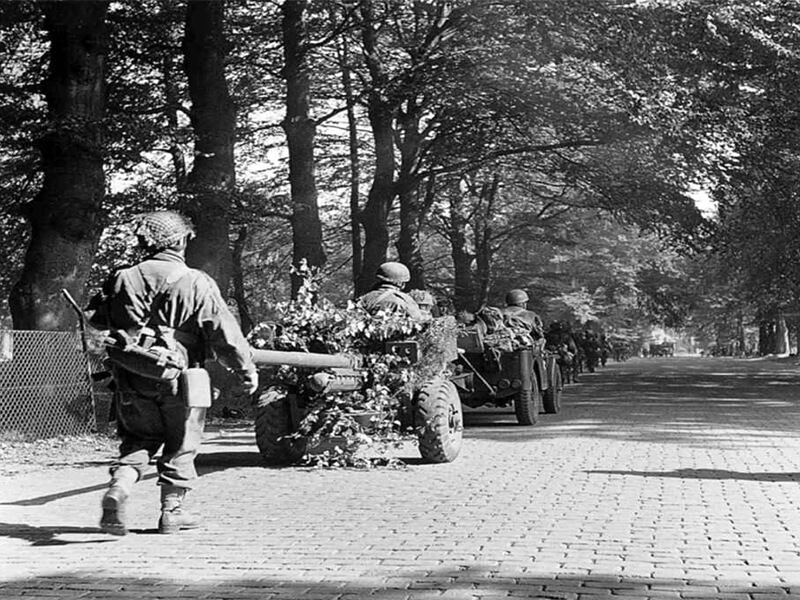


Thanks for all your efforts that you have put in this. Very interesting information.