
| Page Created |
| August 16th, 2024 |
| Last Updated |
| September 20th, 2026 |
| Great Britain |
 |
| Poland |
 |
| The United States |
 |
| Operation Market Garden |
| 1st Airborne Division 1st Polish Independent Parachute Brigade 82nd Airborne Division 101st Airborne Division XXX Corps |
| Other Units Involved |
| 1st Airborne Division 1st Polish Independent Parachute Brigade 82nd Airborne Division 101st Airborne Division |
| September 17th, 1944 – September 26th, 1944 |
| Operation Market Garden |
| Podcast |
| Objectives |
- Airborne forces capture key bridges and terrain in the Eindhoven, Nijmegen and Arnhem area under the tactical command of I Airborne Corps, headed by Lieutenant General Frederick Browning.
- Ground Forces spearheaded by XXX Corps under Lieutenant General Brian Horrocks, are to advance north and link up with the airborne forces and relieve them
| Operational Area |
- Eindhoven area, The Netherlands
- Nijmegen area, The Netherlands
- Arnhem area, The Netherlands
- Highway 69 “Hell’s Highway”, The Netherlands
| Allied Forces |
- First Allied Airborne Army
- 1st Airborne Division
- 1st Independent Polish Parachute Brigade
- 52nd, Airlanding Division
- 82nd Airborne Division
- 101st Airborne Division
- XXX Corps
- Guards Armoured Division
- 43rd (Wessex) Infantry Division
- 50th (Northumbrian) Infantry Division (Reserve)
- 8th Armoured Brigade
- Prinses Irene Brigade
| Axis Forces |
- II SS-Panzer-Corps
- 9. SS-Panzerdivision “Hohenstaufen”
- 10. SS-Panzerdivision “Frundsberg”
- 6. Fallschirmjäger Regiment
- Bataillon I, Hauptmann Emil Priekschat
- Bataillon II, Hauptmann Rolf Mager
- Bataillon III, Hauptmann Horst Trebes
- Pionier Kompanie
- Panzerjäger Kompanie
- Fusilier Kompanie
- Kampfgruppe von Tettau
- Feldkommandantur 642
- SS-Unterführerschule Arnheim
- Bataillon I
- Bataillon II
- Bataillon III
- SS-Polizei Schule
- SS-Ausbildungs und Ersatz Bataillon 4
- Bataillon I
- Bataillon II
- SS-Wach Battalion 3
- Schiffsturm Abteilung 10
- Schiffsturm Abteilung 6/14
- Fliegerhorst Battalion 2
- Fliegerhorst Battalion 3
- Artillerie Regiment 184
- Sicherheit Regiment 42
- Kampfgruppe Knoche
- Sicherheit Regiment 26
- Bataillon I
- Bataillon II
- MG Bataillon 30
- FlaK Abteilung 688
- Bataillon I
- Bataillon II
- Hermann Göering Schule Regiment
- Hermann Göering Schule Regiment
- Bataillon I
- Panzer Abteilung 224
- SS Ersatz Abteilung 4
- Deelen Airfield FlaK Kompanie
- Wach Kompanie
- Reichs AD
- Hermann Göering Schule Regiment
- Sicherheit Regiment 26
- Kampfgruppe Kraft
- SS-Panzer Grenadier Ausbildungs und Ersatz Bataillon 16
- Schwerepanzer Abteilung 506
- Schwerepanzer Kompanie Hummel
- StuG Abteilung 280
- Artillerie Regiment 191
- Bataillon I
- Bataillon II
- Bataillon III
- SS-Werfer Abteilung 102, Hauptsturmfürer Nickmann
- Kampfgruppe Brinkmann
- Kampfgruppe Bruhn
- Kampfgruppe Harder
- Sperrverband Harzer
- MG Bataillon 47
- Marine Kampfgruppe 642
- Kampfgruppe Schörken
- Kampfgruppe Kauer
- SS-Abteilung “Landstrum Nederland”
- Kampfgruppe Knaust
- Ersatz Abteilung Bocholt
- Panzer Kompanie Mielke
- Kampfgruppe Spindler
- FlaK Abteilung Swoboda
- Kampfgruppe von Allworden
- Kampfgruppe Weber
| Logistics |
In August 1944, following the successful Allied breakout from Normandy and the encirclement of German forces in the Falaise Pocket, the Allied armies aggressively pursue the retreating German forces, driving them out of most of France and Belgium.
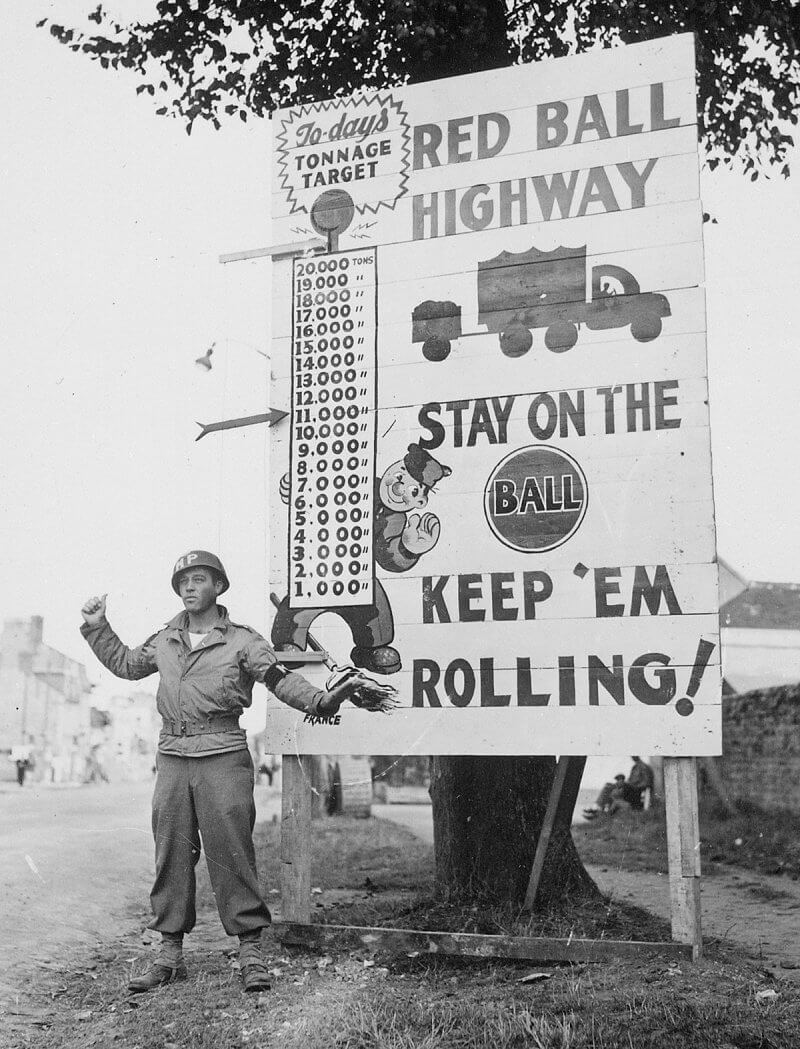
Unknown to the Germans, by late August, the Allied advance is hampered by a severe shortage of gasoline, forcing several divisions to pause and resupply. Eisenhower faces the daunting task of managing the logistical demands of the various Allied armies. While fuel supplies are available in the improvised ports of Normandy, the challenge lies in transporting them across the long distances to the front lines in Belgium and northern France. This fuel is transported in five-gallon jerry cans, hauled by trucks from Normandy in an operation known as the Red Ball Express. The solution to these logistical difficulties appears to be the capture of a major port closer to the advancing armies.
On September 4th, 1944, Field Marshal Montgomery’s forces successfully capture the port of Antwerp in Belgium almost intact, but the Scheldt Estuary, leading to the port, remains under German control. Despite the strategic importance of Antwerp, neither Eisenhower nor Montgomery initially prioritises opening the port, delaying its use by Allied supply ships until November 28th, 1944, after the Battle of the Scheldt.
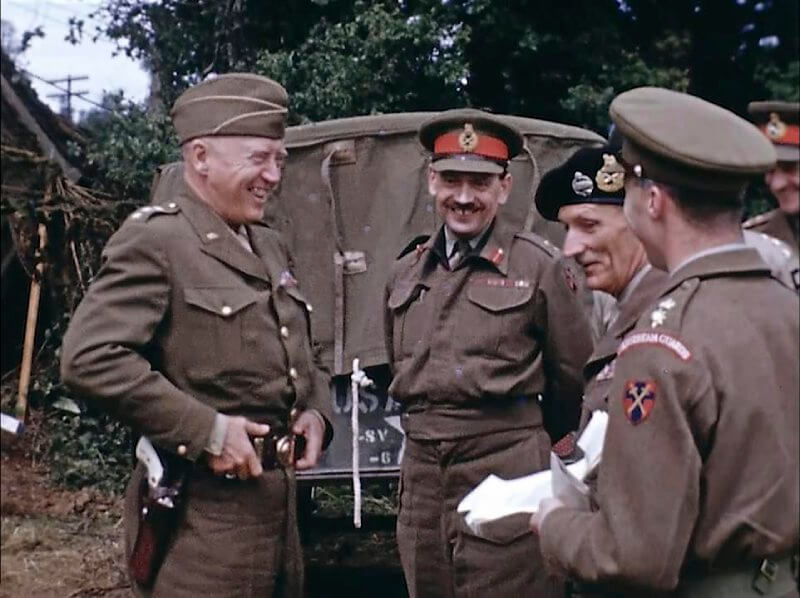
General Eisenhower advocates for a “broad front strategy,” wherein Montgomery’s forces in Belgium and general Bradley’s forces in France advance simultaneously along a wide front into Germany. Montgomery and General George S. Patton, Bradley’s aggressive subordinate, both favor a concentrated “single thrust” into Germany, but each wants to lead it. Montgomery argues that a focused and powerful drive across the Rhine into Germany’s heart, supported by all available Allied resources, is the best strategy. This would, however, reduce Bradley’s American forces to a more static role. Patton, on the other hand, asserts that with enough gasoline, he could be in Germany within days. However, war planners find both proposals tactically and logistically unrealistic.
Although Eisenhower agrees that Montgomery’s advance towards the Ruhr should take precedence, he insists that it is also important to keep Patton advancing. Montgomery counters that with the deteriorating supply situation, he cannot reach the Ruhr unless all resources are concentrated on one thrust, preferably towards Berlin. Initially, Montgomery proposes Operation Comet, a limited airborne operation aimed at capturing bridges on the way to the Rhine, but poor weather and increased German resistance force him to cancel the plan by September 10th, 1944. Operation Comet is in the line of many planned airborne operations before. Between June 1944 and Market Garden at least 15 airborne operations were planned.
- Operation Comet
- Operation Tuxedo
- Operation Wastage
- Reinforcement of the U.S. 82nd Airborne Division June 7th, 1944 to June 10th, 1944
- Operation Wild Oats
- Operation Beneficiary
- Operation Swordhilt
- Operation Hands-Up
- Operation Transfigure
- Operation Boxer
- Operation Axehead
- Operation Linnet
- Operation Linnet II
- Operation Infatuate
- Operation Comet
Most of them became unnecessary simply because the fast Allied advance had already passed the traget area for the planned airborne operation.
| Dolle Dinsdag |
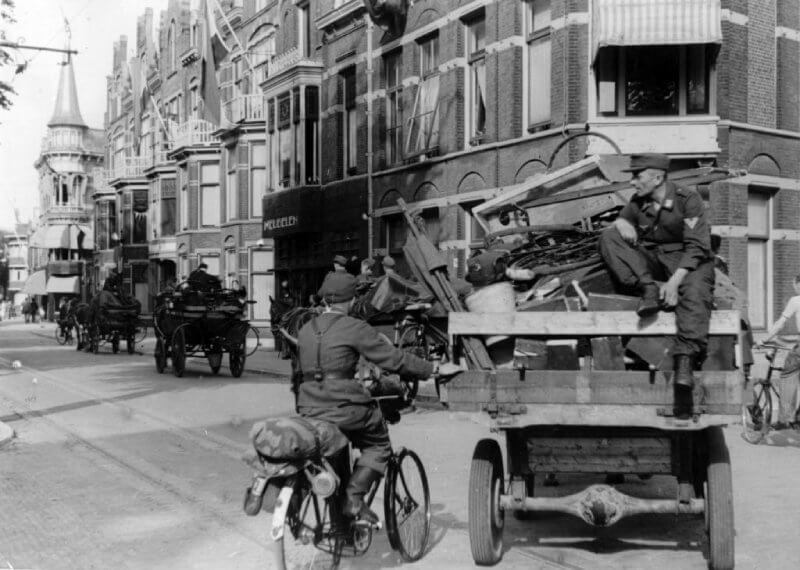
In the days before Dolle Dinsdag (Mad Tuesday), the Allied advance towards the Netherlands looks unstoppable. The German front seems to collapse. Brussels is liberated on September 3rd, 1944. A day later, Antwerp is recaptured from the Germans. Optimists project the momentum forward. At this pace, they reckon, Rotterdam could fall on September 5th, and Amsterdam and Utrecht on September 6th. The rest of the country would surely follow within days. In the south, people can already hear the guns.
Rumour feeds on rumour. Soon many insist that several southern towns are already free. In Rotterdam, word has it the Allies stand at Moerdijk. In Amsterdam, they are said to have reached Rotterdam and Den Haag. A British radio bulletin hardens the belief, reporting that Breda has been liberated.
On September 4th, 1944, Radio Oranje carries a speech by minister-presidentPieter Sjoerds Gerbrandy. He tells listeners that Allied forces have crossed the Dutch frontier and are pressing north. Tellingly, he had altered the draft himself. Where it first said the armies were approaching, he changed the words to say they had already crossed.
In the broadcast, Gerbrandy urges his countrymen to give the liberators the warm and dignified welcome they deserve. The hour of liberation has struck, he declares. Soon the beloved Queen will return. He gives heartfelt thanks to God for deliverance from great and bitter hardship. There will be joy, he says, yet grief too for the fallen. He remembers the compatriots still suffering under the enemy in the Dutch East Indies. Much sorrow remains; many have died and many more will. A final effort is needed, above all from public officials, to forestall the crimes the Germans may commit in their last moments. All resistance groups now form a single organisation under international law. These are historic days, he tells them, and posterity will judge every man and woman by their conduct. He calls for order, discipline, and obedience to the appointed leaders. The Netherlands is rising again, he ends, and may it rise in full greatness.
The following day, Tuesday, September 5th, 1944, the underground paper Het dagelijks nieuws draws on the broadcast and puts out a liberation edition.
Many Dutch people greet the news with celebration. Out come the flags and the orange banners of the House of Orange. Workplaces empty as staff pour into the streets to await the liberators. The mood terrifies the occupier. German soldiers and members of the Nationaal-Socialistische Beweging (National Socialist Movement) panic. Fearing reprisal, they burn their records, gather their belongings, and set out for the supposed safety of Germany. Around forty trains are pressed into service to move the movement’s families eastward. Most of its members make first for the Lüneburger Heide (Lüneburg Heath).
Many Amsterdam members travel by night train to Lemmer. From there they are sent on to Kamp Westerbork (Camp Westerbork). Only two days earlier, the camp’s final transport to Auschwitz had left. The plan is a short stay before onward transfer to Germany by rail.
The movement’s leader, Anton Mussert, chooses the Bellinckhof, a country house near Almelo. From there he too can slip quickly across the German border if he must.
For some, the flight ends in tragedy. On September 6th, a train of women and children of party members leaves Amsterdam for Germany. They are running from the news of the Allied advance. Near Diemen, Allied fighter aircraft strafe the carriages. Around thirty people are killed and many gravely hurt.
What the Dutch cannot know is how thin the Allied spearhead really is. The force at the front is far too small to free the whole country. The main body still lies in France. The troops who reached Antwerp have cleared only a narrow corridor through Belgium. Supply is the deeper trouble. The lines have stretched too far, and they hang on a single artificial harbour, because the Germans hold the fortified French ports. In truth, the Allies have not even reached the Dutch border. Occupied ground lies on either flank, and the leading units risk being cut off. There are signs that the Germans are regrouping. So the Allied command will not gamble on a further thrust north. Its main prize, Antwerp, is already in hand. The false report from Breda reflects a deeper confusion. The advance has been so swift that headquarters barely knows where its own men are. Only some days later do Allied reconnaissance patrols cross the frontier. Maastricht falls on September 14th, 1944, the first major Dutch city to be freed.
| Germans Back in Control |
On September 4th, 1944, Hitler relieves Field Marshal Walter Model of his temporary command in the west, replacing him with Gerd von Rundstedt. However, Model remains the commander of Army Group B. Despite his experience, Model is dissatisfied with his dual role, preferring to be at the front with his troops rather than dealing with the administrative burdens of overall command.
Model faces a dire strategic situation, as his forces have been split in two by the advancing Allies. The 15. Armee, under General Gustav-Adolf von Zangen, is trapped south of the Westerschelde after retreating from the coast and is attempting to escape to North Brabant via Walcheren and Zuid-Beveland. Meanwhile, the 7. Armee has been pushed back by American forces to Aachen and Maastricht. A 120-kilometres gap now exists between these two armies, with no functioning combat units remaining, only scattered groups of German soldiers fleeing north and east. Model fears that the British 2nd Army, positioned at the Dutch border, will exploit this gap. On September 4th, 1944, nothing could have prevented the British from occupying the entire area up to the Maas. Known for his ability to improvise defences on the Eastern Front, Model now faces the daunting task of halting this chaotic retreat. He issues an order to stop the withdrawal, but it reaches only a few.
Lieutenant General Kurt Chill receives Model’s order. Having lost almost the entire 85. Infantrie Division in the fighting, Chill is ordered to regroup the remnants and retreat to Germany. However, upon witnessing the chaotic retreat and reading Model’s directive, Chill decides to ignore his original orders. After gathering his troops, he orders them to dig in along the Albert Canal and places officers at the bridges to stop the fleeing soldiers. Troops ranging from artillerymen to cooks are now repurposed to defend the Albert Canal. Chill’s actions help stabilize the situation in this area, and similar measures are taken across the entire western front. By the second and third weeks of September, over 150,000 German soldiers who had fled are recaptured and reintegrated into the military structure.
Also on September 4th, 1944, Hitler orders General Kurt Student to form the 1. Fallschirm-Armee to close the gap between Antwerp and Maastricht. Student is given 4,000 trained Fallschirmjäger but must also rely on older, inexperienced men, unemployed Luftwaffe personnel, sailors, and anti-aircraft gunners. He also receives twenty-five pieces of mechanised artillery. Student immediately sends his paratroopers ahead, and within twenty-four hours, they reach the Albert Canal. Upon surveying the area, Student realises that Chill has performed a near-miracle in stabilising the front. Student establishes his headquarters in Vught, Noord Brabant, commanding not only the 85. Infantrie Division but also the 7. Fallschirmjäger Division, the 719. Infantrie Division, and the 176. Infantrie Division.
Student’s army receives unexpected reinforcement when Von Zangen successfully leads the 15. Armee across the Westerschelde using various vessels, advancing through Zuid-Beveland into North Brabant. The gap between Model’s two armies begins to close, resolving one of his most pressing problems. Despite these efforts, the defence of the Albert Canal remains weak.
| Lining up for Operation Garden. |
Responsible for capturing the Albert Canal bridges is the Guards Armoured Division who keeps up its drive north. Its tanks are over the Albert Canal at Beeringen by September 7th, 1944. The three villages beyond, Bourg Leopold, Heppen and Hechtel, take five more days to clear. They lie roughly 11 kilometres short of the Meuse-Escaut Canal, the next water barrier. Hechtel is still contested when the Grenadier Guards Group pushes on northward on Saturday, September 9th, 1944. Stubborn German defence exacts a price. One who falls is Lieutenant Sir Howard Frederick Frank, Second Baronet of Withyham, aged twenty-one, struck down when a hit knocks out his tank.
The Irish Guards Group is drawn in too. The 3rd Irish Guards pass the Beeringen bridgehead to the 11th Armoured Division at 17:30 on Friday, September 8th, 1944. They then shift at dusk to Helchteren. The night is spent short of the town, beside tanks of the Regiment’s 2nd Battalion. That pause lays bare a lesson. Pairing a tank unit and an infantry one by cap badge does not make them fight as one. The Division, for all its Normandy record, has not mastered the difference. A 3rd Irish Guards company lies out ahead of the 2nd Irish Guards tanks. The crews keep to habit regardless, hosing .30 machine-gun fire into every noise or stir in the black ahead. One company headquarters ends up trapped in its farmhouse. To bring tank support against a German probe, one of its platoon commanders must sprint through his own side’s fire. The two days, September 8th and 9th, 1944, cost the 3rd Irish Guards nine dead and eighteen wounded. The three officers among the dead fall that morning at Beeringen. Whether the tanks account for any of the others cannot be said.
The training gap shows itself once more the day after. Orders at 14:00 send the 3rd Irish Guards to Exel, three to five kilometres north-east of Hechtel. This time the men perch on the 2nd Battalion’s tanks rather than their own troop-carriers. Lieutenant Brian Wilson, who leads a platoon in the 3rd Battalion’s 2nd Company, sets down the scene afterwards. Most of the men have never stood beside a tank before. It strikes him as odd that home training never once paired infantry of an armoured division with armour. Someone has to explain, there and then, how to reach a crew. A man wanting a word must use the telephone on the tank’s rear, the engine being too loud for speech. As Wilson notes, the din defeats the telephone as well.
Nothing disturbs the ride, and the column is in Exel by about 18:00. The enemy’s recent presence is written across the place: wrecked vehicles, prisoners in the charge of Grenadier Guardsmen, German road signs, and broad pits scooped out to hide tanks and other heavy machines. Barely have the infantry begun digging in for the night when new orders arrive. Lieutenant J. N. Creswell, leading a 2nd Household Cavalry patrol, has come upon an undamaged bridge over the Meuse-Escaut Canal some 11 kilometres north. The Irish Guards Group must take it without delay. Their route runs along a trail of Household Cavalry vehicles posted on the side roads.
The hour at which the Group comes up to the de Groot Bridge, immediately west of Neerpelt, is not recorded. Captain J. A. H. Hendry’s Number 2 Company carries it in a snatched assault, with a Sherman troop under Lieutenant D. Lampard in support. So swift is the British approach that the garrison is caught flat-footed. They had taken the Irish Guards’ tanks, they say, for their own side’s. With the crossing in hand, Captain Hutton of the Royal Engineers sets about lifting and disarming its demolition charges. Wilson, meeting him close by, notes four Irish Guardsmen at his side, pressed into service by their Regimental Sergeant Major. True or not, Hutton earns the Military Cross for the work. The bridge costs the Irish Guards one man dead and five hurt, though that death and two of the wounded may belong to an earlier moment.
At first the Germans stay quiet. Their real answer comes near 09:00 the next morning. An infantry thrust comes in, stiffened by a lone armoured vehicle, a self-propelled gun by some accounts, a Tiger by others. The attackers are turned back. The vehicle first grinds to within 100 metres of the 3rd Irish Guards’ headquarters. No one is sure it is ever knocked out. Captain Edward Rawlence, the Battalion’s Motor Transport officer, dies hunting it with a PIAT. The Regimental Sergeant Major, caught in the same event, appears to take blast and burn wounds to the face and eyes. Three more men are killed and ten wounded before the day is out. German mortars and guns account for some of them, and smash a number of vehicles besides. Among them is the staff car of the Battalion commander, Lieutenant-Colonel John O. E. Vandeleur. Next day the prize is named Joe’s Bridge, a small consolation.
Behind the lines the Germans are assembling a fresh formation to wall off the British lodgement beyond the Meuse-Escaut Canal and throw it back. The order creating Kampfgruppe (battlegroup) Walther, named for the Fallschirmjäger (parachute) Oberst at its head, is given on September 12th, 1944. Its first components are a scattering of Luftwaffe (air force) units. There is Oberstleutnant Friedrich von der Heydte’s Fallschirmjäger Regiment 6, the replacement-training Fallschirmjäger Ausbildungs Regiment Hoffmann under Oberstleutnant Helmuth von Hoffmann, and Luftwaffe Strafbataillon 6, a penal battalion lately up from Italy and still dressed for the tropics. The parachute titles flatter the first two, which are thick with Luftwaffe ground crew of little or no training, nine in ten of them, it is said, in von Hoffmann’s regiment. The penal battalion is barely of use. Reinforcement duly comes from Sturmbannführer (Major) Heinke’s Kampfgruppe of 10 SS Panzer Division, in from Arnhem on September 12th or 13th, 1944. Walther reaches Valkenswaard, 11 kilometres north of Neerpelt, in the small hours of Wednesday, September 13th, 1944. Taking the reins from Oberstleutnant von Hoffmann, he wastes no time in ordering a concerted assault on the Neerpelt bridgehead for the next day.
The overcast keeps German preparations hidden from the air, but not from British gunner-observers, who rain fire on whatever movement they spot. The headquarters of von Hoffmann’s I Bataillon, at Luyksgestel five kilometres north-west of the bridge, comes in for this treatment repeatedly. Leutnant Heinz Volz, the Bataillon adjutant, leaves a picture of it. On September 13th, 1944, a shell lands squarely in Leutnant Hansbach’s trench and kills him. A splinter touches off the grenades a staff man is carrying, and the man is blown apart. A mortar bomb cuts down a Feldwebel at the command post door. One salvo comes in while Oberstleutnant von der Heydte is on hand; he clears the ground-floor window in a graceful bound. Volz, plastered in dust and with splinters singing past, burrows deeper beneath the table. Through it all a field telephone rings on, ignored. When the fire slackens and Volz answers, a Major Schacht at the headquarters of 1 Fallschirmjäger Armee scolds him. Leaving a senior officer holding the line, he is reminded, offends against protocol.
Over on the British side, the 5th Coldstream Guards assume the very tip of the bridgehead on September 12th, 1944, with the Dutch frontier scarcely 1.5 kilometres off. The 2nd Irish Guards’ tanks pull back over the Albert Canal. The 3rd Irish Guards settle into a belt of pine forest on the perimeter’s left. Wilson’s 2nd Company draws the job of guarding Battalion headquarters at close quarters. What looks a comfortable posting sours once the men find they must dig the headquarters staff’s slit trenches as well as their own. Intermittent German shells break the monotony, and so does a pestering night raid by some unidentified light aircraft.
The plan hands the western sector to Fallschirmjäger Regiment 6: take the hamlet of La Colonie, then cross Heunel Heath to reach the bridge. Off to distract the defenders, Fallschirmjäger Ausbildungs Regiment Hoffmann and Hauptsturmführer Dr Segler’s battalion of SS Panzergrenadier Regiment 19 are to strike astride and east of the Hasselt-Eindhoven highway. Jagdpanzer IVs of Hauptsturmführer Roestel’s SS Panzerjäger Abteilung 10 support them. Zero hour is 08:00 on September 14th, 1944, under a light drizzle and cloud low enough to ground the Allied fighter-bombers. Some troops may creep forward before first light; one British unit at least reports infiltrators carrying machine-guns and Panzerfausts. Von der Heydte’s men sweep over a few forward posts short of La Colonie. Then British defensive fire, summoned at 08:30, stops them, and the push stalls amid the houses. The eastern diversions ease little of the strain. Off the roads the Jagdpanzers’ slender tracks flounder in the mire, and their arrival seems to invite a British armoured riposte. As many as three of Roestel’s machines may be destroyed across the day.
Beaten off or not, the assault bears down heavily on the 3rd Irish Guards, and hardest of all on Number 3 Company at the wood’s edge. In timber so dense, German infiltrators prove near impossible to keep out, and Lieutenant Humphrey Kennard’s platoon draws the weight of a resolute attack. It swells until Wilson’s platoon, still tied to Battalion headquarters, has to peel off a rifle section to help. That section, under a Sergeant Sullivan, walks into a German assault and is swallowed whole; one man at least is killed and the others taken. Only at dark does the pressure lift, the Germans slipping away behind a heavy curtain of shell and mortar fire while the Guards pull into a closer perimeter. The day leaves the 3rd Battalion with seven dead, Lieutenant Kennard among them, twenty-three wounded and five missing, the last of these plainly Sullivan’s lost section. Night grants no rest to all. Wilson is sent out to find whether the enemy still sits before Number 3 Company’s old ground, and in what force. He goes with two volunteers, loses his way at the start, then edges past two burning farms his briefing had said nothing of. Beyond them he settles the question: von der Heydte’s Fallschirmjäger hold the woods roughly 550 metres to the Battalion’s front. Some two hours on, the patrol slips back inside, coming in only a few metres from where it left.
Relief reaches the Guards Armoured Division on September 15th, 1944, when elements of the 50th (Northumbrian) Division come up. The 1st Hampshires of 231st Infantry Brigade take over the 3rd Irish Guards’ line. Wilson sees their advance party arrive as he breakfasts, cold, on bully beef and looted German champagne, cold because a German shell had wrecked the 2nd Company cook truck the day before. Around midday the changeover is done, and the Guards tramp back to their transport at a derelict factory just south of Joe’s Bridge, from where they ride to billets farther south. In the eleven days from the freeing of Brussels to their departure from the bridgehead, the Division loses 113 killed, 405 wounded and 80 missing. The weight of it is borne by the 1st Welsh, 3rd Irish and 5th Coldstream Guards. The 3rd Irish Guards perhaps fare worst; officer losses dating from September 8th, 1944 force the Battalion to reorganise eight days later. Even so, the mood runs to impatience, and to bewilderment that the advance is not driven on harder. Wilson says as much. By September 15th, 1944, Joe’s Bridge has been in hand four whole days. The delay unsettles everyone and defies explanation. Each wasted day, he thinks, only hardens the resistance waiting ahead. Later fighting proves him right, and hints that the risk of pressing straight on might well have paid.
With its losses of September 14th, 1944 to nurse, Kampfgruppe Walther settles for hemming the British in, though Joe’s Bridge draws one last, unorthodox effort. On the afternoon of Friday, September 15th, 1944, a party of Kriegsmarine combat swimmers turns up unheralded at the headquarters of SS Panzergrenadier Regiment 21, out on the perimeter’s eastern edge. Its first commander, Hauptsturmführer Krause, seems by now to have given way to Hauptsturmführer Friedrich Richter. Richter vets their papers from Oberkommando der Wehrmacht, grasps that they mean to blow the bridge with a 500-kilogram sea mine, and hands them on to the company beside the Meuse-Escaut Canal under his adjutant, Obersturmführer Heinz Damaske. A truck runs the swimmers and their load to a farm near the front once darkness falls, and there the plan comes apart. The only hands to spare are a few signallers from company headquarters, too few to work the mine quietly in the dark. A three-metre drop to the water makes it worse. What follows is no surprise. The scuffling, the hushed voices and the splashing all carry, and the British across the canal loose off machine-guns and mortars at the racket. Damaske had not cared to imagine a mortar round finding the mine, and the naval party, it turns out, imagines exactly that. Judging the thing impossible in such conditions, they abandon the soldiers to their package.
After this, the bridge is largely left undisturbed, while the German forces surrounding the lodgement restrict themselves to observing British activity. Richter’s men hear heavy vehicles moving along the Hechtel–Valkenswaard road to the south and occasionally see their lights. Other elements of Kampfgruppe Walther make similar reports.
During the night of September 15th and 16th, 1944, 719. Infanterie-Division records an almost continuous flow of traffic on the roads behind the Albert Canal. Kampfgruppe Chill also expects a major British attack once sufficient armour has been concentrated inside the bridgehead.
| Operation Market Garden |
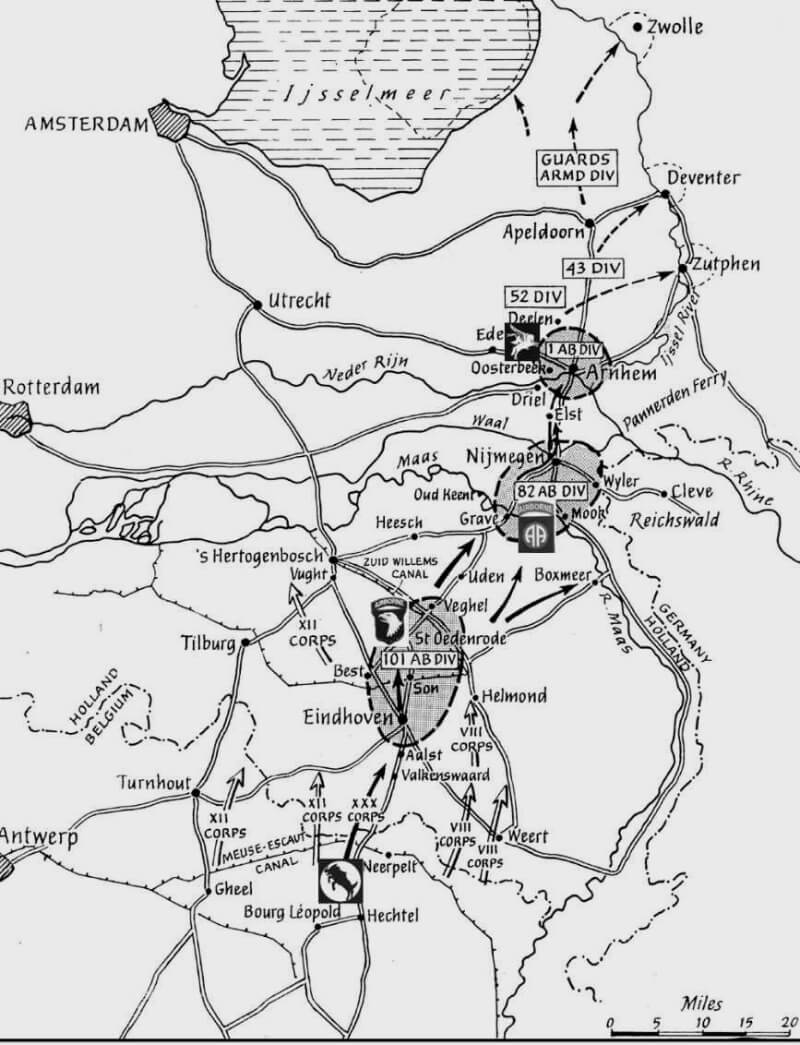
Field Marshal Montgomery devises an enlarged plan to bypass the German West Wall and cross the Rhine towards the Ruhr. He proposes committing the whole First Allied Airborne Army. The scheme also answers a pressing need. V-2 rocket sites in the Netherlands are striking London, and the British government wants them silenced. The design enlarges the earlier Operation Comet to three airborne divisions. It aims to seize the crossings across some 100 kilometres from Eindhoven to Arnhem. The airborne insertion is codenamed Market; the ground relief is Garden. The overarching aim is a bridgehead across the Rhine at Arnhem.
Wretched communications form the backdrop to what follows. Supreme Headquarters Allied Expeditionary Force had moved its forward headquarters from Portsmouth to Granville on August 7th, 1944. The advance has since left it more than 640 kilometres from the front. No direct links reach its Army Groups. Eisenhower’s September 5th signal on supply priority and command arrives in halves. The first part is transmitted at 09:00 on September 7th, the remainder at 10:15 on September 9th. The strain eases only at the end of September 1944, when headquarters moves to the Trianon Palace at Versailles.
On Sunday September 10th, 1944, Montgomery pitches the plan to General Eisenhower in Brussels. Air Chief Marshal Sir Arthur Tedder attends. The meeting takes place aboard Eisenhower’s aircraft, a knee injury having nearly immobilised him. No official record survives. It appears to open badly. Montgomery, still smarting at the loss of the ground command, vents at Eisenhower. Eisenhower reaches over, pats his knee, and reminds him who is his boss. Montgomery apologises, and the talk grows more amicable. Eisenhower approves the plan warmly. He calls it a design in exact concordance with all their understandings.
The two men leave with different understandings all the same. Tedder tells Air Chief Marshal Sir Charles Portal the meeting has cleared the air. Yet he notes Montgomery insisting that priority means absolute priority. The day after, Montgomery is already badgering Eisenhower. He claims the operation cannot launch before September 23rd, and probably not before September 26th. Delay, he warns, lets the Germans prepare. On September 12th Eisenhower sends his chief of staff, Lieutenant-General Walter Bedell Smith, to Brussels. On September 13th Eisenhower tells Montgomery that 1,000 tonnes a day by air is impossible without stripping Market. He agrees instead to 500 tonnes a day by American road transport until October 1st. American units are immobilised to move it. In practice, Market Garden thus receives only limited priority within the wider strategy. Montgomery reads the compromise as total victory. He tells Lieutenant-General Sir Archibald Nye he has personally killed the Saar advance, and calls it a great victory. On September 14th he even directs the British Second Army to plan a further drive on Hamm. Eisenhower has not authorised it.
While that argument runs on, the operational planning is already under way. Eisenhower has his own reasons to embrace the plan. Pressure from the United States to employ the First Allied Airborne Army weighs on him. The airborne forces have been pulled back from the front and sit idle. They comprise three British and three United States divisions, with the Polish 1st Independent Parachute Brigade. From this pool, three divisions and the Polish brigade will be committed. A run of proposed operations has been cancelled by the speed of the Allied advance. Eisenhower judges that Market Garden could carry the Allies across the Rhine.
On September 10th, 1944, he directs Lieutenant-General Lewis Brereton to plan the operation. Brereton commands the First Allied Airborne Army. He is to devise the airborne assault, Market, to run in concert with the ground offensive, Garden. The proposed date, weather permitting, is September 14th. Brereton has little time. He adapts the framework of the cancelled Operation Linnet I and II to the new objectives. He restricts glider missions to single-tows, one glider to each tug aircraft. Linnet had envisaged the more complex double-tow. Poor weather, heavy resupply demands, and scant August training for the IX Troop Carrier Command all count against it. Brereton judges double-tows without practice too risky.
He also settles on a daylight operation. Extensive air support from the Royal Air Force and the United States Air Force makes this feasible. The choice is meant to avoid the dispersal that marred the Normandy landings in June. Weather and logistics push the start to September 17th, 1944. Brereton times the final plan to the dark of the moon that night, to reduce the risk of detection. With daylight already shortening, he rules out two lifts per day. The shortage of troop carrier aircraft then dictates the pace. The airborne phase will need three consecutive days to land every formation in the Netherlands. The approach balances effect against the safety of his troops.
The finished plan rests on two linked operations. Market is the airborne effort. Brereton’s First Allied Airborne Army is to seize the key bridges and terrain. It operates under the tactical command of I Airborne Corps and Lieutenant-General Frederick Browning. Garden is the ground thrust, spearheaded by the British Second Army. Its XXX Corps, under Lieutenant-General Brian Horrocks, is to drive north and link up with the airborne troops. D-Day for Market Garden is set for Sunday September 17th, 1944.
| Operation Market |
Meanwhile Operation Comet is cancelled on September 10th, 1944. The airborne troops assigned to Operation Market are recovering from the cancellation. The 1st Parachute Battalion, at Grimsthorpe Castle and Bourne in Lincolnshire, stays on instant standby until September 14th, 1944, when all ranks receive thirty-six hours’ leave. Some 22 kilometres east at Spalding, the 3rd Parachute Battalion is granted the same leave on the very day the cancellation is announced. It then spends September 12th to 15th, 1944 helping local farmers, presumably with the harvest. The 11th Parachute Battalion, 64 kilometres north-west at Melton Mowbray in Leicestershire, is let out of camp on Tuesday, September 12th, 1944, and sent off on forty-eight hours’ leave the next day. Whether its running mate, 156th Parachute Battalion, also billeted at Melton Mowbray, receives leave after standing down from Comet is unclear. The American formations follow much the same pattern. Sergeant George Kosimaki, a radio operator at the 101st Airborne Division’s headquarters, records that twenty-four-hour passes are cancelled on September 11th, 1944, the men aware that something is afoot once the divisional War Room is placed under strict guard.
The airborne division commanders, with key staff, reconvene at Browning’s 1st British Airborne Corps headquarters at Moor Park on the morning of Thursday, September 14th, 1944. Each has spent the days since the conferences of September 10th and 11th, 1944 drawing up his detailed plan and conferring with staff and subordinates, and now presents that work to Browning and to his fellow commanders. Major-General Maxwell D. Taylor of the 101st Airborne Division opens the briefback. The division’s most northerly objectives, the four road and rail bridges over the Willems Canal and the River Aa at Veghel, go to Colonel Howard R. Johnson’s 501st Parachute Infantry Regiment, using two drop zones. The larger, Drop Zone A, lies just over three kilometres south-west of Veghel and is meant at first to take the whole regiment. That changes after Lieutenant-Colonel Harry W. O. Kinnard proposes putting part of the force nearer the Aa bridges, to sidestep likely resistance on the western edge of Veghel. Kinnard’s 1st Battalion therefore gets its own Drop Zone A-1, between the Aa and the Willems Canal, beside the railway roughly 1.5 kilometres north of the town. The regiment’s 3rd Battalion, under Lieutenant-Colonel Julian Ewell, is to take Eerde just west of Drop Zone A and block the Veghel–Sint Oedenrode road just to the east. Lieutenant-Colonel Robert A. Ballard’s 2nd Battalion, meanwhile, is to drive straight for the two Willems Canal bridges in Veghel’s western outskirts.
The rest of the 101st Airborne Division is to come down on a large combined drop and landing zone some 11 kilometres south-west of Veghel. The southern third, Drop Zone C, falls to Colonel Robert F. Sink’s 506th Parachute Infantry Regiment, tasked to secure the three bridges over the Wilhelmina Canal just south of Son and then push on to Eindhoven. To that end Major James L. La Prade’s 1st Battalion is to move fast through the Zonsche Forest along the canal’s north bank and seize the three bridges. Lieutenant-Colonel Robert L. Strayer’s 2nd Battalion is to advance through Son and approach the bridges from the north, while Lieutenant-Colonel Oliver M. Horton’s 3rd Battalion follows as regimental reserve. The northern third, Drop Zone B, goes to Colonel John H. Michaelis’s 502nd Parachute Infantry Regiment. His 1st Battalion, under Lieutenant-Colonel Patrick C. Cassidy, is to move north-east and secure the four bridges over the River Dommel at Sint Oedenrode. The 2nd and 3rd Battalions, under Lieutenant-Colonels Steve A. Chappuis and Robert G. Cole, are to protect the landing area and act as division reserve. The exception is Captain Robert E. Jones’s Company H of the 3rd Battalion, sent south-west to secure the road and rail bridges over the Wilhelmina Canal just south of Best. It is reinforced with a platoon from Company C and a detachment of the 326th Airborne Engineer Battalion. Taylor adds the Best bridges to the objective list despite British indifference, and whether the move figures in the briefback, or reaches XXX Corps at all, is unclear. The central third, Landing Zone W, is reserved for seventy Waco CG4 gliders carrying elements of Lieutenant-Colonel Harry W. Elkins’s 377th Parachute Field Artillery Battalion, due to arrive an hour after the parachute drop.
Brigadier-General James Gavin’s plan for the 82nd Airborne Division proves rather more intricate. The division’s most westerly objective, the nine-span bridge of some 549 metres over the River Maas at Grave, appears to go to the 2nd and 3rd Battalions of Colonel Reuben H. Tucker’s 504th Parachute Infantry Regiment, under Majors Edward M. Wellems and Julian A. Cook. To seize both ends at once, the 2nd Battalion’s Company E is to be dropped on a small drop zone on the west bank of the Maas, while the rest of the two battalions use the large regimental Drop Zone O between the Maas and the Maas-Waal Canal, north-east of Grave. Tucker’s 1st Battalion, under Major Willard E. Harrison, is to secure the Maas-Waal Canal crossings just east of Drop Zone O, lying south to north near Molenhoek, Malden and Hatert. A fourth crossing farther north at Honinghutie, a substantial combined road and rail structure, is left off the objective list. Gavin logs it as a provisional extra, to be dealt with jointly by the 504th and Colonel Roy E. Lindquist’s 508th Parachute Infantry Regiment, as the fight develops after the landings. His caution presumably reflects a wish not to stretch his units too thinly, and rests on the Market orders requiring seizure of only “at least one” of the four crossings. The division’s other primary task is the great road and rail bridges over the River Waal in northern Nijmegen.
That task is complicated by Browning inserting himself directly into Gavin’s planning. In his Operation Instruction Number 1 of Wednesday, September 13th, 1944, Browning rules that securing the Groesbeek Heights, a wooded plateau south and east of Nijmegen, matters as much as securing the Nijmegen and Grave bridges. He goes further at the briefing. Once Gavin has finished, Browning expressly forbids any move on the Nijmegen bridges until the whole of the Heights is in hand. His worry is that the western end of the Heights overlooks the roads into Nijmegen and the city itself, and offers a route for German counter-attacks from the nearby Reichswald Forest, just across the German border.
Gavin, shares the concern about the ridge overlooking Nijmegen and its approaches, rather than the Heights as a whole. It forces Gavin to string three lightly armed regiments around a perimeter of some 40 kilometres, spread wide and thin across key terrain and road and track junctions. The order is arguably needless as well, for the Nijmegen bridges are not in fact visible from the Heights as claimed, and a much tighter perimeter through the more defensible urban ground on the city’s edge would have served. In short, the Nijmegen bridges are indispensable to Market Garden and the Groesbeek Heights are not, so the bridges should have come first.
Gavin must in any case rework his plan to Browning’s wishes, and his two remaining regiments therefore use two separate drop zones chosen for a rapid grab at the Heights. Colonel William E. Ekman’s 505th Parachute Infantry Regiment is to drop on Drop Zone N, some 8 kilometres east of the 504th‘s main landing area, at the southern edge of the Heights. This zone, shared by Gavin’s division headquarters and Lieutenant-Colonel Wilbur Griffiths’s 376th Parachute Artillery Battalion, sits midway between the Reichswald to the south-east and the village of Groesbeek to the north-east. Ekman is to take Groesbeek village, hold a perimeter along the southern edge of the Heights, and link up with the 504th Parachute Infantry Regiment to the west across the Maas-Waal Canal. Lindquist and the 508th Parachute Infantry Regiment draw Drop Zone T, roughly 3 kilometres to the north-east, between Groesbeek and the village of Wyler just inside the German border. Lindquist is to secure the Heights, hold a perimeter along their eastern and northern edges, and protect the landing ground for Colonel George Billingslea’s 325th Glider Infantry Regiment, due with the second lift on September 18th, 1944; two adjacent glider landing zones lie just east of Groesbeek, between the parachute drop zones. Holding the whole of the Heights makes a perimeter of about 40 kilometres, a tall order even for a formation as seasoned and professional as Gavin’s, and he must spread his men thinly to man it. As Powell notes, a smaller perimeter reaching some 5 kilometres out from the centre of Nijmegen would have denied the Germans both access and observation over the city and its approaches; it would simply not have satisfied Browning’s demand for the entire Groesbeek Heights.
The third and final contributor to the briefback is Major-General Robert Urquhart of the 1st Airborne Division. His plan is essentially Comet without the glider coup-de-main to seize the Arnhem road bridge. As already seen, the Royal Air Force planners have chosen to land the division on heath and farmland some 11 kilometres west of Arnhem. The first lift uses two landing areas: a combined drop and landing area south-west of Wolfheze, and a smaller landing area just north of the town. The former runs north from Heelsum to the Arnhem–Ede railway line just west of Wolfheze, split almost down the middle by a convenient belt of trees. The western half, Drop Zone X, goes to Brigadier Gerald Lathbury’s 1st Parachute Brigade, the 1st Parachute Squadron, Royal Engineers, and the 16th Parachute Field Ambulance. The neighbouring Landing Zone Z is given to Lathbury’s glider-borne elements, to Major C. F. H. “Freddie” Gough’s 1st Airborne Reconnaissance Squadron, and to the 1st Airlanding Anti-Tank Battery, Royal Artillery, the 1st Airlanding Light Regiment, Royal Artillery, the 9th Field Company, Royal Engineers, and the 181st Airlanding Field Ambulance. Urquhart’s tactical headquarters and Brigadier Philip Hicks’s 1st Airlanding Brigade take Landing Zone S, the smaller area north of the railway. A further parachute area some 3 kilometres west of Wolfheze, Drop Zone Y, is set aside for the 4th Parachute Brigade on the second lift of Monday, September 18th, 1944, with the rest of the 1st Airlanding Brigade coming down on Landing Zone S and a redesignated Landing Zone X. The third lift, planned for Tuesday, September 19th, 1944, is to put the 1st Polish Independent Parachute Brigade onto Drop Zone K, on the polder just south of the Arnhem road bridge, while the Poles’ transport and heavy equipment land on Landing Zone L, some 3 kilometres east of Wolfheze, alongside the 878th United States Airborne Engineer Battalion.
Once on the ground, Urquhart’s scheme is relatively simple. Hicks’s 1st Airlanding Brigade is to protect the landing area for the second lift, together with Urquhart’s tactical headquarters and all the divisional units brought in first. Gough’s 1st Airborne Reconnaissance Squadron is to race off in its armed Jeeps, trailed by Lathbury’s 1st Parachute Brigade. Gough’s men are to seize the division’s chief objective, the Arnhem road bridge, and hold it until Lathbury arrives to build a proper perimeter. Once the second lift is down on the second day, the 4th Parachute Brigade and the 1st Airlanding Brigade are to extend the perimeter northwards through Arnhem, gathering the Polish and other glider elements from Landing Zone L on the way. The arrival of the 1st Polish Independent Parachute Brigade near the bridge on the third lift is therefore somewhat redundant, and the Poles are set to cross the bridge and dig in on Arnhem’s eastern outskirts. The intent may be to use them in a later push to the Zuider Zee, or east across the River Ijssel to Deventer or Zutphen; one man of the 44th Royal Tank Regiment recalls his unit being briefed to support a Polish drop near the Zuider Zee.
Urquhart is soon to share Gavin’s experience of Browning’s meddling. On Friday, September 15th, 1944, amid the Market preparations, he somehow finds time for a round of golf on the course beside Moor Park. While he plays, his operations officer, Lieutenant-Colonel Charles Mackenzie, tells him that a few gliders are being trimmed from the division’s first lift. Urquhart agrees without protest, asking only that the cut not touch the guns of the 1st Airlanding Anti-Tank Battery, Royal Artillery. His calm is surprising, since the division is already short of airlift. The few gliders in fact number thirty-eight, thirty-two of them Horsas, enough to carry two-thirds of an airlanding infantry battalion, the other six being Waco CG4’s of unknown origin. More surprising still, given how thin his first lift already is on infantry, the cut falls on the 2nd South Staffords. They are left with only twenty-two of the fifty-six machines needed to lift the whole battalion in the first wave, the remaining thirty-four Horsa loads pushed to the second lift.
The thirty-eight machines have been earmarked to carry Browning and his advanced 1st Airborne Corps headquarters into the 505th Parachute Infantry Regiment’s landing area south of Groesbeek. This is how Browning has chosen to make good his total want of airborne operational experience, and so to shore up his claim to the senior Allied airborne post. There is no practical or operational case for putting Browning in the first lift, or indeed for his being in Holland at all, since nothing he can do there could not be done from Moor Park.
Hard experience has taught both Gavin and Taylor to start with the greatest possible number of fighting men, and so the first lift of each American division carries all three of its parachute infantry regiments, each the equal of a British brigade, plus a little engineer and artillery support. Urquhart, by contrast, fills roughly a third of his first lift with divisional troops, including a whole light artillery regiment and two full field ambulances, and lets one of his two infantry brigades be trimmed of nearly a third of its strength when Browning appropriates the thirty-four Horsas from the divisional glider allocation. Part of this stems from the structure of British airborne divisions, in which two-thirds of the infantry are parachute troops, even though the Air Ministry never means to provide aircraft enough to deliver more than a fraction of them at once. So, Browning’s interference aside, Urquhart as things stand must fill almost a third of his glider lift with divisional troops, because the only infantry to hand come from the 4th Parachute Brigade. Since paratroopers tend to regard gliders as a short step from suicide, turning them into makeshift airlanding infantry would have been awkward, though not impossible.
Yet there is a solution, one that seems never to occur to Urquhart or anyone else, which would have let him match his American counterparts and deliver most, if not all, of his infantry in the first lift. The Royal Air Force contribution to the first lift consists of two formations, Numbers 38 and 46 Groups. The former holds six squadrons of Short Stirlings, two of Handley Page Halifaxes and one of Armstrong Whitworth Albemarles, all rigged as glider tugs, with the Stirlings and Albemarles able to drop parachutists as well. Number 46 Group has five Royal Air Force and one Royal Canadian Air Force squadrons of C-47s and Dakotas, all seemingly rigged for parachuting too, since most of their Market sorties are parachute supply runs. Number 46 Group thus has aircraft enough to deliver most or all of the 4th Parachute Brigade alongside the United States Army Air Forces aircraft dropping the 1st Parachute Brigade, while Number 38 Group tows in the 1st Airlanding Brigade’s gliders and those of vital support units. That would have let Urquhart send two infantry brigades to seize his primary objective while keeping the third back to guard the landing area. The cost would have been bumping most divisional units to the second or even third lifts, but of these arguably only the guns of the 1st Airlanding Light Regiment, Royal Artillery, prove useful.
Lieutenant-Colonel John Frost of the 2nd Parachute Battalion warns of the danger of putting non-airborne commanders over airborne units. However good such men are, Frost observes, they are apt to treat airborne warfare as just another way into battle, when the physical, mental and even spiritual demands of fighting without the normal army’s support are in fact very different. How well this fits Urquhart is clear from his plan, and especially from his treating the assembly of the whole division as no less important than seizing and holding its primary objective. As will be seen, his decisions and conduct once on the ground confirm Frost’s judgement further. These misconceptions should have been corrected by Urquhart’s senior subordinates, but in practice they are little if any more experienced than he is. The point is sharpest with his senior brigade commander, Brigadier Gerald Lathbury, who led the 1st Parachute Brigade in its bid for the Primasole Bridge on Sicily in July 1943, a venture that offered little beyond a lesson in how not to run an airborne operation. Lathbury goes on to repeat the same mistakes in Holland, his plan for the Arnhem bridges resembling a peacetime exercise even more than Urquhart’s. To his credit, Urquhart has noticed, on taking command, a tendency to unwarranted overconfidence in the division, one remarked on by some of his own officers. Sosabowski notes it too during a Market briefing at Moor Park at 17:00 on September 12th, 1944. When Urquhart asks at the end for questions, not one brigadier or unit commander speaks; Sosabowski looks round to find most sitting nonchalantly, legs crossed, bored and waiting for the meeting to end. Questions crowd his own mind, but he senses that raising them would only delay matters and make him unpopular, to no purpose.
In fairness, the officers’ silence may owe something to Browning’s presence at the briefing, and to the weariness bred by the string of cancelled missions before Market. This is certainly Urquhart’s view, and it is shared by others, even the most reluctant, men who had already seen so much fighting at Dunkirk and in North Africa, were sick of the cancellations and keen to go. That many nonetheless harbour doubts is plain from later, lower-level briefings. Lathbury appears to warn Frost that the coming battle will be some bloodbath, a phrase Frost duly passes to his 2nd Parachute Battalion officers. Having briefed the 4th Parachute Brigade as a whole, Brigadier Hackett tells his battalion commanders and a few key officers, with grim foresight, to forget all that, for their hardest fighting and worst losses will come not in defending the northern sector of the Arnhem perimeter but in trying to reach it.
| Operation Garden |
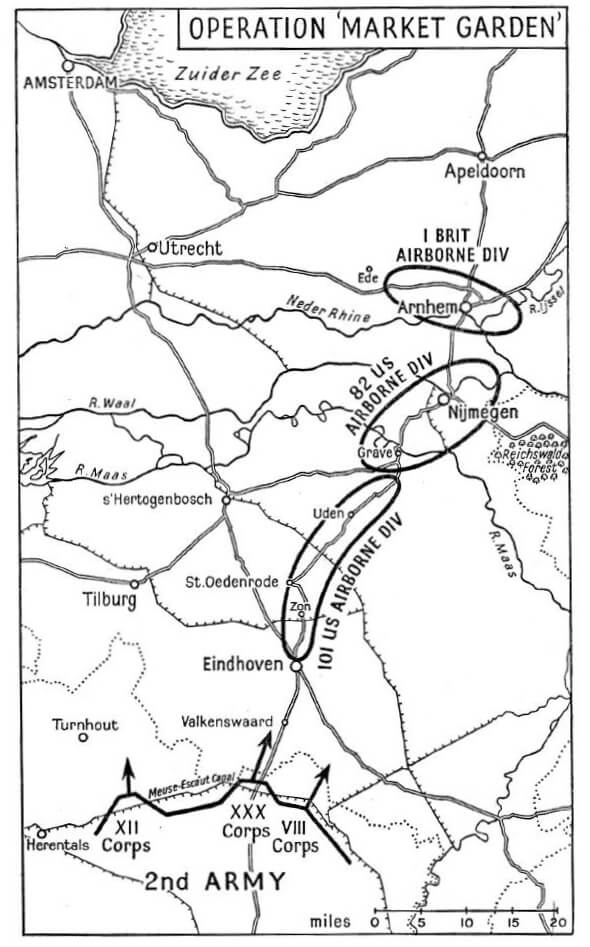
Operation Garden, the ground component, is led by XXX Corps, under the command of Lieutenant General Brian Horrocks, is positioned near Leopoldsburg. The Corps is spearheaded by the Guards Armoured Division, with the 43rd Wessex Infantry Division and the 50th Northumbrian Infantry Division held in reserve. The British 8th Armoured Brigade and the Dutch Prinses Irene Brigade are integral to the ongoing operation. As of September 16th, 1944, the Guards Armoured Division commands a formidable tank force, consisting of 276 tanks. This includes 175 Shermans, with thirty-seven equipped as “Fireflys,” forty Stuarts, fifty-eight Cromwells, and three Challengers.
The operation requires the corps to break out from the bridgehead over the Maas-Scheldt Canal, advancing through Joe’s Bridge at Lommel. Their route follows the path cleared by airborne forces, moving through key locations including Eindhoven, Sint-Oedenrode, Veghel, Uden, Grave, Nijmegen, and finally Arnhem. The timeline for this advance is precise: by 17:00 on the first day, they are expected to reach Eindhoven, followed by Veghel at midnight. On the second day, the objective is to reach Grave by 12:00 and Nijmegen by 18:00. By 15:00 on the third day, they aim to arrive in Arnhem. So, the plan expects XXX Corps to reach the 101st Airborne Division’s area by the end of the first day, the 82nd Airborne Division’s area by the second day, and the 1st Airborne Division’s area by the fourth day at the latest. Once achieved, the airborne divisions would join XXX Corps in breaking out from the Arnhem bridgehead.
Upon securing Arnhem, the corps must push forward towards the IJsselmeer, specifically targeting the area around Nunspeet. The strategic goal is to cut off German forces in the Western Netherlands. Following this, the 43rd Infantry Division is tasked with establishing bridgeheads over the IJssel River at Doesburg, Zutphen, and Deventer, enabling a direct advance into the Ruhr area, a crucial objective within Germany.
XXX Corps faces six major water obstacles along the route from their jumping-off point to the objective on the north bank of the Lower Rhine River. These obstacles include the Wilhelmina Canal at Son en Breugel, the Zuid-Willems Canal at Veghel, the Maas River at Grave, the Maas-Waal Canal, the Waal River at Nijmegen, and finally, the Rhine at Arnhem. The plan hinges on the airborne forces capturing the bridges over these obstacles almost simultaneously. Any failure to secure these bridges would result in significant delays or potentially catastrophic defeat. Anticipating the possibility of the Germans demolishing the bridges, XXX Corps prepares extensive contingency plans. This includes amassing a vast quantity of bridging materials, 2,300 vehicles to transport them, and deploying 9,000 engineers ready to reconstruct the bridges if necessary.
Highway 69, later known as “Hell’s Highway,” serves as the critical route for the planned advance during Operation Market Garden. This road is a narrow two-lane highway, partially elevated above the flat polder and floodplain terrain surrounding it. The soft ground on either side makes it difficult, if not impossible, for tactical vehicles to maneuvre off the road. The landscape is dotted with dikes and drainage ditches, while dikes themselves are often lined with trees or large bushes, and the roads and paths are similarly bordered by trees. In early autumn, these natural features severely restrict visibility, posing significant challenges for the advancing forces.
Although the area is predominantly flat, with less than 9 metres of variation in elevation, Lieutenant-General Brian Horrocks, commander of XXX Corps, notes the challenges presented by the terrain. He describes the country as “wooded and rather marshy,” making any attempts at outflanking maneuvers virtually impossible. Two key high ground areas, both reaching heights of 90 metres, are strategically crucial. One is located northwest of Arnhem, and the other is the Groesbeek ridge in the 82nd Airborne Division’s sector. Securing these elevated positions is essential for holding the highway bridges, which are vital to the success of the entire operation.
The operation assumes that German resistance has largely collapsed, with the German Fifteenth Army in retreat from Canadian forces and believed to have no significant armored units available. The Allied command expects XXX Corps to encounter limited resistance along Highway 69, with the German defenders spread thin over a 100-kilometres front as they attempt to contain the scattered airborne landings from the Second Army in the south to Arnhem in the north.
| Final Preperations |
With the briefback done, the division commanders are cleared to brief their own subordinates and set the final preparations for Market in motion, though in places the ball is already rolling. The 1st Parachute Brigade holds an orders group at its headquarters at Syston on September 13th, 1944, issuing an intelligence summary and Air Operation Order Number 1 the same day; its glider element is briefed by the intelligence officer at the airfields at Keevil and Tarrant Rushton on September 15th, 1944. The pilots of the Glider Pilot Regiment appear to be briefed at the same time. The morning of Saturday, September 16th, 1944 goes on loading equipment, followed by more briefings, at which Miller learns he will also carry passengers. These include an unnamed colonel of the 1st Airborne Division Signals, possibly Lieutenant-Colonel Tom Stephenson, a Major Oliver of the army’s public relations office with a photographer sergeant named Harvey, Stanley Maxted of the British Broadcasting Corporation and Alan Wood of the Daily Express. Miller’s feelings are mixed: excited at so interesting a load, yet uneasy that his passengers will be no help unloading the Horsa on the ground.
The men of the 1st Parachute Battalion are given thirty-six hours’ leave from their billets at Grimsthorpe Castle and Bourne on September 14th, 1944, followed by a battalion orders group at Lieutenant-Colonel David Dobie’s headquarters at 20:00 on Friday, September 15th, 1944. Troop briefings come the next day, with the officers being unimpressed by the far-flung drop zone and volunteering en masse, without success, to jump on or beside the Arnhem road bridge. The 2nd Parachute Battalion’s orders group at Stoke Rochford settles that Major Digby Tatham-Warter’s A Company will lead the advance from the landing area. Lieutenant Colonel Frost is packing the brass hunting horn he uses to rally his men into his combat kit and telling his batman to load his golf clubs and dinner jacket into the staff car for despatch to Holland with the battalion ground party. At Spalding a little to the south-east, Lieutenant-Colonel John Fitch’s 3rd Parachute Battalion follows the same course after its spell with the farmers, if slightly later, Fitch holding his orders group on Friday, September 15th, 1944, with troop briefings the day after.
As a rule the British units stay in their camps until D-Day, then move by road to the airfields, though there is at least one sanctioned exception. On the morning of Friday, September 15th, 1944, the 2nd Parachute Battalion is shuttled in sealed trucks under military police escort to a cinema in Grantham for a special screening of the 1941 comedy Hellzapoppin’, with the American comedians Chic Johnson and Ole Olsen; Private James Sims reckons it the funniest film he has ever seen. American practice, by contrast, is to move units from their sometimes-far-flung billets into quarters on the airfields and brief and prepare them there. Most of the accommodation is tented, though the 401st Glider Infantry Regiment is housed in an aircraft hangar fitted with bunks at Aldermaston. Not every unit is billeted whole. The 3rd Battalion of the 501st Parachute Infantry Regiment flies from Chilbolton near Winchester, while the rest of the regiment flies from Aldermaston, some 32 kilometres to the north-east near Newbury. The units of the 82nd and 101st Airborne Divisions are locked down by nightfall on Friday, September 15th, 1944. Not all take kindly to it.
Much of Saturday, September 16th, 1944 goes on troop briefings. The commander of the 508th‘s 3rd Battalion, Lieutenant-Colonel Louis G. Mendez, uses one to air his anger at the United States Army Air Forces’ performance in Normandy, where only eight of his battalion’s sticks came down on the right drop zone, the rest scattered up to 24 kilometres astray. To prevent a repeat, Mendez charges the aircrew before him that they had once given him the finest combat-ready force of its size, half of it lost by the time he gathered it in Normandy, and asks that this time they put the men down in Holland or in hell, but all together in one place.
Things run much the same some 160 kilometres to the south-west, where the 101st Airborne Division is settled on six airfields of the 53rd Troop Carrier Wing at Aldermaston, Chilbolton, Greenham Common, Membury, Ramsbury and Welford, lying west, south and east of Newbury in Berkshire. Sergeant George Kosimaki of the division headquarters notes in his diary being briefed on September 15th, 1944, and drawing ammunition and Dutch currency the next day at Greenham Common. At Ramsbury the barbed wire and armed guards give Corporal Hansford Vest of the 502nd Parachute Infantry Regiment the same sense of imprisonment; since Ramsbury is given over wholly to glider serials, he is presumably part of the regiment’s glider-borne Jeep lift. If so, he travels with the regiment’s chaplain, Captain Raymond S. Hall, medically barred from jumping by Normandy wounds, much to his chagrin, and, like most paratroopers, convinced gliders are lethally unsafe. First Sergeant Daniel Zapalski of the 502nd’s 3rd Battalion at Greenham Common is likewise recovering from a Normandy leg wound, but fares better at outflanking authority. Barred from jumping by his battalion commander, Lieutenant-Colonel Robert G. Cole, Zapalski secures written proof of his fitness from the regimental surgeon. Cole calls him a fatheaded Polack, impractical, burdensome and unreasonable, but lets the medical verdict stand, and Zapalski jumps into Holland with his battalion. Like many of his comrades, Private Donald R. Burgett of the 1st Battalion, 506th Parachute Infantry Regiment, has grown jaded through sixteen false alarms and three dry runs. His mood lifts on being served a full fried chicken dinner with all the trimmings, and ice cream, soon after reaching a large tented camp at Chiseldon near Membury; he had drawn the same superior United States Army Air Forces rations just before Normandy. Private William J. Stone, of a forward observer team from Battery B, 321st Glider Field Artillery Battalion attached to the 3rd Battalion, 506th, makes the same link at Chilbolton on September 16th, 1944, over a steak dinner and fruit cocktail. Fruit cocktail is a rarity in the European theatre, he reflects, and its arrival with steak, which never reaches their menu, lends the air an ominous quality; the feeling only deepens as the C-47s land at the end of dinner, their pilots wanting a share of the steak and fruit cocktail. Burgett also notes that the briefing after the fried chicken is strikingly short beside those of May and June, a few maps only, with none of the detailed talk, aerial photographs or sand-table models used before the D-Day drop.
By the evening of Saturday, September 16th, 1944 the briefings and preparations are largely done. At Ruskington near Sleaford, Major Gough of the 1st Airborne Reconnaissance Squadron marks his forty-third birthday by visiting his parachute contingent in their billets. The squadron’s glider party, thirty-one armed Jeeps under the second-in-command, Captain David Allsop, waits with its gliders and Halifax tugs at Tarrant Rushton in Dorset. The mood there is quiet and a little sceptical, part of the squadron having been airborne when an earlier operation was cancelled. Some of the pathfinders of the 21st Independent Parachute Company at nearby Newark are in better spirits; Corporal Alan Sharman is coated green by a smoke flare set off as a joke by one of his men, and spends much of the night scrubbing off the dye. A few slip the lockdown altogether: some of the 1st Parachute Brigade’s signal section repair to the Plough Hotel in Syston village, and some of the 1st Airlanding Anti-Tank Battery seem to visit a public house at Tarrant Rushton. Many share the reconnaissance squadron’s hunch that the operation will be cancelled at the last moment. They are wrong.
Brereton takes the decision to launch Market at 19:00 that evening, on the strength of a favourable long-range weather forecast. H-Hour, the moment the 1st Allied Airborne Army is to begin landing on Dutch soil, is fixed at 13:00 on the afternoon of Sunday, September 17th, 1944. The rank and file do not know it, but their superiors do, for Brereton makes his decision known at a final high-level meeting called by Browning in the early evening of September 16th, 1944.
| Initial Bombing |
That night, the Royal Air Force Bomber Command sends between 223 and 282 aircraft against an anti-aircraft battery and four Luftwaffe fighter airfields well placed to interfere with the Market fly-in. One of the airfields has lately taken in a unit flying the new Messerschmitt 262 jet fighters, and the bombing cráters its runways badly enough to stop flying. Two Avro Lancasters fail to return from the strike on the flak battery, perhaps colliding after releasing their loads. There are no survivors, and the fourteen Royal Air Force and Royal Canadian Air Force aircrew of Numbers 90 and 115 Squadrons thus become the first casualties of Operation Market Garden. With daylight a further twenty-three Mosquitoes and 200 Lancasters bomb German anti-aircraft positions along the Dutch coast, with particular attention to three coastal batteries on the island of Walcheren in the mouth of the River Scheldt. Soon afterwards the United States 8th Air Force joins in, sending up to 852 B-17 bombers to drop roughly 3,190 tonnes of ordnance on a fifth airfield and 117 German anti-aircraft positions along the fly-in route; the attack costs two more B-17s and three escorting fighters. Meanwhile the Continent-based British 2nd Tactical Air Force strikes inland, hitting German barracks at Arnhem, Cleve, Ede and Nijmegen. Then 212 fighter-bombers of the United States 9th Air Force attack the anti-aircraft positions the B-17s had struck earlier. In all, the Allied air forces fly 1,395 bomber and 1,240 fighter sorties during the night of September 16th, 1944 and the following morning.
| Lift off |
The take-offs for operation Market Garden are set to start after 09:00, the British aircrew and glider pilots are roused at 05:00. A final briefing with the Royal Air Force tug crews confirms the fine forecast, and so that Market is on. The weather is clear over Fairford, but thick fog lies over Membury to the south.
The Market first lift is the largest single mass of military transport aircraft ever gathered for an airborne operation. Its powered element numbers 1,534 machines. Of these, 332 are Armstrong Whitworth Albemarles, Handley Page Halifaxes, Douglas Dakotas and Short Stirlings of Royal Air Force Numbers 38 and 46 Groups. The rest are Douglas C-47s of the United States Army Air Forces’ 50th, 52nd and 53rd Troop Carrier Wings. The unpowered element runs to at least 491 gliders. Most are British Airspeed Horsas, carrying just over three tonnes, though at least thirteen are General Aircraft Hamilcars, spanning some 34 metres and lifting almost eight tonnes. All carry British troops or equipment for the 1st Airborne Division, towed by Royal Air Force aircraft of Numbers 38 and 46 Groups. The remainder are roughly 120 American-built Waco CG4’s, carrying guns, Jeeps and equipment for the 82nd and 101st Airborne Divisions.
The first lift thus involves more than 2,000 aircraft and gliders from twenty-four airfields. These are spread across a belt some 80 kilometres and more west of London, and 160 kilometres north of the capital in the East Midlands. Marshalling this host, sending it out over the North Sea by two waypoints, and timing the leading elements to deliver together, makes the Air Plan a masterpiece of staff work in itself. Two assembly points serve the effort: Hatfield north of London for the western airfields, and March in Cambridgeshire for those in the East Midlands. The glider tugs, all western-based, take off first, being slower than the parachute transports and set farther out. To gain height and formation, these serials first fly west, some as far as the Bristol Channel, before wheeling 180 degrees to join the western parachute transports carrying the 101st Airborne Division. From there the glider element flies east-north-east for almost 160 kilometres, meeting the East Midlands transports carrying the 1st and 82nd Airborne Divisions over Aldeburgh on the Sussex coast. Assembled at last, the armada divides to follow two paths into Holland.
The Northern Route, for Nijmegen and Arnhem, crosses the Suffolk coast at Aldeburgh, codenamed Antigua. It runs south-east over a ship-borne beacon codenamed Tampa for about 160 kilometres to the island of Schouwen off the Dutch coast, codenamed Bermuda; seventeen rescue launches mark the way. Near the midpoint a further fifty-six glider combinations join from Manston in Kent. Here the British glider element forms three neighbouring streams some 2.4 kilometres apart, filling a corridor of sky up to 160 kilometres long. At Bermuda the route doglegs almost due east to a point just north of Eindhoven. There the stream splits: the aircraft and gliders for the 1st Airborne Division peel north towards Arnhem, while those for the 82nd carry on to the Grave and Nijmegen landing areas.
The Southern Route belongs to the 101st Airborne Division alone. It runs east from Hatfield for almost 80 kilometres to the Essex coast near Harwich. It then veers south-east across the Thames Estuary to the Kent coast near Margate, and east across the mouth of the English Channel, again marked by ten patrolling rescue launches. After the coast near Ostend, the route runs east past Antwerp to a point just south of the Albert Canal. There it turns north over Bourg Leopold and the Garden jump-off line, heading for the landing areas just north of Eindhoven. Having delivered their loads, the three sections of the armada are to wheel 180 degrees and retrace their paths home, to ready for the second lift the next day. Besides the electronic Eureka beacons and the marker and rescue boats on the sea legs, the transport fleet enjoys heavy fighter cover. The Northern Route is guarded by 371 Royal Air Force Mosquitoes, Spitfires and Tempests. The United States 8th Air Force provides 548 P-38 Lightnings, P-47 Thunderbolts and P-51 Mustangs for the Southern. Sixty per cent of the fighters fly escort, the rest a rolling flak-suppression effort ahead of the fly-in.
Breakfast and muster over, the British units in their regular billets are trucked to their airfields from 07:00. The journeys vary. The 1st Parachute Battalion travels some 24 kilometres from Grimsthorpe to the 61st Troop Carrier Group’s base at Barkston Heath. The 2nd and 3rd Parachute Battalions, at Grantham and Spalding, lie about 13 and 48 kilometres from the 314th Troop Carrier Group’s field at Saltby. Most of the 1st Airlanding Brigade appears to move from Woodhall Spa in Lincolnshire to temporary billets nearer the western tug airfields; the 1st Border is billeted at Burford, some 10 kilometres from Number 512 Squadron’s base at Broadwell.
Already at their airfields, the American airborne troops return to quarters after breakfast for their equipment, then move to the C-47’s and Waco CG4’s drawn up by runways and perimeter tracks. Non-commissioned officers in charge of sticks receive slips bearing their aircraft number, also chalked on the machine. In the Membury fog the 1st and 2nd Battalions of the 506th Parachute Infantry Regiment struggle to find their C-47s. The men then begin pre-jump routine, packing and mounting A5 Parapacks, the padded containers for supplies and heavy kit slung on racks beneath the aircraft or pushed out the door in mid-stick. Parachutes are colour-coded for quick recognition: red or yellow for ammunition and explosives, blue for rations, green for fuel, white for signals or medical stores; coloured lens-lights can be fitted for night drops. The parachutes arrive by truck. Some sticks draw T7 models, the standard American T5 modified in-theatre by divisional riggers with a quick-release box like that on the British X-type. The change answers a Normandy problem, where several American paratroopers had drowned, dragged into floodwater by canopies that would not collapse before they could free the many harness buckles or cut loose.
Ammunition is issued now, again from trucks. Each man carries a heavy load: two cans of .30 belt, two bazooka rounds, two mortar bombs, blocks of C2 plastic explosive, blasting caps, lengths of detonating cord and sometimes an anti-tank mine, on top of water, three days’ rations, spare clothing, combat kit, personal weapon, parachute, reserve and Mae West. The burden is heavy enough that most paratroopers cannot board without help, but it is a sensible precaution for men behind enemy lines with thin resupply. It is standard on both sides. Gavin has his 82nd troopers carry all the ammunition and anti-tank mines they can after Normandy, and orders a further 700 anti-tank mines shared across each of his three parachute infantry regiments.
At the British fields, crews run final checks and fit parachutes, and canteen trucks issue hot tea and bacon sandwiches.
Colonel George Chatterton, commanding the Glider Pilot Regiment, flies Lieutenant-General Browning’s Horsa. Major-General Urquhart flies from Fairford with a senior pilot, Lieutenant-Colonel Iain Murray, commanding Number 1 Wing of the Glider Pilot Regiment. Urquhart travels with his aide-de-camp, Captain Graham Roberts, the wing padre Captain George Pare, his batman Private Hancock, a signaller and two military policemen as escort, presumably from the 1st Airborne Division Provost Company; the Horsa’s body carries his radio-fitted Jeep and two motorcycles for the escort. As he prepares to board, Mackenzie raises an American query about bombing the Wolfheze mental asylum, in the woods just east of Landing Zone Z, and a six-wagon flak train on a nearby siding. The Americans will attack only if the 1st Airborne Division takes responsibility, which Mackenzie has already accepted for Urquhart. The strike is set for an hour before the landing.
What follows has drawn little comment, yet it bears directly and badly on later events at Arnhem, and casts doubt on how well Urquhart grasps his task. Accounts differ on who begins the exchange, but by Urquhart’s biography Mackenzie asks how command of the division is to pass should Urquhart be put out of the battle. The answer is that command falls first to Brigadier Lathbury of the 1st Parachute Brigade, perhaps already signalled in outline to the senior commanders. Next comes Brigadier Philip Hicks of the 1st Airlanding Brigade, then Brigadier John Hackett of the 4th Parachute Brigade. Hackett is senior in time-in-rank, but Hicks has more infantry experience, Hackett having been a cavalryman before airborne service. The trouble is not the decision but its timing. To take even a conventional formation into battle with such basics unsettled and unacknowledged would be questionable, near negligent. To do so in an airborne operation is plainly negligent, arguably a dereliction, for tow-rope failure, engine trouble, enemy fire or a bad landing meant no one was sure to reach Holland fit to command. That Urquhart leaves it so late, and that no staff officer or subordinate warns him, looks like more of the unwarranted overconfidence running through the division. It is further sign that he has not grasped how airborne command and operations differ from the conventional kind, as he is soon to confirm on the ground.
By 09:00 the Membury fog has burned off, the weather now fine and clear but for broken cumulus. The Market force begins taking off at 09:45, starting with the glider combinations from the Berkshire and West Country fields. Where not already staggered at the runway’s end, gliders are towed forward and hitched to their tugs. Horsas use hemp ropes some 90 metres long, with a built-in telephone cable for speech between glider and tug; the American CG4 uses a nylon cable just under 2.5 centimetres thick.
The combinations lift off every thirty-five to sixty seconds. All the 1st Airborne Division’s first-lift gliders get away without serious accident, though there are minor mishaps. One Horsa aborts on take-off at Keevil over a load-balance problem; a tractor hauls it clear and round to the back of the queue, where reseating the passengers cures the fault, and another Stirling takes it up. At Manston the Horsa carrying B Company of the 2nd South Staffords, under Major Robert Cain, parts from its Albemarle tug five minutes up and lands safely in a field after crashing through a fence.
Once up, the combinations fly west and climb to some 760 metres before levelling off, some going as far as the Bristol Channel. One such, a Stirling of the Keevil-based Number 299 Squadron towing a Horsa with twenty-one men of the 9th Airborne Field Company, Royal Engineers, carries Market’s first army fatalities. Just inland of Weston-super-Mare the Horsa’s tail comes away and the fuselage and wings plunge earthward; the tow-rope snaps under the strain, sparing the tug. None aboard survive. The cause is never established; it may lie with the explosives the sappers carried, or with the rear fuselage, built to detach quickly for unloading and perhaps failing in flight.
In all, twenty-two Horsa’s lose their tow while still over south-east England. Some are cast off when their tugs, mostly the twin-engine Dakotas, suffer engine trouble; those aircraft were arguably underpowered for towing beside Number 38 Group’s four-engine bombers. Most, though, are simple tow-rope failures, many from sharp turns to avoid collision, worst for combinations from Blakehill Farm and Broadwell, whose flight paths converge, and made worse by poor station-keeping in the low cloud over the Oxfordshire fields. The losses fall hardest on the 1st Airlanding Brigade, above all the 1st Border and 7th King’s Own Scottish Borderers, which lose fourteen gliders between them. The Border’s include the Horsa of the battalion commander, Lieutenant-Colonel Thomas Haddon, second to lift from Broadwell, whose instrument faults force a landing; its passengers are back at Broadwell by midday to arrange places in the second lift. Lieutenant Robert Crittenden’s platoon of C Company force-lands in a cornfield near Braintree in Essex after a towrope failure and is ferried back to its start point by a nearby American unit in B-26 Marauders; all fly out with the second lift the next day, bar one man hurt in the landing.
The first parachute transports, carrying the Pathfinders who are to mark the landing areas ahead of the main body, leave while the gliders are still taking off. The 186 men of the 21st Independent Parachute Company, tasked to mark the British drop and landing zones, depart Fairford at 10:00 in twelve Short Stirlings of Number 190 Squadron. It is their first jump from Stirlings. The exit is a large coffin-shaped hole in the rear floor, fitted with a heavy U-shaped bar to keep strops off the tailplane. A jumper’s head seems barely to clear the bar, and the violent slipstream sets the canopy oscillating hard; a trial of Stirling training descents early in 1944 had left over a hundred qualified paratroopers refusing to jump, whatever the penalty. For Arnhem the company’s three platoons split into sticks of fifteen or sixteen, four or more men in each carrying kitbags of Eureka beacons and other bulky markers. Every marking set is carried in triplicate, so any platoon can do another’s task in a pinch. To keep the sticks tight, these men stand nearest the hole to jump first; stick commanders place themselves in the middle, a senior non-commissioned officer at the rear. The American Pathfinders leave at 10:25 in six C-47’s, two carrying 82nd men to Grave and Groesbeek, the rest carrying the 101st‘s to Veghel and Son–Sint Oedenrode. The gap in timing may reflect the British trying to mask their intent within the wider bombing effort by a roundabout route, while the Americans fly straight to the target; that the British Pathfinders have only twenty minutes to work before the 13:00 arrival of the main force supports this.
The main parachute body begins taking off at 11:00, an aircraft leaving every five to twenty seconds. Eight C-47’s carrying the 1st Airborne Reconnaissance Squadron’s parachute party leave Barkston Heath on the hour. The 82nd’s transports lift from Cottesmore, Folkingham and Spanhoe at precisely 11:09, and the aircraft carrying Support Company, 2nd Parachute Battalion at 11:30, ten minutes after the first lift from Saltby. The last parachute transport is up by 11:55. By then more than 20,000 men, 330 guns, 551 Jeeps and Universal Carriers and some 600 tonnes of equipment are in the air over southern England. After meeting the glider serials over Hatfield and March, the host shakes out at some 460 metres into three parallel streams about 16 kilometres apart and up to 160 kilometres long; in places a fixed point takes an hour and a half to pass. By chance Sunday, September 17th, 1944 has been named a Day of Thanksgiving for Royal Air Force Fighter Command’s Battle of Britain victory, and the roar of the Market force drowns church organs, drawing worshippers and householders out to watch.
The aircraft jockey into final formation as the two streams cross the coast. On the Northern Route the Number 46 Group Dakotas towing the 1st Airlanding Brigade lead as the armada crosses the Suffolk coast at Aldeburgh, with Number 38 Group’s four-engine bombers and the other British gliders behind. Next come the C-47s of the United States 50th and 52nd Troop Carrier Wings, carrying the 1st Parachute Brigade and the 82nd’s three parachute regiments and other elements. At the rear fly the gliders of Browning’s forward corps headquarters. Three Horsas have to ditch in the North Sea, two from tug engine trouble and one from tow-rope failure; all come down safely, their crews and passengers taken up by the rescue craft along the route. One is cast off when its Stirling loses both starboard engines; it breaks up on impact, but all aboard are picked up within minutes. At one point the northern stream flies straight at a formation of B-17’s on a reciprocal course; collision is avoided as the Americans climb over the glider serials.
The B-17’s have been flying final preparatory strikes in Holland, perhaps against the German flak battery at Wageningen, some 19 kilometres west of Arnhem. Twenty-four Douglas Bostons, forty-eight North American Mitchells and fifty de Havilland Mosquitoes of the British 2nd Tactical Air Force bomb targets in and around Arnhem itself. Deelen airfield, heavily bombed by the Royal Air Force on September 3rd, 1944, is hit again, and a Dutch SS barracks at Ede is struck at the request of Brigadier John Hackett, whose 4th Parachute Brigade is to land on Drop Zone Y in the second lift on September 18th, 1944; Ede lies barely 1.5 kilometres west of the zone. The Mosquitoes hit the Willems Barracks in Arnhem accurately and set it ablaze, but some bombs fall in nearby streets, firing a high school and a restaurant too. Arnhem’s fifteen firefighters, under Dirk Hiddink, are sent out with orders to let the German-held barracks burn and save the civilian buildings around it, but the damage is too great for their two handcarts of gear. Other aircraft knock out twelve flak positions by the Arnhem road bridge, though again some bombs fall wide, striking the prison, the courthouse and the church, convent and school of the Insula Dei Catholic community. Many civilians are at worship when the bombing starts, among them 1,200 in the city’s Grote Kerke; the congregation stands and sings the Dutch national anthem to a hand-pumped organ, the raid having cut the power. German losses are unclear, as are the Dutch civilian dead of that morning, folded into the later battle total of 188. Thirty-seven civilians die at Wageningen and 59 at Ede. A further 90 are killed in the strike on the flak train and mental asylum at Wolfheze, authorised in writing by Mackenzie for Urquhart just before the force took off. The attack, apparently by United States B-26 Marauders, comes in two waves. The first hits the railway station, gouging some 200 craters northward. The second strikes the asylum in the woods east of Landing Zone Z and walks its bombs on into Wolfheze, yet misses the main hospital building the Germans hold; 46 of the 90 dead are asylum patients. In truth the flak train threatens nothing. Used at first to clear equipment from Deelen after the September 3rd, 1944 raid, it had been badly damaged by Allied fighter-bombers, which also knocked out all six of its 20-millimetre guns.
Meanwhile the Market force nears the Belgian and Dutch coast. Two glider combinations do not quite reach land. One Horsa, flown by Captain Wreford Tallentire and carrying part of Browning’s forward corps headquarters, ditches off Walcheren Island in the Scheldt Estuary and is shelled without effect by a German shore battery; a British launch rescues all aboard unharmed that evening. The wild shooting proves deliberate, the gunners are impressed Red Army prisoners of Armenian origin, eight of whom are later executed for sabotage. Lieutenant W. G. Beddowe and his platoon of the 7th King’s Own Scottish Borderers ditch just off the beach and, wading ashore, become Market’s first Allied prisoners of war. The head of the northern stream makes landfall at Bermuda, over Schouwen Island, at about 12:15, roughly 160 kilometres and forty minutes’ flying from the landing areas. Schouwen’s unsuppressed flak claims three of the 82nd’s aircraft. One C-47 of the 315th Troop Carrier Group, flown by Captain R. E. Bohannan, is set alight when tracer ignites the Parapacks slung beneath. Bohannan holds the burning transport steady long enough for the fifteen men of Company H and the crew chief, Sergeant T. N. Carter, to jump, then the aircraft noses over and drives at full throttle into a flooded area, killing Bohannan and the rest of his crew, Lieutenants D. H. Felber and B. P. Martinson and Staff-Sergeant T. P. Epperson. The sight prompts several jumpmasters to have their sticks stand and hook up early. Another C-47, towing a CG4, is also hit; the glider breaks apart and the tug crash-lands, killing its crew.
At the head of the stream the British gliders take most of the flak that briefly slips the escorting fighter-bombers. Several men are wounded by shrapnel through the plywood, and the co-pilot of the 1st Border Horsa flown by Lieutenant-Colonel John Place is struck in the head and killed by a splinter. In all, eight Horsas seem to be lost between the coast and the landing area near Wolfheze. One, carrying a Jeep, trailer and four men of the 1st Airlanding Light Regiment, Royal Artillery, breaks up under a direct hit. Two more, carrying a gun crew of the same unit and a platoon of the 2nd South Staffords, come down near Tilburg, some 80 kilometres south-west of Arnhem; all reach safety over a month later with Dutch Resistance help. Two others, carrying 6-Pounder guns of the 1st Airlanding Anti-Tank Battery, land short of the zone and rally late but intact under their own power. The formation thunders on to the final waypoint just north of Eindhoven, where the aircraft and gliders for the 1st Airborne Division peel north towards Arnhem while the 82nd‘s transports carry on east for Grave and Groesbeek.
| Multimedia |



| Multimedia |