
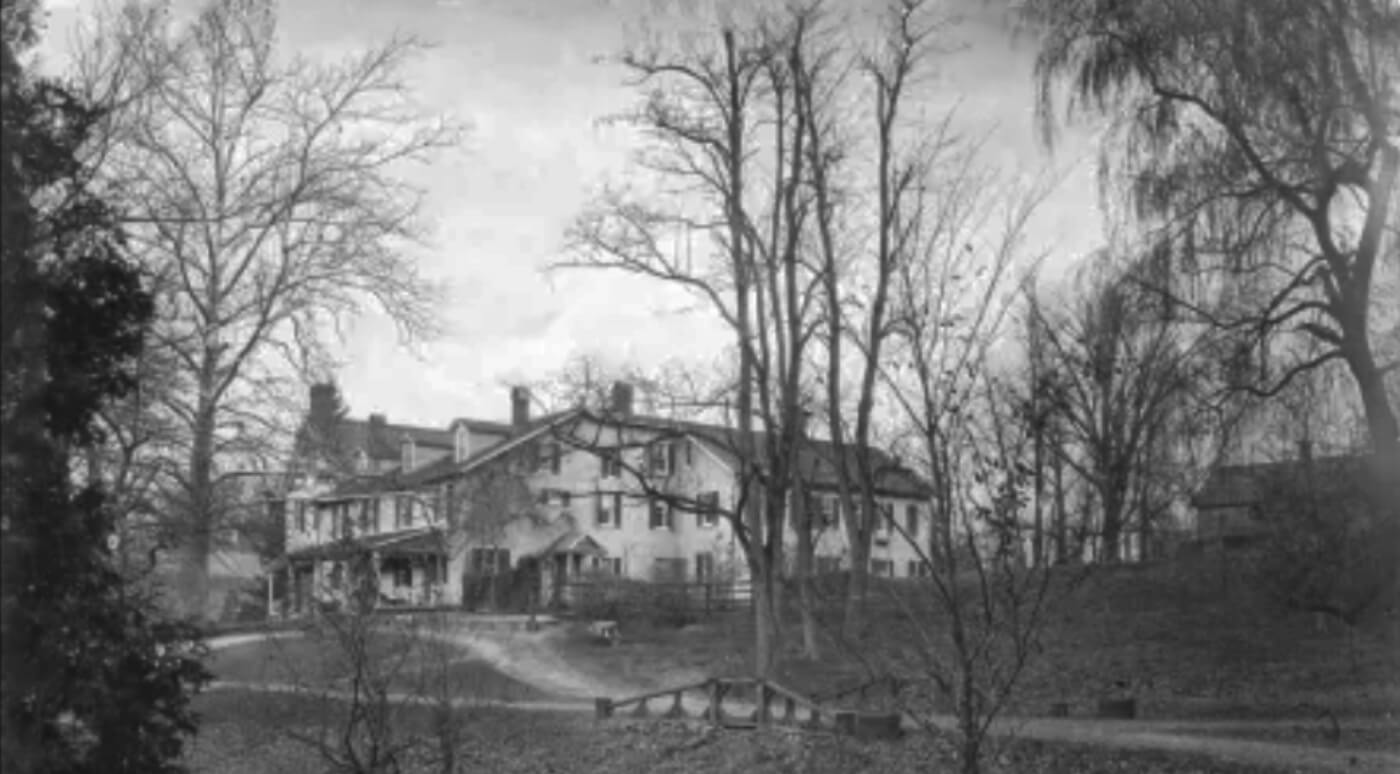

| Training Area E, |
In late 1942, as recruitment within the Office of Strategic Services increases rapidly, General William Donovan’s staff secures a new training facility known as Area E. This installation is officially opened in November 1942, with the specific purpose of instructing new recruits in the clandestine disciplines of Secret Intelligence, the covert branch responsible for espionage.
In contrast to the woodland camps used for paramilitary instruction, Area E comprises several secluded country estates and a former private school situated in the rural landscape of Baltimore County, Maryland, approximately 48 kilometres north of Baltimore, near the town of Towson and the hamlet of Glencoe. This configuration follows the British precedent of using remote manor houses for espionage instruction. Its proximity to Washington, D.C. and Office of Strategic Services Headquarters allows for convenient oversight while maintaining operational secrecy.
The initial mission of Area E is to deliver foundational training to future Office of Strategic Services intelligence officers, primarily those joining the Secret Intelligence branch and, in due course, the Counterintelligence (X-2) branch. It is, in effect, the OSS’s Basic Spy School, where personnel are introduced to the techniques required for covert work across theatres in Europe and Asia.
More advanced Secret Intelligence training is later undertaken at Area RTU-11, better known as “the Farm” in Lothian, Maryland. At Area E, however, Donovan seeks to instil the specialised skills, confidence, and adaptability needed for espionage and sabotage behind enemy lines. The training emphasises operations in occupied territory, including the recruitment of agents, intelligence-gathering, sabotage coordination, and support to local resistance movements.
By early 1944, Area E’s role is expanded following an effort by the Office of Strategic Services Schools and Training Branch to standardise induction training across the entire organisation. A two-week course, referred to as the “E-type” curriculum, is introduced to provide a shared foundational programme for all operational recruits, including those from Secret Intelligence, Special Operations, Morale Operations, and X-2. This curriculum is first implemented at Area E, making the facility a general induction centre for all Office of Strategic Services personnel, regardless of final assignment. While the experiment meets resistance from some branches, it marks a brief period during which Area E assumes a central function in Office of Strategic Services training doctrine.
| Training |
The training delivered at Area E is extensive and multifaceted. From its inception through 1943, the curriculum focuses heavily on espionage tradecraft for Secret Intelligence personnel. Recruits are taught surveillance, the collection and transmission of intelligence, recruitment of sub-agents, use of secret writing, cryptography, map reading, and the development of cover identities. Operational security is paramount trainees abandon their real names and ranks, don neutral uniforms, and adopt aliases.
The curriculum is hands-on and immersive. Trainees rehearse deception, escape and evasion, and infiltration techniques within controlled environments designed to simulate enemy territory. The emphasis is not only on tradecraft but also on the physical and mental fortitude necessary for covert operations.
With the implementation of the “E-type” basic course in 1944, the curriculum is broadened. All operatives receive condensed instruction in skills traditionally associated with other OSS branches. These include hand-to-hand combat, the use of pistols and submachine guns, demolition and sabotage methods, clandestine wireless operations, Morse code, basic field medicine, and infiltration and exfiltration techniques.
Instructors at Area E include specialists in close-quarters combat, among them Captain William E. Fairbairn, a British expert in silent killing and unorthodox warfare. Though Fairbairn lectures at several Office of Strategic Services training locations, his influence is felt at Area E through the incorporation of his methods into combat instruction.
Psychological and political warfare also form part of the training. Recruits study propaganda techniques and Morale Operations, learning how to spread misinformation, manipulate enemy morale, and undermine occupying forces. Counterintelligence is also introduced, preparing officers to identify double agents and detect hostile infiltration. This reflects Area E’s increasing alignment with the X-2 training programme from 1943 onwards.
The training regime is realistic and rigorous. Declassified accounts describe scenarios such as final field exercises in which trainees are tasked with penetrating secure industrial sites. One such exercise in 1943 involves an Office of Strategic Services candidate being transported to the Area E-3 facility on the Nolting estate before undertaking a mock infiltration mission at a Baltimore shipyard.
Trainees are constantly assessed. Those deemed unsuitable, whether for lack of discretion, inability to handle stress, or failure to meet performance standards, are removed without notice. This enforces discipline and emphasises the seriousness of the organisation’s security culture.
Area E is one of the few Office of Strategic Services facilities to train both men and women. Given the significant roles played by women in intelligence and courier operations, mixed-gender instruction is both logical and necessary, setting it apart from the male-only paramilitary camps operated elsewhere.
| Multimedia |
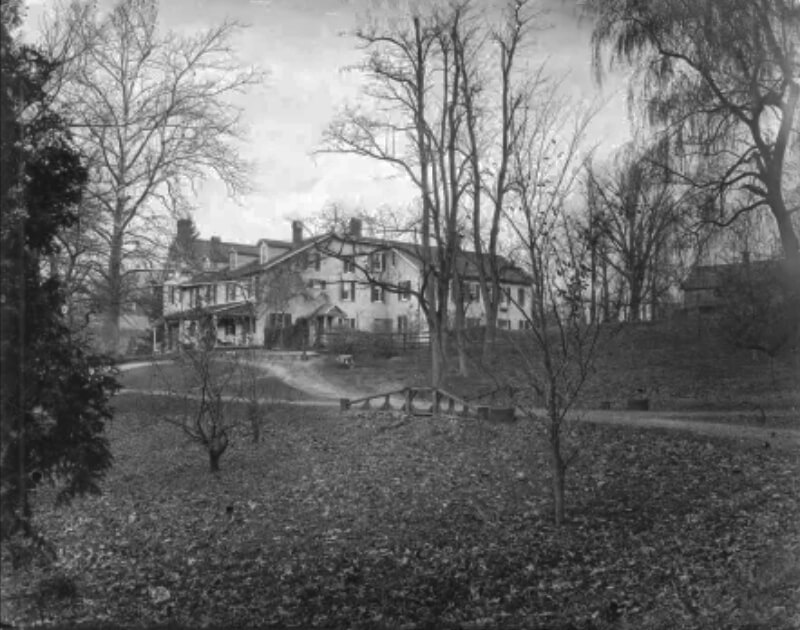
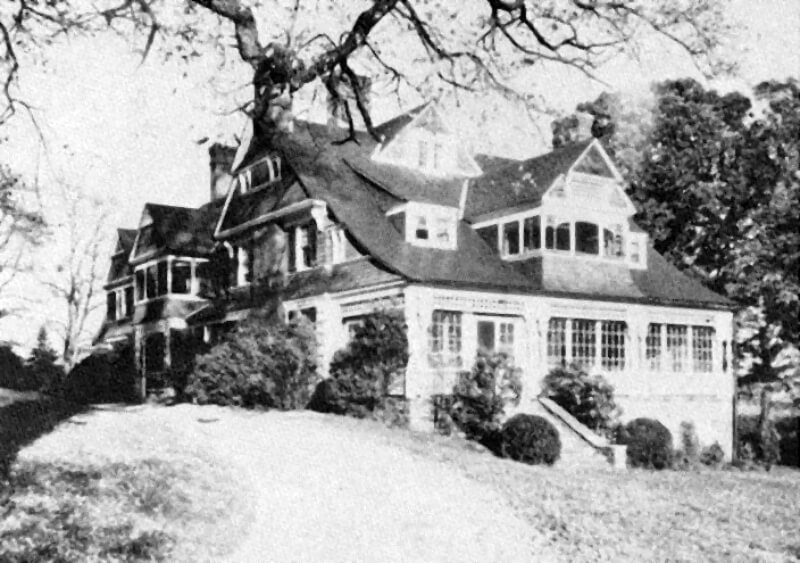
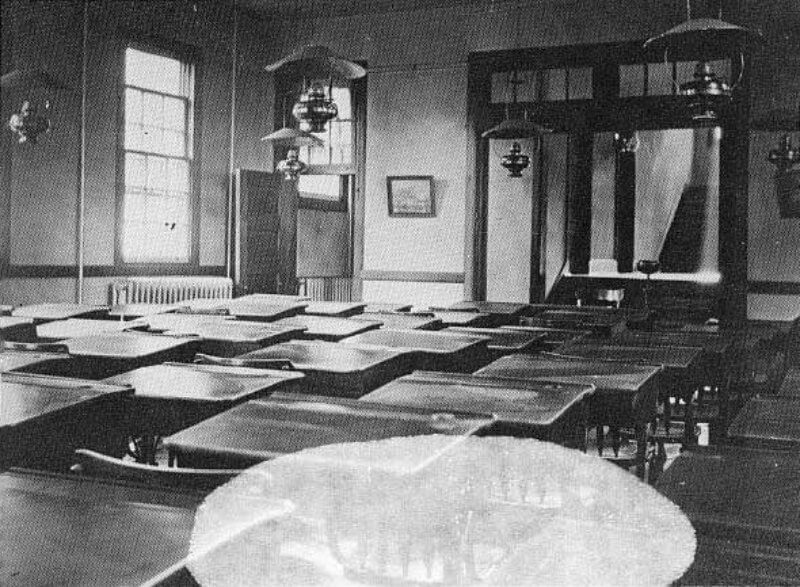
| Area E |
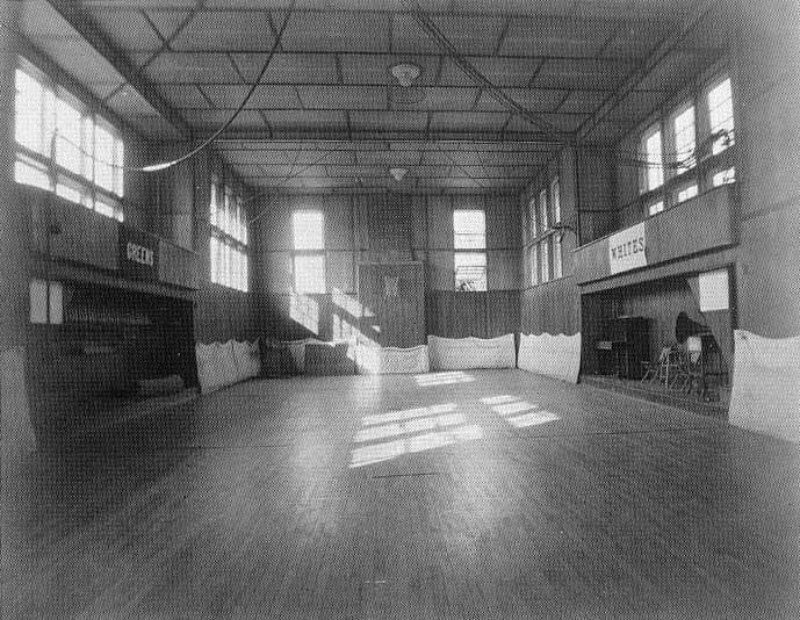
Area E occupies a unique position among the many training facilities operated by the Office of Strategic Services during the Second World War. Unlike the contiguous woodland camps commonly used for paramilitary training, Area E is not a single self-contained complex. Instead, it comprises a network of country estates scattered across the rural landscape of northern Baltimore County, Maryland. For administrative purposes, these separate properties are collectively designated by the OSS as “Area E.”
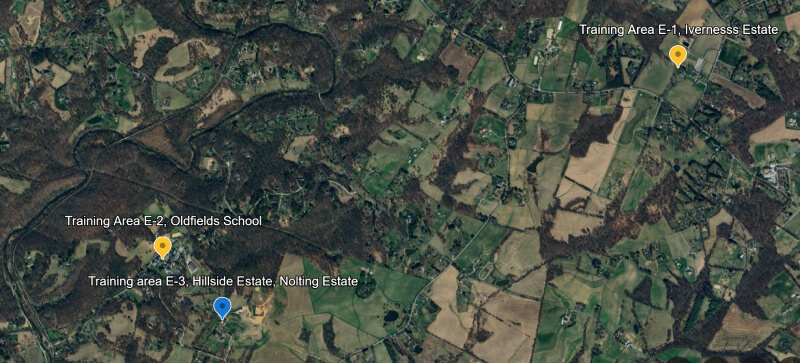
This decentralised structure is designed to suit the covert nature of the activities carried out on site, with each sub-location adapted to fulfil a different training function. According to surviving Office of Strategic Services records, Area E consists of three principal facilities: Inverness estate (E-1), Oldfields School (E-2), and the Nolting estate, also known as Hillside (E-3).
Together, these three sites provide training accommodation for approximately 165 students, supported by a cadre of instructors and a logistics staff numbering close to fifty. Due to their separation across the county, personnel frequently travel between the locations by vehicle. Office of Strategic Services trainees arriving from Washington, D.C., typically disembark at the Phoenix, Maryland railway station, located just south of Glencoe, before being transported by car to their assigned site, most often E-3.
In addition to the physical training grounds, the rural surroundings provide the privacy necessary for instruction in surveillance, escape and evasion, and clandestine fieldcraft. The proximity to Baltimore and Towson also enables the inclusion of urban infiltration exercises, such as a 1943 operation involving the covert infiltration of a shipyard.
| Training Area E-1 |
Training Area E-1 is the Inverness estate, located near Towson, Maryland. Its grounds spanned about 40 hectares of rolling farmland. The estate is situated in the historic My Lady’s Manor area, a rural district granted in 1713 and still largely agricultural. This country manor is under the private ownership of Leslie Kieffer and accommodates approximately twenty-four trainees at any one time. Inverness features a large manor house and open grounds that lend themselves to scenario-based instruction in espionage tradecraft.
Trainees at Inverness undertake practical exercises including mock surveillance, covert meetings, and escape drills staged both within the interior rooms of the manor and across the estate’s fields. Outbuildings are repurposed by instructors into simulated safe houses and operational hideouts. The estate’s rural setting makes it ideal for low-profile firearms training and controlled demolitions, activities which must be conducted without drawing outside attention.
Its location near the urban centres of Towson and Baltimore enables instructors to organise supplementary exercises in populated areas. These may include shadowing suspects, delivering dead drops, or blending into civilian environments, all vital skills for operatives assigned to occupied Europe.
| Training Area E-2 |
Designated E-2, the Oldfields School is an exclusive private girls’ boarding school situated near the village of Sparks-Glencoe. Temporarily leased to the Office of Strategic Services, the estate belongs to Major Watts Hill and offers purpose-built dormitories and academic facilities. This allows it to accommodate up to seventy-seven trainees, making it the largest of the three sub-sites in terms of capacity.
The School’s existing infrastructure makes it ideal for classroom-based instruction. Office of Strategic Services recruits use the lecture halls and seminar rooms for theoretical training, written assessments, and technical subjects such as map reading, intelligence planning, cryptography, and communication protocols. The site’s quiet and orderly environment is repurposed for espionage training without drastically altering the visual appearance of the school.
Though primarily focused on indoor instruction, the school’s grounds may also support basic outdoor drills and rehearsals. Its proximity to the other Area E estates allows instructors to coordinate multi-site training exercises involving both theory and practical elements.
| Training Area E-3 |
Known as E-3, the Nolting estate, also referred to as Hillside, is situated approximately one mile east of Glencoe village. In 1942, the estate is owned by Harry C. Gilbert and offers accommodation for around sixty-four trainees. Like Inverness, Hillside is a secluded rural property with expansive grounds and a main house adapted for use as a training facility.
Hillside is ideally suited for operational scenarios and field exercises. According to local accounts, the Office of Strategic Services leases not only the Nolting estate but also nearby Filston Manor for instructional purposes. These sites are adapted to simulate hostile territory: instructors convert barns and outbuildings into safe houses, set up obstacle courses, and prepare escape-and-evasion environments.
Recruits conduct surveillance drills, evasion manoeuvres, and clandestine meetings under simulated field conditions. The estate’s isolation allows for limited use of firearms and explosives without detection. Instructors frequently use the surrounding forests and trails to create realistic pressure scenarios that test trainee improvisation, stealth, and endurance.
Due to its central role in Area E’s training programme, E-3 serves as a primary receiving location for new Office of Strategic Services personnel arriving via Phoenix railway station.
| Multimedia |
| Operational Branches and Inter-Agency Tensions |
Although originally focused on the SI branch, Area E gradually comes to support multiple branches of the Office of Strategic Services. The X-2 counterintelligence branch begins using the facility for basic instruction once its own training structure matures. Personnel who later serve as spies or counterintelligence officers in theatres such as Europe or China frequently pass through Area E.
In 1944, as the E-type curriculum is introduced, the facility temporarily functions as a common training ground for all operational units. Special Operations, Operational Groups, and Morale Operations recruits begin receiving introductory instruction alongside intelligence officers. Previously, Special Operations and Operational Groups operatives trained primarily in woodland camps such as Area A and Area B, focusing on demolition, combat, and guerrilla tactics. At Area E, however, they are introduced to espionage, propaganda, and psychological warfare.
Despite this integration, inter-branch rivalries emerge. Some in the Special Operaations branch criticise Area E for over-emphasising lectures and theory at the expense of physical training. SI and X-2 officers, meanwhile, argue that certain material is outdated or irrelevant to operational realities. These disagreements contribute to the eventual abandonment of the unified training model.
Other Office of Strategic Services elements also interact with Area E. While Research and Analysis personnel seldom require field training, some attend portions of the basic course to familiarise themselves with clandestine methods. Communications (Commo) personnel, trained primarily at Area C in Virginia, occasionally visit Area E for cross-training purposes.
By the end of its operational life, Area E has trained a diverse cohort: spies, saboteurs, propagandists, and counterintelligence officers. Although the attempt to centralise Office of Strategic Services training proves temporary, Area E leaves a lasting mark. It not only serves as the crucible for America’s first large-scale espionage instruction but also contributes significantly to the professionalism and discipline of the intelligence officers deployed across theatres of war.
Area E ceases operations in July 1944 following sustained complaints from various Office of Strategic Services branches regarding its training structure. Nonetheless, Office of Strategic Services Headquarters remains committed to the underlying concept of a standardised induction course, the so-called “E-type” basic training, for all new operational personnel.
Rather than abandon the approach, the Office of Strategic Services opts to relocate the programme. By the latter half of 1944, a revised two-week Office of Strategic Services Basic Unit Training course is implemented at other sites, including Area A in Prince William Forest, Virginia, and select overseas training centres. This updated curriculum receives formal approval from the Secret Intelligence, Counterintelligence, and Morale Operations branches, and, albeit reluctantly, from Special Operations as well.
Thus, while the Towson facility is formally closed, the instructional model it pioneers endures. Schools and Training Branch Order No. 1, issued on July 21st, 1944, officially disbands Area E, retroactively effective from July 17th, 1944. Its cadre of instructors is reassigned across the Office of Strategic Services training infrastructure, carrying with them the practical lessons, both successful and flawed, gleaned from their experience at Towson.
By the final year of the war, the Office of Strategic Services training network encompasses sixteen sites, including newly established facilities on the West Coast and expanded assessment stations.