
| Page Created |
| August 7th, 2026 |
| Last Updated |
| August 14th, 2026 |
| Fiji |
 |
| Great Britain |
 |
| New Zealand |
 |
| Solomon Islands |
 |
| Tonga |
 |
| The United States |
 |
| Related Pages |
| 1st Commando Fiji Guerrillas Guadalcanal, 1st Commando Fiji Guerrillas New Georgia, 1st Commando Fiji Guerrillas Vella Lavella, 1st Commando Fiji Guerrillas Landing Craft Vehicle, Personnel |
| July 2nd, 1943 – August 12th, 1943 |
| New Georgia Campaign |
| Objectives |
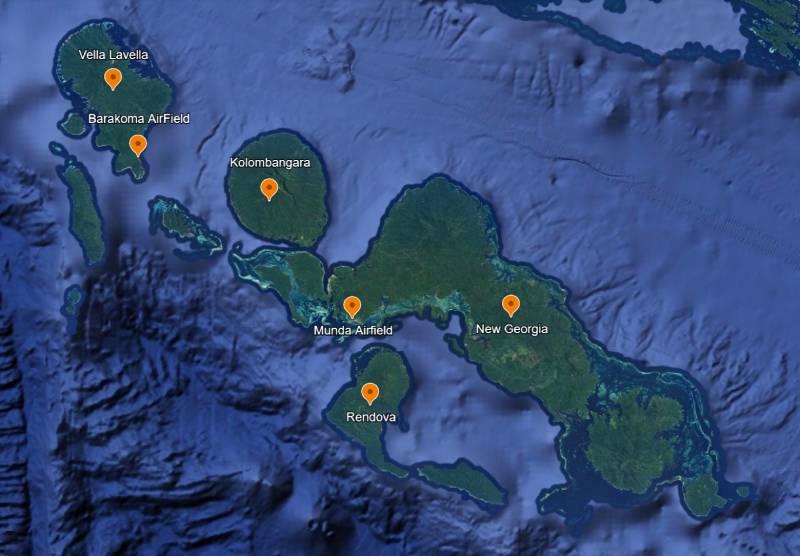
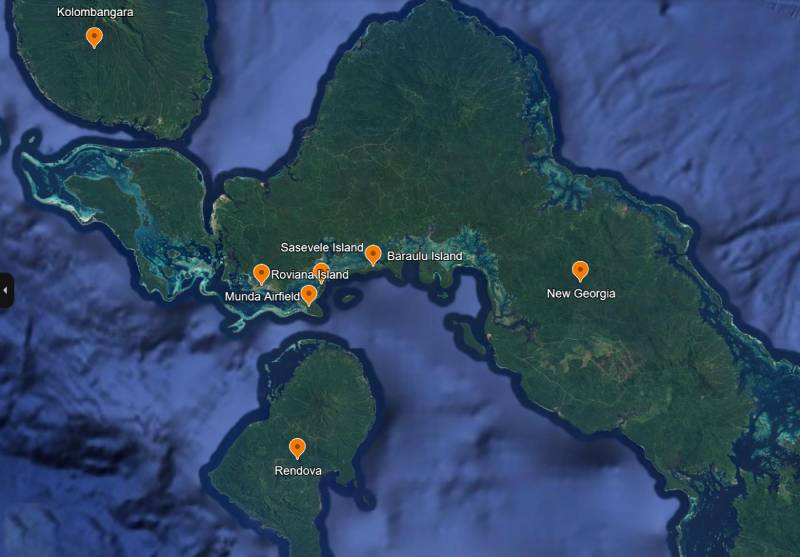
- The strategic aim was the capture of Munda Airfield, held by an estimated five thousand-plus Japanese within a 6.4-kilometre arc. The commandos’ specific objective within that was not to take ground but to provide reconnaissance and intelligence: patrolling from the right flank to the airfield, behind the Japanese lines, and keeping the Americans informed of enemy dispositions, strength, and any outflanking moves. In practice this widened into three concrete sub-tasks, feeling out enemy positions ahead of the American advance, acting as battle guides leading front-line American units, and finding and reporting a viable supply beachhead (which produced Laiana, the campaign’s decisive beachhead). The reconnaissance role was the stated objective; the guiding and the fighting were what the situation forced on top of it.
| Operational Area |
| Allied Forces |
- U.S. 43rd Infantry Division
- 169th Infantry Regiment
- 1st Commando Fiji Guerrillas
| Axis Forces |
- Japanese garrison of New Georgia
| New Georgia |
Tripp’s patrols stood ready to move at an hour’s notice. Through these anxious hours the commandos crowded round the wireless transmitter while the intelligence sergeant deciphered each message as it came. The suspense broke when the Operation Order arrived on June 24th, 1943. D-day for the commandos was set for July 2nd, 1943. That gave the non-commissioned officers seven days to weigh the plan and make final adjustments to their gear for the assault on New Georgia.
The order was comprehensive and laid out the unit’s opening moves in detail. But the New Zealanders, schooled by past experience, argued the situation from every angle and provided for every contingency. This habit of steeling their minds against sudden change made them wonderfully adaptable later in the campaign. The careful plans assumed Munda airfield would fall within ten days; it took thirty-five. They assumed the Onaiavisi Passage would serve only in the opening stages, with enough ground won in a few days to open an easier supply route. That proved wrong. The passage had to carry the whole thirty-five days of the campaign. In theory, two regiments of the U.S. 43rd Infantry Division would form a 3.6-kilometre front on the Bariki River, then sweep onto the Munda Field. The commandos were to patrol from the right flank to the field, behind the Japanese lines, and warn the Americans of any enemy attempt to outflank them. Over five thousand Japanese were reckoned to hold a 6.4-kilometre arc round Munda.
This knowledge of enemy strength was invaluable. It came from a New Zealander, Captain D. G. Kennedy, a member of the Solomon Islands Civil Administration. He had stayed on New Georgia throughout the Japanese occupation and kept the American command supplied with details of enemy movements up to the last minute before the attack.
First Commando’s small intelligence section was hard pressed to furnish maps for every patrol leader. The generosity of the 43rd Infantry Division helped greatly. The commandos used maps better than any other infantry unit, so the Americans gave them more than their quota of the latest hasty-terrain and photo maps. The New Zealanders studied them until they held a complete picture of the Munda area in their minds.
Every man was to carry his own equipment on his back, with some discretion allowed as to what he took besides his five days’ rations.
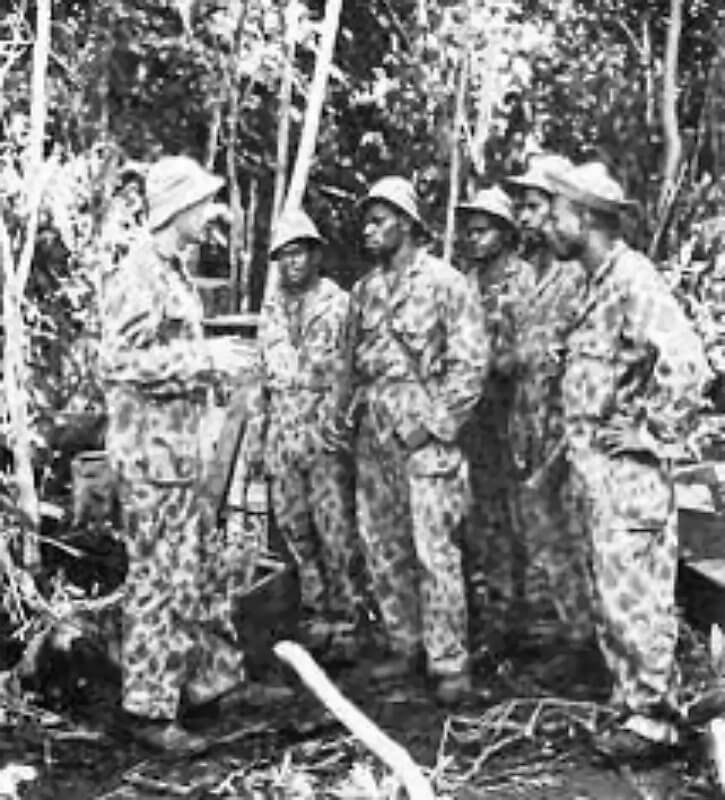
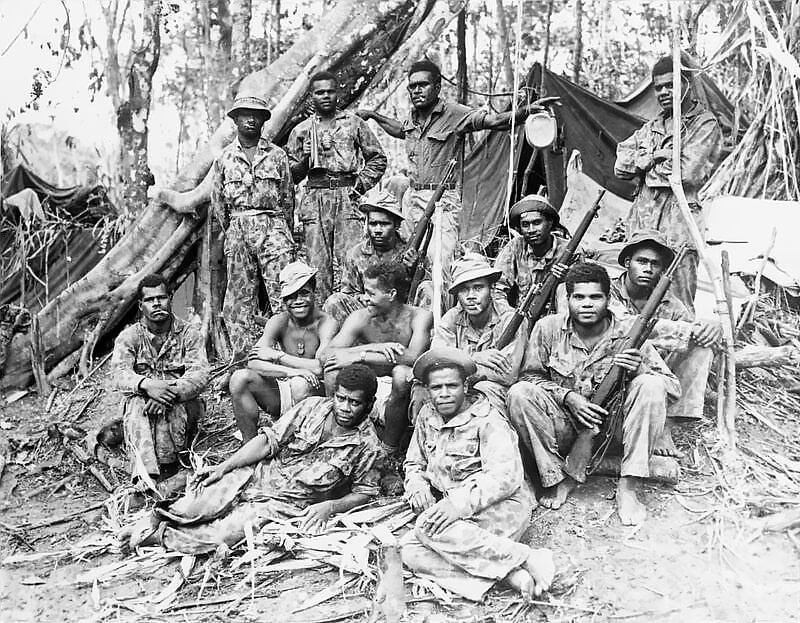
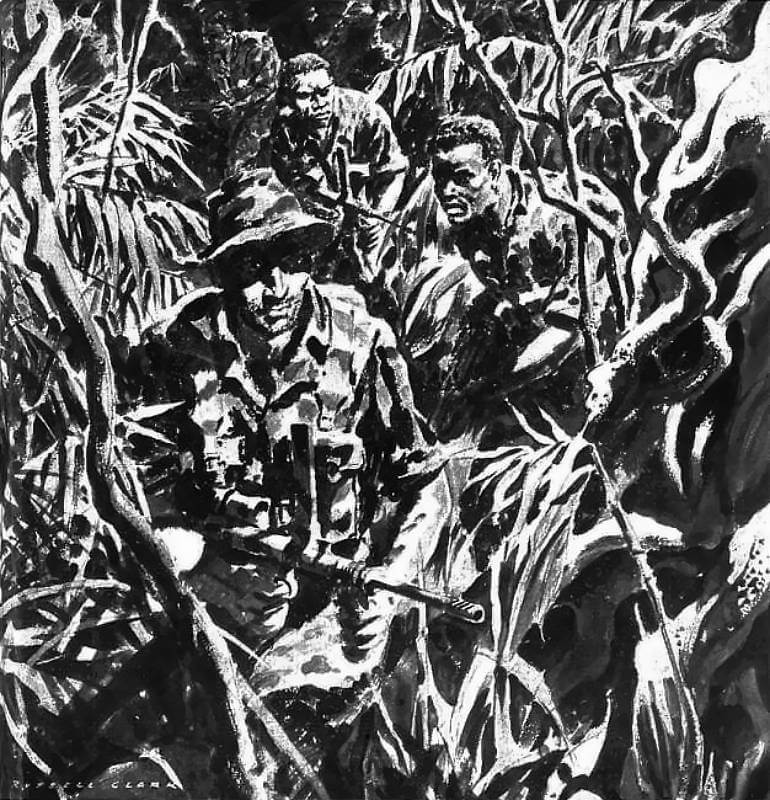
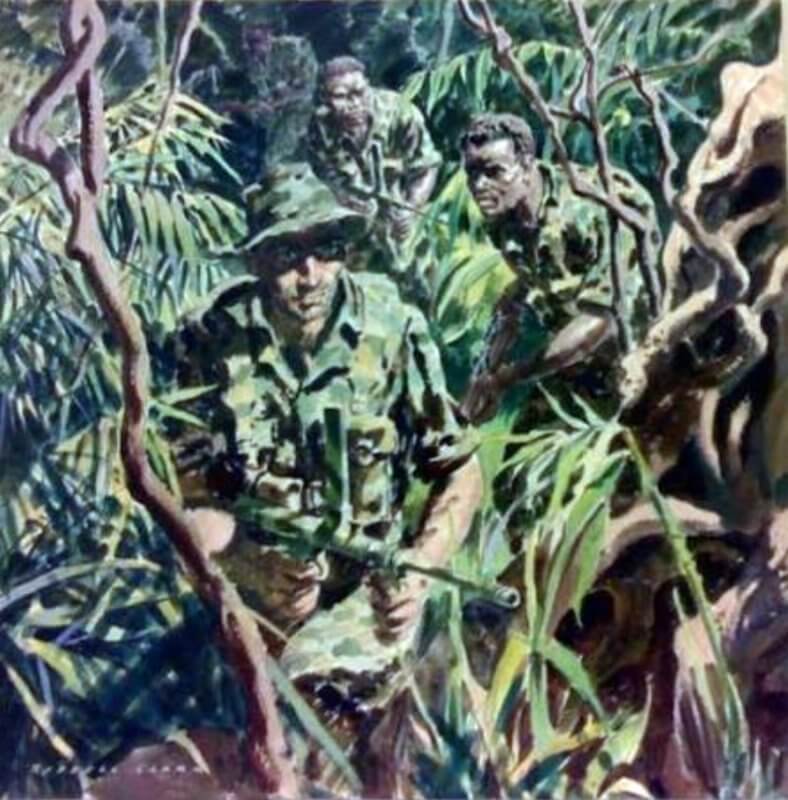
No green dye could be found for the Fijians’ light khaki battledress, so they were issued American camouflaged jungle-suits. This mattered beyond concealment; without it they risked looking like the Japanese. They wore New Zealand leather boots, better all round than the American canvas-and-rubber jungle-boots, which made the feet sore after a few hours. Tin hats and respirators went as far as the beachhead but were not worn on patrol. The New Zealand steel helmet serves poorly in the bush, though it helps in air-raids against the shrapnel that showers down from anti-aircraft barrages. It flops about and spoils vision in the undergrowth. Unless well covered, it rings out like the Bells of Saint Mary’s when struck by branches, and silence is golden in jungle warfare. By now the commandos bristled with automatic weapons and trusted them, thanks to long practice on Guadalcanal, where ammunition ran plentiful in the forward areas. They carried Owen guns, rifles, pistols, and grenades.
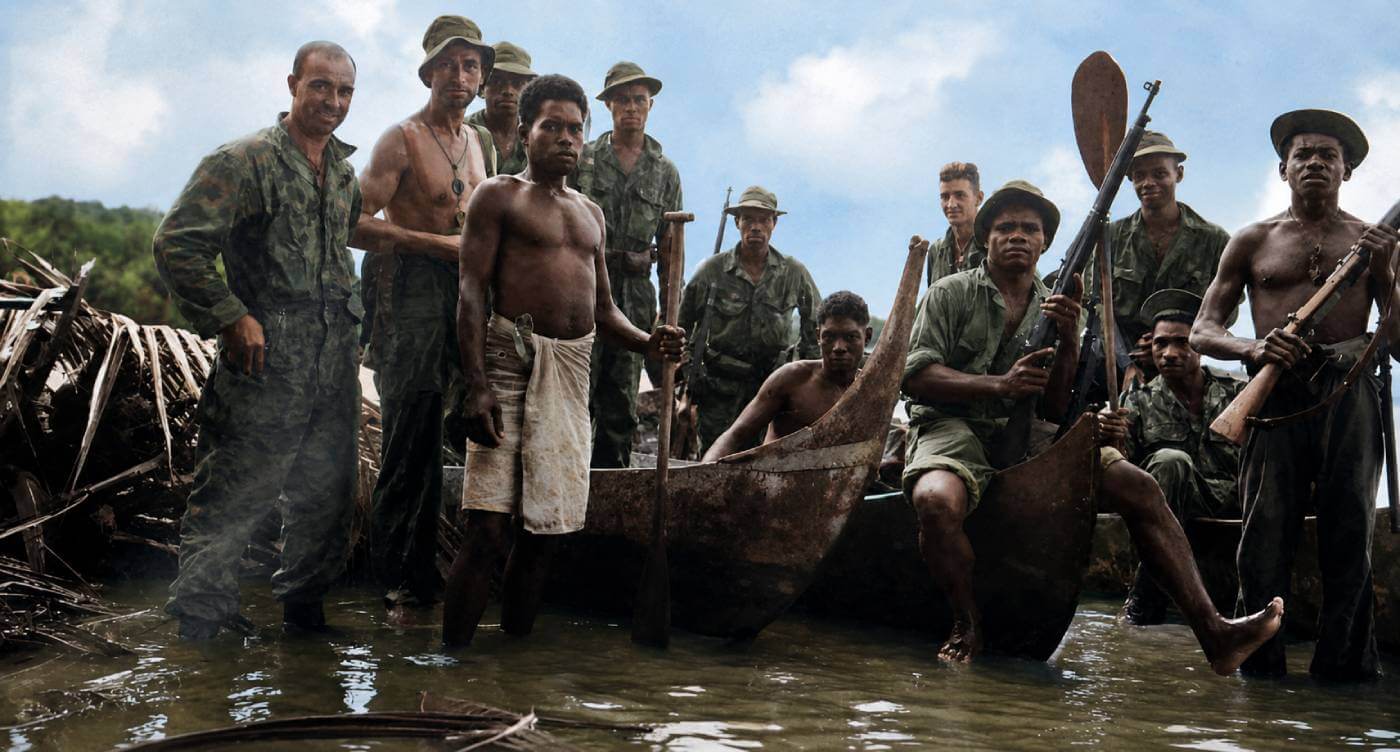
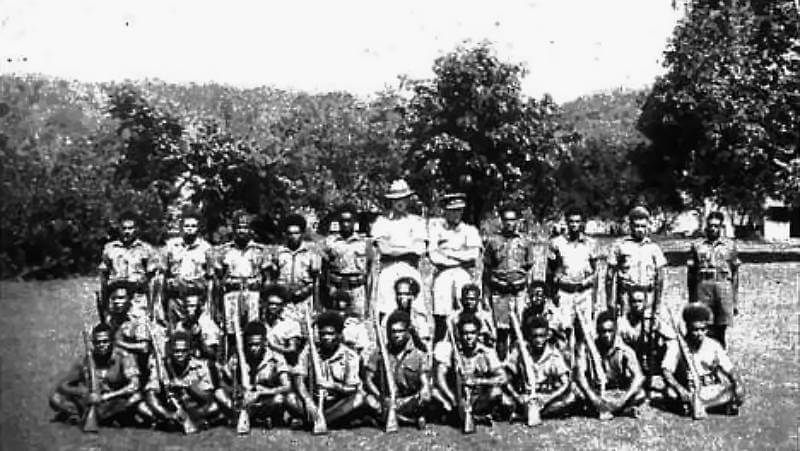
On July 1st, 1943, the radio announced an American landing on Rendova Island, just off the New Georgia mainland and about 11 kilometres across the water from Munda. The Americans had wiped out the small garrison of about sixty Japanese and set up a headquarters on the island. To the commandos waiting at Aola it seemed the show would be over before they arrived. A few days later their hunger to fight was more than satisfied. The dream came true, though it proved a nightmare. On July 2nd the American destroyer U.S.S. Talbot reached Aola Bay, and half the unit embarked. A storm blew up during the process, and the men were soaked before they scrambled from the Higgins boats onto the destroyer. It was an unlucky start; the clothing would stay wet for weeks. Just then the drenching troubled no one. The commandos were elated at the prospect of anything that would break the monotony of recent life. The party numbered twenty-three New Zealanders, two Englishmen, seventeen Tongans, eighty-seven Fijians, and one Solomon Islander.
The eleven-hour voyage was an experience in itself. The destroyer ran alone, trusting her speed to carry her clear of trouble. Three Japanese warships bore down on the Talbot late in the afternoon, then turned off her course. The commandos sat on deck and revelled in the speed. They also enjoyed three of the best meals they had had in a long time, and joked that the American Navy was feeding them up for the kill.
At midnight the Talbot hove to outside the Onaiavisi Passage, the entrance to the Roviana Lagoon. The commandos climbed down rope ladders into the Higgins boats, so laden with gear that a man overboard would have sunk like a stone. They landed on Baraulu Island and met some Americans who had come ashore the night before. The Americans had frightened off a Japanese machine-gun detachment at the passage mouth. Fourteen of the enemy had fled east along Baraulu; the rest, about sixty, had gone west along Sasavele and Roviana. There had been little action, but two men had been shot by accident in the night. In such darkness friend and foe could not be told apart, even touching. One trigger-happy man firing was enough to set the whole camp blazing at any moving shape. The commandos sat at the water’s edge, waiting for daylight to show them where they were.
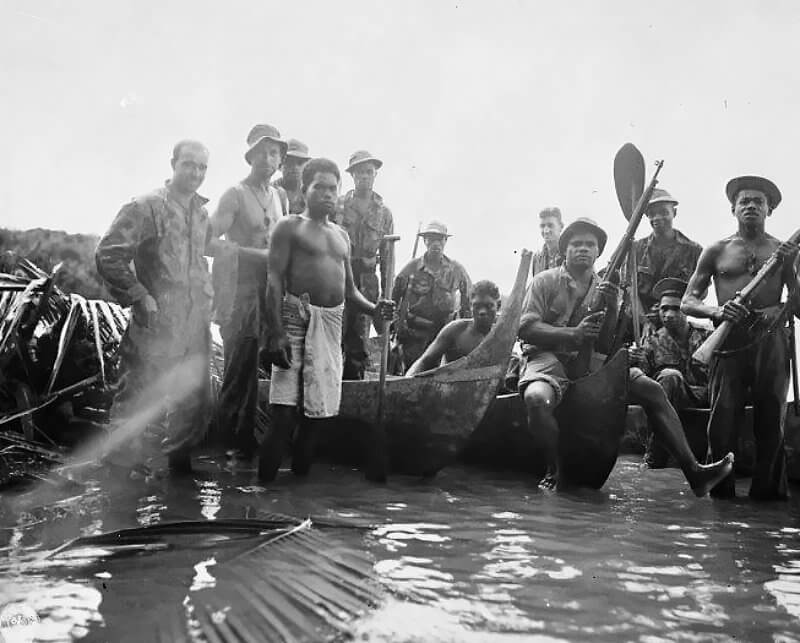
Their first task was to clear the small islands of Baraulu, Sasavele, and Roviana before crossing the lagoon to the mainland. Local natives were on hand with canoes. On July 3rd the Tongan patrol, with a New Zealand sergeant, used them to race across the Roviana Lagoon to the far end of Baraulu and cut off the retreating Japanese. Persuading the Solomon Islanders to ferry them across was no small feat, for the men were plainly scared. Still, Ken Crass prevailed after long argument in Pidgin, and they set out in three boats. The sun shone from a clear sky, and it was hard to believe war lay so close, with Japanese lurking somewhere among the dozens of jungle-covered islets. The lagoon lay glassy calm. Then came a roar of aeroplanes over the water, and the commandos’ hearts froze for a moment as they craned to identify the craft. They proved American. A moment later the men watched dive-bombers go into action over Munda Airfield a kilometres off. They counted dozens of planes diving through the Japanese flak; on so clear a day they could even see the bombs fall. Not one plane was shot down. The fireworks lasted only minutes, and the canoes paddled on to the north-eastern end of Baraulu, where they landed. The Solomon Islanders would not wait with the canoes unless six Tongans stayed to guard them, cutting the patrol to twelve. On foot they rounded the island’s eastern tip to a deserted village where the enemy was thought to be. They surrounded it and closed in, but a thorough search showed the Japanese had already slipped to the mainland. The patrol returned to the canoes and paddled back to the passage just before dark. Had they failed to reach the American camp by nightfall, they would have had to wait until morning, for the guards could not risk men approaching from the enemy’s direction in the dark.
That same day Tripp and the rest of the commandos moved west along Sasavele Island and on to Sturdy Point on Roviana without sighting the enemy. They bivouacked there and were joined by a platoon of Americans, who had come along the coast by Higgins boat because they could not keep pace with the commandos on foot. This party, now about a hundred and thirty strong, pushed on to the western tip of Roviana. There they found ample sign of a very recent, hasty Japanese retreat. The Americans proposed placing field guns on the point, only three miles from Munda, and wirelessed headquarters that it was safe to bring the guns forward. To save time, the commandos were to return to the Onaiavisi Passage in the Higgins boats that carried up the artillery. They were halfway through embarking when the Japanese began shelling them from Munda. Lieutenant Masefield got his patrol away in one boat, but Tripp and the rest had to take cover in the bush. Ben Masefield reached the passage that day. Tripp’s party chose to walk and did not arrive until noon the next day. The shells wounded no one.
Meanwhile the Americans had landed on the mainland at Zanana, 11-kilometre from Munda, unopposed. Captain Scherrer, intelligence officer for U.S. 43rd Infantry Division, to which the commandos were attached, made the beachhead with some of his staff and a reconnaissance platoon, about forty men. The original plan called for far more assault troops, but with these held up, Scherrer used his initiative. He knew the Japanese had been wholly surprised on the outer islands, and he judged rightly that they would pull their small Zanana detachment back as they had pulled back from the passage.
A battalion landed at Zanana the day after Scherrer, and a New Zealand sergeant landed too, reporting to Scherrer on July 4th. Communication was poor between Zanana, the passage, and Force Headquarters on Rendova, and the New Zealander had to explain what on the outer islands had delayed the commandos. Scherrer was keen to move while the Japanese were off balance, but he waited for the commandos to feel out the enemy positions.
The Japanese had fallen back to their main defences round Munda, though one had been taken the first day. With nowhere to hold the prisoner overnight, Scherrer and another officer had slept with their arms round him. When the New Zealander arrived next morning, the man was begging to be shot. He had little English, and it seemed he distrusted the fine treatment he was getting. Most Japanese prisoners in the Guadalcanal campaign had been nervous at first, then calmed once they saw they would not be tortured.
The American battalion decided to push to the Bariki River on July 4th, and the Tongan platoon, brought over to the mainland, went forward with it. The battalion cut a track through the coastal swamp to the mouth of the Bariki, three miles off. A patrol of five Japanese attacked one American company on the way, and the Americans cut them down before they could do harm. The five had crept within three yards yet were killed before they could throw their grenades. The Americans were so shaken by their first success that the dazed company commander asked the New Zealand sergeant escorting the Tongans what to do next. The New Zealander felt as squeamish as anyone present. But with a naturally ruddy complexion, against the pale Americans, he looked all confidence. The Japanese bodies seemed as pathetic as the waxy carcasses in a butcher’s shop. None stood over five feet, and their limp, delicate hands looked unfit to wield a weapon. The New Zealander searched the bodies for identity discs and documents, sent back to Force Headquarters for the language section. One American took a sabre from the dead Japanese officer, but most of the men were in no mood for souvenirs.
Once the battalion had set up a perimeter on the Bariki’s eastern bank, the Tongan patrol scouted the ground and bivouacked out in front without seeing the enemy. They woke to find that some Japanese had spent the night close by. Both sides grasped the situation at once and took cover to size each other up. In doing so, a Tongan and a Japanese dived behind the same tree. In the confusion the Japanese was unsure of the Tongan’s nationality and asked whether he was Japanese or American. The Tongan answered with a bullet. The rest of the enemy withdrew at the shot, and the Tongans returned to battalion headquarters. They reported the enemy’s position, but nothing further was done.
Seeing how much the battalion had abandoned along the way, ploughing through mud to the Bariki, the New Zealand sergeant returned to Scherrer at the beachhead. He suggested moving supplies along the coast by native canoe. Word went to the Onaiavisi Passage for Masefield to bring the canoes and his patrol across to the mainland, where he arrived at midday on July 5th. Scherrer meant to set up an advanced headquarters in the upper Bariki and, if he could, place his wireless transmitter on high ground for better reception. To this end a party of thirty commandos and a dozen Americans set off along the Munda Trail at one o’clock. The gear forced them into single file on the well-marked track. Besides their personal kit, the Americans bore the wireless transmitter, receiver, and generator, and the commandos carried extra gear for the Tongans. Barely 1.5 kilometre into the silent jungle, all hell broke loose. The enemy had a machine gun on the track and opened up on the Americans in front. The Americans threw grenades and went to ground, and the Japanese fell back about a hundred yards, probably to a better spot from which to judge the opposing strength. Masefield seized the lull to organise the commandos’ attack. After a quick whispered word he took the lead, the non-commissioned officers holding the flanks, and they went forward again with the Americans in the middle. Masefield got his first shot in at a few metres, and the fighting ran close. The Japanese threw many grenades, loud but harmless. The commandos held their fire where they could, working round the enemy’s flank, but each time they closed the Japanese withdrew. They formed a closed perimeter, each man two or three yards from those beside him, and advanced in that circle against ambush. Visibility fell below 10-metres here, and the men at the rear could tell the fight had swung to their side only by the bullets clipping the undergrowth. About fifteen Japanese seemed to be present. For all their shouting, they showed themselves so little that no proper aim was possible.
The commandos had trained to shoot only at something, and their silence had the Japanese bluffed. The enemy could see them creeping round the flanks and threw everything they had; grenades, rifle, and machine-gun fire flew everywhere, and it seemed a wonder anyone escaped so much lead. But the dark, dirty, stinking jungle has its compensations in cover from fire and view. The Japanese would not hold their ground and plainly kept retreating for fear of being outflanked. Commando tactics mystified them, used as they were to American methods. The Americans usually advance behind a blaze of fire, shooting at anything, trusting firepower to carry them through.
In this fighting the aim is to outflank the enemy while guarding against ambush. If you cannot reach him from the side, you root him out from cover with grenades. Rifle fire from the front counts for little against jungle cover, but a grenade thrown past the tree that hides him will likely catch him with the cross-burst.
The commandos kept working round the side, but the enemy fell back about a hundred yards at a time. They stacked the surplus gear near the track, hoping to move faster and catch him, but he retreated quicker after each clash. As dark came on, the commandos gave up the chase. It was too late to set up headquarters in the upper Bariki, so they turned off the Munda Trail to the river mouth and made their headquarters with the battalion bivouacked in the swamp.
The fight had run on and off for three hours, pushing the Japanese back nearly 3 kilometres. Yet the commandos fired under a hundred rounds and threw about five grenades. The Japanese fired something like a thousand rounds and threw over twenty grenades, and may have used a two-inch mortar too, though the commandos could not yet tell the enemy weapons apart with certainty. Distant bombs falling on Munda added to the din, and two thunderstorms broke that afternoon.
The Fijians were bewildered by the noise, but training carried them, and they did the right thing by instinct and followed their six New Zealand non-commissioned officers well, given their state. Late in the afternoon they were badly shaken when one of them, Emosi, took a bullet in the shoulder. Certain he was dead, they would not go near him. A New Zealand sergeant rushed over, stopped the bleeding, bandaged him, and got him on his feet, to Emosi’s own surprise. The other Fijians then came forward and made a stretcher to carry him to the battalion aid station.
The Europeans felt the strain of their first action too, but none lost self-control. They held one advantage over the Fijians: their minds were full of managing their sections. Worrying over others kept them from worrying about themselves, a little. The Americans and New Zealanders also had general education behind them. They knew machine-gun fire had its limits, knew when the Japanese were reloading and when to risk a move, and drew comfort from the American battalion not far off. The Fijians had no way to orient themselves. They could not read maps, and to them this was simply a patch of jungle, miles and miles from home. They left it wholly to their New Zealand leaders until they knew the ground. Their fear at Emosi’s wound was understandable; in training they had had no way to gauge the difference between a killing shot and a wounding one.
What the enemy lost that afternoon is unknown beyond some wounded. The commandos came off with their single casualty, chiefly through the enemy’s poor marksmanship and the weakness of the Japanese grenade.
Once the decision came to head south to the Bariki mouth, there was no time to go back for the extra gear. Some Tongans went for their packs at daylight, but found a number of Japanese guarding them. Too few to attack, they left the packs, not recovered until days later when the enemy was pushed from the area.
The battalion had settled in its swamp bivouac, untroubled by the enemy. It was waiting for two other battalions to reach the Bariki before it moved. But those two were held three days on Rendova, reforming after heavy losses in an air-raid. They had landed on Rendova on July 1st, only for Japanese bombers to catch them before they had dug their foxholes. It was a cruel stroke for the Americans, upsetting the whole timetable. By the time the attack began, the Japanese had recovered from their surprise.
On July 6th, 1943, Ben Masefield led a patrol into enemy territory behind Munda Airfield. It crossed many tracks but saw no enemy. At last it bivouacked overlooking the Bairoko–Munda trail, the likely route of enemy evacuation or reinforcement, whichever the Japanese chose. From 8 kilometres inside enemy country, this patrol would send back the information that gave the Americans the key to the whole campaign.
That morning Tripp’s party reached the Bariki, and unit headquarters was set up inside the American perimeter, which became the front line a few hours later. The hope had been to place commando headquarters apart from the American units, so the men could sleep after their long patrols behind the lines. That had to be dropped. Communication was poor, and the commandos had to report their reconnaissance straight to the American commanders in the front line, or the information would be stale before the Americans could act.
The American battalion meant to send a company to clear out the Japanese the commandos had fought on the Munda Trail the day before, but held off until afternoon. By then the enemy had recovered and, with reinforcements, dug in firmly on a knoll a few hundred yards north of the battalion, on the same side of the river.
Several commandos guided the American company to the enemy on the knoll, and the fight for Munda began in earnest. No regular front could hold in the thick bush, and small groups fought in every direction. The enemy got right behind the battalion bivouac and showered it with lead, and cut the telephone wire back to the beachhead. No troops held the three-mile stretch between beachhead and battalion to stop such infiltration. Three Tongans, Inukia’agana, Mahe, and Vave, killed five of the enemy and helped carry back the wounded Americans. Vave took bullets in the calf of each leg and two in the upper arm, yet reached the first-aid station unaided.
The fighting eased towards dark, but the Japanese harassed the bivouac all night. They screamed as though being knifed, to unnerve the Allies into shooting one another in the dark. They drew fire from the perimeter, then tossed a grenade at the muzzle-flash. All these old tricks, fully anticipated, worked well, and half a dozen Japanese could keep a battalion awake with ease. You can smell a Japanese a few yards off in the dark, but that gives no direction. The only course is to sit tight in your foxhole until he attacks, which is seldom. He sees no better in the dark than we do. He uses the threat of attack to set his enemies knifing each other and firing wildly among themselves. The urge to rise and strike at him in the dark is very strong at first, but the jungle soldier learns its futility and stays in his foxhole, swallowing the wretched sense of helplessness.
On July 7th, 1943, the battle resumed at daylight. The Americans tried to shift the enemy from his prepared positions atop the knoll with mortar bombs. But when the infantry pulled back for the barrage, he followed them down the hill, then returned to his dugouts the moment it lifted. No advance was possible that day.
During the night Japanese snipers had entered the bivouac and hidden in the trees, easily done amid the frequent thunderstorms. They lay doggo by day until the perimeter fire rose to a crescendo, then took a pot-shot at someone well exposed in a clearing. They were no great marksmen, but they had the desired effect on morale. So cunningly were they hidden under green nets that they could not always be seen even when looked at straight on; even the sharp-eyed Fijians struggled. The Americans found shotguns useful for finding them; a burst of buckshot up each tree exploded any notion that the Japanese are indifferent to pain.
Two commando patrols made a six-hour reconnaissance of the enemy positions beyond the Bariki. One came back with a negative report; the other brought word of Japanese reinforcements moving round the American flank. The density of the bush shows in this: the two patrols worked only a few hundred metres apart, yet one pushed several kilometres into enemy country without seeing a single Japanese. A negative report served American intelligence as fully as a contact. They needed to know where the enemy was not, as well as where he was. The Americans meant to advance where the enemy was absent, for they could not move three battalions bodily through the jungle while fighting all the way. Every patrol demanded the same skill and daring. The usual long-range practice was to leave the Bariki heading several hundred yards back towards Zanana, then turn north behind the fighting, cross the Munda Trail, then turn west and march by map and compass to the ground beyond the Bariki and behind Munda Airfield. The commandos could prowl the Japanese bivouacs unseen more freely 6.5 kilometres inside enemy territory, where he least expected them, than a few hundred yards from the fighting.
The second American battalion reached the Bariki at the height of a battle on July 7th. Hearing the shooting on the flank, it rushed into the first battalion’s bivouac. The Americans on the perimeter took it for a Japanese battalion charging from the rear through the undergrowth, and stampeded towards the river. Some Fijians and a couple of New Zealanders, not knowing the cause, foolishly did the same. The mob might be running still had Tripp not stopped the rot. Though he could not see the cause of the panic, he stood up with some of his non-commissioned officers who held their ground. Then he bellowed above the din, “Get back in your bloody fox-holes and stay there!” Such was the command in his voice that he stemmed the tide, and all returned to their posts, no doubt mortified to learn they had fled their own comrades.
The American battalion had run out of rations, and the small commando unit gave all it could spare. The first of the commandos’ reserve ammunition and food came up the coast by native canoe. When the canoes reached the Bariki mouth, the Solomon Islanders heard the battle, leapt out, and fled through the swamp to the beachhead. The New Zealand non-commissioned officers, as handy with a canoe as any native, carried on up the river, and the rations were shared with the American units, some without food for twenty-four hours. The first wounded went out in these canoes. Over the next few days the commando quartermasters ran a transport service second to none, until American engineers turned the Munda Trail into a jeep road.
On July 8th three commando patrols went out beyond the Bariki, and Masefield sent back a report from the Bairoko trail.
The third American battalion reached the Bariki, and the Japanese were finally forced off the knoll and back across the river. The Americans now straddled the Munda Trail. Commando headquarters moved to 169th Regimental Command Post near the trail. Next day two patrols located the positions to which the Japanese had withdrawn, about a thousand yards north-west of the American camp.
That same day a Fijian helping the quartermaster at Zanana assisted some Americans in taking five unarmed Japanese who had swum in from an island in the Roviana Lagoon. Weak and hungry, they had been part of the force that eluded the commandos on the outer islands at the landing.
The campaign was now a week old. After a brilliant start, it had settled into a war of attrition with no spectacular gains. The Americans pounded Munda day and night with artillery from Rendova, 10 kilometres off. By night the Navy stood off Munda Point to aid the guns; by day American dive-bombers pierced the Japanese anti-aircraft fire to keep the airfield out of action. This softening-up did not, as hoped, drive the enemy from the island. It forced him into the jungle, where he fought the American infantry desperately. His scant artillery was almost knocked out in the first few days, but his mortar fire proved very effective. Mortars were the heaviest weapons usable near the front, since artillery or bombs from afar were sure to hit friend and foe alike. Mortar observers on both sides had to climb trees, and even then saw little, directing fire only at a few good targets. Later, when the fighting moved into the thinner-wooded ground round the airfield, artillery came into its own.
The Japanese soldier was ready to die for his country. Even so, he took great pains to dig in and camouflage his positions. Commando patrols had to get right into a bivouac to see it. The snipers held the most wretched perches for hours, waiting for a target to move into their fire. But their manner seemed one of resignation rather than well-directed courage; often they threw their lives away for nothing. They seemed small-minded, leaning on their officers to plan an attack, though they needed no officer present to carry out orders. The cunning they showed in night harassment was probably taught them, for it ran to a pattern. It kept working because fresh men reached the American lines daily, and all the foreknowledge in the world would not banish the cold shivers of the first few nights’ experience. The men who made the night attacks were a specially trained company. In later weeks, when these were killed, the ordinary infantry tried the same tactics and notably failed.
That special company was helped by the American battalions sitting in one bivouac night after night. So many saplings had been felled for shelter that the place was now a great clearing, easy to find. The company also captured some American grenades and put them to good use.
The Japanese were slower than the Americans to change tactics and more open to surprise. This likely owed to their early easy successes, when they always attacked and never had to guard against counter-attack. So badly was the enemy caught off balance in the first days on New Georgia that he had not ranged his artillery on the narrow Onaiavisi Passage, through which thousands of troops poured. It was later found he had expected a frontal assault across the Munda Bar.
The Japanese infantry’s usual response on contact was to fight back hard, whatever the enemy’s size, but their resolve was not bottomless. Their name for audacity rests on a few exceptional cases. The snipers bold enough to squat in trees inside the American bivouacs were the exception. Yet a soldier need meet only one such incident to fire his imagination and keep him wary. The Japanese had not yet changed from the 25 calibre to their later 7.7 millimetre weapons, so their small bullets more often wounded than killed. The enemy sometimes yelled to frighten his foe, but this served only on the first encounter; after that it gave his positions away. At times he threw grenades with no target, seemingly to demoralise by noise alone. Sometimes he cut off his bullet tips to make them deadlier and shorten their flight, the idea being that, if he surrounded an enemy party, there was less risk of hitting his own men. In the jungle there is no front line as in open country. Infiltration made it a jumble of little fights everywhere. It was guerrilla warfare throughout, and the commandos found the best fighting unit was about fifteen men, though situations varied and larger numbers sometimes served. Reconnaissance wanted as few as possible, but temperament had to be weighed, and such patrols usually ran to at least four. One man could move most freely round a bivouac, but very few had the nerve for it. Besides, one man’s reading of what he saw might be coloured by imagination, and a companion checked it.
Fighting in the jungle is an eerie, terrifying business, worse still for many Americans who had not braced their minds against the claustrophobic press of dense bush, quite apart from the fighting. To the New Zealanders and Fijians the jungle was second nature, and they felt safer in its cover than in open warfare like the desert. Even so, it was a nightmare at times.
| Reinforcements |
The commandos had now reached a serious state of exhaustion, and most were withdrawn to the little island of Bethleham in the Roviana Lagoon, where they were safe enough to sleep. On July 15th, 1943, this party moved to Rendova Island. Tripp, one sergeant, and four Fijians stayed at Laiana, and Sergeant MacKenzie’s patrol remained with the U.S. 169th Infantry Regiment.
With the Americans established at Laiana, only three miles from Munda, the fight for the airfield seemed to have reached its final stage. But a strong force of Japanese reinforcements crossed the hills from Bairoko and cut the American supply line between the fighting troops west of the Bariki and the original beachhead at Zanana. The ground between the Zanana beachhead, which held 43 Division’s headquarters, and the Laiana beachhead became a no-man’s-land, though the commandos crossed it often. At one point a battalion of the U.S. 172nd Infantry Regiment was cut off from the main body. Running short of rations, it had to ransack the packs left behind by the evacuated sick and wounded, while the air force dropped rations by parachute. Once Laiana was firmly held, the Americans blasted the coral inside the Roviana Lagoon and brought their Higgins boats along the mainland coast from Zanana. This tortuous supply route partly held up the advance.
Meanwhile on Guadalcanal, Captain Williams prepared reinforcements from the rest of 1st Commando there. They comprised fourteen New Zealanders, eleven Tongans, forty Fijians, and twenty-three Solomon Islanders, and they reached Rendova on July 16th, 1943. Williams crossed to Laiana to meet Tripp, and the two officers returned to Rendova to regroup the unit. Heavy enemy air-raids on Rendova and the lack of facilities there meant the American aid station evacuated all casualties clear of the war zone. Wounded commandos went out with Americans to any available hospital in the South Pacific. From the Rendova aid station, by warship or barge, they found themselves in hospitals on Russell, Florida, Guadalcanal, the New Hebrides, New Caledonia, and even back in Fiji. Two months passed before the Officer Commanding knew for certain where some of his men were, and then only because they wrote him personal letters. The Fijians were helpless in this respect, unless evacuated alongside a New Zealander. One Tongan, Inukika’agana, was returning to New Georgia from Guadalcanal on an LST when the ship was torpedoed. After a few hours in the water he was picked up by a Higgins boat and returned to Guadalcanal. There were many ways a man could be cut off from the unit with no New Zealander to look after him. When Williams’s party was en route for New Georgia, two Fijians fell ill with malaria and had to be put ashore at the Russell Islands.
On July 17th, 1943, Tripp and Williams conferred with XIV Corps Headquarters, now on Rendova. It was decided that Williams should take seventy commandos across to the New Georgia mainland while Tripp gathered the rest of his men.
Williams’s party reached Zanana late in the afternoon and was ordered forward at once to Headquarters of the 43rd Infantry Division, as a large Japanese force was approaching. The commandos manned the perimeter with the help of headquarters personnel, clerks, drivers, medical orderlies, and the like, who had not fired a rifle since their basic training. A very rapid small-arms refresher took place as they settled down for a grim fight. The Command Post was attacked soon after dark. Screaming and yelling, the Japanese rushed from the jungle in all directions. The commandos’ Owen guns cut them down before any could breach the perimeter. The Fijians could see in the dark better than anyone, and they not only met the onslaught superbly but shot with deadly accuracy. Tafa, a Tongan, shot a Japanese officer whose body the enemy did not recover. On him were found documents giving the full strength of the Japanese force and the details of its mission. Tafa and others were covering the Munda Trail, down which many of the enemy charged. When the Japanese were driven back, a pall of smoke hung from the long bursts of machine-gun fire. The officer had not been able to see Tafa’s foxhole. He approached with sword in one hand and grenade in the other, and was about two metres from the hole when Tafa’s Owen gun caught him.
The Japanese kept attacking through most of the night, dragging away their dead and wounded, but were finally beaten back by accurate shellfire from Rendova. In the morning thirty-four Japanese dead were found, too close to the perimeter for the enemy to retrieve. American casualties were light, and the commandos hardly scratched.
On July 18th, 1943, Williams made his headquarters at 43rd Infantry Division’s Command Post, keeping one patrol for local protection. Another patrol led a company of 148th Infantry Regiment to trace the line of the Japanese retreat. One Tongan was wounded when this patrol met the enemy beyond the Bariki, but after a slight skirmish the party broke off and returned to Zanana that night.
The same day Lieutenant Harper, Sergeant Collins, and thirteen Fijians worked through the enemy positions to relieve MacKenzie’s patrol at 169th Regimental Command Post, now near the Munda Trail about nine hundred metres west of the Bariki. Fighting his way out the next day, MacKenzie lost one man from his patrol, Isimeli, a Fijian.
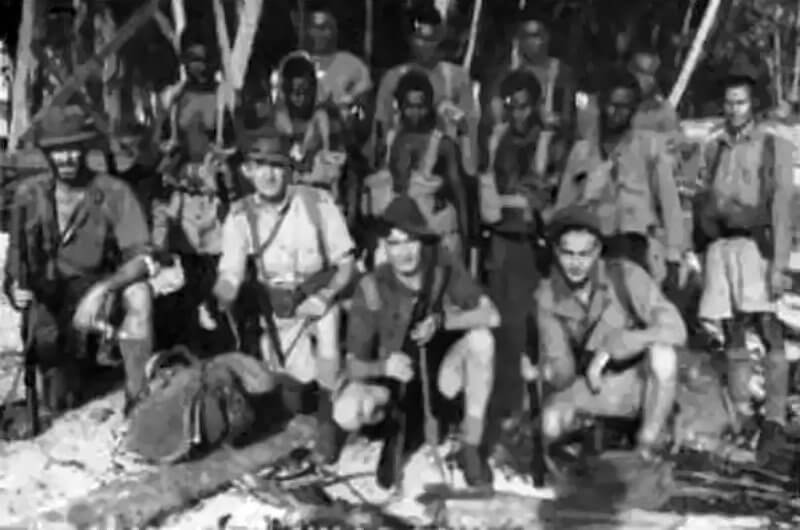
Another commando patrol began a long-range reconnaissance north of 169th Regimental Command Post. American units were being cut off by infiltrating enemy reinforcements. The situation was so desperate when Tripp returned to the mainland on July 19th, 1943, that he had to make up as many patrols as he could for attachment to American units. This meant cutting each patrol to about four natives and one New Zealander. Natives were plentiful, but there were too few New Zealanders to lead them, and no Fijian could work alone. A Fijian could go into enemy territory and return with ease unaccompanied, but since he could not then fix the enemy’s positions on a map, his reconnaissance would be useless. The New Zealanders by now had sound military knowledge and experience and knew what to look for. American commanders committed hundreds of troops on the strength of their reports, so the commandos bore a grave responsibility. Tripp’s many small patrols ranged over the enemy’s territory day and night, keeping the Americans supplied with vital information. For want of New Zealanders they could not harass the enemy, and their work was mainly observation, though they cut every Japanese telephone wire they came across. When they spent nights in American bivouacs they helped man the perimeter against the continued night attacks. Over these few nights the commandos accounted for several of the enemy without loss.
By now the 43rd Infantry Division had suffered severe casualties, and 37th Infantry Division came in to help. On July 23rd, 1943, the commandos were attached to 37th Infantry Division. First Commando had worked with this division in Fiji, and reunions under present conditions were often dramatic. Knowing the commanding officers was an advantage too. In the jungle it was suicidal to wear badges of rank, for the snipers were always after the leaders. New Zealand sergeants often told American colonels what to bloody well do, not realising to whom they spoke, and there were times when they only pretended not to know. The American senior officers were always approachable and co-operative and often asked the New Zealanders for suggestions on the plan of action. The New Zealanders did in fact know much of what the Japanese were doing and all of what the Americans were trying to do. So it was useful to have a New Zealander present, whenever possible, at the American commanders’ conferences. One general held up his conference over an hour, waiting for a New Zealand sergeant to report.
The 37th Infantry Division set its headquarters forward of Laiana beachhead, it now being clear that the rapidly changing jungle strategy could not be run without the commander on the scene.
Tripp received news of his promotion. He had been a major over a month without knowing it. He now made his headquarters at the Divisional Command Post, with patrols attached to various American regiments. These patrols paved the way for the American advance on the veritable fortress of coral the Japanese had built round the airfield. The enemy pillboxes carried layers of logs and coral, and a direct mortar hit had little effect on those inside. The infantry had to roll grenades down the tunnels at the rear, since the front apertures took only a machine-gun muzzle. One commando patrol, leading a unit of 161st Infantry Regiment, knocked out a pillbox entirely with a grenade perfectly lobbed by Iowani Naqamu. The same patrol guided an American mortar and rifle platoon into an excellent position, from which the Americans routed a strong Japanese force.
The following day Vic Skilling and Iowani led an American company through intermittent fire to the rear of Japanese positions on a ridge overlooking Munda Airfield. On this patrol Iowani sprained his ankle. It was still swollen the next day when Skilling had to go out on another patrol that promised to be dangerous and delicate, through Japanese positions. Tripp advised Iowani not to go, but Iowani said that if Corporal Skilling was going he wanted to go too. Tripp let him, thinking the ankle could not be as bad as it looked. The patrol pushed far enough into the enemy defences to be the first ground troops to set eyes on the airfield that had caused so much fighting. When an American doctor later examined Iowani’s ankle, he found it seriously sprained, and it must have been agony throughout the patrol.
The Americans had regained the initiative, and with flame-throwers and tanks, victory was in sight. The heavy bombardment had levelled the jungle round Munda, and where the American infantry struck open patches, the Japanese were plainly outclassed by firepower. Still the enemy fought bitterly, and the commandos’ charmed life wavered.
Corporal “Major” Duffield was working with 161st Infantry Regiment on another sector. On July 26th, 1943, as he pointed out the enemy positions to an American officer, a Japanese sniper shot him.
On July 27th,1943, Sergeant Bill Collins was killed trying to take a machine-gun nest at the ration dump of 148th Infantry Regiment, back on the Munda Trail. Collins had been slightly wounded twice some days before but insisted on staying in the fight. Seven of his Fijians were sent to Rendova to rest, and Collins went after Japanese snipers alone. The Americans credited him with personally destroying nine of the enemy and forcing several machine-gunners to retire. The commander of 148th Infantry Regiment, Colonel S.A. Baxter, reported that of all the officers and men who had served with him in combat, Collins stood out for his eager desire to close with the enemy, and that his devotion to duty had inspired his American comrades under fire for the first time. Collins had also given material help, the colonel added, in evacuating the wounded. He had volunteered to assist a platoon of American engineers who were fighting off Japanese while operating a bulldozer on a road near a ration and ammunition dump. The enemy, short of food, was attacking the dump heavily, and the engineers had to withdraw to allow a mortar barrage. After taking many risks to gather wounded, Collins was about to leave with the engineers when a burst of Japanese machine-gun fire caught him.
Sid Heckler was also attached to 148th Infantry Regiment. On July 27th, 1943, he and some Tongans were leading a section of Americans over by the Bairoko trail when they came on five Japanese telephone wires. Heckler called up some American automatic weapons to help set an ambush, then cut the wires. They waited only half an hour for the enemy repair party. Six Japanese, led by a sergeant-major, came up the track jabbering like schoolchildren. The ambush sprang, and not one of them moved more than two metres. The officer carried a list of casualty returns, valuable information, and his sword was later presented by the Tongans to their Queen in Tonga. The Americans repaired the lines, and a Japanese of the language section was escorted up to listen in on enemy conversations. These men of the American language section ran tremendous risks. They were liable to be shot by the Allied forces in the forward area, and had their own race captured them, their fate would have been too dreadful to contemplate.
On July 28th, 1943, thirty-four of the Fijians resting on Rendova were evacuated to Guadalcanal. Their nervous strain could not be eased on Rendova, so frequent were the air-raids. What little air power the Japanese had was concentrated on the American bases there, and twelve raids a day were not uncommon.
The commandos still had a dozen small patrols out on New Georgia, and as the Japanese lost their grip on the airfield, Tripp pushed the patrols farther north towards Bairoko. Early in August the enemy was retreating to Bairoko, but he still fought fierce delaying actions to keep the American units from linking up. Several battalions remained cut off by strips of no-man’s-land, and wounded had to be evacuated under strong armed escort. The commandos did much of this escort work and killed many Japanese who tried to ambush them.
On July 29th, 1943, Sergeant Ensor and four Fijians were fighting with U.S. 169th Infantry Regiment when Selesetino rescued an American soldier from a shell hole twenty metres from a Japanese machine-gun.
The Americans brought in another division to speed the enemy on his way, and on August 3rd, 1943, the commandos transferred to U.S. 25th Infantry Division.
The same day Lieutenant Paul Harper, who had been attached to several American units, was killed trying to relieve a beleaguered American detachment on the Bairoko trail. The detachment was in desperate need of water, rations, and ammunition, and Harper volunteered to lead a supply party to it. On the way, Japanese ambushed the party, but Harper led his patrol against them, killing them and taking their machine-gun. The party pressed on, carrying the captured weapon. As they reached the detachment they were mistaken for a Japanese force, and the detachment opened fire. Harper and one of the Americans were killed before the party could shout its identity.
During his attachment to 148th Infantry Regiment, Harper had carried out varied duties beyond patrolling. For several days he had helped an American battalion commander run his unit, so many American officers having become casualties. His death was as much a blow to the Americans as to the New Zealanders.
On August 4th, 1943, Brian Ensor too was killed, taking part in an attack with an American company. Ensor had done the reconnaissance for the attack the day before. Though due to leave the fighting area for a rest, he wanted to watch the attack and see the results of his work.
The next day, August 5th, 1943, Munda Airfield was captured, and large-scale organised resistance ceased. It was estimated that over three thousand Japanese had been killed and several thousand wounded during the operation.
Several thousand Japanese escaped to Bairoko, but many drowned when American naval and air forces sank their evacuating craft. The small commando unit, less than one per cent of the Allied force engaged, must have accounted for over six per cent of the enemy dead through its intelligence work. Eleven commandos were killed during the campaign. American losses were lighter than the enemy’s, thanks to artillery, air, and naval support, but their casualties would have been graver but for their splendid medical service and system of evacuating the wounded. Sixty-five per cent of the Allied wounded were hit in the extremities; legs could not always be kept behind cover. The proportion of wounded to killed ran high, because the small point twenty-five Japanese bullet had to strike a vital spot to kill.
| School of Experience |
| Aftermath |
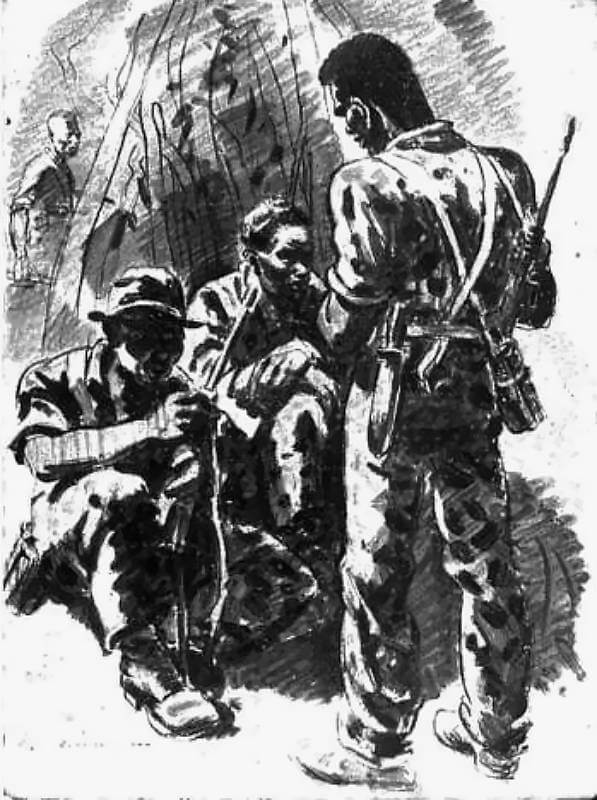
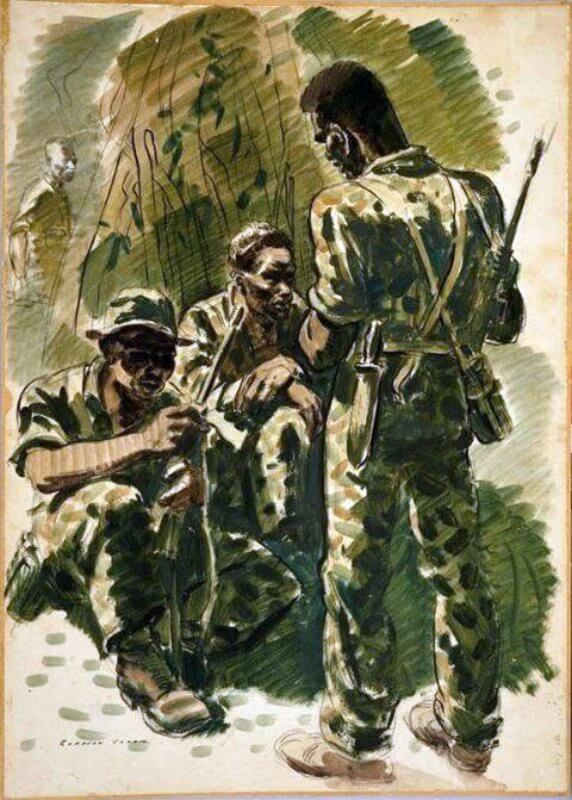
Before they adapted to jungle conditions, the American infantry approached Munda like a giant but timid snail nearing an ant hill. The commando patrols were the sensitive feelers that shot out from the snail and reported when the way was clear. The unit was too small to be called, precisely, the spearhead of the Allied force, though it came very close. Large infantry forces cannot be manoeuvred in the jungle, and the enemy too is forced to fight in small groups. Mind-conditioning is vital in the passage from training to the real thing. Plainly, if infantry battalions must adopt guerrilla tactics to any degree, they should be trained for it before battle, not during.
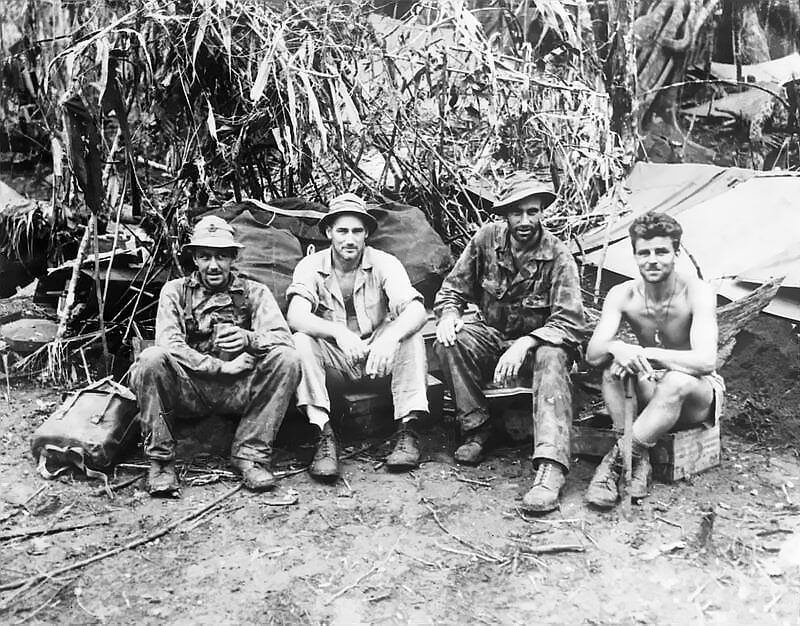
After the battle, the commanding general of the 37th Infantry Division issued a training memorandum to his forces. Peak efficiency, he wrote, comes from repeatedly negotiating slippery, rugged jungle trails under heavy loads. To get along in the jungle is to operate under combat conditions there, and to do it often enough that it comes with relative ease. There was no question this could be done, he said, the best illustration being the non-commissioned officers of the South Pacific Scouts, white men from New Zealand, whose capacity for traversing the jungle by night and day over many miles was equalled by none of his own troops.
Though the jungle round Munda cut visibility to a few hundred metres, the commandos had known far thicker bush in training in Fiji. The battle was confined to a few square miles, none of it as steep as the mountains of Guadalcanal or Fiji. The commandos had thus trained for harder patrols than action demanded, and their physical capacity was never fully stretched. But the nervous tension of long hours scouting behind the lines sapped vitality. It was only because the travelling itself came with relative ease that their vitality lasted as long as it did.
The Americans fought heroically, yet some must have found it hard to grasp what they were fighting for, on a wild, seemingly useless, jungle-covered island 1,600 kilometres from home, slogging their hearts out in fever-ridden swamps and living like animals for weeks on end. Conditions were severe. Rain fell throughout, and temperatures reached 35 degrees Celsius. Strangely, mosquitoes were not especially numerous, but other insects abounded. Several thousand men were evacuated with combat fatigue alone, and dysentery was common. The “C” ration grew unpalatable, and the men ate only enough to stave off hunger. Their diet fell out of balance too, for they ate the biscuits and threw away the meat, losing all desire for it after a few days’ action. The American units brought their cooking stoves as close to the fighting as they could, but many men went weeks without hot food. An occasional hot meal or drink stimulated the appetite even for “C” rations and could keep the troops’ strength up and their fighting efficiency higher. The Allied units had no “canned heat” of the kind the Japanese used to cook their rice. The commandos managed a hot cup of tea now and then from Solomone, the Officer Commanding’s batman. Solomone was an outstanding Fijian character, an asset throughout the battle as scout and morale-builder both. A clever clown in training days, with excellent English, he amused New Zealanders and Fijians alike. Most of all, he had an uncanny knack of producing a cup of tea under appalling conditions. How much these cups of tea contributed to the commandos’ endurance can never be measured, but their value was beyond doubt.
The strength of 1st Commando on New Georgia dwindled to eleven New Zealanders, twenty-eight Fijians, and six Tongans. These men followed the retreating enemy with 25th Infantry Division. Patrols kept the Japanese under close watch at Zieata in the north and Piru Plantation to the west, the plantation patrolled by Solomon Islanders under Len Barrow. The Japanese barges could be seen leaving various points, hoping to escape up the Kula Gulf, only to be intercepted by the American Navy. For a week the patrols reported the enemy’s evacuation. With little resistance met, the unit was withdrawn from the island. It returned to Guadalcanal on August 12th, 1943, to reorganise.
| Sources |