
| Special Forces Operations in May 1940 |
| May 10th, 1940 – May 13th, 1940 |
| Fall Gelb, Phase 1 |
| Fallschirmjäger, Infanterie-Bataillon z.b.V. 100, Brandenburgers |
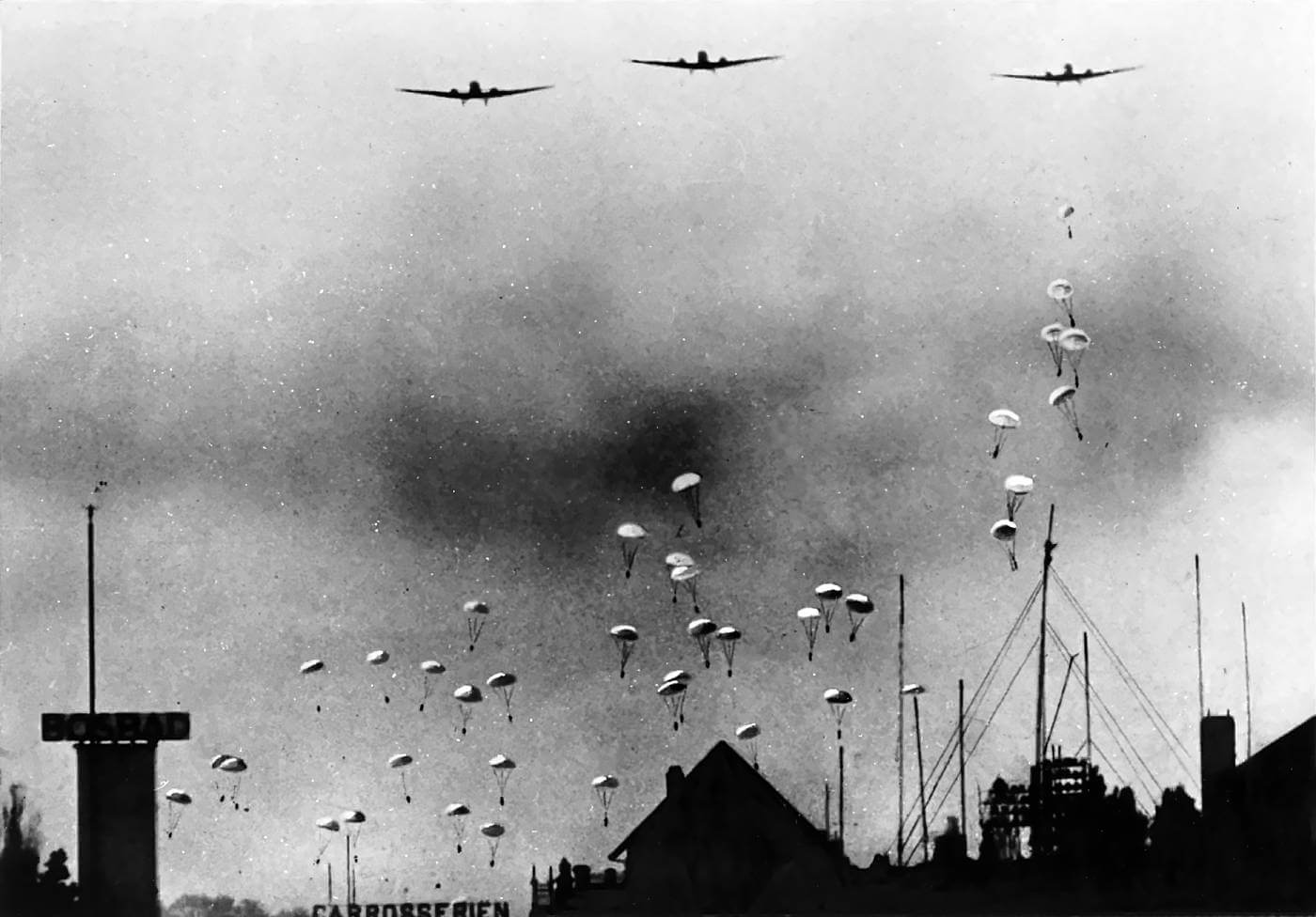
| Germany launches Fall Gelb in the early hours of May 10th, 1940. The offensive strikes simultaneously across three axes, catching the Allies in a strategic posture that proves catastrophic. Army Group B, under Generalfeldmarschall Fedor von Bock, advances into the Netherlands and northern Belgium. Its task is to draw Allied mobile reserves northward. Army Group A, under Generalfeldmarschall Gerd von Rundstedt, executes the decisive thrust through the Ardennes. Army Group C, under Generalfeldmarschall Wilhelm Ritter von Leeb, fixes French forces along the Maginot Line. The Allies interpret the German move into the Low Countries as the main effort. General Maurice Gamelin activates Plan D, ordering the best Allied formations, including the British Expeditionary Force under General Lord Gort, into Belgium. The French First Army and the BEF race north-east toward the Dyle river line. This is precisely what the German Oberkommando des Heeres intends. In the Netherlands, Fallschirmjäger and air-landing troops strike simultaneously at Rotterdam, The Hague, Dordrecht, and Moerdijk. The airborne assault aims to seize bridges and paralyse Dutch command before ground forces arrive. German paratroopers land on and around The Hague in a bid to capture the Dutch government and royal family. Dutch defenders inflict serious losses on the air-landing formations at Valkenburg, Ockenburg, and Ypenburg. The operation at The Hague fails. The bridges at Dordrecht and Moerdijk, however, fall intact. The 9. Panzer-Division races north from Maastricht to relieve the airborne bridgehead. At the Albert Canal, Sturmgruppen of Sturmabteilung Koch assault the canal bridges and the fortress of Eben-Emael in the pre-dawn darkness. Glider-borne engineers of Sturmgruppe Granit land on top of Eben-Emael at 05:20 hours and neutralise the fort’s artillery casemates with hollow-charge explosives. Sturmgruppe Stahl takes the Veldwezelt bridge. Sturmgruppe Beton takes Vroenhoven. Sturmgruppe Eisen fails at Kanne, the Belgians destroy the bridge before the gliders land. The fall of Eben-Emael and the capture of two intact canal bridges opens the route into Belgium for the 6. Armee. In the Ardennes, the armoured spearheads of Panzergruppe Kleist push through Luxembourg and into the Belgian Ardennes. General Erich Hoepner’s XVI. Panzerkorps advances into Belgium on Army Group B’s southern flank. The French and Belgian high commands assess the Ardennes as impassable to armour. French cavalry screening forces encounter the German advance and fall back. The decisive battle of the campaign is still days away, but the strategic deception is already succeeding. |
| May 10th, 1940 |
| Fall Gelb, Maastricht Gateway |
| Infanterie-Bataillon z.b.V. 100 |
| The Germans plan a three-stage assault to force the Maastricht Gateway. Covert sabotage teams of Infanterie-Bataillon z.b.V. 100 enter Maastricht the night before the invasion to disable demolition charges on the three Maas bridges. All three teams fail, intercepted, dispersed, or arrested at the last moment. Every charge remains intact. Sonderverband Hocke also from Infanterie-Bataillon z.b.V. 100 follows at 03:20 on May 10th, 1940: 88 men in Dutch Marechaussee uniforms, papier-mâché helmets, and Dutch-plated motorcycles. Their cover is already blown by a Berlin security leak. They fight through the outer defences, exploit a gap left open by a negligent Dutch platoon commander at Mariënwaard, and race toward the bridges through the city streets. A Dutch rearguard at the Akerstraat destroys the lead armoured cars and halts the entire column. By the time Hocke’s men reach the bridges, the Dutch have blown all three. Sint Servaasbrug at 06:45, Wilhelminabrug at 06:52, the railway bridge at 07:00. Leutnant Hocke is killed in the final explosion. Every bridge is gone. 4. Panzer-Division arrives at the Maas minutes later and watches the last span collapse. Pionier-Bataillon 51 immediately begins improvised crossings, rafts, ferries, then a 16-tonne pontoon bridge operational at dawn on 11 May. Infantry Kampfgruppen push west to link up with the Fallschirmjäger holding the Albert Canal bridgeheads at Vroenhoven and Veldwezelt. A French armoured counterattack, having driven 240 kilometres in under twelve hours, arrives to find the crossings already in German hands and is repelled. The Dutch demolition succeeds tactically. It imposes a twenty-hour delay on 6. Armee. It is not enough. By the morning of May 11th, 1940, 314 tanks are crossing the Maas. The Maastricht Gateway is open. |
| May 10th, 1940 |
| Unternehmen Danzig, Sturmgruppe Stahl |
| Fallschirmjäger |
| May 10th, 1940 |
| Unternehmen Danzig, Sturmgruppe Beton |
| Fallschirmjäger |
| May 10th, 1940 |
| Unternehmen Danzig, Sturmgruppe Eisen |
| Fallschirmjäger |
| May 10th, 1940 |
| Unternehmen Danzig, Sturmgruppe Granit |
| Fallschirmjäger |
| May 10th, 1940 – May 31st, 1940 |
| German invasion of Belgium and France |
| No. 3 British Air Mission, Phantom Squadron |
| In May 1940, as a German invasion of the Low Countries appears imminent, the “Phantom” Squadron, part of No. 3 Air Mission, mobilises for its mission. On May 10th, 1940 they leave Valenciennes and enter Belgium, setting up an Advanced Report Centre at Mielen-sur-Aelst, while the Air Mission goes to the Belgian Grand Quartier General (G.Q.G.) at Willebroeck. Lieutenant-Colonel Hopkinson deploys liaison officers and patrols to strategic locations, and soon, vital reports on military movements and actions start arriving at the Centre. Over the next days, these reports cover enemy advances and Belgian withdrawals, showcasing the Squadron’s effective training. By May 12th, 1940, the Mission moves to the Forest des Soignes, south of Brussels. “Phantom” establishes connections with the French and contacts the British cavalry. As the British and French Armies strengthen the Dyle position, “Phantom” completes a successful phase, transitioning to a new challenge of competing with other information sources. They continue relaying critical information to the Allied Central Air Bureau (A.C.A.B.) and the British Expeditionary Forces’ GHQ. As the war situation escalates, “Phantom” plays an increasingly crucial role in reconnaissance and protection. On May 18th, 1940, Hopkinson offers the Squadron’s services to “Macforce”, conducting patrols and maintaining liaison with British and Allied formations. By May 23rd 1940, the Squadron moves to the General Headquarters reserve at Premesques, continuing its important liaison duties. With the Battle of the Beaches imminent, Wing Commander Fairweather advises a withdraw. The Squadron undertakes various tasks, including aiding the 4th Division and covering the retreat of the 144th Infantry Brigade. From May 28th, 1940, on the Squadron evacuates for England. Tragically, oone of the vessel carrying a part of the unit, the Abukir, is torpedoed, resulting in significant loss of life, ten officers and twenty-two other ranks die, including Wing Commander Fairweather. |
| May 13th, 1940 – May 15th, 1940 |
| Fall Gelb, Phase two: The Meuse crossing |
| The decisive stroke of the campaign occurs at the Meuse river. General Erich von Manstein’s concept, the Sichelschnitt, or sickle cut, requires the armoured mass of Army Group A to cross the Meuse before Allied reserves can redeploy. On May 13th, 1940, three crossing sites open simultaneously. Generaloberst Heinz Guderian’s XIX. Panzerkorps forces the river at Sedan. Generaloberst Hermann Hoth’s XV. Panzerkorps crosses at Dinant. General Georg-Hans Reinhardt’s XLI. Panzerkorps crosses at Monthermé. French resistance collapses at Sedan within hours. The psychological impact of the Stuka attacks breaks infantry holding the riverbanks before German engineers complete the bridges. |
| May 15th, 1940 – May 21st, 1940 |
| Fall Gelb, Phase three: The drive to the sea |
| Guderian turns his panzers west rather than north. This is the Sichelschnitt in motion. The armoured corridor races across the rear of the Allied forces committed in Belgium, cutting their lines of communication and supply. By May 20th, 1940 the lead elements of 2. Panzer-Division reach Abbeville and the Channel coast. The Allied armies in Belgium, including the British Expeditionary Force, the French First Army, and the Belgian Army, are severed from the French forces to the south. The encirclement is complete in principle, though not yet sealed. |
| May 21st, 1940 – June 4th, 1940 |
| Fall Gelb, Phase four: The Dunkirk perimeter |
| Hitler issues the halt order on May 24th, 1940, stopping the panzers short of Dunkirk. The precise reasons remain contested. Hermann Göring asserts the Luftwaffe can finish the surrounded forces alone. The ground is assessed as unsuitable for armour. Whatever the cause, the pause allows the British to establish a defensive perimeter around Dunkirk. Operation Dynamo, the naval evacuation, begins on May 26th, 1940. Over nine days, 338,226 Allied troops, British, French, and Belgian, are lifted from the beaches and harbour. Heavy equipment, vehicles, and artillery are abandoned. The British Expeditionary Force survives as a fighting force; its equipment does not. |
I’m really impressed with your writing skills and also with the layout on your blog. Is this a paid theme or did you customize it yourself? Either way keep up the nice quality writing, it is rare to see a great blog like this one today..