
| Page Created |
| August 8th, 2026 |
| Last Updated |
| August 26th, 2026 |
| Fiji |
 |
| Great Britain |
 |
| New Zealand |
 |
| Solomon Islands |
 |
| Tonga |
 |
| The United States |
 |
| Related Pages |
| 1st Commando Fiji Guerrillas Guadalcanal, 1st Commando Fiji Guerrillas New Georgia, 1st Commando Fiji Guerrillas Vella Lavella, 1st Commando Fiji Guerrillas Landing Craft Vehicle, Personnel |
| August 15th, 1943 – September 26th, 1943 |
| Vella Lavella Campaign |
| Objectives |
- The commandos’ objective was to locate and observe the few hundred Japanese who had fled north, and specifically to protect the coast-watcher at Topolando and reconnoitre the enemy positions on the island’s northern tip, so that a radar station could be established there to give earlier warning of raids from Bougainville. This split into three patrol tasks: Tripp up the east coast toward Lambu Lambu Cove, Williams up the west coast to guard Topolando and scout the north, Graham inland to watch the cross-island track. The objective throughout was observation and reporting, counting and tracking the retreating enemy so American aircraft and artillery could destroy them, rather than assault.
| Operational Area |
| Allied Forces |
- U.S. 43rd Infantry Division
- 169th Infantry Regiment
- 1st Commando Fiji Guerrillas
| Axis Forces |
- Japanese garrison of Vella Lavella
| Vella Lavella |
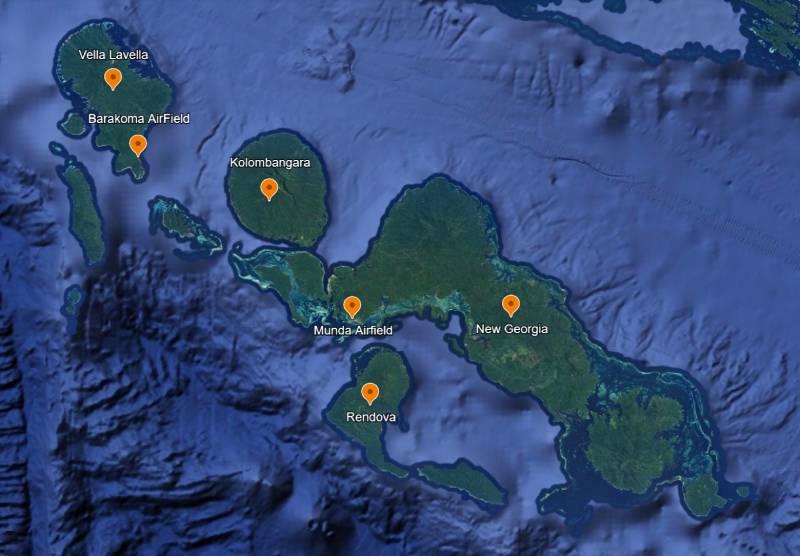
After Munda fell, the Americans decided to bypass Kolombangara, with its estimated ten thousand Japanese, and occupy Vella Lavella farther north. They landed on the island’s southern end without land opposition on August 15th, 1943, and set up a defensive perimeter large enough to shield the construction battalions building an airfield at Barakoma. They captured several unequipped Japanese, shipwreck survivors from naval battles in these waters, but a few hundred enemy fled north, and the Americans did not trouble to chase them at first. Later, air-raids on Barakoma grew serious, and they decided to place a radar station on the island’s northern tip. It would give longer warning of enemy planes coming from Bougainville.
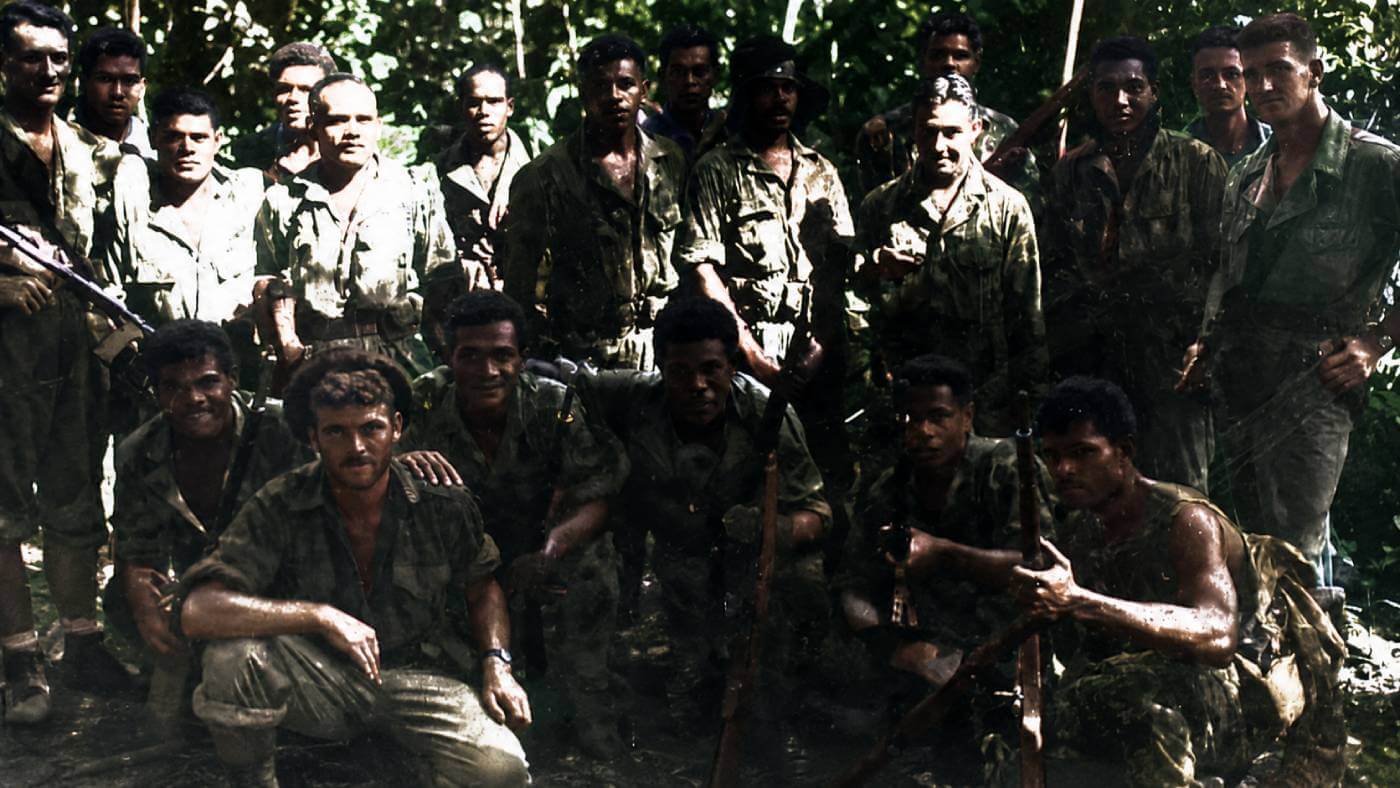
On August 25th, 1943, Tripp received orders to ready fifty commandos for Vella Lavella. Two patrols were made up of the fittest available. The sick and wounded were drifting back from the hospitals, but most of the unit was still weak from malaria.
The Vella Lavella patrols were re-equipped and embarked from Guadalcanal on August 29th, 1943. The party comprised ten New Zealanders and forty Fijians. In addition, Lieutenant D.G. Graham and three sergeants from the 3rd New Zealand Division were attached for experience.
Reaching Barakoma on August 31st, 1943, the party spent the day gathering information from the local people. The unit was attached to the U.S. 35th Infantry Regiment under Colonel Brown, and the tasks were as follows. Tripp and a patrol of sixteen were to work with the first battalion of 35th Infantry Regiment up the east coast to the Lambu Lambu Cove area. Williams and a patrol of twenty were to go up the west coast, to protect the coast-watcher at Topolando and reconnoitre the enemy positions on the northern tip. Graham and a patrol of nine were to go as far as the Oula River on the west coast, then turn inland to watch the Japanese track across the island’s centre.
On September 2nd, 1943, the patrols left the Island Command Post at Barakoma, and Tripp’s patrol reached its reconnaissance area that day. Splitting up, the commandos worked with small groups of Americans. One patrol shot two Japanese at Baka Baka Mission on September 3rd, and the next day a company of Americans killed twelve more. A map was found on a dead Japanese officer, showing the enemy’s defensive positions at Horaniu, and Tripp sent it with other captured documents back to the Command Post. The Americans decided to send up another battalion and artillery to attack in force. Meanwhile the commandos patrolled daily to watch for any change in the enemy’s positions. These days brought some delicate missions. Americans and commandos camped close enough to the enemy to hear the parachutes open as Japanese planes flew over each night to drop supplies to their troops.
The American artillery arrived, a heavy barrage was laid down, and on September 14th,, 1943, the infantry attacked again, only to find the guns had done all the work. The American reading of the Japanese map had proved remarkably accurate; the artillery scored direct hits on most of the defence posts. The enemy had fled, leaving many dead behind, along with equipment: ten 1943-model 20-millimetre guns in perfect condition, two 90-millimetre mortars, some 75-millimetre mountain guns, and large stores of ammunition, medical supplies, and rations.
These positions had been prepared for about two thousand men. Plainly the enemy had meant to make a stronghold on the island at the same moment as the Americans, who had fortunately got in first. The captured map and the accurate gunfire that followed changed the enemy’s plans, and he now headed across the island to the north-west. From the captured stores the commandos drew “canned heat,” vitamin pills, and medical supplies. For several days the unit lived on Japanese rations, equal to their own and in some respects better; some of the enemy’s tinned salmon was of outstanding quality. Among the medical stores were thousands of atabrine tablets, brewer’s yeast tablets, and cod-liver-oil capsules.
Tripp’s patrols on the east coast met no more Japanese in the next few days and returned to Barakoma on September 20th, 1943.
On September 5th, 1943, Williams reached Topolando after a strenuous journey by land and sea. The route ran 80 kilometres (fifty miles), the bush so thick the patrol had to cut its way. Small as it is, Vella Lavella rises to a peak of 914 metres (three thousand feet) a few miles inland, exceptionally steep country with few native tracks.
Williams met Lieutenant Josselyn, who had watched the coast through the Japanese occupation. Josselyn gave him the latest on the enemy in his area, and the commando patrols began scouting at once. Because of much enemy activity on Umomo Island, a little dot close to the coast, Williams and two Fijians went to investigate. Barefoot, the patrol crept within a few feet of the Japanese. On September 7th, 1943, it located ten Japanese on Umomo and twenty-two at the mouth of the Timbala River. The patrol then joined thirteen more commandos at Etupeka.
The next day Graham’s patrol arrived, having lost the Japanese cross-country trail. The commando force, now about twenty-five men, further reconnoitred the Timbala River, planning to attack the enemy from the south-west. But stray Japanese kept trickling into the area overnight, until there were a hundred armed men. Williams decided to return to the Command Post for reinforcements before attacking, and arrangements were made to cut tracks to within twenty metres of the enemy, giving a company easy access.
On September 11th, 1943, Williams and Josselyn went from Etupeka to the Command Post in under fifteen hours. Despite their haste they got no reinforcements, for the task of clearing the enemy from the northern coast had gone to 14th New Zealand Brigade, and the Americans were awaiting its arrival.
Williams returned to his men, still watching the growing enemy forces in the north. On September 16th, 1943, the patrols located two hundred and thirteen Japanese heading for Warimbari Bay. Graham’s patrol counted eighty-six as they passed within a few feet of his hiding place. Some of the enemy passed close to Topolando, and it was feared they would find Josselyn’s radio transmitter. The large set was moved to a safer hiding place, but Williams kept a small set going at Topolando and kept the Americans informed. When a barge-load of Japanese left the island, a plane would leave Barakoma and sink it within a few miles. This way of getting results with little risk was the best technique the commandos had devised, and they thoroughly enjoyed it. High up, they could see many miles out to sea, as well as along the foreshore.
Williams was out one day at Pakoi Bay with three natives when he suddenly ran into a dozen Japanese. An amazing thing happened: the Japanese got the greater fright and ran for their lives. Either the New Zealander’s size worried them, or they were poorly armed.
On September 18th, 1943, Graham was recalled to Barakoma, where the 14th New Zealand Brigade had landed. He was able to supply accurate locations for the five hundred Japanese now trying to evacuate the northern coast. The 14th Brigade took charge of operations and cleared the island of Japanese a fortnight later.
The commandos took no part in this attack, there being now too much sickness in the unit. The patrols returned to Guadalcanal on September 26th, 1943.
| Multimedia |
| Sources |