
| Page Created |
| August 7th, 2026 |
| Last Updated |
| August 12th, 2026 |
| Fiji |
 |
| Great Britain |
 |
| New Zealand |
 |
| Solomon Islands |
 |
| Tonga |
 |
| The United States |
 |
| Related Pages |
| 1st Commando Fiji Guerrillas Guadalcanal, 1st Commando Fiji Guerrillas New Georgia, 1st Commando Fiji Guerrillas Vella Lavella, 1st Commando Fiji Guerrillas Landing Craft Vehicle, Personnel |
| April 19th, 1943 – July 1st, 1943 |
| Guadalcanal Campaign |
| Objectives |
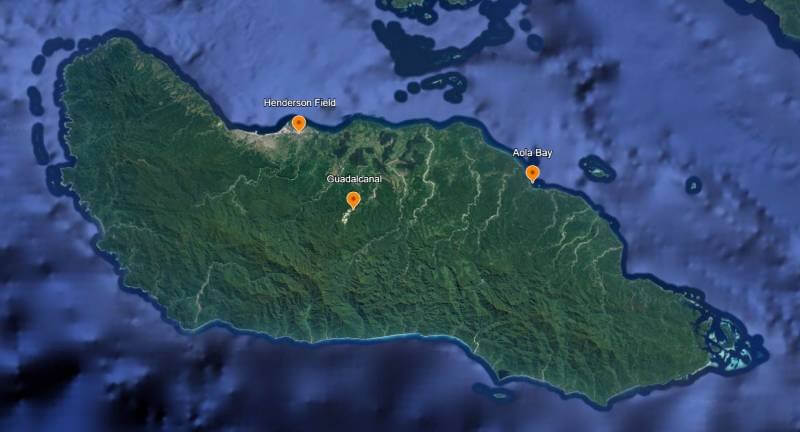
- The commandos’ task was consolidation and clearance. Concretely: unload the convoy and establish at the Aola Bay base; then systematically comb the island for the stray, starving Japanese left behind after the enemy’s defeat, taking the surrender of those who would give up. Beyond the sweep, the unit absorbed the Special Party and the reduced Dukwasi patrols, took over responsibility for coastal patrolling, and used the abandoned battlefields as a training ground, learning the enemy’s equipment, habits, and bivouac preferences. It also extended the sweep to other southern-Solomons islands, notably San Cristobal, chasing indications of enemy spies and coast-watchers.
| Operational Area |
| Allied Forces |
- 1st Commando Fiji Guerrillas
| Axis Forces |
- Remaining Japanese Garrison of Guadalcanal
| Guadalcanal |
The convoy with the men of the 1st Commando Fiji Guerrillas sailed from Suva on April 15th, 1943. Each man began taking half an atabrine tablet daily, to build resistance to malaria. For the New Zealanders the voyage passed calm and uneventful, filled with the usual boat-drills and sunbathing. For the Fijians it was an event in itself. They delighted in the ship’s machinery and were overjoyed to see moving pictures for the first time, though the clever dialogue passed them by. Guadalcanal came into view on April 19th, 1943, and the ship hove to off Kokombona Beach. The commandos were set to unload the holds; the 1st Battalion was to stack the cargo in dumps ashore. Guadalcanal had no wharves, so the whole task ran on Higgins boats that grounded on the coral sand. The unloading was done in a record four hours. The ship’s captain was much relieved, keen to be gone before the Japanese bombers made their nightly call.
The captain wrote a special letter of praise to the commander of the Fiji Brigade Group. Commander F. W. Benson called the Fijians the finest troops his ship had carried anywhere in the South Pacific. Their spirit inspired all hands, he wrote, and their cleanliness of person and quarters surpassed anything he had met. The officers’ handling of the men, he added, drew open admiration from American officers of both Army and Navy, and their close interest in each trooper showed in the spirit of every man. During the unloading, he reported, officers and men made a game of it and set a record likely to stand a long while, boosting the tonnage per hour by nearly thirty per cent over his ship’s previous best and leaving all others something to aim at.
No one from 1st Commando could go ashore until unloading was finished. With no one to guard the unit’s gear at the dump, a New Zealander smuggled himself ashore in a truck as it was hoisted from the hold into a barge. He reached the beach to find the commando stores mixed in with every other unit’s. By then it was late afternoon, and sorting had to wait until morning. The rest of the commandos landed at five o’clock. They marched 3 kilometres to Mamara and bivouacked among coconut trees on an old battlefield. A horrible stench hung in the air. Booby-traps and skeletons lay about, and all had to be cleared before dark, with slit trenches dug against air-raids.
That night two Japanese, hunting for food, came to a ration dump near the bivouac. Solomon Islanders at Mamara village caught one of them. Next morning this starving, naked prisoner was lashed to a wheelbarrow and wheeled in triumph to the American prison camp by a dozen jubilant islanders.
The episode fired the commandos to plunge into the surrounding bush at once, after stray Japanese. But too much remained to be done, locating stores and improving the bivouac’s sanitation, and no patrol could leave before the following day.
The unit had landed 80 kilometres west of the Special Party at Aola Bay. Major Clemens met Captain Tripp, and they arranged for the move on Good Friday, April 23rd, 1943. The men went on foot along the coast, the heavy gear by schooner. Along the way other units stole valuable equipment. The quartering staff soon grasped Guadalcanal “ethics,” and their own later acquisitions furnished the commandos with most of the comforts that God-forsaken archipelago could offer.
Save for poor communication, the base at Aola Bay was ideal. The former District Officer’s house quartered the officers. Native huts served for the non-commissioned officers, the orderly room, the stores, and the like. The Fijians and Tongans lived in tents and were delighted with their new home. There was a broad lawn for parades, a good beach for physical training and swimming, and even a barbed-wire pen for the recalcitrant. A half-mile coral road was laid to a spring of excellent drinking water. An old hand pump was found, repaired, and set on a three-metre stand over the spring. A truck bearing a large iron tank backed into this contraption, and the tank filled through a bamboo tube. The pumping was meant as a minor punishment in place of confinement to barracks. But the Fijians found such fun in it that the penalty vanished. Mosquitoes were far fewer at Aola, and with better living conditions health improved greatly. The septic sores that had plagued the men in Fiji cleared up entirely.
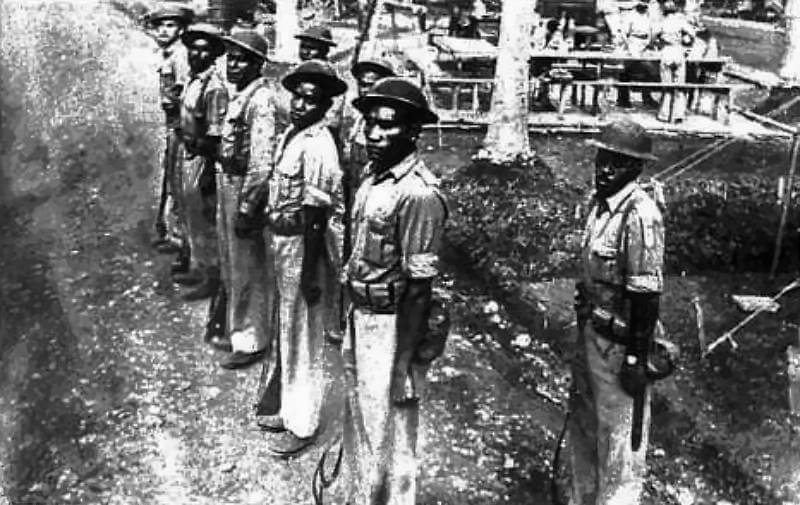
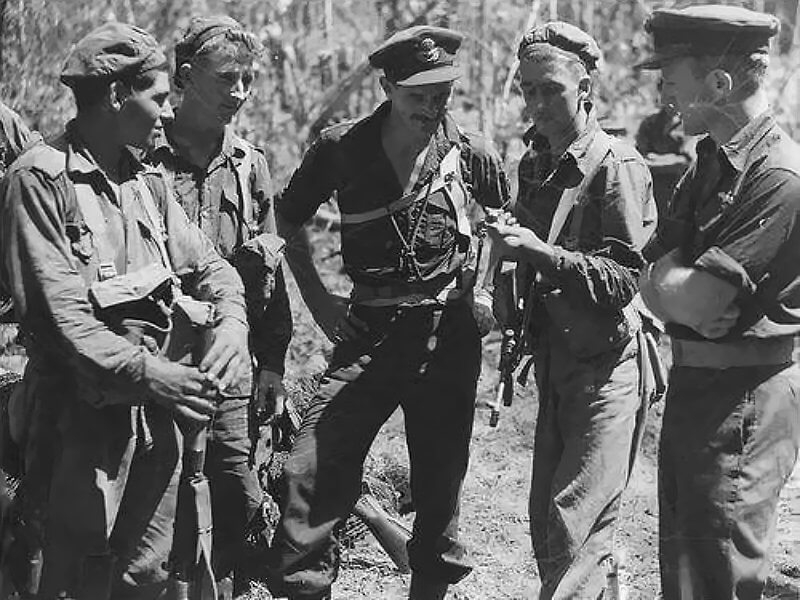
The Special Party joined the 1st Commando Fiji Guerrillas, and Captain Williams became second-in-command to Tripp. The unit came under Major Clemens’ command. The whole force administered from Aola Bay numbered forty-four New Zealanders, four Englishmen, one hundred and fifty-six Fijians, twenty-eight Tongans, and two hundred Solomon Islanders, a total of four hundred and thirty men from whom to draw patrols. Each group drew a different rate of pay, and three ration scales fell to the quartermaster to work out.
Orderly-room enquiries ran in four languages: English, Fijian, Tongan, and Pidgin English. Keeping a straight face was hardest when a Solomon Islander wrestled with Pidgin. It has a firm idiom, and the New Zealanders found it harder to follow than Tongan or Fijian. What threw them at first was English words set in native syntax. Ask the negative “Didn’t you see him?” and the islander answers “yes” where English idiom means “no.” Anything impressive takes the prefix “big fella,” and distance is measured by piling up “gos,” more of them for a longer march. The islanders reached some strange combinations. An elephant became a great bullock with a tail at each end. A cross-cut saw was two men working like brothers, pushing and pulling a giant axe. An aeroplane was once a schooner belonging to Jesus Christ, though the men had since learned to name a P-38 a Lightning and a B-17 a Flying Fortress.
Once the speech was less amusing. Some Solomon Islanders were with a Special Party patrol during the fighting. At a critical moment behind enemy lines, one blurted out that he was afraid, cold to the belly, and knew nothing. What the New Zealander in charge said in reply cannot be set down.
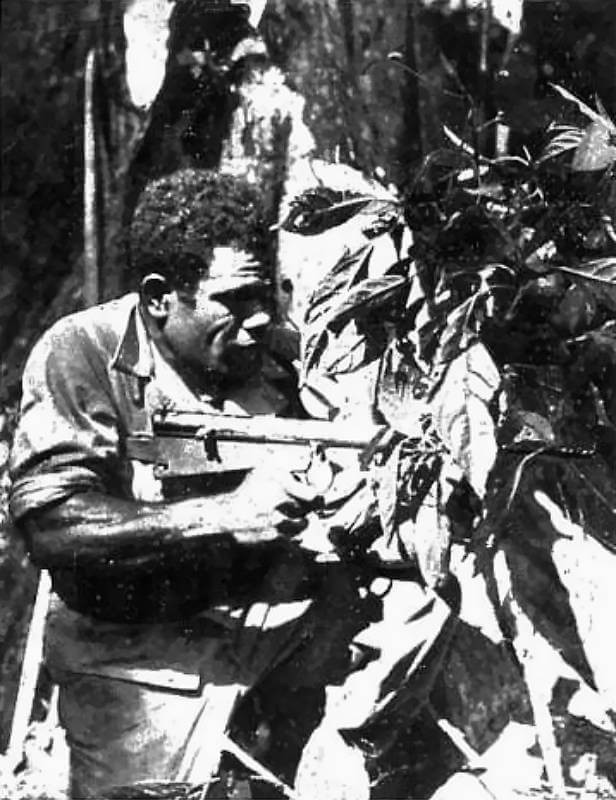
The “Dukwasi” unit had amassed nearly every kind of small arm, and the civil administration gave First Commando free use of whatever it wanted. On the Special Party’s advice, the Thompson sub-machine guns were exchanged for Australian-made Owen guns, far better for bush fighting. Sid Heckler’s tommy-gun had jammed at the worst possible moment, all for a speck of grit in the mechanism. The Owen was as simple as a toy and took the unavoidable mud without complaint. It was lighter and more accurate too, and its .38 calibre served amply for jungle ranges.
The commandos worked hand in glove with the civil administration, whose members were mostly Englishmen sent to the Solomons by the British Colonial Office in London. At the Teneru camp the New Zealanders and Englishmen shared a mess for several months, the best on Guadalcanal at the time. It drew visitors from across the island. Paul Holmes, the quartermaster, spent much time at Teneru. All supplies landed nearby on Lunga Beach, and he had to be on hand to secure the unit’s share of the few good things each shipment brought. Energetic as ever, he was, as the Americans said, always on the ball. Major Clemens, wonderfully persuasive and a great friend to senior American officers, secured extra luxuries for the mess. The Americans disliked mutton, and through their generosity the commandos sometimes enjoyed a leg all the way from New Zealand, perhaps even from a unit member’s own farm.
The New Zealanders soon befriended their countrymen in the Air Force and Navy in the Solomons. Several were entertained aboard the New Zealand corvettes. The Royal New Zealand Air Force let the commandos use its postal service, giving them a better air-mail link than they had known in Fiji. Some letters reached them three days after posting. The commandos repaid the kindness by hosting the other services at the Teneru mess.
The intelligence section was hard at work, planning operations, arranging wireless links between Aola and Teneru, and sorting out Solomon Islanders who seemed to be nobody’s responsibility. Before First Commando arrived, the Dukwasi unit had held half of Guadalcanal’s coastal strip. A New Zealander went out by schooner to find these isolated native patrols. He reported back a week later. The islanders were doing no patrolling, and their rifles lay rusted and uncleaned. They had received no supplies for weeks from the civil administration and had settled among other natives in the southern coastal villages, ignoring their duties. First Commando could spare no New Zealander to supervise them. So the farce ended with the men discharged and the United States Army Air Force flying over the beaches each day.
1st Commando stayed busy, patrols combing the island for stray Japanese. Some of the enemy surrendered; others chose to starve slowly in the bush. Back at base, resting and drying out, the men spent much time on the rifle range. Most lost about six kilograms (a stone) after a week’s reconnaissance in the mountains, but soon regained it where rations were plentiful, if dull. The food now came wholly from the American Army, a great improvement on Fiji’s bully-beef and biscuits.
Most work fell to independent patrols of about fifteen men. Local natives forever reported enemy activity in the mountains. Yet when the commandos investigated, they found the natives were lying to seem important and win food, or that the Japanese had been seen six months before. The commandos did glimpse one or two Japanese in the jungle, but these escaped. Hunting a lone man in that undergrowth was like chasing one grass-grub in an acre of corn.
Guadalcanal is smaller than Viti Levu, yet twice as high, its mountains reaching 3,000 metres. Their sides are exceptionally steep. The Solomons lie in the earthquake belt, so landslides are frequent. Where they fall, the bush gives way to long grass on the steep patches. Guadalcanal sits on the thermal equator. It draws heavy rain like Fiji but knows no hurricanes. Large trees such as mahogany survive, and the undergrowth is a little easier to penetrate than Fiji’s.
In June a determined sweep of the north-western end was made. Seven patrols worked the mountains there for a week. The only result was a bundle of documents the enemy had left months before. This part of the island had become like a boneyard at a slaughterworks. Wild pigs had rooted up the buried Japanese, and the natives too had searched for gold teeth. Great heaps of coconut shells everywhere marked the enemy’s diet before his defeat. Roaming the old battlefields taught the commandos much about the Japanese soldier. They came to know every kind of enemy equipment, still plentiful on the ground, and learned the country he favoured for a bivouac. He had pushed no more than 3 kilometres inland and leaned toward low ground, valleys and swamps. The stench of some of these mosquito-breeding spots nearly sickened the commandos. Small wonder the Japanese had suffered so heavily from malaria and other diseases.
After Guadalcanal came orders to comb other islands in the southern Solomons. Signs pointed to enemy spies and coast-watchers on San Cristobal, 80 kilometres south-east. A task force of four American Navy vessels and six commando patrols went to investigate. Three weeks of patrolling turned up nothing, and the commandos returned to Guadalcanal.
Now came a reorganisation of the Dukwasi and 1st Commando units. The Dukwasi had to be cut back sharply. Its loose structure could not work on its own. First Commando, by contrast, was highly organised and far more effective. Feeding the commandos took fifteen tons of rations a month, and the quartering staff worked hard to place supplies where patrols could reach them every few days. A patrol usually carried four days’ rations on its back. The Dukwasi shrank to two patrols of the best available Solomon Islanders, under Lieutenants Crass and Barrow, both attached to Tripp’s command. Major Clemens had to return to the civil administration. He was preparing to become District Officer on New Georgia, once that island was retaken. The change to 1st Commando was not radical. Instead of platoons, the whole unit split into independent patrols of fifteen. Each held a New Zealand sergeant and corporal and thirteen Fijians, with a lieutenant over every three. The Tongans mostly worked under their own non-commissioned officers and their Tongan officer, Lieutenant H. Taliai.
The Americans disliked the unit’s name. They thought it better changed to South Pacific Scouts, to spare their commanders any confusion about its work. To the Americans “scouts” carried much the sense the English give “commando,” though both words hold various popular meanings. South Pacific Scouts appeared on all American operation orders, but in its own records the unit kept its title of First Commando Fiji Guerrillas.
Every member of the Special Party was suffering badly from repeated malaria, and the Fiji Brigade Group decided to withdraw them from the malarial zone. Weeks passed, though, before transport could be found.
In June the Governor of Fiji and the commander of the Fiji Brigade Group flew up to visit the unit. With them came Lieutenant-Colonel Ratu J. L. V. Sukuna, Commander of the Order of the British Empire, the leading chief of Fiji. He brought a large quantity of yanggona root, since the proper kind does not grow in the Solomons. He stayed several days at Aola, and much kava-drinking followed, which lifted the Fijians’ morale.
The Fijians missed evening recreation as keenly as the New Zealanders. At base camp the men lay naked under mosquito nets, sweating and thinking until sleep came in the cool early hours. On patrol sleep was no trouble; a man curled at a tree’s foot and, wet as he was, dropped off from sheer exhaustion.
For a few weeks after landing, the Fijians showed signs of homesickness. Never before had they strayed far from their villages. Once the novelty of being overseas wore off they grew restless and did childish things. A few threatened to burn the guardhouse; others took hens from the local natives, strange conduct for a normally honest people. The fits were not serious and soon passed. The men also struggled with a wholly tinned diet and longed for a good meal of dalo.
A schooner called at Aola once a week, and the administrative staff spent much time moving between base and Teneru. Administration had to be doubled, to supply and run patrols in so many places at once.
A short lull in June gave time for a Court of Enquiry and Board of Survey on equipment lost or worn out. The Fiji Brigade Group still ran a system of peace accounting, and every emergency ration and field dressing had to be accounted for one by one. Officers and non-commissioned officers laboured for days to gather the information needed to write off a few shillings’ worth of gear.
Crocodile hunting became a base-camp pastime. One crocodile was killed at the mouth of the Aola River after many attempts on its life. Tripp had put a pistol shot into it without effect, and traps had been set more than once. In the end it took a whole patrol’s combined effort to shoot it dead. Most of the commandos were months on Guadalcanal before they first saw a crocodile. That explained their apparent boldness at river crossings; one look at the ugly reptiles leaves anyone crocodile-conscious. The Solomon natives cross streams by canoe, or wade to the sandbar at a river mouth, to dodge the crocodiles. The commandos could not always spare the detour, so they plunged into the muddy water and swam hard with a prayer on their lips.
On June 16th, 1943 the commandos watched part of the greatest air battle ever fought over Guadalcanal. One patrol, on reconnaissance in the mountains behind Henderson Field, had a grandstand view. On a fine afternoon a Japanese force, put at sixty bombers and sixty fighters, came at Henderson Field from several directions. A hundred American planes rose to meet them. While the two forces fought over the northern coast, a second Japanese wave swept in from the south. It damaged the airfield and struck two ships lying off Lunga Beach. Still it proved a field day for the American pilots. Zeros drifted down by the dozen; from a distance they seemed to fall slowly, though they dropped from 6,000 metres. Enemy planes that broke away, out of ammunition, were caught farther north by a returning American task force. It had found no target all day, so its full magazines were turned to deadly use on the enemy. The Americans later claimed one hundred and seven Japanese planes downed for the loss of six. Judging by the part they had seen over Guadalcanal, the commandos found the lopsided figures easier to credit than they might have.
| Multimedia |
| Aftermath |
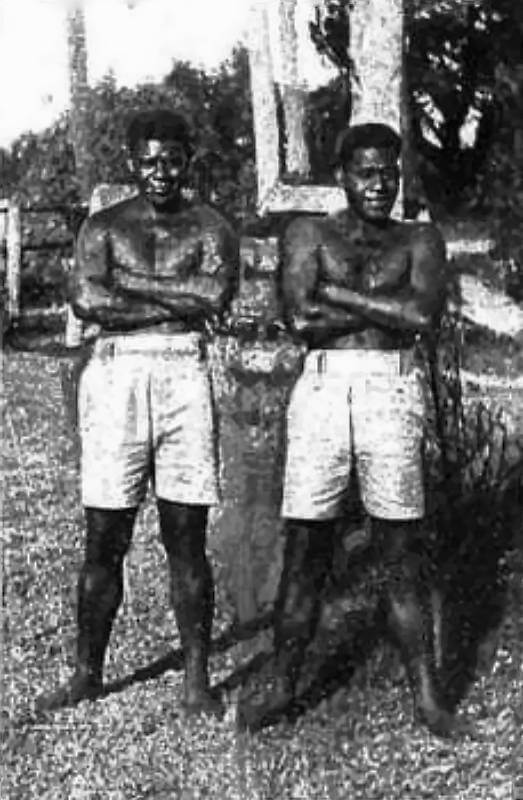
June also brought a unique sports meeting at Aola. Besides the various European nationalities, three native races competed. It was likely the first time Tongans, Fijians, and Solomon Islanders had gathered in numbers for such an event, and the rivalry ran fierce. The natives wanted a place in every race, though no prizes were offered; one Fijian broke his collarbone in a hard-fought contest. Uraia, the doctor, won the high jump at 1.68 metres without a single practice jump. The Tongans took the tug-of-war, edging out the small Solomon Islanders in the day’s most thrilling event. A coconut-tree climbing contest closed the meeting, won easily by a Fijian named Kelemeti. He fairly ran up the trunk, knocked off the nut, and slid down the 18-metre tree almost as fast as the nut fell, at the cost of a week’s attendance at the Regimental Aid Post. A concert followed that night, but the men were so spent that they gladly cut it short and went to bed.
The Guerrilla Gazette had lapsed for months under the weight of work. Now it reappeared on Guadalcanal, run off on the duplicator at the Fourteenth United States Corps Headquarters. The intelligence section also produced a daily news sheet of world events taken from the radio. This was sometimes rendered into Fijian. The Tongans read English well enough, and it was thought not worth translating the news into the Solomon Island tongue, those natives being too primitive, it was held, to grasp a world war.
The Americans had many operations mapped for the commandos, but often could not give a start date until the last minute. It was known that another American advance in the Solomons was near. Late in June, Tripp received official word to ready half his unit for an attack on New Georgia, in the centre of the group.
| Sources |