
| Page Created |
| August 7th, 2026 |
| Last Updated |
| August 19th, 2026 |
| Fiji |
 |
| Great Britain |
 |
| New Zealand |
 |
| Solomon Islands |
 |
| Tonga |
 |
| Additional Information |
| 1st Commando Fiji Guerillas Order of Battle Commanders Operations Equipment Multimedia Sources Biographies |
| Operations 1st Commando Fiji Guerrilla |
| April 19th, 1943 – July 1st, 1943 |
| Guadalcanal Campaign |
| 1st Commando Fiji Guerrilla |
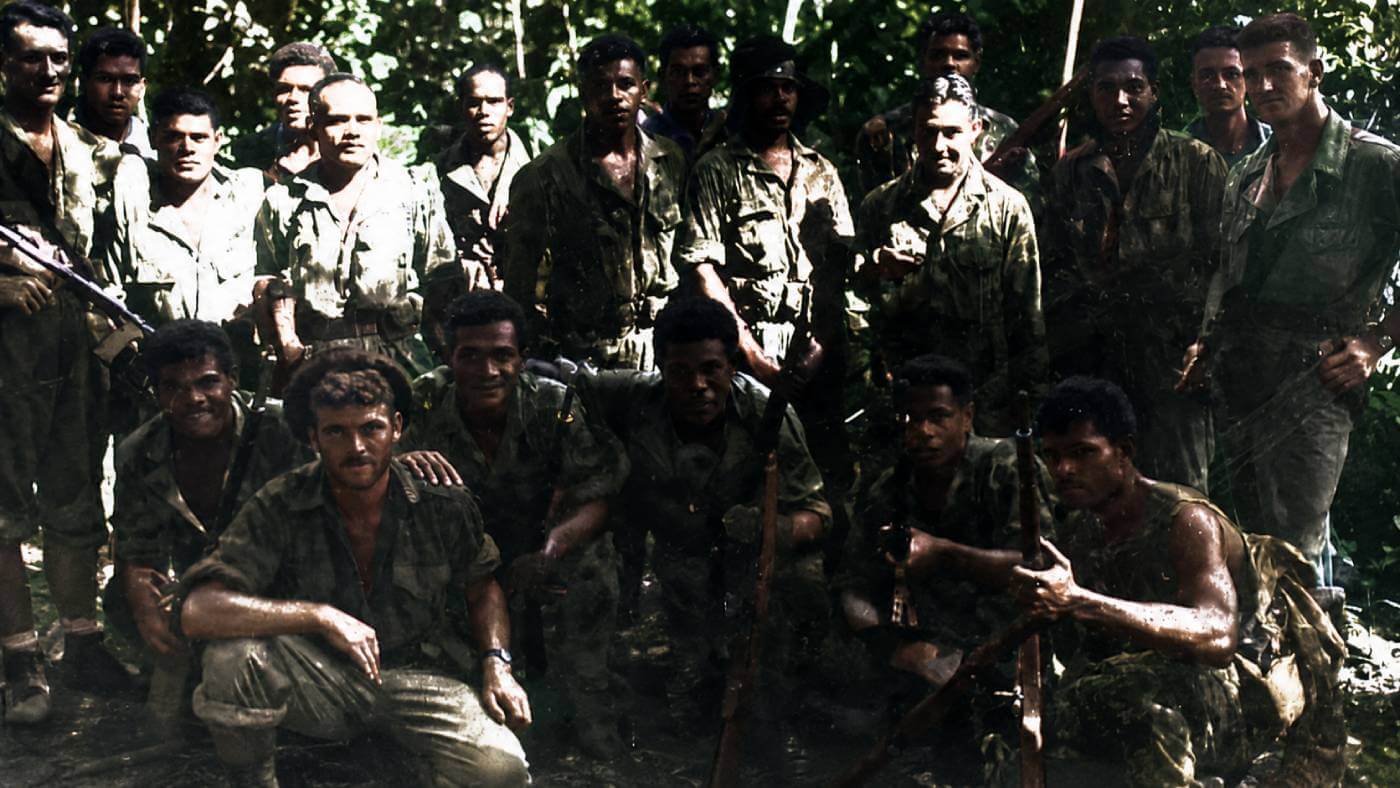
| The 1st Commando Fiji Guerrillas sail from Suva on April 15th, 1943, dosing on atabrine against malaria, and reach Guadalcanal on April 19th, unloading off Kokombona Beach in a record four hours that earns written praise from the ship’s captain, Commander F. W. Benson. After bivouacking on an old battlefield at Mamara amid skeletons and booby-traps, the unit relocates on Good Friday, April 23rd, 1943, to a near-ideal base at Aola Bay, roughly 80 kilometres east of its landing point. There the Special Party merges into the unit: Captain Williams becomes second-in-command to Tripp, all under Major Clemens. The combined force numbers 430 men, 44 New Zealanders, 4 Englishmen, 156 Fijians, 28 Tongans, and 200 Solomon Islanders, administered across four languages and three ration scales. The men swap Thompsons for Australian Owen guns, work closely with the British civil administration, and enjoy comparatively good conditions and improved health at Aola and the Teneru mess. Operationally the period is mostly anticlimactic. Patrols of about fifteen comb the mountains for stray Japanese with little result; a task-force sweep of San Cristobal finds nothing. A reorganisation follows: the loosely run Dukwasi unit is cut to two patrols under Lieutenants Crass and Barrow, Clemens returns to the civil administration ahead of a District Officer posting on New Georgia, and First Commando restructures into independent fifteen-man patrols. The Americans rename it South Pacific Scouts in their orders, though it keeps its own title internally. June 1943, brings colour rather than combat, a malaria-driven decision to withdraw the Special Party, a visit by the Governor of Fiji and Ratu Sukuna bearing yanggona root, a multi-race sports meeting, a grandstand view of a major air battle over Henderson Field on June 16th, 1943, and the revival of the Guerrilla Gazette. The chapter closes late in June with Tripp ordered to ready half his unit for the coming attack on New Georgia. |
| July 2nd, 1943 – August 12th, 1943 |
| New Georgia Campaign |
| 1st Commando Fiji Guerrilla |
| The 1st Commando Fiji Guerrillas, New Zealand NCO,s leading Fijians, Tongans, Englishmen, and Solomon Islanders, received their operation order on June 24th, 1943 for an assault on New Georgia, with D-day set for July 2nd. Intelligence on Japanese strength (over 5,000 men holding a 6.4 km arc around Munda) came largely from Captain D. G. Kennedy, who had remained on the island through the occupation. The commandos, well-supplied with maps by the U.S. 43rd Infantry Division, sailed from Aola aboard USS Talbot and landed at the Onaiavisi Passage on July 2nd, 1943. From July 2nd to July 4th, 1943, the unit cleared Baraulu, Sasavele, and Roviana, finding that the Japanese had mostly withdrawn to the mainland. American forces meanwhile landed unopposed at Zanana, and Captain Scherrer pushed inland on his own initiative while the enemy was off balance. American battalions advanced to the Bariki River. On July 5th, 1943, a mixed commando-American party was ambushed on the Munda Trail; in a three-hour running fight the commandos used quiet flanking and grenade tactics to push the Japanese back nearly 3 kilometres, taking only one casualty (Emosi, wounded). The plan had assumed Munda would fall in ten days and that the Onaiavisi Passage would be needed only briefly; both proved wrong, Munda took thirty-five days, and the passage carried the whole campaign. From July 6th, 1943 the campaign settled into grinding jungle warfare. Commando patrols ranged up to 6–8 kilometres behind Japanese lines, and their reconnaissance, reporting where the enemy was and was not, became the key intelligence guiding the American advance. The text details Japanese night-harassment tactics (screaming to provoke friendly fire, hidden tree snipers, camouflaged coral pillboxes) and the contrast between commando stealth and American reliance on firepower. Supply ran through a native-canoe service the commandos operated until the Munda Trail became a jeep road. By mid-July the commandos were badly worn; most were withdrawn to rest while reinforcements from Guadalcanal reached Rendova on July 16th, 1943. Japanese reinforcements from Bairoko cut American supply lines, creating no-man’s-land between the beachheads. On the night of July 17th–18th, Williams’s party helped repel a major Japanese assault on the 43rd Division command post, leaving 34 enemy dead. The commandos were reattached successively to the 37th (July 23rd, 1943) and 25th (August 3rd, 1943) Infantry Divisions. As the Americans gained the upper hand with tanks and flame-throwers, several commandos were killed in the closing weeks: Duffield (July 26th, 1943), Sergeant Bill Collins (July 27th, 1943, credited with nine enemy killed), Lieutenant Paul Harper (August 3rd, 1943, killed by friendly fire while relieving a cut-off detachment), and Sergeant Brian Ensor (August 4th, 1943). Munda airfield fell on August 5th, 1943, ending organised resistance. An estimated 3,000-plus Japanese were killed and several thousand wounded; many drowned during the evacuation to Bairoko. Eleven commandos died in the campaign. The unit, less than 1% of the Allied force, is credited with accounting for over 6% of enemy dead through its intelligence work. Survivors shadowed the Japanese retreat and withdrew to Guadalcanal on August 12th, 1943, to reorganise. The lesson is that large forces cannot manoeuvre in jungle, so infantry should be trained in jungle and guerrilla movement before combat rather than during it. The 37th Infantry Division’s commanding general later cited the New Zealand NCO’s as a benchmark for jungle mobility that none of his own troops matched. |
| August 15th, 1943 – September 26th, 1943 |
| Vella Lavella Campaign |
| 1st Commando Fiji Guerrilla |
| Fifty commandos of the 1st Commando Fiji Guerrillas, ten New Zealanders and forty Fijians, with Lieutenant D. G. Graham and three sergeants of the Third New Zealand Division attached for experience, embarked from Guadalcanal on August 29th, 1943 for Vella Lavella. Most of the unit was still weak from malaria, so the two patrols were made up of the fittest men available. The Americans had bypassed Kolombangara and its estimated ten thousand Japanese to occupy Vella Lavella, landing unopposed on August 15th, 1943, and building an airfield at Barakoma. A few hundred of the enemy had fled north, and when air-raids worsened, the Americans decided to place a radar station on the island’s northern tip, the task that drew the commandos in. Reaching Barakoma on August 31st, 1943, and attached to the U.S. 35th Infantry Regiment, the force split into three patrols: Tripp up the east coast toward Lambu Lambu Cove, Williams up the west coast to reconnoitre the northern tip, and Graham inland to watch the enemy’s cross-island track. On the east coast, a map taken from a dead Japanese officer revealed the defensive positions at Horaniu. The Americans brought up artillery, and when the infantry attacked on September 14th, 1943, they found the guns had done all the work, the shellfire, guided by the captured map, had scored direct hits on positions prepared for two thousand men. The enemy fled north-west, abandoning guns, mortars, ammunition, and stores of rations and medical supplies. For days the commandos lived on captured Japanese rations, in some respects better than their own. On the west coast, Williams reached the coast-watcher Josselyn at Topolando after a punishing 80-kilometre march through steep, thickly forested country. His patrols kept watch on Japanese forces massing in the north, over two hundred counted heading for Warimbari Bay on September 16th, 1943, and fed the positions back by radio. From their high vantage the commandos perfected a low-risk method they enjoyed: whenever a barge-load of Japanese put off from the island, a plane from Barakoma would sink it within a few miles. When the 14th New Zealand Brigade landed to clear the northern coast, Graham supplied accurate positions for the five hundred Japanese now trying to evacuate. The brigade took charge and cleared the island a fortnight later. The commandos took no part in the final attack, sickness was too heavy in the unit, and returned to Guadalcanal on September 26th, 1943. |