
| Page Created |
| February 5th, 2026 |
| Last Updated |
| February 22nd, 2026 |
| Germany |
 |
| Related Pages |
| Fall Gelb DFS 230, Lastensegelflugzeug Fort d’Ében-Émael Preperations Unternehmen Danzig Fall Gelb, The Maastricht Gateway Unternehmen Danzig, Sturmgruppe Beton Unternehmen Danzig, Sturmgruppe Eisen Unternehmen Danzig, Sturmgruppe Granit Unternehmen Danzig, Sturmgruppe Stahl |
| Fall Gelb, Maastricht Gateway, May 10th, 1940 |
| Podcast |
| Objectives |
- Seize the Bridges over the river Maas in Maastricht, The Netherlands.
| Operational Area |
| The Plan |
Fall Gelb begins on May 10th, 1940. It is the German plan for the invasion of the Netherlands, Belgium, Luxembourg, and France. The plan is designed to draw Allied armies forward into Belgium. It is also designed to conceal the decisive breakthrough further south through the Ardennes.
In May 1940, 6. Armee is commanded by Generaloberst Walther von Reichenau. The army forms a major component of Heeresgruppe B. Its role is not to deliver the main strategic breakthrough. Its role is to strike into Belgium at speed, smash open the Belgian frontier defences, and force the Allied response.
Generaloberst Walther von Reichenau sees the crossings over the Maas at Maastricht, together with the Albert Canal, as the Maastricht Gateway into Belgium. Central to this concept is the Albert Canal line north of Eben-Emael. Von Reichenau treats the capture of Fort Eben-Emael as a prerequisite before committing his main concentration of forces. This is the sector where he intends to break through the Belgian line, then roll up the enemy through fast-moving, expanding operations.
Von Reichenau clearly recognises the danger of delay. Every hour that the Albert Canal remains uncrossed erodes surprise and momentum. The psychological shock on the defender weakens steadily with time.
Adolf Hitler shares this anxiety. He expects that failure to secure Eben-Emael and the bridges will stop the panzer spearheads. Infantry divisions, he believes, will be drawn into prolonged and costly battles to force the canal defences. The Eben-Emael sector thus becomes the cork in the bottle, threatening the entire German strategy by allowing the Allies time to organise and consolidate in central Belgium.
The opening attack of 6. Armee is launched between Venlo and Aachen. A leading operational echelon of four corps advances with ten infantry divisions. XXVII. Armeekorps, comprising 299. Infanterie-Division and 263. Infanterie-Division, is tasked with attacking the Dutch border fortifications east of Maastricht.
At the same time, an independent advance guard operates under the direct command of 6. Armee. This force consists of the reinforced 4. Panzer-Division. Its mission is to push ahead rapidly and force the Maas crossings in the centre of Maastricht.
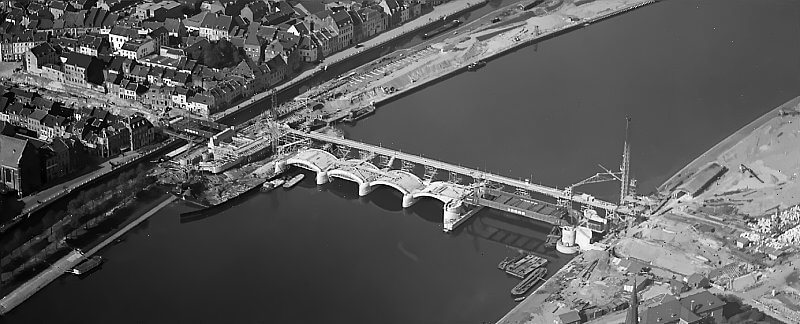
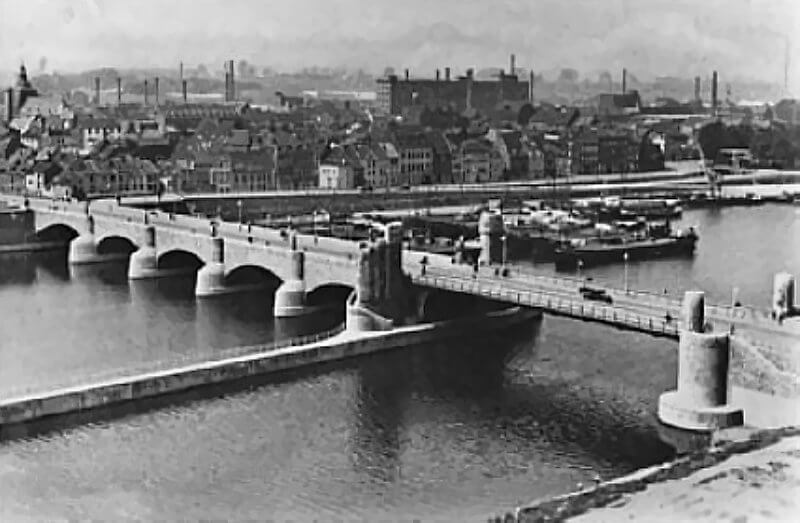
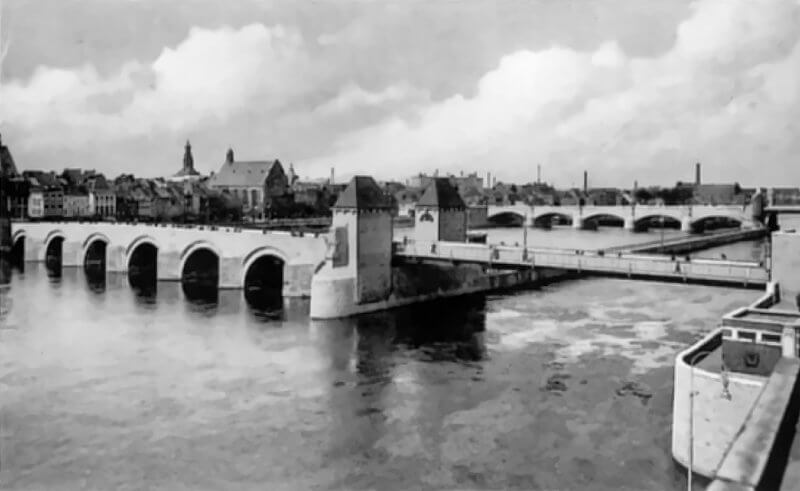
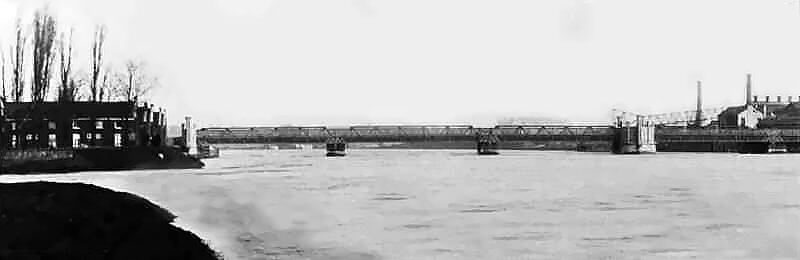
The city of Maastricht in the southern Netherlands is situated on the river Maas at a strategic crossing point. Therefor the three main bridges over the Maas in Maastricht are key objectives in the German invasion plan. The three bridges are the Sint Servaasbrug, the Wilhelminabrug, and the railway bridge to the north. The German plan, devised with Adolf Hitler’s direct involvement, involves a coup de main against the three main crossing points in Maastricht. These are the Sint Servaasbrug, the Wilhelminabrug, and the railway bridge. The aim is to capture these bridges before the Dutch can destroy them. 4. Panzer-Division, with over 340 tanks, is to break through Maastricht into Belgium. For this purpose, undamaged bridges are considered vital.
The seizure of the Maastricht bridges is directly linked to the assault on the Belgian fortress of Eben-Emael. The fortress lies only a few kilometres south-west of Maastricht. It is regarded as a major Belgian strongpoint. It dominates large sections of the Albert Canal, the Maas, and the four nearby bridges. If Eben-Emael remains operational, the 4. Panzer-Division risks becoming trapped in a dangerous situation.
This strategic reality drives the Germans to develop an integrated plan. The plan aims to seize Eben-Emael by surprise. It also aims to capture the three Albert Canal bridges at Vroenhoven, Veldwezelt, and Kanne. The mission is given to a special battalion of 7. Flieger-Division. The main body of this division is intended for operations against Fortress Holland.
A small assault force of Fallschirmjäger is landed by glider directly onto Eben-Emael. They carry hollow charges capable of destroying heavy fortifications. At the bridges, small task forces, also largely Fallschirmjäger, land by glider. They are reinforced later by parachute troops. These lightly equipped units land in a sector defended by a Belgian division. They also face more than 1,000 men inside the fortress.
To reinforce these light airborne forces quickly, the Germans need an immediate ground route. A secure crossing base on the Albert Canal depends on fast reinforcement. For that reason, the intact capture of the Maastricht bridges is treated as imperative.
German intelligence on Maastricht is extensive. The Germans know the Dutch bridge security measures. They know the guard routines. They know the demolition instructions. They know the precise locations of the explosive charges. This intelligence is gathered by numerous agents. Some are Dutch. Others are German. Maastricht has many German residents.
The plan on the attack on the Maastricht bridges is to occur in three stages. The German plan is to capture the bridges before the Dutch can destroy them. The plan relies on speed, deception, and surprise.
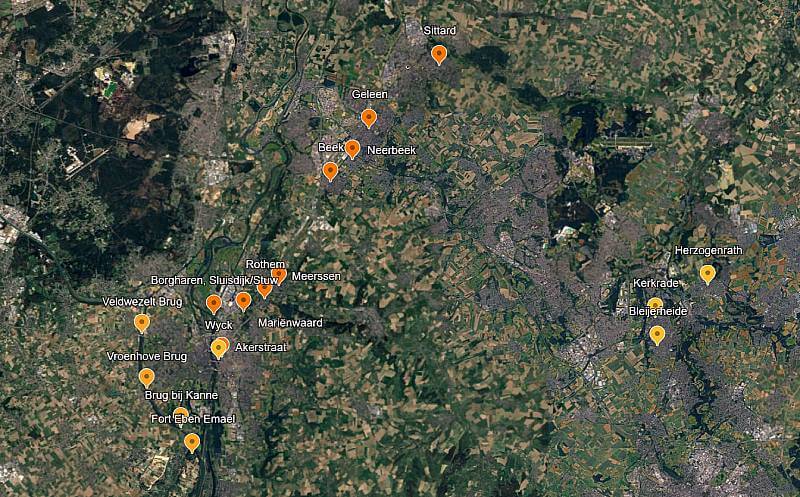
Stage 1 starts before the invasion, when German agents sneak into Maastricht wearing civilian clothes. The men are part of Infanterie-Bataillon z.b.V. 100.
Infanterie-Bataillon z.b.V. 100 is formed by the German Abwehr in October 1939 for special missions. The battalion consists of four companies. The 1st, 2nd, and 3rd companies are Pionierkompanien. The 4th company is a heavy company. It includes two Panzerabwehrkanone platoons and two schweres Maschinengewehr platoons. The battalion is regarded as a Sturmbataillon. However, it is equipped and organised as a Pionierbataillon. Its total strength is about 550 men. The commander is Hauptmann Fleck.
They disguise themselves as ordinary Dutch civilians. One commando group consists of seven men. It includes one German Unteroffizier and six Dutch collaborators. They wear civilian clothing. On May 9th, 1940, they assemble in the Wijk suburb of Maastricht. At sunrise on May 10th, 1940, they are to attack the Dutch guards at the Wilhelminabrug and prevent demolition.
A second group consists of thirty men in civilian clothing. Three groups of ten men cross the border on the evening of May 9, 1940, near Herzogenrath. They are to collect bicycles stored for them at Bleierheide. They are also to collect weapons previously hidden at Kerkrade. They are then to move towards the other two bridges in Maastricht.
Their mission is to identify the Dutch demolition explosives on the bridges. Before that, they are to carry out covert reconnaissance of the bridges and guard patterns. At H-Hour, they are to remove the explosives or disable the fuse. The plan is to prevent the destruction of the bridges at the time of attack.
These advance teams are supported by a second unit in Phase 2. Sonderverband Hocke is commanded by Leutnant Hans-Joachim Hocke. Sonderverband Hocke consist of men who are also selected from Infanterie-Bataillon z.b.V. 100.
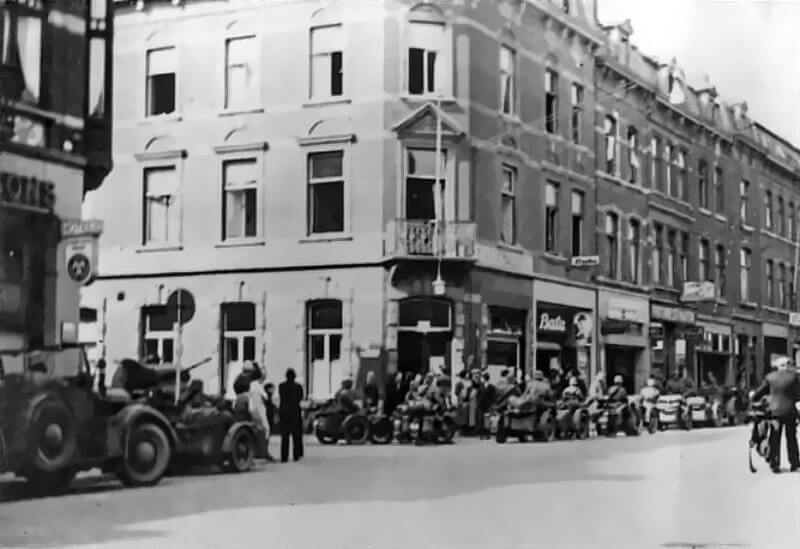
Sonderverband Hocke is to cross the Dutch border about 21 kilometres north-east of Maastricht, near Sittard, 03:20 on May 10th, 1940. They move in small groups on different routes. They wear Dutch Marechaussee uniforms, traveling with motorcycles with sidecars and armoured cars. Their task is to bluff their way onto the bridges at dawn. They are also to disable demolitions if the advance teams have failed. If the advance teams have succeeded, they are to capture the bridges and hold them until the units from Phase 3 arrive.
Phase 3 of the assault plan is the conventional assault by 4. Panzer-Division. Because major water obstacles lie along the axis of advance, 4. Panzer-Division is equipped with substantial engineer mobility resources, including rubber boats and bridging equipment.
A second operational echelon is scheduled to follow. Comprising I. Armeekorps and XVI. Armeekorps, it is committed late on day one and into day two, and is intended to drive the breakout into Belgium.
Within XVI. Armeekorps, 3. Panzer-Division and 29. Infanterie-Division (motorisiert) are designated as the leading formations. They are supported by the slower infantry divisions of I. Armeekorps, including 11. Infanterie-Division and 61. Infanterie-Division. A further reserve of five fresh infantry divisions is also available.
The army is supported by the Luftwaffe. VIII. Fliegerkorps, commanded by General der Flieger Wolfram von Richthofen, provides offensive air support, while 2. Flak-Korps under General der Flakartillerie Hubert Desloch supplies air defence. Stuka dive-bombers are integrated for close support, with anti-aircraft guns and fighter patrols providing protection against enemy aircraft.
On the Dutch side, Maastricht also receives special attention. Dutch planners recognise the city’s strategic importance. The bridges are the central concern. The defences are therefore stronger than elsewhere in the province. Roughly 750 men are assigned to defend the bridges and selected strongpoints. About 200 of these men are deployed in the border area with Belgium.
Two companies, roughly 300 men, form the outer defences of the city. They are ordered to deny initial access to the enemy and then withdraw. They are to defend barricades which they must construct themselves. They have only two anti-tank guns.
A second line is formed behind them. It consists of only 100 men. The remainder, roughly one company, holds permanent posts on the west bank of the Maas and at the three bridges. Their heavier weapons include several 20-millimetre anti-tank guns and four 75-millimetre anti-aircraft guns.
| May 9th, 1940 |
On A−1 day, IV. Armeekorps is responsible for moving Infanterie-Bataillon (motorisiert) zur besonderen Verwendung 100 from Linnich to its assembly position at Gillrath. At Gillrath, the battalion is connected by field telephone to the town of Wehr via 7. Infanterie-Division’s telephone exchange, designated line number H…33 158, with pickup at the Gillrath post office. A direct telephone line is also prepared from Düsseldorf, at the Ständehaus, to Linnich at the post office, for the transmission of alarm signals.
The alarm order is to be sent directly from Armeeoberkommando 6 to the battalion by telephone. A backup channel runs through IV. Armeekorps.
Infanterie-Bataillon (mot.) zbV. 100 operates its own radio on 1445 kHz under callsign “20”. 4. Panzer-Division reports bridge status on 580 kHz, with 708 kHz serving as the backup frequency. These transmissions are made without callsigns.
Bridge-status signals follow a coded letter system. Each bridge is assigned a designated letter. The suffix “a” indicates that the bridge is intact and captured. The suffix “b” indicates that the bridge is destroyed. Reconnaissance aircraft operating overhead signal bridge status using coloured smoke flares. Yellow smoke indicates that the Maastricht bridge is intact. Blue smoke indicates that the Veldwezelt bridge is intact. Red smoke indicates that the Vroenhoven bridge is intact.
| Multimedia |
| Advance Teams |
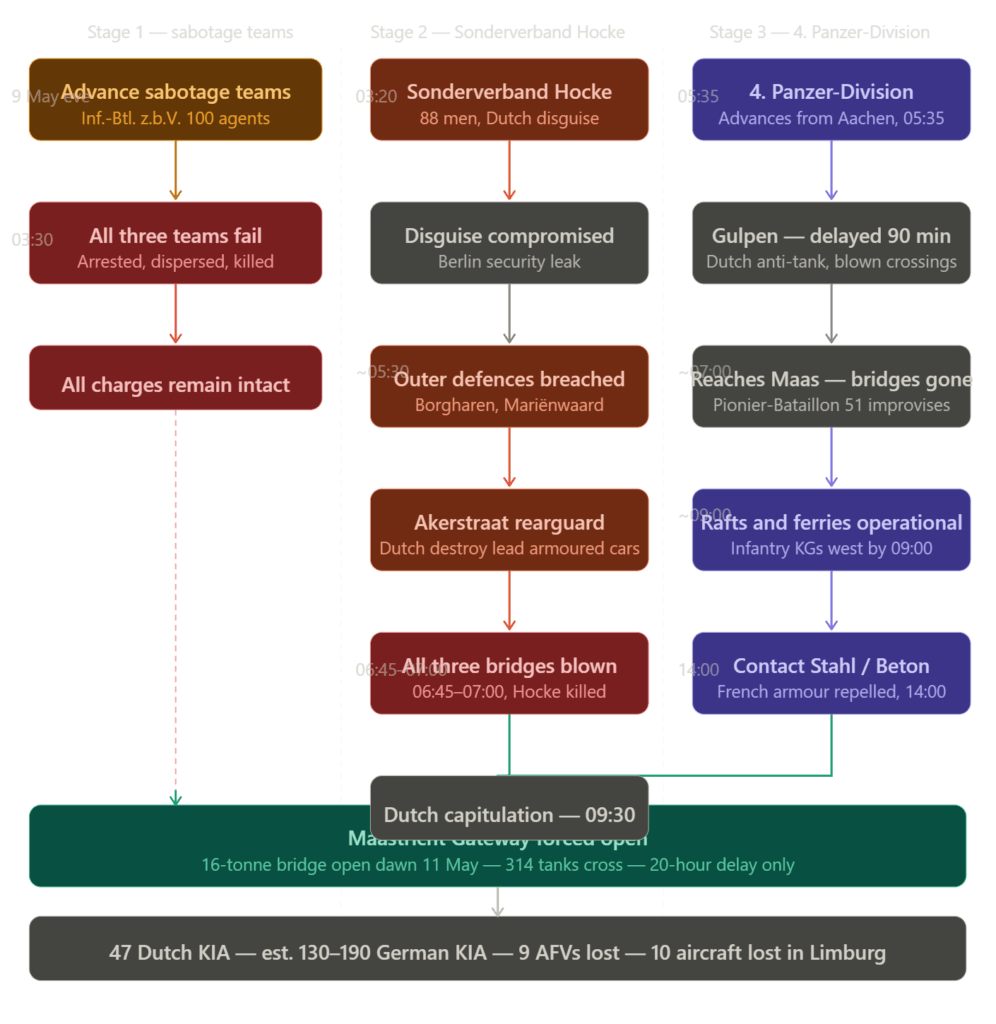
The first to deploy in the Maastricht Gateway are the advance sabotage teams. Their task is to disable the demolition charges. The thirty-man commando group that crosses the border near Herzogenrath on the evening of May 9th, 1940, is stopped by Dutch troops shortly before reaching Maastricht. The group is broken up. Most of them are captured and the rest of them disperses. The third team reaches Maastricht on the evening of May 9th, 1940. They shelter in the home of a German resident. Their target is the Wilhelminabrug.
As said earlier, this group consists of one German Unteroffizier and six Dutch collaborators. During the long wait, the men consume alcohol. By the morning, only the German and one Dutchman remain capable of action. At 03:30, they approach the bridge posing as civilian workers. They attempt to blend with genuine workers.
The Dutch guards notice them. Their nervous behaviour draws suspicion. The two are arrested. They resist. The Dutch collaborator breaks free and runs. He draws a pistol while fleeing. A Dutch guard kills him with a well-aimed rifle shot. With this, all three sabotage efforts fail.
| The advance of Bataillon zbV 100 |
At 03:45, a German motorized column moves along minor field roads from Geleen. The unit crossed the Dutch border near Sittard. The column is a Sonderabteilung Hocke with 88 men. The unit travels by armoured cars and 22 motorcycles with sidecars and heavy machine guns. The column has the mission to seize the three bridges in Maastricht undamaged.
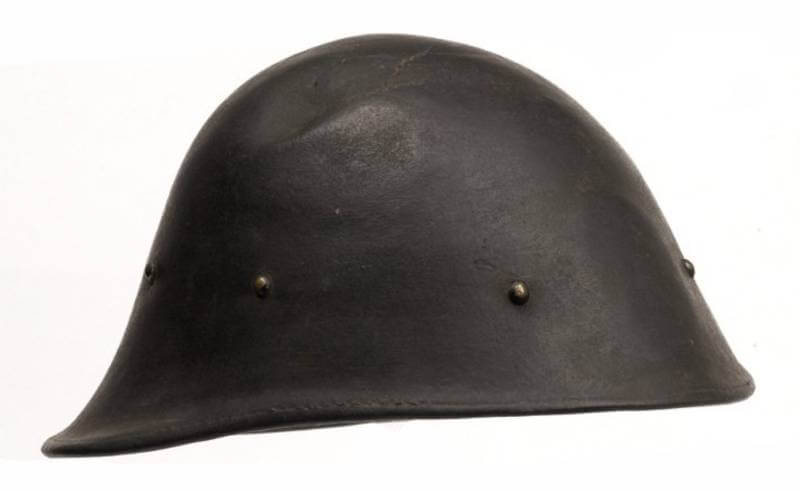
No fight is to be started before the official German invasion. The soldiers wear Dutch Marechaussee uniforms and helmets over their German uniforms. The helmets are replicas made of papier-mâché. The motorcycles have Dutch registration plates.
However, at the last moment, German invasion plans are compromised by an error within the Reichsverteidigung Ministry in Berlin. Dutch forces are fully alert shortly after midnight about the disguised Marechaussee.
By avoiding the main road from Geleen to Beek, they bypass the Dutch position at Neerbeek. From Beek, they continue without interference towards Maastricht. The soldiers know only the password for May 9th, 1940. The column moves by without being noticed. Few residents of Beek notice the column. Employees of the Dutch battalion headquarters also notice the movement.
Bataillon zum besonderen Verwendung 100 is delayed during its advance. Roadblocks must be removed. Armoured vehicles and mechanised guns must fight through the suburb of Rothem. They then reach the outer defences at Mariënwaard.
At this position, the Dutch defend a T-iron roadblock. A modern 47-centimetre anti-tank gun is available. The Dutch platoon commander fails in his duty. He forgets to seal the T-iron obstacle. He also removes the anti-tank gun from its position. He intends to fire at aircraft.
As a result, German vehicles pass through the outer defences with little difficulty. The effect spreads quickly. Other Dutch posts see German forces appearing in their rear.
The main body of Bataillon zbV 100 crosses the border at 04:35 on May 10th, 1940. This is the official start of the invasion. It follows the same route as the Hocke detachment. They wear German uniforms.
| The Borgharen sluice complex |
The sluice complex at Borgharen lies just north of Maastricht. It is another vital waterworks. It cannot be destroyed. An infantry platoon is stationed at the complex. A nearby machine-gun casemate provides additional support.
In the early morning, a patrol of six German motorised infantry approaches the eastern guard post. It is a reconnaissance party from the Hocke force. The patrol is challenged and ordered to halt. Four men are taken prisoner. Two escape.
They are a reconnaissance party from the Hocke detachment. The Dutch challenge them and order them to halt. Four Germans are captured, while the remaining two manage to escape.
The Dutch lieutenant anticipates further enemy movement. Confident that a larger force will follow, he orders his men to remain alert and hold their positions. Shortly afterward, additional German soldiers appear on motorcycles. The Dutch allow them to approach to within 50 metres before opening fire with two machine guns and every rifle available. The Germans are forced to pull back briefly.
German reinforcements arrive rapidly. Under increasing pressure, the Dutch squad is overwhelmed. The defenders attempt to withdraw toward the sluice complex, but the movement is difficult under steadily intensifying German fire. The troops defending the sluice itself continue to hold out. However, the south-eastern squad, responsible for covering the northern entrance into Maastricht, is compelled to retreat when their machine gun fails.
A breach opens in the outer defences. Most of the German attackers exploit the opening at once, breaking through the defensive line and advancing toward the city.
| The advance into Maastricht |
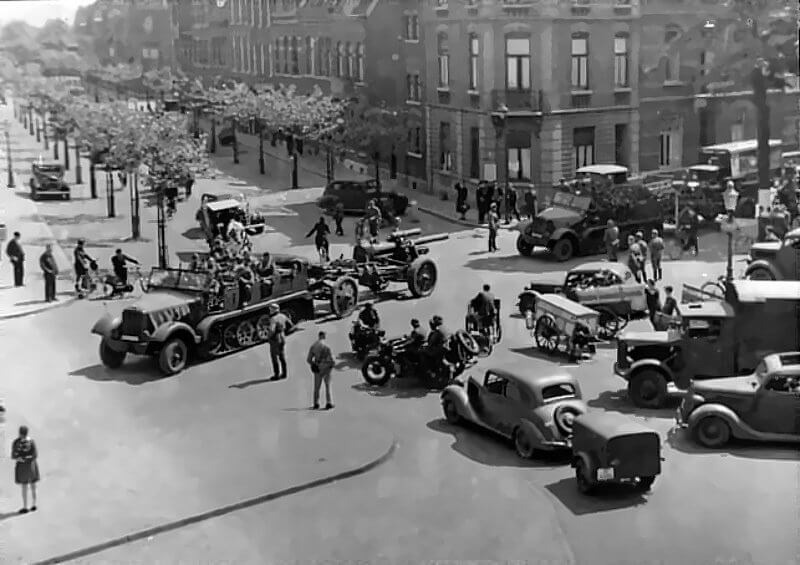
The rear-guard of the outer defences is tasked with delaying the German advance. Meanwhile, armoured cars and mechanised guns of Bataillon zbV 100 race through Maastricht towards the bridges.
At the Akerstraat in Maastricht, near the railway station, a rear-guard group takes position. They are supported by two 20-millimetre anti-tank rifles. When the first German armoured cars appear, the Dutch open fire at once. German guns and machine guns respond immediately. The engagement becomes intense and lethal.
The Dutch anti-tank rifle crews hit the first two armoured cars and likely a third. The damaged vehicles block the road and halt the following cars. The Germans attempt to evacuate wounded crewmen. More infantry and 37-millimetre anti-tank guns are brought forward.
The Dutch position consists of about two dozen men behind sandbags. The sandbags are gradually smashed away by sustained German fire. The German troops are surprised that repeated 20-millimetre and 37-millimetre fire, grenade bursts, and machine-gun fire do not eliminate the defenders.
When German infantry closes to near point-blank range, the Dutch sergeant orders an organised withdrawal. The squad retreats successfully. They reach the west bank of the Maas shortly afterwards. The rear-guard performs exceptionally.
| Destruction of the bridges |
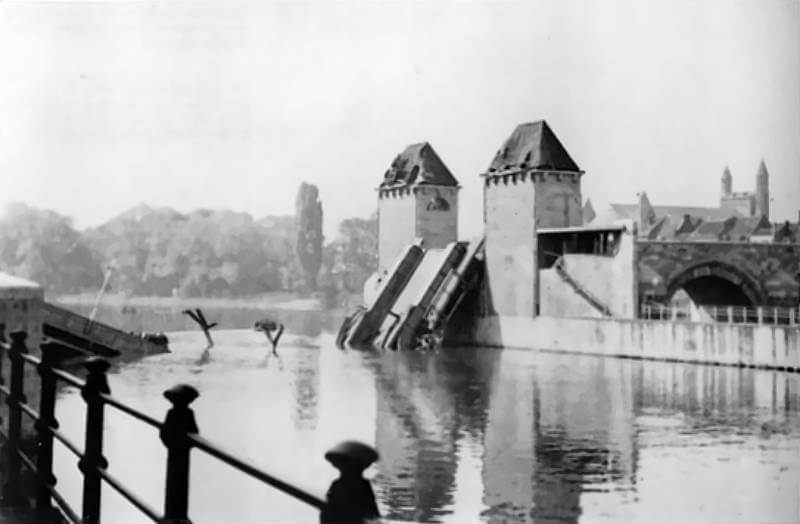
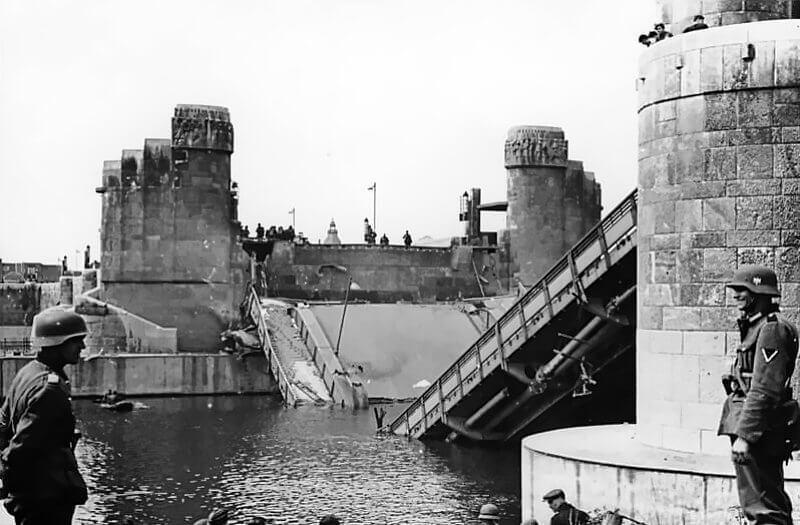
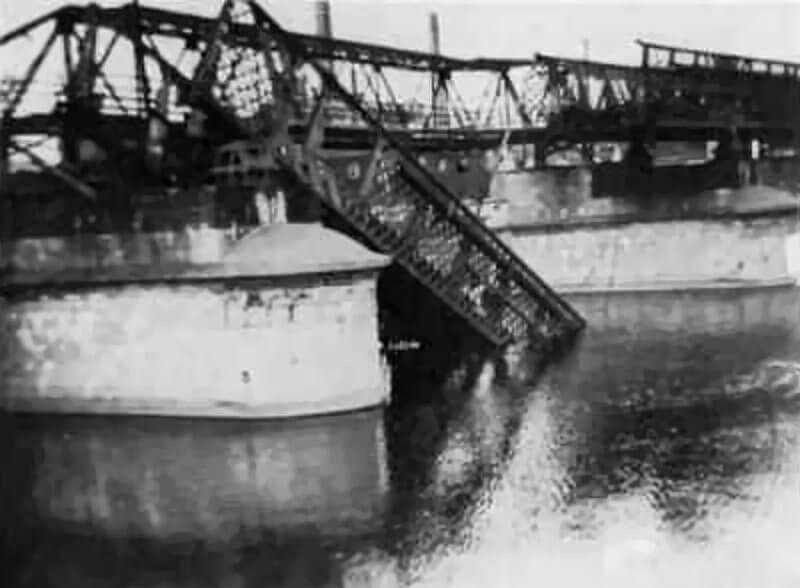
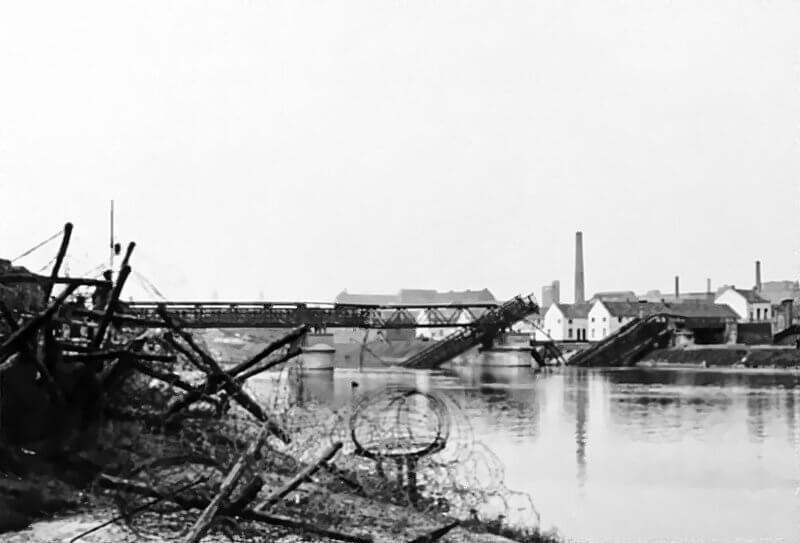
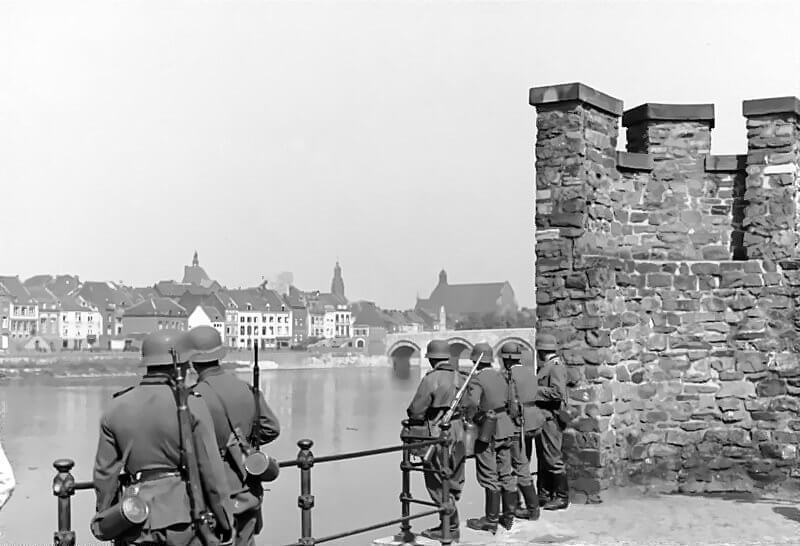
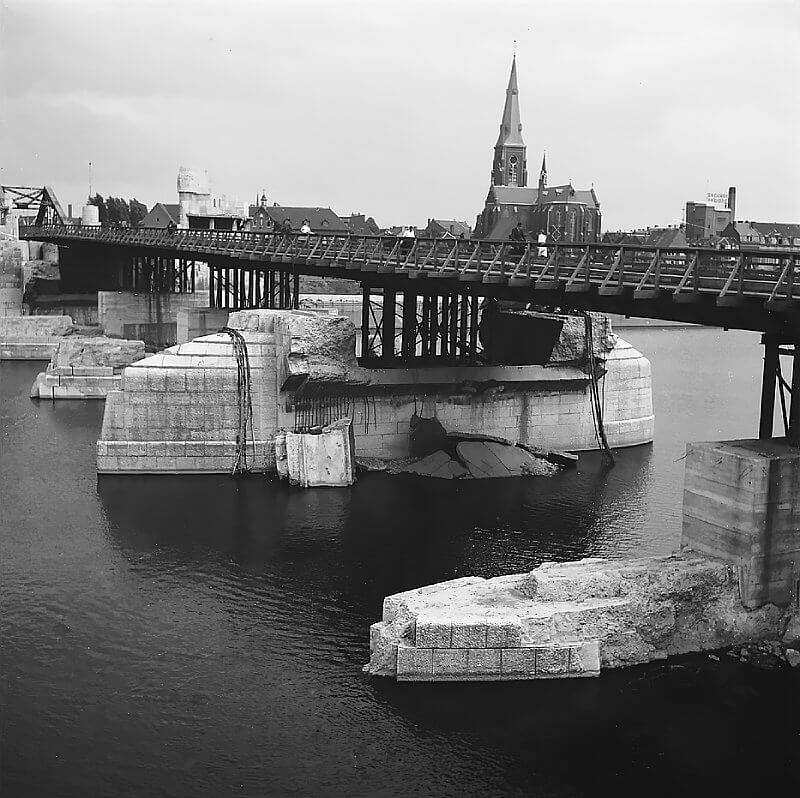
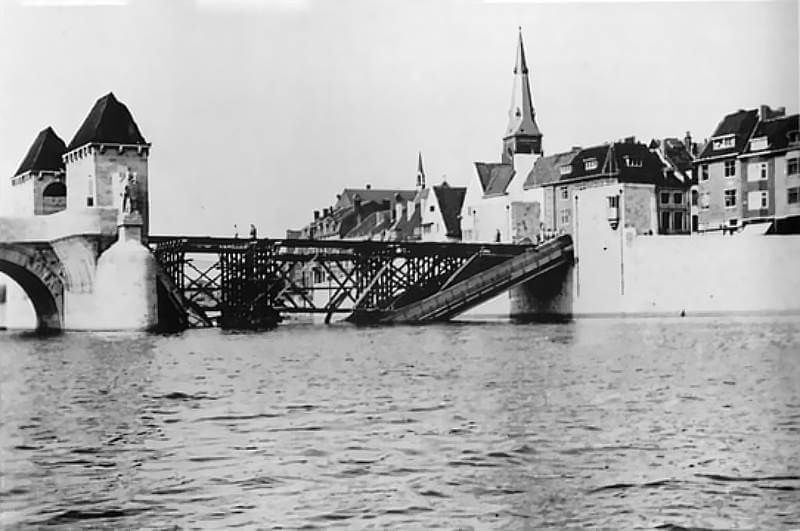
At 06:45, as the first armoured cars of Bataillon zbV 100 come into view of the Sint Servaasbrug, the bridge is blown. The Wilhelminabrug is demolished at 06:52. German efforts to seize both bridges intact fail completely.
The final objective is the railway bridge. With timber modifications, it can also serve as a tank crossing. It is defended by a platoon of roughly 35 men. They are supported by one heavy machine gun, three light machine guns, and two 20-millimetre anti-tank rifles.
From the north, the defenders face the remnants of Sonderverband Hocke. These troops have already exploited the breach created at Borgharen. The head of the German column of cars and motorcycles is hit by Dutch anti-tank rifles and heavy machine-gun fire. The anti-tank rifles prove especially effective.
The Germans dismount and take shelter in a factory. They then attempt to advance towards the bridge. The Dutch defenders withdraw to the west bank. They close the iron gates across the track.
The first Germans reach the gates. They are led by Leutnant Hocke. They climb over. Dutch fire drops several men. Others reach the bridge itself. At that moment, the burning fuse reaches the demolition charges. The charges explode around 07:00, sections of the bridge collapse into the river. Several Germans are killed in the explosion. Leutnant Hocke is among them.
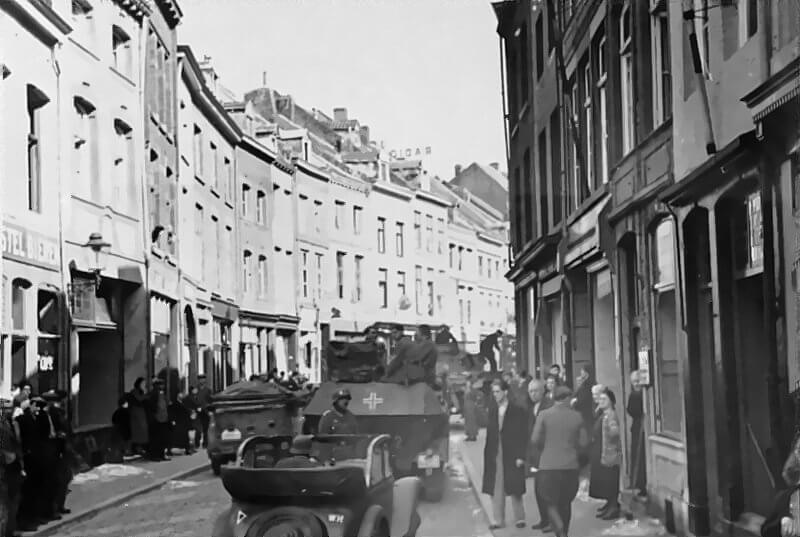
The main body of Infanterie-Bataillon z.b.V. 100 reaches Maastricht together with the northern advance guard of 4. Panzer-Division. It is then held up by a roadblock at Maastricht railway station and reaches the Maas only minutes after the bridges have been destroyed.
At 07:20, the battalion reports to 4. Panzer-Division that all the Maastricht bridges are demolished upon its arrival. It further reports that, after a brief fight with Dutch guards, it crosses the Maas using rubber boats.
The battalion reaches the bridge at Vroenhoven on the Albert Canal at 12:00. It arrives at the same time as 7. Kompanie of Schützen-Regiment 12 from 4. Panzer-Division. The bridge had been seized earlier that morning by Sturmgruppe Beton. The battalion remains at Vroenhoven until May 11, 1940.
The pioneers of 3. Kompanie of Infanterie-Bataillon z.b.V. 100 are directed from Maastricht to the bridge at Veldwezelt. They move with an s.M.G. half-platoon and two mortars. At Veldwezelt, they defend the bridge to the north. This bridge was captured earlier on May 10th, 1940, by Sturmgruppe Stahl, and the position is held by the Kompanie until May 11th, 1940.
| Multimedia |
| Holding the west bank |
After the destruction of all three Maas bridges, Dutch forces on the west bank have one remaining task. They must prevent German crossings for as long as possible.
South of Maastricht, at the Sint Pietersberg, five heavy machine guns and several light machine guns engage a German reconnaissance column of 4. Panzer-Division. Several soft-skinned vehicles are destroyed. A light armoured car is also knocked out. The German column is unable to clear the barricades on the west bank.
At the destroyed bridges, small Dutch groups continue to harass the Germans. The Dutch are spread across many strongpoints. A sniper detachment occupies the stone towers of the bridge. When the Germans place an anti-tank gun in front of the bridge, aimed at the area of the Sint Servaasbrug, Dutch fire kills the entire crew immediately. A replacement crew suffers the same fate.
A small number of rubber boats attempt to cross the Maas. They are shot to pieces. The Germans then withdraw from this location.
The heaviest fighting occurs at the destroyed railway bridge. Sonderverband Hocke, reduced in strength, receives reinforcements as the German main force arrives. Two armoured cars attempt to approach on the east bank. Both are quickly immobilised by Dutch anti-tank rifles. A light tank is also disabled by the same weapons. German losses are heavy.
At 07:45, three armoured cars and a mechanised gun from Bataillon zbV 100 arrive. The Dutch infantry position becomes critical. Many defenders are killed or wounded. One of the two anti-tank rifles is destroyed by a direct hit.
The defenders contact the territorial headquarters and report the situation. They learn that Dutch resistance in Maastricht is ordered to cease.
| Multimedia |
| The decision to capitulate |
Luitenant-kolonel A. Govers is the territorial commander of South Limburg. At about 07:00, he holds a staff conference in the Tapijnkazerne. The captured documents include maps and directions. The plans identify the German units involved.
The situation is clear. All Maas bridges are destroyed. A full German tank division is operating in South Limburg. The Territorial Commander has only two companies remaining. They have no anti-tank guns and no artillery.
Maastricht is an ancient city with significant cultural heritage. Govers decides it should not suffer unnecessary destruction. The meeting concludes that all further resistance in and around Maastricht must cease. These positions are the last standing defences in Limburg. He then decides that further resistance is pointless.
At 08:15, Govers goes under a white flag to the Wilhelminabrug. He offers the capitulation of the Dutch garrison. By 09:30, all Dutch troops in and around Maastricht lay down their weapons.
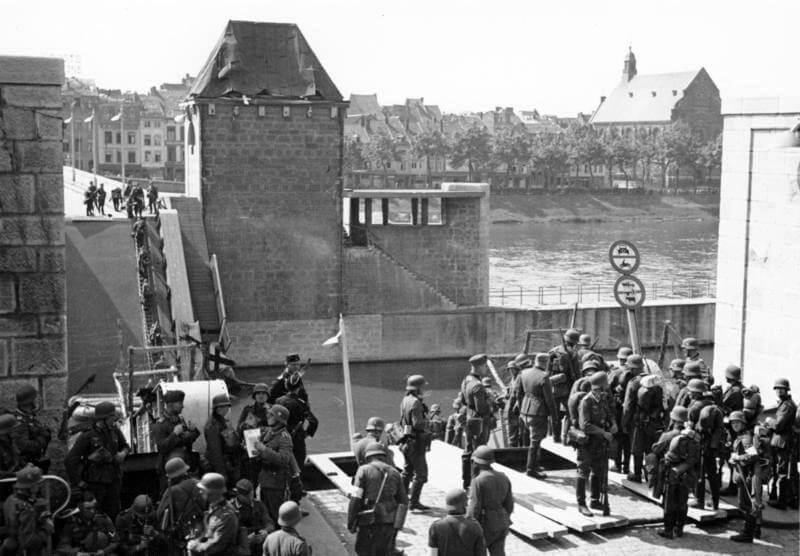
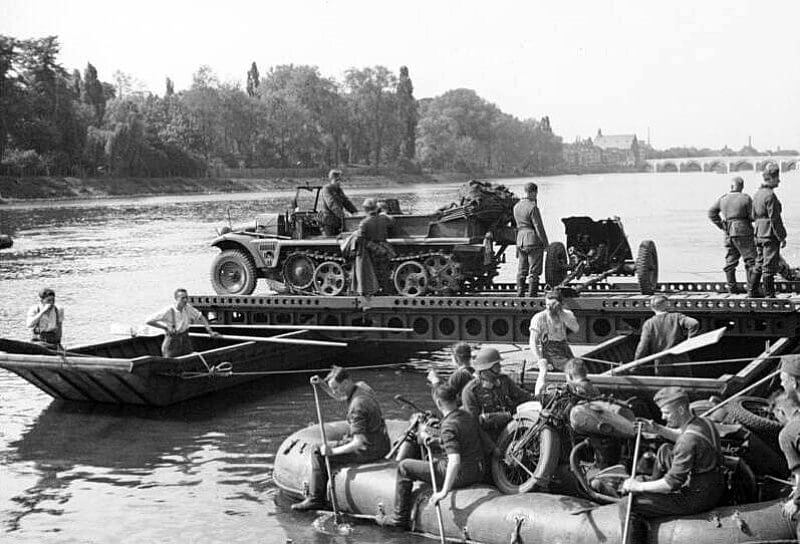
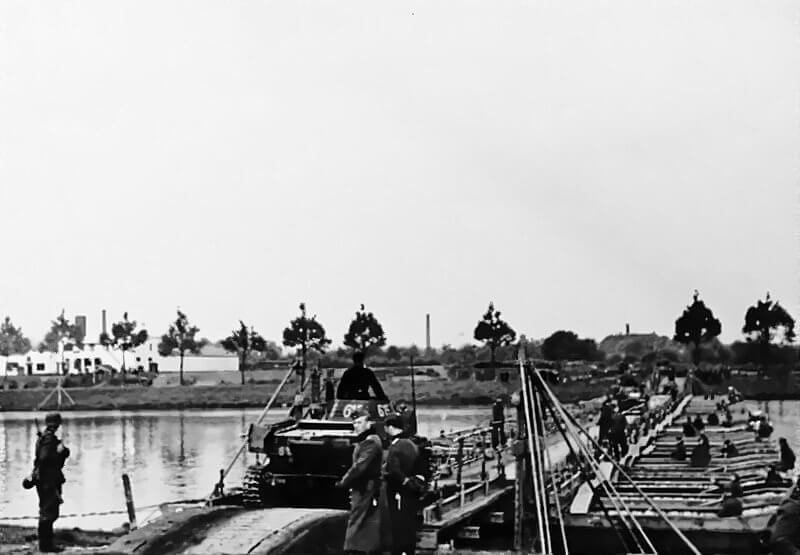
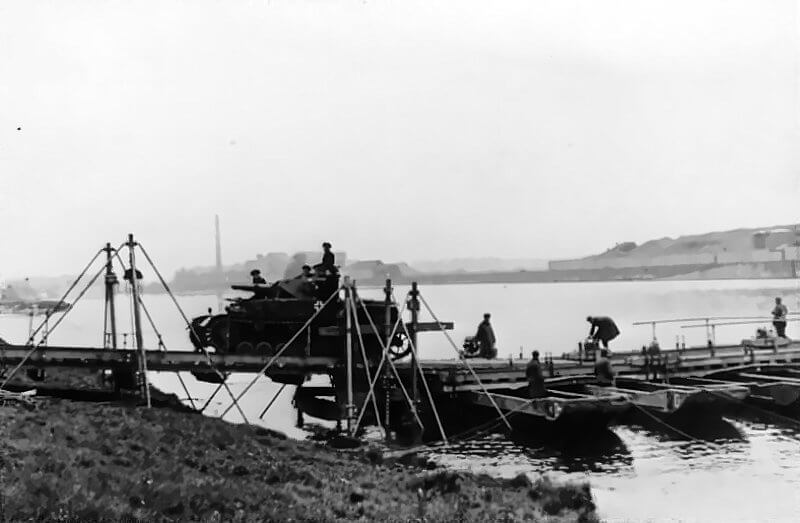
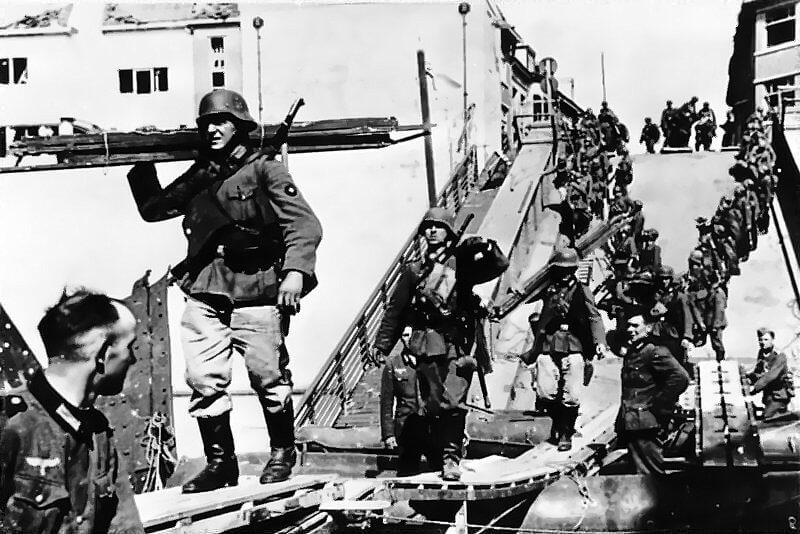
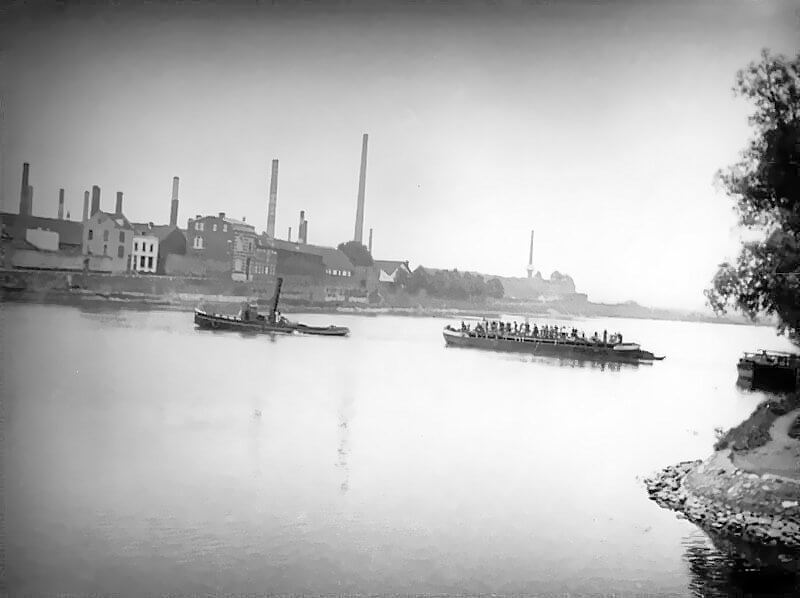
From that moment, German forces begin provisional repair work on the bridges. They make use of rubber boats. Ferry pontoons are also brought into service. A pontoon bridge is constructed.
From the early morning of May 11th, 1940, the 314 tanks of 4. Panzer-Division of 6. Armee cross the Maas.
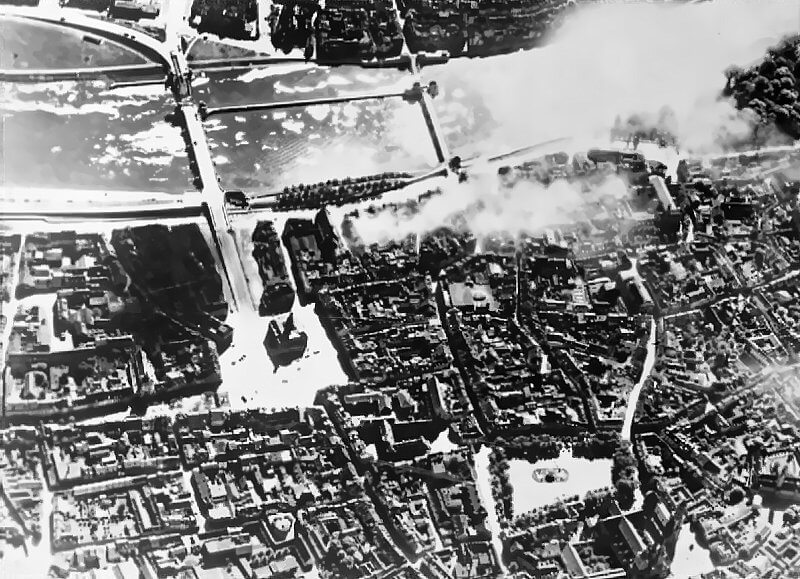
Isolated Allied air attacks on May 11th and May 12th, 1940, fail to achieve their aim. They do not halt the German advance. The partly restored bridges and other German targets are missed. Instead, Allied bombs strike the Grote Staat, Grote Gracht, Onze Lieve Vrouweplein, Kesselskade, Rechtstraat, and the corner of Hoogbrugstraat and Wycker Grachtstraat. Thirteen people are killed. About one hundred are wounded.
| The advance of the 4. Panzer-Division |
At 04:35 reports of Fallschirmjäger success on the Albert Canal and Fort Eben Emael reach German headquarters. Meanwhile the Wehrmacht crosses the borders in a coordinated assault. Two infantry divisions of XVII. Armeekorps advance on foot and encounter only limited Dutch resistance, facing no more than five battalions of border troops.
Designated routes remain open for 4. Panzer-Division, which is ordered to dash toward the Maas bridges at Maastricht and then drive on to the Albert Canal.
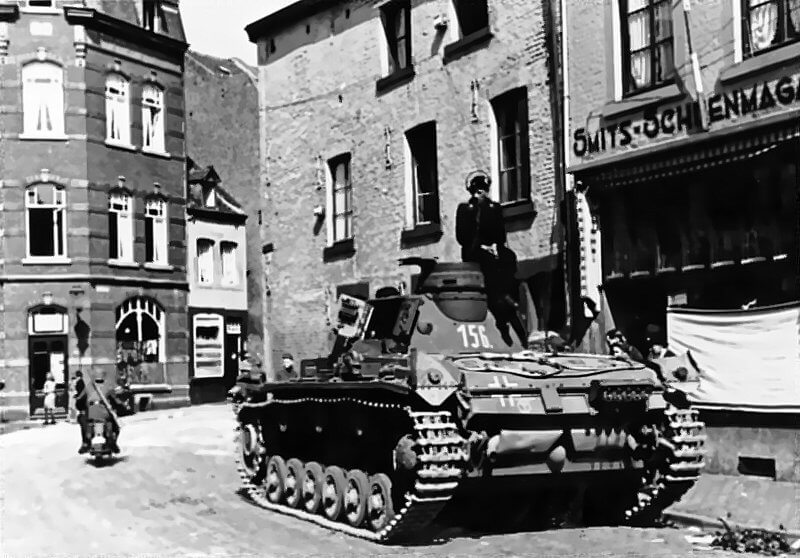
The armoured thrust is led by the motorcyclists of 7. Aufklärungs-Abteilung, followed by Infanterie-Regiment 151. This regiment is detached from 61. Infanterie-Division and attached to 4. Panzer-Division. To maintain tempo, the infantry ride in trucks and are grouped with a battalion of Panzer-Regiment 35, forming the spearhead of the westward advance.
Along the southern of the three advance routes, the battalion of Panzer-Regiment 35, leading the left marching group, crosses the border north of Aachen at 05:35. The crossing is unopposed. After roughly two kilometres, the column reaches the main road toward Maastricht and advances as far as Gulpen.
At Gulpen, Dutch troops resist. The crossings over the Geul have been demolished, and the defenders hold positions behind the wrecked bridge with anti-tank guns. Breaking through this first obstacle belt and its associated defences takes more than ninety minutes.
The panzer column then descends into the Maas valley at about 07:00. At that moment, the commander sees the Maas bridge explode directly in front of his column. At the railway station on the right bank, the Germans encounter a motorcycle section from a z.b.V. Wecke battalion, which reaches Maastricht no earlier than the panzers themselves.
For Infanterie-Regiment 151, reinforced by Pionier-Bataillon 51, the demolition of the Maastricht bridges is a catastrophe. The regiment is intended to reinforce the Fallschirmjäger landed on Fort Eben-Emael.
The Germans push forward to the bridge site and consolidate their position. They exchange fire with Dutch troops holding the far bank. An 88-millimetre Flak gun is brought up and fires across the river. Following this, the Dutch defenders surrender under a white flag, opening the way for engineers to begin crossings using rafts.
Fortunately for , engineer support is integral to the 4. Panzer-Division plan. Two companies from Pionier-Bataillon 51 are attached to the leading columns. Should Bataillon zur besonderen Verwendung 100 and the Fallschirmjäger fail, these engineers are to force crossings immediately. They carry obstacle-crossing equipment prepared for rapid deployment.
Within an hour, the first rafts capable of carrying men and light vehicles are operating on the Maas. According to a panzer officer, by around 09:00 the pioneers of Pionier-Bataillon 51 move forward toward Kanne, travelling in requisitioned Dutch lorries and on bicycles.
Meanwhile, the commander of 4. Panzer-Division regroups his forces and gives crossing priority to two infantry Kampfgruppen from Infanterie-Regiment 151. These units are ordered to move as quickly as possible toward the two Albert Canal bridges that are still intact.
Ready-made temporary bridge sections are carried on vehicles, unloaded, and fitted between the broken halves of the large Maastricht bridges. Because the demolitions are incomplete and the bridge spans hang into the river, these sections create improvised footbridges.
Between 11:00 and 12:00, rafts capable of carrying heavier vehicles begin operating, ferrying loads of four and eight tonnes. Vehicles cross in small numbers and move on to join the infantry Kampfgruppen stretched along the roads toward Objectives Stahl and Beton, approximately four kilometres away.
Crossing remains slow at first, with only small and lightweight elements able to pass. Once across, these troops move immediately toward their assigned objectives.
While personnel, light equipment, and vehicles continue to be ferried, other engineers work to expand the crossings. They construct ferries and bridges capable of carrying tanks and heavy vehicles of 4. Panzer-Division. This armour is required both to secure the Albert Canal bridgeheads and to serve as the springboard for XVI. Armeekorps on Day Two of the offensive.
Infanterie-Regiment 151 makes first contact with Sturmgruppe Stahl at about 14:00, with contact at the other crossings following shortly thereafter. Several attempts by the reinforced Infanterie-Regiment 151 to cross the Albert Canal during the evening fail. The regiment remains on the eastern bank until May 11th, 1940.
These initial arrivals consist mainly of reconnaissance, observation, and command elements and possess little combat power. As additional troops and support weapons reach the canal line, they are fed into the two bridgeheads. Infanterie-Regiment 151 does not fully take over Ziel Stahl and Beton until around 20:00. German losses at Ziel Stahl amount to eight killed and thirty wounded.
Earlier that afternoon, leading infantry elements arrive in time to help defeat an attack by a small number of French light tanks from the 3e Division Légère Mécanique. These vehicles have driven roughly 240 kilometres in under twelve hours in an attempt to reinforce a critical point in the Belgian line. They are unable to enter Belgium until German forces violate Belgian neutrality.
The French tanks suffer mechanical breakdowns and are subjected to Luftwaffe interdiction. Arriving with limited combat power, their crews are shocked to find the crossings already in German hands. Their probing attacks are repelled by the Fallschirmjäger and the light anti-tank weapons of Infanterie-Regiment 151.
On the afternoon of May 11th, Infanterie-Bataillon z.b.V. 100 is placed under Infanterie-Regiment 151. At the same time, the regiment must detach Pionier-Bataillon 51 to secure Fort Eben-Emael. Infanterie-Regiment 151 is now reinforced to the strength of five battalions. By the evening, it holds the area of Sichen-Sussen and Eben-Emael. It is placed under direct command of XVI. Armeekorps.
Heavy pontoons then begin ferrying the first panzers across the Maas. A 16-tonne bridge constructed at Maastricht opens at dawn on May 11th, 1940. The Dutch demolition of the bridges imposes a delay of roughly twenty hours on 6. Armee. Nevertheless, with two bridgeheads secured over the Albert Canal and permanent bridges capable of carrying heavy equipment in place, the Maastricht Gateway is forced open.
| Aftermath |
Fighting in South Limburg, in the sector Roosteren to Maastricht, costs 47 Dutch military lives. This includes 2 officers, 7 NCOs, and 38 corporals and soldiers. There is no exact figure for civilian losses.
German losses are not fully known. In some actions, accurate figures exist. It is estimated that 130 to 190 German soldiers are killed in the fighting in the south. This includes losses at Vroenhoven and Veldwezelt, which are largely inflicted by Belgian forces. Wounded are likely at least three times that number.
It is confirmed that 186 German soldiers killed in Limburg in May 1940 are buried at Ysselsteyn. Some may have died of wounds sustained elsewhere.
German material returns confirm that nine armoured cars and tanks are destroyed in Limburg. Ten German aircraft crash in South Limburg. These are mainly Junker 52 and Junker 87 aircraft.
| Multimedia |
| Sources |