
| Page Created |
| November 28th, 2025 |
| Last Updated |
| December 10th, 2025 |
| Great Britain |
 |
| Additional Information |
| Unit Order of Battle Commanders Operations Equipment Multimedia Multimedia 2 Sources Biographies |
| Operations, 79th Armoured Division |
| June 6th, 1944 |
| Operation Overlord |
| 79th Armoured Division |
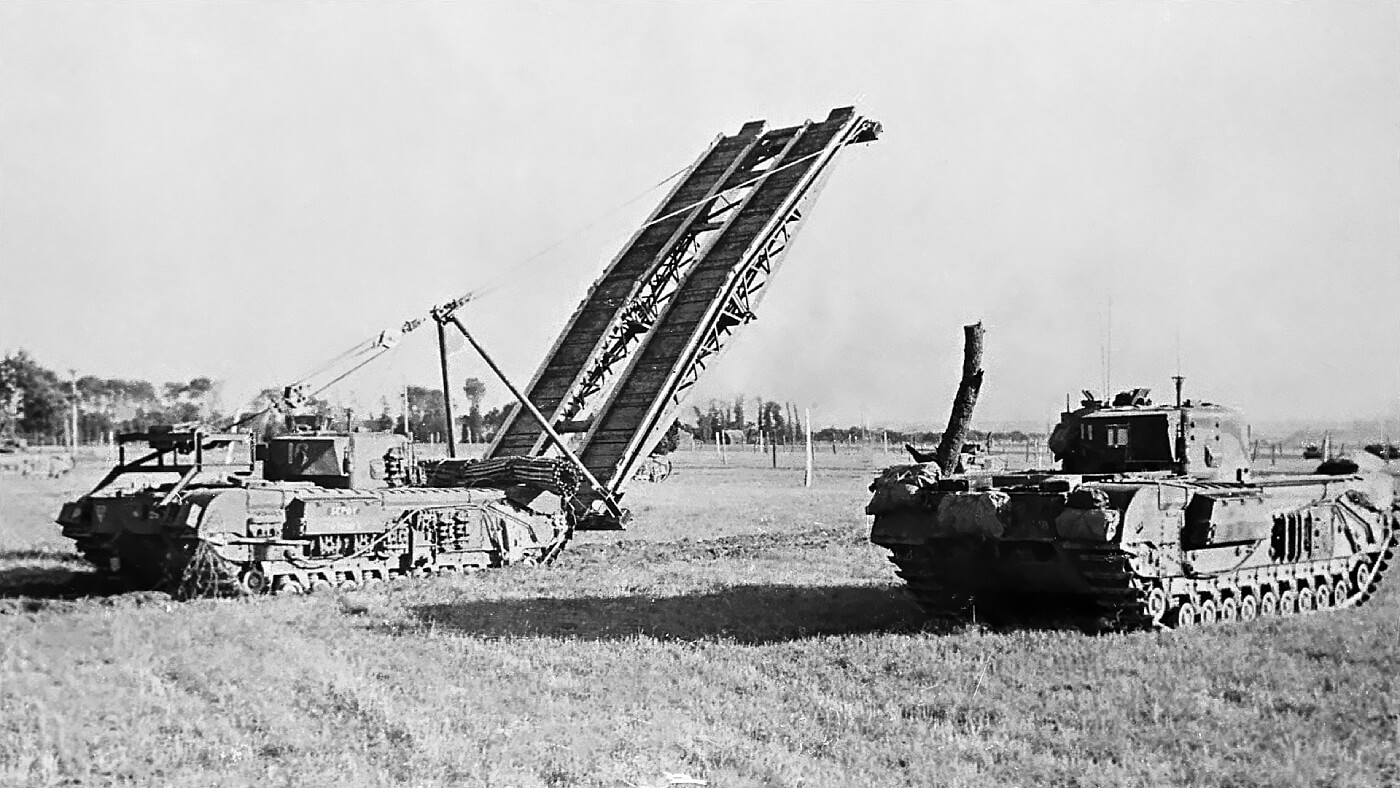
| The specialised armour of the 79th Armoured Division supports the British and Canadian landings on Gold, Juno, and Sword Beaches. Its objectives are to: * Land DD tanks to provide immediate armoured fire support. * Use Sherman Crab s, AVRE’s, Crocodiles, and engineer teams to breach obstacles, clear mines, destroy strongpoints, and open beach exits. * Enable infantry divisions to break off the beach quickly and advance inland. * Support follow-on operations by employing specialised armour in coordinated assaults once off the beaches. Major-General Hobart’s further objective is to ensure his specialised units are used strictly within their defined roles and not misemployed as assault tanks by infantry commanders. The assault begins under difficult conditions. On Gold Beach, rough seas prevent the Duplex Drive tanks from launching, leaving the infantry exposed. The Nottinghamshire Yeomanry lose eight Duples Drive tanks. Heavy fire at Le Hamel destroys most of the first flail tanks. German guns at La Rivière and Le Hamel resist naval and air bombardment until Sherman Crab’s, AVRE’s, and Centaurs suppress them. Engineers fight through mines, mud, and soft clay to open multiple exits, clearing more than a thousand yards of beach by dusk. On Juno Beach, delayed armour and hidden obstacles slow the advance. The Canadian infantry face severe fire until the 6th Canadian Armoured Regiment’s Duplex Drive tanks arrive, knocking out several guns and machine-gun posts. Close-set villages and heavy mining complicate movement. AVRE’s push through congestion and open four exits by 09:00, enabling an inland advance by early afternoon. On Sword Beach, the built-up coastline and poor seas create uneven resistance. The 13th/18th Royal Hussars land thirty-three of thirty-four Duplex Drive tanks. Supported by Crab’s, AVRE’s, and bulldozers, they clear five exits in the first hour despite close combat in seafront buildings. Objectives are secured by evening. Across all three beaches, the 79th Armoured Division opens thirteen of eighteen planned lanes. It suffers 179 casualties and heavy vehicle losses but ensures far faster progress than on Omaha Beach, where unprotected American engineers face devastating fire. |
| June 17th, 1944 |
| Capture of the Douvres-la-Délivrande radar station |
| 79th Armoured Division, Royal Marine Commandos |
| The assault force consists of No. 41 Royal Marine Commando, supported by AVRE’s from 26 Assault Squadron, Crabs from B Squadron, 22 Dragoons, and a diversion by two troops of AVRE’s from 77 Assault Squadron. Their objective is to capture the fortified Douvres-la-Délivrande radar station, defended by anti-tank guns, machine-gun posts, twin Spandau weapons, and more than two hundred German troops. The first fully coordinated infantry and specialised armour attack is carried out. Planning is detailed, rehearsals are complete, and artillery smoke and high explosive support each phase. The combined assault quickly overwhelms the position and succeeds with the loss of only one AVRE. |
| June 7th, 1944 – August 1944 |
| Bocage War |
| 79th Armoured Division |
| Specialised armour from the 79th Armoured Division, particularly AVRE’s and Crocodiles, is used to overcome the movement restrictions caused by the Norman hedgerows. Their objective is to create gaps in the Bocage, neutralise German positions concealed behind the banks, and assist infantry in regaining mobility for a breakout. Once the beachhead is secure, the Allies confront the Bocage. Planners underestimated its effect on operations. The hedgerows restrict movement and strongly favour German defence. British forces encounter fewer hedgerows and have equipment better suited to the challenge. After two weeks, 79th Armoured Division identifies that AVRE’s can blast gaps with petard mortars. Crocodiles join these teams, using flame and explosive force to dislodge German troops hidden behind the embankments. The Americans face denser hedgerow terrain and lack specialist vehicles. Tankdozers offer limited help until soldiers improvise steel prongs on Sherman tanks, creating the Culin cutters. These Bocage busters, combined with tight infantry–armour cooperation, finally enable an American breakout. The differing experiences highlight Britain’s advantage in possessing a centralised pool of specialised armour ready for varied tactical tasks. |
| September 10th, 1944 – September 12th, 1944 |
| Capture of Le Havre |
| 79th Armoured Division |
| Brigadier Duncan leads the assault group of 79th Armoured Division in the attack on Le Havre. His force includes two Crab regiments, one AVRE regiment, two Crocodile squadrons, and several newly converted Kangaroo armoured personnel carriers. The 49th Royal Tank Regiment and the 1st Canadian Armoured Personnel Carrier Regiment, both forming part of the 31st Tank Brigade, provide the Kangaroos. Their objective is to breach minefields and obstacles, destroy German concrete positions, suppress defences with flame, and carry infantry forward under armour to secure the port. The 79th Armoured Division supports 1st Corps in the assault on Le Havre. The attack begins after heavy air and artillery bombardment. Crabs and AVRE’s open lanes through the dense mine belts and obstacles. AVRE crews also use Snakes to clear paths when resistance is strong. Crocodiles move forward and fire flame into defended positions, encouraging German troops to surrender. Kangaroos follow with infantry to protect the armour from panzerfaust teams. The assault method mirrors Normandy but now includes large-scale use of Kangaroos. The close cooperation of Crab’s, AVRE’s, and Crocodiles proves decisive. The 49th and 51st Infantry Divisions advance rapidly, and Le Havre is captured in under three days with only fifty British soldiers killed. |
| September 17th, 1944 – September 22nd, 1944 |
| Operation Wellhit |
| 79th Armoured Division |
| The 3rd Canadian Division conducts the assault on Boulogne, supported by 79th Armoured Division subunits under the control of Brigadier G. S. Knight of 31st Armoured Brigade. Three armoured columns are each led by 79th Armoured Division tanks and commanded by a lieutenant colonel. Each assault team includes one troop of Crabs, two troops of Crocodiles, and a half-troop of AVRE’s. Kangaroos carry infantry to secure gaps created in the defences, while bulldozers prepare routes through bomb-damaged ground. Their collective objective is to breach the perimeter, carry infantry through the city, and force German defenders to surrender strongpoints. The 3rd Canadian Division attacks Boulogne. Infantry first clear the outer defensive ring. Three armoured columns then push into the city. Bombers create openings in the perimeter, which Kangaroos exploit by delivering infantry directly into the breaches. Bulldozers follow to level craters and rubble. Urban fighting proves far more difficult. German resistance is strong and armour movement is restricted by narrow streets. Progress is slow, but Crocodiles play a decisive role in forcing defenders out of fortified buildings. After four days the city falls. The assault method again proves effective, but heavy bombing is judged a mistake because the resulting rubble obstructs the advance. During these operations, American forces conduct their own assault on Brest and continue to seek flame tanks for European combat. |
| October 2nd, 1944 – November 8th, 1944 |
| Battle of the Schelde |
| 79th Armoured Division, Royal Marine Commandos, Commandos |
| The 79th Armoured Division supports the clearance of the Scheldt Estuary and the opening of Antwerp. Its specialised units include Crab’s, AVRE’s, Duplex Drive tanks, bulldozers, and the newly introduced Buffalo amphibious vehicles. Their objectives are twofold: first, to break coastal and dike defences and open beach exits; second, to transport assault troops, vehicles, and supplies across the flooded terrain and onto the beaches. The 11th Royal Tank Regiment becomes the main amphibious transport unit, having exchanged its Canal Defence Light tanks for Buffaloes. Engineer units also adopt Buffaloes, rapidly expanding the amphibious fleet. Duplex Drive tanks from the Staffordshire Yeomanry provide fire support, but with limited effectiveness in steep and muddy terrain. The division begins small amphibious assaults in early October along the southern edge of the Scheldt. Buffaloes from the 11th Royal Tank Regiment and Duplex Drive tanks from the Staffordshire Yeomanry support the 3rd Canadian Division. More than six hundred vehicles and two infantry brigades are carried in 880 loads, with minimal casualties. A larger assault follows on October 26th, 1944, with the 52nd (Lowland) Infantry Division as the assault force. The 79th Armoured Division supplies Buffaloes and Duplex Drive tanks for more than seven hundred crossings. Steep banks and dikes hinder the Duplex Drive tanks, limiting their ability to provide supporting fire, but the operation sets the stage for the final attack on Walcheren. On November 1st, 1944, the main assault on Walcheren Island begins, led by the 4th Special Service Brigade. German minefields, wire, concrete, and reinforced dikes make conditions extremely difficult. Naval and air bombardments fail to neutralise German artillery, damaging several landing craft. Once ashore, attackers face deep clay that bogs many vehicles. Less than half the specialised armour reaches inland positions, though Landing Craft Vehicles move without difficulty. The Germans resist for almost three days. Flooded ground slows every advance. Clearing the island takes more than a week. Buffaloes perform well in the waterlogged terrain, but most other specialist vehicles contribute little in the mud. |
| March 23rd, 1945 – March 27th, 1945 |
| Operation Plunder |
| 79th Armoured Division |
| The 79th Armoured Division prepares the specialised armour for the Rhine crossing in Operation Plunder. Its key units include Buffalo amphibious vehicles, Sherman Duplex Drive tanks, and the Canal Defence Light squadron. Their objective is to carry assault infantry across the Rhine, support the initial landings with armoured fire, illuminate the crossing, and ensure a rapid establishment of bridgeheads. Four Buffalo regiments are tasked with transporting the infantry of the Highland Division, the 3rd Canadian Division, and the 43rd and 15th (Scottish) Infantry Divisions. Duplex Drive tanks from both British and American units must lead the assault waves. The Canal Defence Light squadron is assigned to illuminate the far bank and guide ferry movements during night operations. By March 1945 Allied forces mass along the Rhine for the final advance into Germany. Operation Plunder is planned and rehearsed on a scale second only to Normandy. Training wings of the 79th Armoured Division work intensively with the infantry and armour they will support. Maintenance becomes critical as many Sherman Duplex Drive tanks need new flotation gear. American forces face shortages and depend heavily on British stocks to make their own Duplex Drive tanks operational. The assault mirrors D-Day. On the night of March 23rd, 1945, troops board Buffaloes and begin the crossing. Duplex Drive tanks enter the river in large numbers and, despite some bogging in the mud of the eastern bank, enough reach firm ground to deliver effective direct fire support. On the nights of March 24th, 1944, and March 25th, 1944, the Canal Defence Light tanks are used for the first time in combat. Their powerful beams guide Buffalo traffic and deter swimmer and mine attacks. German gunners target the lights, but only one vehicle is lost and the squadron completes its task. Between March 24th, 1944, and March 26th, 1944, the four Buffalo regiments make more than 3,800 crossings, transporting the assault brigades with only thirty-eight casualties and nine Buffaloes lost. On March 26th, 1944, Churchill and Brooke cross the Rhine in a Buffalo with Montgomery and Hobart. Churchill addresses the crews and praises their achievement. The crossing is a vast and complex undertaking carried out with exceptional precision. |