

| Page Created |
| July 14th, 2025 |
| Last Updated |
| August 14th, 2025 |
| The United States |
 |
| Related Pages |
| Landing Craft, Assault Landing Craft Vehicle, Personnel Operation Overlord Operation Neptune Omaha Beach Omaha Beach, German Defences Omaha Beach, Provisional Ranger Group Omaha Beach, 1st Infantry Division Omaha Beach, 29th Infantry Division Omaha Beach, 29th Infantry Division, 116th RCT Omaha Beach, 29th Infantry Division, 115th RCT |
| June 6th, 1944 |
| Omaha Beach, 29th Infantry Division, 116th Regimental Combat Team |
| Objectives |
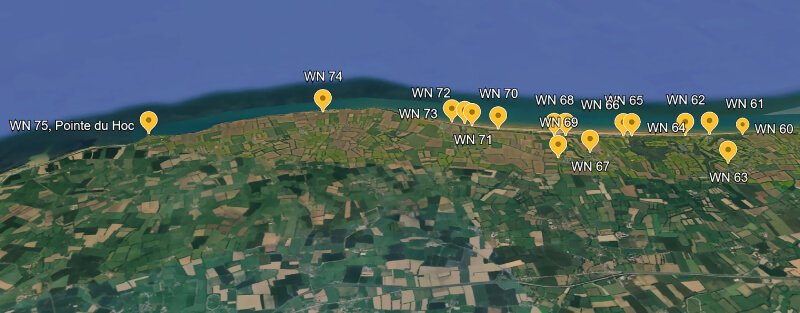
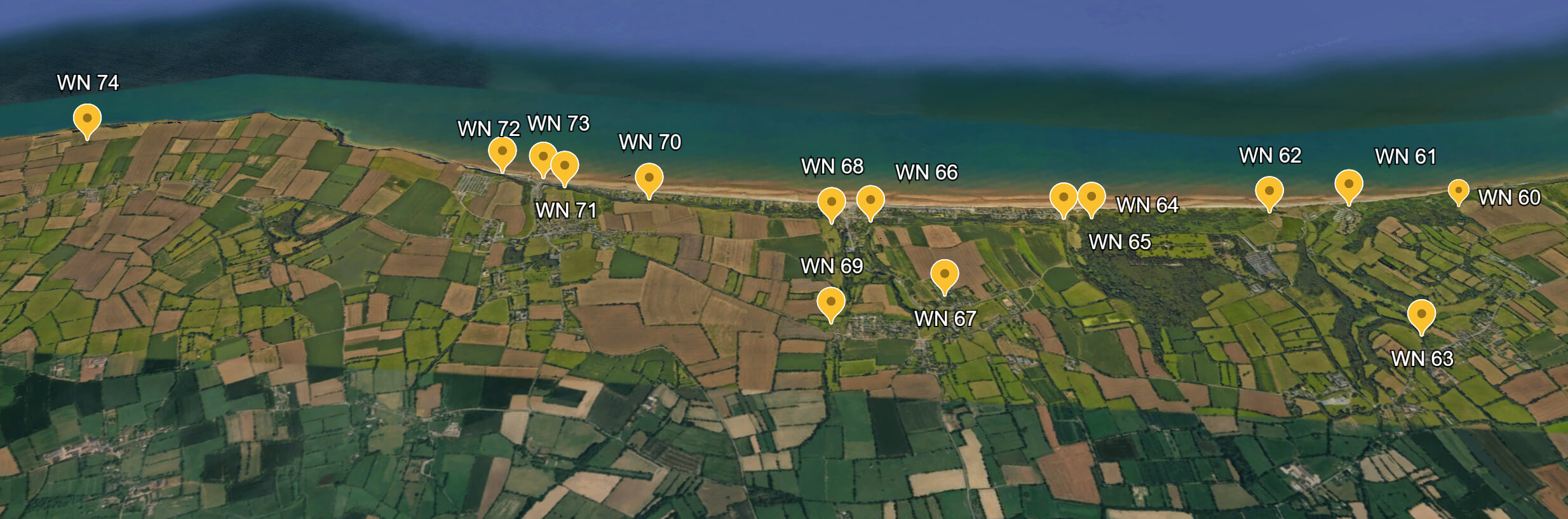
| Operational Area |
| Allied Forces | ||||
 |
- 116th Regimental Combat Team
- 1st Battalion, 116th Infantry Regiment
- 2nd Battalion, 116th Infantry Regiment
- 3rd Battalion, 116th Infantry Regiment
| Axis Forces |
| 352. Infantrie-Division |
 |
- Grenadier-Regiment 914
- I Bataillon (I./914)
- II Bataillon (II./914)
- Grenadier-Regiment 915
- I Bataillon (I./915)
- II Bataillon (II./915)
- Grenadier-Regiment 916
- I Bataillon (I./916)
- II Bataillon (II./916)
- Artillerie Regiment 352
- I Bataillon (I./352) 3 batteries of 105-millimetre leFH 18/40
- II Bataillon (II./352) 3 batteries of 105-millimetre leFH 18/40
- III Bataillon (III./352) 3 batteries of 105-millimetre leFH 18/40
- IV./352 with batteries of 150-millimetre sFH 18
- Panzerjäger-Abteilung 352
- Kompanie
- Kompanie
- Kompanie
- Pionier-Bataillon 352
- Divisions-Füsilier-Bataillon 352
- Nachrichten-Abteilung 352
- Feld-Ersatz-Bataillon 352
- Heeres-Küsten-Batterie Maisy (H.K.B. 6./1716 and 8./1716)
- Batterie 6: Four 105-millimetre leFH 414(f) French howitzers
- Batterie 8: Four 100-millimetre Czech guns (K.14/19) in open pits
- Heeres-Küsten-Batterie Pointe du Hoc (H.K.B. 2./1261)
- Six 155-millimetre GPF-T (French) naval guns
- Heeres-Küsten-Batterie Trevieres / Formigny
| 716. Infantrie-Division |
 |
- Grenadier-Regiment 726
- I Bataillon (I./726)
- II Bataillon (II./726)
- Grenadier-Regiment 736
- I Bataillon (I./736)
- II Bataillon (II./736)
- III Bataillon (III./736)
- Artillerie-Regiment 1716
- I Bataillon (I./1716): 100-millimetre Czech field guns
- II Bataillon (II./1716): 105-millimetre leFH 18 German howitzers
- III Bataillon (III./1716): 150-millimetre sFH 414(f) French heavy howitzers
- IV Bataillon: Mixed coastal defence guns and anti-tank weapons
- Panzerjäger-Bataillon 716
- Pioneer-Bataillon 716
- Nachrichten Bataillon 716
- Feld-Ersatz-Bataillon 716
- Heeres-Küsten-Batterie Longues-sur-Mer (H.K.B. 2./1260)
- Heeres-Küsten-Batterie Mont-Fleury (H.K.B. 1./1260)
- H.K.B. Wn61 / Wn60 (Colleville-sur-Mer sector)
| Reserve Units |
- Ost-Bataillon 439 (Ukrainian)
- attached to 716. Infantrie-Division
- Ost-Bataillon 642 (Georgian/Russian)
- attached to 352. Infantrie-Division
- Ost-Bataillon 630
- uncertain but possibly attached to 716. Infantrie-Division
| June 6th, 1944 |
The transport U.S.S. Thomas Jefferson, carrying early waves of the 116th Regimental Combat Team, completes its unloading in sixty-six minutes. This efficiency is helped by the ability to rail-load twenty-five of its thirty-three landing craft, which are then swung overside. The craft depart the rendezvous area at 04:30, twenty-five minutes ahead of schedule. Control officers fear worsening sea conditions may delay the approach.
| The Way In, June 6th, 1944 |
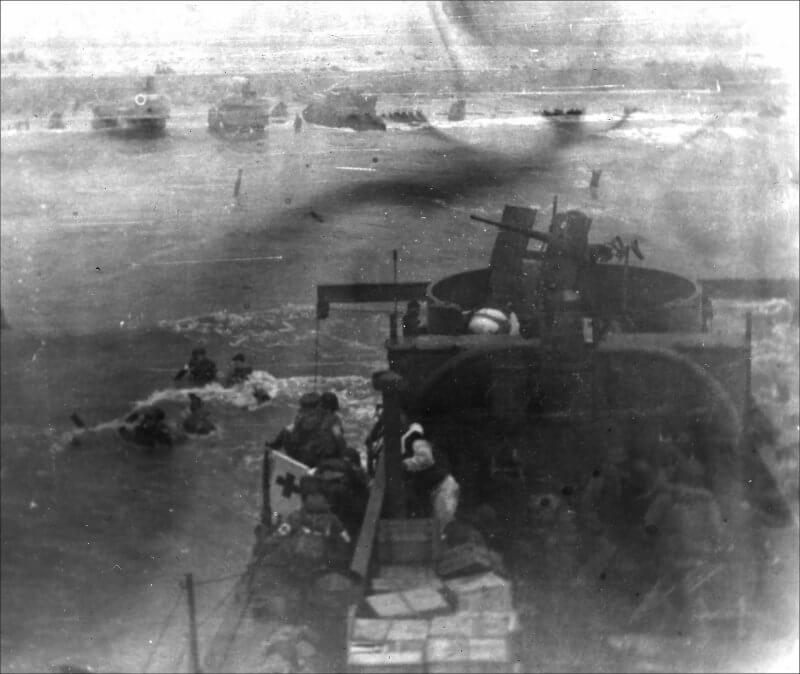
As the landing craft begin their run toward the line of departure, the sea’s roughness takes a heavier toll. Spray drenches the Landing Craft Vehicle, Personnel and Landing Craft, Assault. Many begin to ship water immediately. Pumps are used at full capacity, but in several craft the flooding exceeds what the pumps can handle. Assault troops are forced to bail with their helmets. Craft slowed by flooding struggle to maintain formation. Attempts to accelerate result in heavier seas breaking over the bows, worsening the flooding.
Despite these challenges, only a small proportion of the craft suffer serious trouble. Of the 180 to 200 landing craft involved in the assault waves of the two regimental combat teams, ten are known to swamp. Some sink shortly after leaving the transports; others founder near the shore. Most of the soldiers in these stricken craft are rescued by nearby naval vessels or passing ships, though some remain in the water for hours.
Within most craft, the soldiers are soaked from the start. Cold spray penetrates their clothing. The confined space leaves little room to move. Seasickness soon affects the majority. Though men have eaten the same breakfast and received the same training, the impact varies wildly between boat teams. In some, no one is affected. In others, everyone becomes ill.
The combination of cold, immobility, and seasickness leaves many men physically weakened by the time they reach the beach. Yet these are not untested troops. They have faced similar conditions during training. Some are lifted by the intensity of the moment. One officer recalls his men talking excitedly about the devastation they expect from the naval bombardment. Yet he himself remains detached. To him, it looks like another large-scale exercise at Slapton Sands. He cannot shake the feeling that the landing will be another grim two-day task, though this time, without the comfort of a hot shower at the end.
In the western sectors of Omaha Beach, the 116th Regimental Combat Team prepares to land under similar conditions. Their DD tanks, from the 743rd Tank Battalion, are not launched at sea. Landing Craft Tank commanders assess the heavy surf and cancel the waterborne deployment. All thirty-two tanks are brought directly to the beach.
Navigation again proves the main obstacle. Like the 16th Regimental Combat Team, the 116th Regimental Combat Team troops are assigned narrow beach zones with precise objectives. Landing in the correct location is essential. But strong eastward currents, poor visibility, and the dislocation of control vessels cause confusion.
One section from Company E, 116th Regimental Combat Team, is meant to land on Easy Green. Instead, scattered boats reach Fox Green, well within the 16th Regimental Combat Team sector. Most landings are off by hundreds of metres. This is enough to disrupt unit tasks and coordination. Unfamiliar terrain prevents identification of defensive structures. Boat teams cannot form up properly. Company sections arrive fragmented.
The scattered landings strip away tactical advantages. Sections with heavy casualties in leadership suffer most. Cut off and unsure of their location, they cannot reorganise effectively. Attempts to execute planned tasks falter.
Like their counterparts on the eastern beaches, the 116th Regimental Combat Team lands under the echo of naval fire. Rockets, shells, and tank rounds strike the coastline. But many German strongpoints survive. As the boats near shore, machine-guns and artillery open fire. The enemy defences are intact and active.
Air bombardment offers little help. At 06:00 hours on D-Day, 480 B-24 bombers of the U.S. Eighth Air Force strike targets along the coast. Cloud cover over France forces the Eighth Air Force to rely on Pathfinder radar. The bomb release is deliberately delayed to protect the landing forces. As a result, the majority of 13,000 bombs fall inland, up to five kilometres from the beach. The beach itself remains intact. No craters offer cover for the advancing troops. German defensive positions are not seriously damaged.
The landing craft carrying the 116th Regimental Combat Team suffer minimal artillery losses. Most infantry reach the shore despite the confusion. But the real damage is strategic. Units land disorganised, disoriented, and under fire. The plan to reduce defences systematically collapses. What follows is a desperate, improvised struggle for survival and advance.
| Landing of the Regimental Combat Team, June 6th, 1944 |
At 06:30, the 116th Regimental Combat Team begins its assault. The 743rd Tank Battalion lands all tanks by Landing Craft Tank. On the right flank, Company B comes ashore near the Vierville draw. Artillery fire devastates the landing. The company commander’s Landing Craft Tank sinks offshore. Four officers are killed or wounded. Only one lieutenant remains. Of the sixteen tanks, eight reach the waterline and begin firing.
Companies A and C land further east. Their tanks come ashore without initial losses. The 116th Regimental Combat Team receives far less engineer support than planned. Beach clearance efforts on Dog Green, Dog White, and Dog Red are compromised by delays and mislandings. Some engineer teams land without infantry cover. They are targeted immediately.
Of sixteen armoured bulldozers, only six reach shore in working order. Three are knocked out quickly. Explosives, buoys, and marker poles are lost. Several demolition teams suffer catastrophic casualties. One team loses eight men when an artillery shell detonates their rubber boat. Another is wiped out when its Landing Craft Medium is hit during unloading. A third suffers a mortar strike that ignites their explosives mid-transfer.
Support Team F lands at 07:00. A shell hits the ramp. Three men fall into the sea. A second round strikes the bow. Fifteen are killed. Only five reach shore.
Engineers who survive begin work under fire. The rising tide floods lower obstacles. Infantry crossing the beach disrupts clearance. A dozer becomes trapped by troops seeking cover. Charges cannot be set off while infantry are among the obstacles.
One Landing Craft Vehicle, Personnel crashes into mines, forcing engineers to abort their task. In another case, a vehicle severs the primacord. A naval officer loses his fuses to shrapnel. A mortar shell hits Team 12’s fuse, triggering a premature detonation. Nineteen men die.
By the end of the first phase, six full gaps and three partial ones are cleared. Only two full gaps are in the 116th Regimental Combat Team zone. The rest lie along Easy Red. Only one gap is marked, making them difficult to locate at high tide. Casualties among the engineers, including naval personnel, reach forty-one percent. Most occur in the first half hour.
| A Company, 1st Battalion, 116th Regimental Combat Team, June 6th, 1944 |
A Company, 116th Regimental Combat Team, forms the first wave of the 1st Battalion, 116th Regimental Combat Team. The landing craft disembarks its troops just to the left of the Rangers and directly in front of the Vierville draw. This is among the most heavily defended sections of Omaha Beach, identified by the Germans as Stützpunkt Vierville.
To the right of the draw lies Widerstandsnest 72, one of the strongest German positions along the beach. Its primary casemate contains an 88-millimetre PaK 43/41 antitank gun. The gun faces east, covering the length of the beach in enfilade. A reinforced wall shields the embrasure from direct naval fire. An antitank wall extends east from the casemate, barring vehicle access off the beach. Beside it stands another enclosed bunker with a pivot-mounted 50-millimetre gun. This weapon can fire either east or west. Atop the bunker sits a captured French Renault tank turret, repurposed for defence. On the bluff beyond, two hidden Tobruks contain 81.4-millimetre mortars. Several trenches in the vicinity hold MG 34 or MG 42 machine guns.
To the left of the draw lies Widerstandsnest 71. This position consists of trenches and machine-gun emplacements overlooking the Vierville exit. Though less heavily armed than Widerstandsnest 72, its elevation and firepower make it highly effective against infantry.
The preliminary bombardment fails to weaken the defences. Widerstandsnest 72 is targeted by Landing Craft Tank (Rocket)-464, which launches over one thousand 127-millimetre rockets. These fall short of the beach, leaving the strongpoint intact. Widerstandsnest 71 is shelled by U.S.S. McCook at 05:50. The destroyer fires 220 rounds at three preselected targets over a twenty-minute period. At 06:16, the vessel ceases fire, judging the positions neutralised. This halt comes fifteen minutes before the first wave reaches the shore.
Expecting only light resistance, A Company lands in front of both Widerstandsnest 71 and Widerstandsnest 72. German mortars and machine guns engage them before they reach the beach. Casualties mount immediately. Within minutes, A Company loses three of its four platoon leaders and sixteen junior officers. The men disembark from LCAs, which have narrow ramps. Troops exit one by one, exposed to direct fire. As the ramps fall, machine-gun bursts sweep the craft. Mortars rain down from above. These are precisely ranged and guided by coloured stakes placed on the sand.
Within ten minutes, the unit is effectively leaderless and immobilised. Lieutenant Edward N. Garing remains in the surf where his landing craft faltered. The other officers are dead, save Lieutenant Elijah Nance. He is hit in the heel disembarking, then again in the torso on the beach. Lieutenant Edward Tidrick is shot in the throat as he jumps into the water. He reaches the sand, collapses near Private Leo J. Nash, and gives a final order: “Advance with the wire-cutters.” Nash has none. Tidrick exposes himself again and is cut down by machine-gun fire from head to pelvis. German gunners firing from the cliffs above now strike directly into the ranks below.
Captain Taylor N. Fellers and Lieutenant Benjamin R. Kearfott land with thirty men in LCA 1015. No full account of their fate survives. Every man aboard is killed. The bodies are later found scattered along the beach.
During these first chaotic minutes, the men are forced into the surf, weighed down by their gear. Helmets and weapons are cast aside in attempts to stay afloat. Survival becomes the only objective. Enemy snipers appear to focus fire on officers and non-commissioned leaders. All the sergeants are soon killed or wounded. A medical boat team lands near Tidrick’s position and is annihilated by machine-gun fire. Their bodies drift with the tide.
The survivors abandon any thought of assault. They focus instead on rescuing comrades from the water. Those still able push or drag wounded men towards the shore. On the sand, some crawl back into the surf to save the drowning. Many are shot while attempting to help others. The wounded are often too burdened by equipment to stay afloat. Their rescuers strip themselves of their own gear and cut away the wounded’s packs. They then cast the heavy items aside into the water.
Within twenty minutes, A Company is no longer a combat unit. It becomes a small, desperate rescue group. No orders are given. Every uninjured man acts on his own initiative. The mission to secure the Vierville draw has failed. The landing has become a desperate bid for survival.
| G Company, 1st Battalion, 116th Regimental Combat Team, June 6th, 1944 |
Company G, meant to land on Dog White, instead comes ashore in scattered groups east of Dog Red. Some land near grass fire smoke, which blinds enemy gunners. These troops cross the flat with few losses and reach the shingle in fifteen minutes. However, their disorientation and lack of orders prevent further movement. Other sections face heavier fire, losing fourteen men from one boat before reaching cover.
| F Company, 1st Battalion, 116th Regimental Combat Team, June 6th, 1944 |
Company F lands near les Moulins draw. Three of its six sections, unprotected by smoke, face intense fire and take forty-five minutes to cross the sand. Half are casualties. The rest are disorganised and unfit for further assault. The other sections reach the shingle but lose their officers.
| E Company, 1st Battalion, 116th Regimental Combat Team, June 6th, 1944 |
Company E veers nearly 1.6 kilometres east. It misses Easy Green entirely. Three boat teams Company E, 116th Infantry, land on Fox Green. Sixty men reach the shingle. Captain Laurence Madill is wounded while crossing the beach and again while retrieving mortar rounds. Fatally hit, he urges his sergeant to lead the men off the beach. The company is scattered all over the beach.
| Second Wave, 116th Regimental Combat Team, June 6th, 1944 |
By 07:00, Company A is shattered. Company F is broken. Company G is disoriented. Only its strongest elements prepare to move west. Around that same time, the second group of assault waves begins landing. The landings continue for forty minutes and conclude with the arrival of the support battalions of both regimental combat teams. By now, conditions no longer match the original plan. The tide has risen over 2.4 metres in one hour, surging through the obstacle belts. Only a few gaps have been cleared. Enemy fire, which devastates the first wave, remains unneutralised. No advance has yet been made beyond the shingle. The tanks and isolated infantry pockets onshore offer limited covering fire.
As a result, the landings mirror much of the chaos and loss of the earlier waves. Casualties remain high on the shrinking tidal flat. Unit experiences vary. Enemy fire, now partially diverted by the forces already ashore, is less concentrated in some areas. However, mislandings continue. Infantry units are dispersed. Engineers are prevented from completing assigned tasks. Headquarters elements land separately from their units, complicating reorganisation.
In the 116th Infantry Regiment, rifle companies in these later waves are reorganised. Each company contains two assault sections equipped similarly to those of the first wave. Their task is to mop up enemy positions bypassed earlier. The remaining four sections carry standard rifle platoon equipment.
Support units expect that initial penetrations will already be secured. Orders instruct them to move inland as rapidly as possible in boat sections toward battalion assembly areas. The 1st Battalion, 16th Infantry Regiment, mirrors the structure of the first wave entirely. This likely reflects its experience from earlier landings in North Africa and Sicily, where assault plans had also failed to unfold as intended.
In the 116th Regimental Combat Team, three companies of the 1st Battalion are scheduled to reinforce Company A at Dog Green in front of the Vierville exit. Only two or three boat sections reach that area. Company B, due at 07:00, misses its landmarks. Its landing craft scatter over nearly 1.6 kilometres to both sides of the target. Only the flanking sections take part in the subsequent fighting. Craft landing near Dog Green face the same deadly fire that destroys Company A. Survivors from both units merge in a struggle for survival at the water’s edge.
Company C arrives at 07:10, landing one kilometre east of the Vierville exit on Dog White. This mislanding proves advantageous. One of its six craft becomes entangled in a mined obstacle and spends twenty minutes manoeuvring clear. Another capsizes in surf, spilling equipment and men into 1.2 to 1.5 metres of water. This section, assigned to mop up Vierville draw, loses all flamethrowers, bangalore torpedoes, demolition charges, and mortars. Despite this, enemy fire is unexpectedly light. The company lands at the edge of a smoke belt created by grass fires on the bluff. Only five or six casualties are suffered. Four or five tanks are visible, but no other infantry units are nearby.
Company C’s sections cluster within a hundred-metre frontage behind the four-foot timber sea wall. The men regroup in good order. Equipment is mostly intact. The unit is better organised than any other force in the 116th Regimental Combat Team’s zone at this point.
Company D fares worse. Three of its craft ship water; one is abandoned offshore, and the section does not land until after midday. A second is sunk by a mine or artillery round 365 metres from the shore. Half the men swim ashore under fire. A third craft lands 135 metres from the waterline. Seeing other riflemen remaining in the surf, the men follow suit, sheltering behind obstacles. Two hours pass before survivors reach the beach. One mortar is recovered, but no ammunition. The second platoon brings ashore only two machine guns and a single mortar. The first platoon lands one mortar and one machine gun by noon. The heavy weapons company plays little role in the assault.
The battalion’s misfortune worsens. Three craft carrying Headquarters Company, the command group, and the Beachmaster party land several hundred metres west of Dog Green, below the cliffs. Headquarters Company suffers heavy losses among officers and Non-Commisioned Officers. This includes the commanding officer of the 58th Armored Field Artillery Battalion. Crossing the tidal flat under concentrated fire costs them between half and two-thirds of their strength. Survivors take cover in rock crevices at the cliff base. Sniper fire pins them in place for most of the day. They are so scattered that they rely on radio for internal communication.
Company H of the 2nd Battalion, 116th Regimental Combat Team, lands at 07:00 and completes the battalion’s deployment. Its condition allows little fire support. The 1st Machine-Gun Platoon and two mortar sections land on Easy Red, where they later assist the 18th Regimental Combat Team. Other sections land on Dog Red and Easy Green. One loses all but six men before reaching the shingle.
Battalion Headquarters and its company arrive at 07:00 on Dog Red. Heavy fire greets them as ramps lower. Many seek cover behind tanks on the waterline, which become artillery targets. Major Sidney V. Bingham, Jr., the battalion commander, reaches the shingle and begins organising the remnants of Company F. With no radio contact, he has no means of coordinating with his scattered battalion.
Only four sections of Company G have landed in good condition. To reach their intended sector on Dog White, they must move laterally several hundred metres behind the crowded shingle. As they begin, small-arms fire disrupts progress. One by one, individuals and groups halt or split off. Only a few reach Dog White by 08:30, after the main action has ended there.
Major Bingham’s attempts to mount an assault at les Moulins fail. He leads about fifty men from Company F across the shingle near a prominent three-storey house at the mouth of D-3 draw. Trenches near the house provide cover. However, many rifles are clogged with sand and fail to operate. Bingham leads ten men almost to the top of the bluff east of the draw. Unable to neutralise an enemy machine-gun nest, the group retreats to the house.
| Third Wave, 116th Regimental Combat Team, June 6th, 1944 |
The 3rd Battalion, 116th Infantry, is scheduled to land between 07:20 and 07:30 on Dog White, Dog Red, and Easy Green. Arriving five to ten minutes late, the battalion comes ashore east of les Moulins. Some elements touch down on Easy Red. Until now, only a few isolated sections have landed between D-3 and E-1 draws. Now the area becomes congested. Craft from Companies I and K arrive in close order on the right flank. Small-arms fire is light. Company K suffers no losses reaching the shingle. Company I loses only a few men. Nevertheless, confusion reigns. Different units land on top of one another. Reorganisation is delayed.
Company L lands midway between the draws. Its craft are more scattered. Fire is so light that troops remain unaware of it for several minutes after landing. Company M lands even further east on Easy Red. One Landing Craft, Assault arrives damaged by a mine. Enemy fire increases near E-1 draw. The men are tired and struggle under the weight of their gear. Many hesitate near the waterline, seeking shelter behind obstacles. As the tide pushes them forward, the company moves up together. Only a few are hit. One soldier later remarks, “The company learned with surprise how much small-arms fire a man can run through without getting hit.”
Eighteen Landing Craft Assault carry the 5th Ranger Battalion and Companies A and B of the 2nd Ranger Battalion. They wait offshore for news from Pointe du Hoc. One craft is already swamped, and its men transfer to a Landing Craft Tank. After waiting until 07:15 with no signal, the Rangers conclude the assault at Pointe du Hoc has failed. According to plan, they begin landing behind the 1st Battalion, 116th Infantry, intending to move inland via Vierville draw.
As the flotilla approaches, Lieutenant Colonel Max F. Schneider sees the chaos on Dog Green and redirects the landing further east. Even so, Companies A and B of the 2nd Rangers land on the edge of Dog Green and face the same deadly fire. One of five craft strikes a mine. The thirty-four men aboard swim ashore under fire. The other craft suffer under small-arms and mortar fire. Only thirty-five men from Company A and twenty-seven from Company B reach the sea wall.
The 5th Ranger Battalion lands on Dog White. Thirteen of its fourteen craft arrive in two waves and land close together. A nearby Landing Craft Infantry is hit and set ablaze as the Rangers pass through the obstacles, but none of their craft are struck. About 450 Rangers cross the beach with only five or six casualties. They find the sea wall already crowded with troops from the 116th Infantry and join them there.
Compared to the first wave, the later assault waves on the western beaches fare much better. Five of the eight rifle companies from the 116th Regimental Combat Team land with minimal losses. Some benefit from smoke cover, but the higher volume of landings also overwhelms German defences, preventing concentrated fire. By 07:30 hours, assault troops now line nearly the entire beach front in the 116th Regimental Combat Team zone. The only significant gap remains on Dog Green, where almost no combat-effective units remain.
At 07:30, regimental command parties begin landing. Colonel Charles D. W. Canham and Brigadier General Norman Cota come ashore with the main command group of the 116th Regimental Combat Team. Their landing craft strikes an obstacle and dislodges a Teller mine, which fails to explode. The party lands in one metre of water and loses one officer crossing the beach. They arrive at an ideal location. Company C and several elements from the 2nd Battalion are nearby, and the main force of Rangers is landing in the same area. Smoke covers the bluff, and enemy fire is ineffective. The command group is well positioned to direct the next phase of the operation.
| Support Units, 116th Regimental Combat Team, June 6th, 1944 |
Between 07:00 and 08:00 hours, not only infantry units come ashore. Elements of the 81st Chemical Weapons Battalion, combat engineer battalions, advance parties from the Provisional Engineer Special Brigade Group, naval shore fire control teams, medical detachments, antiaircraft units, and the first components of artillery formations begin to land. Artillery landings are scheduled to commence in the following hour. However, mislandings continue to plague the operation. As with the infantry, support and specialist units are scattered, often far from their intended landing sectors. Engineers tasked with clearing exits or marking beaches sometimes land hundreds or even thousands of metres away, separated from their equipment or forced to abandon it in the surf.
One engineer unit carrying beach-marking panels meant for Dog Red lands more than 1.6 kilometres away on Easy Red. They set up their panels anyway. Around 08:30, on Dog White, an officer sees two engineers dragging a heavy explosives box behind the sea wall. When they pause to rest, one wipes sweat from his face and asks, “Where are we? We’re supposed to blow something up near Vierville.” Then they lift the box and move off—toward the most dangerous part of the beach.
As the tide moves in past the obstacle belts, navigation for incoming craft becomes more difficult. Gaps are still scarce. Larger vessels such as Landing Craft Infantry and Landing Ship Tank must weave through stakes and mined timbers. Some craft strike sandbars among the obstacles and drop their ramps in deep water. Others somehow reach shallows. Few are destroyed before unloading troops, though there are exceptions. On Landing Craft Assault 853, a mine explosion kills half the 116th Regimental Combat Team’s boat team aboard. Many other craft suffer heavy damage, often during retraction or while stuck in the obstacle zone under fire. Some are hit by German mortars and artillery. Though not all are sunk, the losses are vivid and deeply demoralising for troops watching from behind the embankment.
One of the most harrowing incidents involves Landing Craft Infantry 91, which carries the alternate headquarters of the 116th Regimental Combat Team. The vessel approaches Dog White around 07:40. The crew, veterans of Salerno and Sicily, attempt to push through the obstacles. The craft is hit by artillery. Backing out, they try again, but rising tide now hides Element C, and the craft cannot pass. Ramps drop in nearly two metres of water. As officers begin to disembark, a shell or rocket strikes the crowded forward deck. A wall of fire erupts. Some men, clothing ablaze, leap into the sea and attempt to swim ashore under continued shelling. None of the twenty-five men in compartment one are believed to survive. Moments later, Landing Craft Infantry 92 arrives in the same sector and suffers nearly the same fate. An underwater explosion ignites the fuel tanks. Both vessels burn for hours. The artillery fire comes from German batteries near Pointe de la Percée. Allied tanks are instructed to neutralise them but are too engaged with strongpoints directly in front of the landing area to respond.
Further east, Landing Craft Infantry 85 attempts to land Company A of the 1st Medical Battalion on Fox Green. The craft glides over the pilings of Element C but is struck by artillery as it grounds. The crew deems the water too deep and reverses, backing off while burning in one of its holds. On the second attempt, few men disembark before the ramps are destroyed. Fire spreads through the forward holds. Converted into an improvised hospital ship, the vessel backs away again, extinguishes the flames, and transfers casualties to another ship.
Conditions for vehicle landings are now disastrous. Half-tracks, jeeps, and trucks that survive the approach often face steep difficulties unloading under fire. Once ashore, they find no usable exits through the shingle embankment. Many become trapped on the narrowing sand strip. Vehicles landing in clusters risk being immobilised by enemy fire or mechanical failure. Artillery and mortar fire pick off easy targets among the crowded machinery.
Losses in equipment are extreme. Engineer stores essential for beach clearance are heavily depleted. The 397th Antiaircraft Artillery Automatic Weapons Battalion loses twenty-eight of its thirty-six machine guns during disembarkation. Infantry units struggle to recover heavy weapons. Water and sand disable many arms. On reaching cover, troops often strip and clean their rifles immediately. Much special equipment, bangalore torpedoes, ammunition, demolition gear, is lost when men are forced to debark in deep water. Still more is carried ashore at great personal risk, causing further casualties. Radios suffer worst. Many are dropped or water-damaged. Colonel Charles D. W. Canham reports that three-quarters of the 116th Infantry’s radios are lost or rendered useless. This cripples command and control on the beach and throughout the day.
From 07:30 onwards, regimental and battalion command groups begin arriving. They find scenes of confusion and devastation. Along nearly 5,500 metres of coastline, behind the sea wall or shingle embankment, assault elements are immobilised. Due to mislandings, most companies are scattered and cannot function as unified tactical units. Officer and Non-Commsioned Officer losses are particularly severe in front of key German strongpoints, rendering many units leaderless. Sections from multiple companies are bunched together, particularly on Dog White, Easy Green, and Fox Green. Naval personnel, shore fire control teams, and engineers are all intermingled with the infantry. In some places, later arrivals cannot even find shelter behind the embankment and must lie exposed on the open sand.
Disorganisation is inevitable. The lack of radios and the mislanding of command elements make it difficult to restore order. Even when a command party lands in the right place, it can only affect a narrow sector. This situation forces small groups, sometimes mere boat-section remnants, to take responsibility for reorganisation and morale themselves.
Morale is a serious concern. Many troops have now endured their first experience of enemy fire. They have witnessed heavy casualties in their own units and nearby. Few battlefield conditions are more damaging to morale. Behind them, the tide washes over the wounded still lying on the sands. Bodies drift ashore near the shingle. Fires rage offshore. New disasters continue to unfold in the second and third landing waves. Men lie stunned behind the embankment. Though it offers little protection from shells, it shields them from snipers and machine guns. Ahead lie mines, barbed wire, and an open beach flat under observation. Beyond that, the steep, exposed bluffs. German strongpoints remain active. From the beach, it is impossible to know that enemy fire is weakening. The men see only what they have survived and what lies ahead. They do not yet realise that resistance is breaking in places.
Support is limited. Naval gunfire has largely ceased. Without direct communication from shore fire control parties, destroyers are forbidden to engage targets obscured by smoke in case friendly troops are nearby. The tanks are firing where they can, but infantry must rely primarily on their own weapons—many still fouled by water and sand.
By 08:00 hours, German observers on the bluff may well believe the invasion has failed. From their perspective, the Allied assault appears broken at the water’s edge. But the reality is different. At three or four points along the four-mile beachfront, American infantry are already breaching the German defensive crust. The initial footholds are tenuous, but the tide is turning. The beachhead, though fractured and bloody, is beginning to take shape.
| Assault up the Bluff, 116th Regimental Combat Team, June 6th, 1944 |
The defining fact of the first two hours at Omaha Beach is that, despite heavy casualties, lost equipment, and total disorganisation, the assault troops do not remain pinned behind the sea wall and shingle embankment. At multiple points across the four-mile frontage, men find the determination to leave cover and advance over the open beach flat toward the bluffs. Forced by mislandings to abandon carefully rehearsed tactics, they improvise assault methods to overcome the German defences in front of them.
In nearly every case, where movement is attempted, the attackers push through the beach defences. Some breakthroughs are made by full companies. Others are achieved by intermingled sections from different units, or by small groups of twenty to thirty men unaware of other advances nearby. Battlefield isolation is common. On such terrain, it is often impossible to see what is happening even a few hundred metres away.
Several factors contribute to these early penetrations. Chance plays a role. Some landings happen where enemy defences are thin, where smoke from grass fires provides cover, or where strongpoints are already suppressed by naval fire or tank support. On Fox Green, destroyers and tanks provide direct fire in support of the assault. Combat engineers blow gaps through wire entanglements, help navigate minefields, and even fight as infantry beyond the beach.
But the decisive factor is leadership. Wherever men begin to move forward, it is because one or two individuals, usually junior officers or noncommissioned officers, lead by example. On Easy Red, a lieutenant and a wounded sergeant from the engineers walk through fire to inspect the wire. The officer returns, disgusted by the men still lying behind the shingle. He calls out, “Are you going to lie there and get killed, or get up and do something?” When no one responds, the two of them fetch explosives and blow a gap in the wire.
Elsewhere, a lieutenant of engineers crawls through suspected minefields with a hunting knife, probing the ground inch by inch. On Dog Green, a young officer from Company B of the 116th Regimental Combat Team leads a solo charge against a rifle pit. Hit by three bullets and fragments from his own grenade, he hands his map to a sergeant and orders the group to press on.
These early penetrations are not made at the planned exit draws. Instead, they occur in the gaps between strongpoints. Mislandings may contribute, but the primary reason is that the German fortifications at the draws, D-1, D-3, and E-3, remain intact. Units landing directly in front of them suffer devastating losses and are unable to advance. The first successful assaults happen where the German line is weakest.
The most important breakthrough on the western beaches takes place at Dog White. Here, Company C of the 116th Infantry and the 5th Ranger Battalion land together and in good condition. They suffer light losses. Along the shingle, men are packed shoulder to shoulder behind the timber sea wall. Mixed among them are sections from other companies and a few engineers. General Norman Cota and Colonel Canham arrive around 07:30 and move among the troops, urging leaders to get their men moving. Canham is wounded in the wrist by enemy fire.
The sector is favourable for an advance. Nearby strongpoints lie several hundred metres to each flank. No concentrated fire is directed into the assembly area. Smoke from grass fires drifts across the bluff, masking German observation. From the sea wall to the base of the slope is only 140 metres, across open terrain with little cover. The bluff itself is steep but marked by folds and depressions that offer defilade against small-arms fire. Enemy defences here consist mainly of rifle pits and deep trenches just below the crest.
At 07:50, Company C begins to move. Private Ingram Lambert crosses the promenade road and attempts to ignite a bangalore torpedo under the wire. The fuse fails, and Lambert is killed by machine-gun fire. Second Lieutenant Stanley Schwartz retrieves the device, fixes the fuse, and detonates it. The explosion opens a large gap. The first man through is shot down, but others follow. Some reach empty trenches beyond the road, joined by troops who cut through the wire by hand. After five to ten minutes, more troops arrive. They push forward in single file through tall grass and bushes. On the slope, the smoke and terrain offer some concealment. Fearing mines, they climb slowly. No defenders remain at the top. The column pushes inland a few hundred metres before halting under flanking fire. Only six men have been hit since leaving the beach. Captain Berthier Hawks, wounded during landing, reaches the top with his men.
The 5th Ranger Battalion joins the advance shortly after it begins. Formed up just before 08:00, the Rangers receive the codeword “Tallyho” from Lieutenant Colonel Schneider. This is the order for each platoon to proceed inland to the assembly point south of Vierville. Four bangalore torpedoes are used to clear wire. The men dash across the beach flat and begin climbing through smoke so thick that some wear gas masks. At the top, contact is lost and formations break down. German signs warn of mines. Engineers later recover over 150 from this field. The lead platoons continue inland, while others pause to regroup. On the left, Company D encounters a trench system and clears it, knocking out a machine gun sited along the bluff’s edge. In total, the Rangers lose only eight men during the advance.
By 08:30, the final elements of Company C and the 5th Ranger Battalion begin leaving the sea wall. General Cota’s command party sets up temporarily on the bluff. Mortar fire kills two men near him and knocks the general off his feet. The headquarters group moves to the top, joined by parts of Company G and a machine-gun platoon from Company H. Disorganised troops from various units now intermingle in the fields beyond the bluff, unsure of what to do next. Small-arms fire and occasional shells slow any further progress.
Just east of Dog White, remnants from Companies F and B widen the penetration. Three sections from Company F climb the bluff. A section from Company B follows but is stopped by a machine gun. First Lieutenant William Williams assaults the position alone. He is wounded but orders his men to continue toward Vierville.
Between the D-3 and E-1 draws, the 3rd Battalion of the 116th Regimental Combat Team lands on a 900-metre stretch covering Easy Green and the western edge of Easy Red. The battalion is nearly 1,200 metres off target. Losses are light crossing the beach. Company I breaches the wire in two places and begins advancing in section-sized groups. Leadership proves difficult. One section leader finds himself with only ten men after moving forward, the rest having fallen behind and never reappearing.
The flat below the bluff is open and marshy. The slope itself is steep and bare, with few natural shelters. German fire is light. Mines cause the greatest delays. Advancing groups form columns or single files, moving cautiously and slowly. It takes thirty minutes for the lead elements to reach the crest. Once on top, they gather behind a hedgerow, out of contact with other units and unsure of their position. Company K follows a similar route but suffers more from mines. Naval fire exposes some of the minefields, and guides mark safe routes. Once atop the bluff, K’s men move inland but are pinned by distant machine-gun fire.
Company L’s sections are more spread out and take longer to consolidate. They advance without serious resistance and turn southwest, encountering scattered German positions. Company M, closer to the strongpoints at E-1, is caught under heavy fire. Most of its men reach a gully and set up machine guns and mortars. Their fire supports other units but they cannot advance until reinforcements arrive later in the morning.
| Support Units, 116th Regimental Combat Team, June 6th, 1944 |
The assault at Omaha Beach proceeds, but not as planned. Penetrations occur where German defences are weakest, along the bluffs between the draws intended for beach exits. The F-1 strongpoint is knocked out, but no engineers are nearby, and the slope is too steep for immediate use. At the main draws, only E-1 sees progress. A flanking assault by Company E, 16th Infantry, moves against the strongpoint on the eastern side after scaling the bluff. Elsewhere, small and scattered assault teams push inland without neutralising the critical exit defences.
At 08:00, key strongpoints at E-3 and D-3 remain fully operational. German fire continues to make landings costly, especially near the draws. Engineers, delayed by mislandings and equipment losses, are unable to clear exits. No gaps exist yet in the shingle embankment. As a result, early infantry breakthroughs cannot be reinforced. Vehicles begin arriving but find only a narrow strip of sand with no room to manoeuvre. They are exposed to flanking artillery and mortar fire. This congestion forces landing craft to divert to Easy Red and Easy Green, threatening a pile-up.
By 08:30, the 7th Naval Beach Battalion orders a halt to all vehicle landings. Dozens of craft, including DUKWs and rhino-ferries, now wait offshore. DUKWs struggle in the heavy seas. To maintain steerage, they burn fuel rapidly and risk foundering. The suspension delays the arrival of heavier support weapons. The Antitank Company of the 116th Infantry lands only three 57mm guns. They remain stranded under fire. The 16th Infantry’s antiaircraft guns are mostly lost during unloading. Its Cannon Company gets its half-tracks ashore after two attempts, but these cannot move through the wreckage and congestion. Six 105mm howitzers are lost when their DUKWs swamp. Twenty men are killed.
Field artillery units fare no better. The 111th Field Artillery Battalion is devastated. Its forward teams land in front of les Moulins between 07:30 and 08:30. They suffer heavy losses. Unable to land their guns, they switch to infantry duties. Their radios fail, damaged by seawater. Lieutenant Colonel Thornton Mullins, wounded twice, begins organising stray infantry. He is killed by a sniper while directing a tank’s fire. His guns are aboard thirteen overloaded DUKWs. Five are swamped soon after leaving their Landing Craft Tank. Four more go down while circling offshore. One capsizes en route. Another breaks down near the beach and is sunk by machine-gun fire. Of the final two, one is hit and set ablaze by artillery. The last survives long enough to transfer its howitzer onto a rhino-ferry. This single gun reaches shore in the afternoon, placed under control of the 7th Field Artillery Battalion.
Other artillery units also suffer. The 7th Field Artillery Battalion loses six howitzers to swamping. Others cannot land. The 58th Armored Field Artillery Battalion provides early fire support from Landing Craft Tank but loses senior officers ashore. Three of its landing craft strike mines at 10:30. One capsizes, another sinks, and a howitzer must be jettisoned from the third. The 62nd Armored Field Artillery Battalion refrains from landing until later. Elements of the 197th and 467th Antiaircraft Battalions begin landing after 08:30, taking heavy losses but supporting the infantry directly with their guns.
Conditions improve later in the morning. Tank fire gradually knocks out many German gun emplacements. However, the tanks operate under extreme conditions. They are trapped between the tide and the embankment, unable to cross the shingle. They are exposed to direct fire and difficult to control. At 08:20, the commander of the 741st Tank Battalion comes ashore, but his radio fails. He loses three of five staff members while attempting to issue orders along the beach.
At the other end of the beach, Lieutenant Colonel John S. Upham Jr., commanding the 743rd Tank Battalion, is shot down while directing tank fire. Still, the tanks continue fighting. Some fire until submerged by the rising tide. Others are repaired under fire. Many units later report that tank support was crucial to breaking German resistance. One officer, witnessing the brutal fighting at les Moulins, states that the tanks “saved the day.”
Naval gunfire also begins to play a more active role. The destroyer U.S.S. Carmick supports tanks on Dog Green by adjusting fire based on tank bursts. A patrol craft supports Company G by firing directly into a German strongpoint at les Moulins until destroyed by return fire.
At 10:00, LCT 30 and LCI(L) 544 charge toward E-3 draw. They fire continuously as they breach obstacles and engage enemy positions. These actions demonstrate that the beach obstacles can be overcome by larger craft, which had previously held back.
Improved communications now allow naval fire support to be more precise. Earlier, General Cota had advised naval fire controllers not to designate targets until control was re-established. By 10:00, destroyers close to within 900 metres of the shore and begin suppressing strongpoints from les Moulins eastward. Engineers and infantry pinned near the sea wall are heartened by this new fire support.
At 11:00, Colonel George Taylor orders all available tanks to push through E-3 draw. Only three reach the assembly point. Two are knocked out as they attempt the ascent. Captain W. M. King is ordered to gather the remaining tanks. He moves down the beach, finding each tank in turn. When he reaches the last, its commander is wounded. King takes command and drives back east through wreckage and chaos. He skirts wounded men and disabled vehicles. A Teller mine, possibly dislodged from an obstacle, destroys his tank’s track. He and his crew proceed on foot to E-3.
The decisive breakthrough comes at E-1 draw. The strongpoint on the eastern side is neutralised by Company E’s flanking assault. The unfinished western position remains active but is contained by fire from Company M, 116th Regimental Combat Team. At 10:00, engineers from the 37th Engineer Combat Battalion bulldoze a gap in the dune line east of the draw. Company C of the 149th Engineers opens another to the west. The arrival of destroyers accelerates the work. In the next two hours, engineers fill the antitank ditch, clear mines, and ready the route for vehicles.
Meanwhile, major infantry reinforcements land in front of E-1. Resistance at the draw collapses. E-1 becomes the first viable exit off Omaha Beach. The Americans now begin to move inland in force.
| Move Inland, 116th Regimental Combat Team, June 6th, 1944 |
The assault moves forward, but not according to plan. Penetrations occur where enemy defences are weak, on open stretches of bluff between the draws. The F-1 strongpoint is knocked out early. But the ground here is so steep that no exit is prepared. No engineer units are available to make it usable.
At the main draws, only at E-1 is one strongpoint being reduced. A platoon flanks it from the bluff top. Elsewhere, scattered infantry fight their way inland toward assembly points. Most enemy strongpoints at key draws, especially E-3 and D-3, remain active.
Heavy fire continues along the beach. It halts all movement near the main draws. Engineers, mislanded and under-equipped, cannot open exits. At 08:00, no gaps exist in the shingle embankment for vehicles or personnel.
Penetrations made between 06:30 and 08:30 cannot be exploited. Vehicles now land but find no room to move or take cover. Artillery fire and flooded obstacles push more craft to land on Easy Green and Easy Red. These sectors now face overcrowding and renewed enemy shelling.
By 08:30, the commander of the 7th Naval Beach Battalion radios an order halting all vehicle landings. Dozens of craft, including DUKW’s and rhino-ferries, circle offshore, waiting. DUKW’s struggle in the rough sea. They must run at half-throttle to maintain steerage, exhausting fuel within 10 to 12 hours. Some risk foundering.
The hold-up affects support weapons. The 116th Regimental Combat Team’s Antitank Company lands one gun platoon of 57-millimetre weapons. These remain under fire for hours.
The 111th Field Artillery Battalion of the 116th Regimental Combat Team suffers complete disaster. Forward parties land between 07:30 and 08:30 in front of les Moulins. Infantry remnants are pinned there, and artillery personnel suffer equally. Their radios are ruined by seawater. With no contact, Lieutenant Colonel Thornton Mullins states, “To hell with our artillery mission. We’ve got to be infantrymen now.” Though twice wounded, he organises small infantry groups. He leads a tank forward, directs fire on an enemy emplacement, and is killed by a sniper while crossing open ground.
The battalion’s howitzers are loaded on thirteen DUKW’s, each carrying fourteen men and all essential equipment. The load makes them hard to steer. Five DUKW’s swamp shortly after launching. Four more are lost while circling. One capsizes. One stops 500 metres from shore with engine trouble and is sunk by machine-gun fire. The final two press forward but cannot find a landing site.
One DUKW is hit by artillery. Eight men swim to safety. The last craft tries to find directions from shore and Navy. The shore gives contradictory orders; the Navy has no idea. The DUKW waits beside a rhino-ferry but begins to sink. Several men save the howitzer by transferring it to a crane-equipped rhino. This one gun reaches shore later that day, taken over by the 7th Field Artillery Battalion.
Other artillery battalions also struggle. The 58th Armoured Field Artillery Battalion supports early landings from Landing Craft Tank. Its commander and reconnaissance officer are casualties by 07:30. At 10:30, three of its Landing Craft Tank attempt to land. One strikes a mine and capsizes. Another sinks. The third jettisons its howitzer to stay afloat.
The 62nd Armoured Field Artillery Battalion does not attempt landings before noon. Elements of the 197th and 467th Self-Propelled Antiaircraft Battalions begin landing after 08:30. They lose men and vehicles but support the infantry with close-range fire.
Conditions improve slightly later in the morning. Enemy fire from strongpoints decreases as tanks knock out positions. Yet the tanks remain exposed. Many are stuck between the high tide and the embankment. They cannot get beyond the shingle. Their movements are limited. Coordination is almost impossible. Tank crews operate in isolation across the beach.
Lieutenant Colonel John Upham, commander of the 743rd Tank Battalion, is killed while directing tank fire.
The destroyer U.S.S. Carmick aids tanks at Dog Green. These tanks reach the promenade road and fire towards the Vierville draw. The U.S.S. Carmick adjusts fire using tank bursts as aiming points. The naval gunners support tank action in silence.
Naval support becomes decisive by mid-morning. Early efforts are limited. But as communications improve, destroyers close to shore. Patrol craft engage strongpoints at les Moulins. One is set ablaze by German artillery but keeps firing until hit directly.
At 11:00, two landing craft charge through obstacles toward E-3 draw. LCT 30 drives in at speed, all guns firing. It continues to engage a bunker after beaching. LCI(L) 544 smashes through beach obstacles, firing on a fortified house. These actions show larger craft can breach obstacles, many had hesitated earlier.
Gunfire Support Craft Group reports at 09:15 that they struggle to find targets. Friendly troops are too close. General Cota tells observers at 08:00 it is “unwise to designate a target.” But by 10:00, naval guns come into their own. Two destroyers move within 900 metres and hit strongpoints from les Moulins eastward. Infantry pinned at the sea wall and engineers at the draws welcome the support. Encouraged, Colonel Taylor orders all available tanks to move on E-3 draw.
Several tanks head there. Only three arrive. Two are knocked out as they try to climb the draw. Captain W. M. King is tasked with rounding up the tanks. He runs west along the beach, reaching each tank. He finds one commander wounded and takes over. As he drives east, he weaves through wreckage and wounded. A Teller mine disables the tank. King and the crew continue on foot.
On the west side, fire from Company M, 116th Regimental Combat Team, contains the remaining bunker. Company C, 149th Engineer Combat Battalion, opens a gap to the west.
With naval support, progress accelerates. Within two hours, the antitank ditch is filled. Mines are cleared. Engineers prepare E-1 for vehicle use. Reinforcements land in strength in front of the draw. Final enemy positions collapse by 11:30. Engineers clear mines inside the draw. Bulldozers from the Engineer Special Brigade Group push through the western slope. E-1 becomes the main route off the beach.
Between 08:00 and 09:00, penetration of the beach defences achieves definite success through determined action despite severe difficulties. However, this success remains limited, creating challenges for exploiting the breakthroughs and reaching planned D-Day objectives. Only fractions of the assault Battalion Landing Teams scale the bluffs during the morning. These initial groups rarely exceed company strength, often comprising just one or two boat sections. They lack heavy weapons, tanks, and artillery support. Establishing effective communication to coordinate naval gunfire beyond the bluffs proves slow and difficult. Equipment losses further restrict communication within and between units throughout the day.
Units frequently become intermingled as they reach higher ground. This issue is worsened by officer casualties, scattered headquarters groups, and communication problems, all consuming valuable time. Blocked exits and persistent enemy fire on the beaches prevent early reinforcement of units that have advanced inland. Many assault troops remain behind the seawall, psychologically pinned down by enemy fire. Motivating these troops forward requires considerable time and effort, often involving lateral movement towards breakthrough points. Reserve regiments, delayed by the confusion of intermingled landings in congested sectors, play a minimal role until mid-afternoon. Even then, their full potential remains underutilised.
German resistance benefits from these weaknesses and favourable terrain, ideal for defensive and delaying actions. Advancing Allied groups repeatedly encounter small, well-prepared enemy positions. These strongpoints typically centre around machine guns positioned along hedgerows with clear fields of fire. Sniper activity further complicates locating enemy defences, making each position slow to neutralise with available weapons. Attempts to bypass resistance result in fragmented assault groups and decreased control as units push inland. Fighting through hedgerow terrain presents significant difficulties, especially for troops experiencing it for the first time. Although German forces reach company strength at only a few locations, notably around Colleville, their actions successfully halt the V Corps advance well short of the intended D-Day objectives.
| Vierville, June 6th, 1944 |
At 08:00, approximately 600 troops move inland from Dog White Beach. Company C leads the advance, closely followed by the main Ranger force of eight companies. Accompanying them are headquarters staff of the 116th Regimental Combat Team, engineers from the 121st Engineer Combat Battalion, and fragments from Companies B, F, G, and H. Reaching the bluff in small groups, the men halt and cluster in nearby fields. Any initial order soon breaks down as arriving units intermingle, severely delaying reorganisation. Although there are no major enemy positions nearby, scattered sniper fire, occasional bursts from distant machine guns, and short artillery bombardments cause further confusion. Two hours pass before significant progress resumes.
One small unit pushes inland alone much earlier. A platoon from the 5th Ranger Battalion, commanded by First Lieutenant Charles H. Parker Jr., finds no friendly troops upon reaching the bluff. Parker decides immediately to head southwest around Vierville towards the battalion’s assembly area. After advancing 800 metres without opposition, the platoon encounters enemy fire near Château de Vaumicel, south of Vierville. For the remainder of the morning, Parker’s men slowly manoeuvre around this resistance, aiming for the château grounds.
Shortly after 09:00, the Command Post group of the 116th Regimental Combat Team crosses the bluff. They discover Rangers and scattered elements of the 116th Regimental Combat Team across the fields, with leading troops already near the coastal highway. The headquarters’ communications team has landed elsewhere, leaving only one functioning radio operated by the liaison officer of the 743rd Tank Battalion. Colonel Canham, lacking contact with division or his battalions, remains unaware of conditions at the Vierville exit. He assumes the assault battalions are advancing towards assembly areas.
Between 10:00 and 11:00, under the guidance of General Cota, forward movement resumes. The 5th Ranger Battalion attempts to cross the coastal highway and bypass Vierville to the south. Concurrently, the 116th Regimental Combat Team’s elements move directly towards the village. As the Ranger column reaches the highway, enemy machine-gun fire from a hedgerow halts progress. One platoon moves forward to suppress this position, only to encounter another enemy machine gun firing from the left. When a second Ranger platoon engages this new threat, further hidden enemy guns open fire. A third flanking attempt also fails due to additional machine-gun fire. Efforts to obtain artillery support fail, as observers from the newly landed 58th Armored Field Artillery Battalion report terrain obstacles. Four hours pass without significant progress. By 14:00, the Rangers abandon their southern advance, instead following the coastal highway into Vierville.
This route into Vierville had already been used earlier that day. Company C of the 116th Regimental Combat Team, along with small isolated groups from other companies, entered the village before 11:00. Company B of the 5th Ranger Battalion advances along the Vierville highway, mistakenly believing the main Ranger column follows closely behind. With General Cota near the lead, the village is taken without significant opposition. A platoon from Company B, 116th Regimental Combat Team, continues south towards Château de Vaumicel, encounters enemy resistance, and captures 14 prisoners. Shortly after, the platoon faces a German counterattack from troops arriving by truck from the south. Reduced to 25 men and without automatic weapons, the platoon withdraws to the château, repelling the enemy assault with accurate rifle fire. Around noon, Parker’s Ranger platoon joins them, unaware other friendly forces are nearby.
By midday, Company B of the 5th Ranger Battalion and Company C, 116th Regimental Combat Team, advance west along the coastal highway towards Pointe du Hoc. Approximately 450 metres from Vierville, they encounter fierce enemy resistance from well-prepared defensive positions along intersecting hedgerows. Over several hours, both units attempt repeatedly to outflank or neutralise these emplacements. German machine-gun positions prove difficult to locate and engage, checking every attempt to cross exposed fields. At 17:00, when the main Ranger force arrives, an organised assault is initially planned but subsequently cancelled. Colonel Canham decides against further attacks towards Pointe du Hoc, choosing instead to hold defensive positions around Vierville.
Around midday, the command group of the 116th Regimental Combat Team reaches their planned Command Post site southwest of Vierville. Under constant sniper fire and isolated from other units, they encounter a platoon from Company B, 5th Ranger Battalion, which becomes the Command Post’s defensive guard. Patrols sent towards Louvières to locate the 2nd Battalion return after fighting for nearly a kilometre without contacting friendly forces. Skirmishes continue around the Command Post throughout the afternoon, with fifteen Germans killed nearby. At 18:30, the commander of the 1st Battalion arrives, providing Colonel Canham the first information about conditions on Charlie Beach. Around midnight, Canham learns the 2nd and 3rd Battalions are near St-Laurent.
Between 12:00 and 13:00, naval gunfire directed by shore observers from the 116th Regimental Combat Team heavily bombards the strongpoint guarding Vierville exit. After initial salvos from battleship Texas and destroyer U.S.S. McCook, many German defenders surrender, and further shelling neutralises the position. General Cota subsequently walks unopposed down the exit to the beach, capturing prisoners en route. Observing little activity at Vierville beach, he proceeds eastward towards les Moulins, noting that engineers are about to clear obstacles in the draw.
Engineers from the 121st Engineer Combat Battalion, responsible for Vierville exit, face severe challenges upon landing. Widely dispersed and with 75 per cent equipment loss, the battalion suffers heavy casualties. Officers spend hours regrouping scattered personnel and salvaging gear under sniper fire. Combat patrols begin clearing enemy positions along the bluffs. One patrol finds the strongpoint at Hamel-au-Prêtre heavily damaged by naval bombardment, but enemy tunnels extending inland complicate clearing operations.
By nightfall, Vierville remains the weakest sector of the beachhead. Defence positions west and southwest of Vierville are held by the 5th Ranger Battalion, remnants of the 1st Battalion, 116th Regimental Combat Team, and small elements from engineer units and the 2nd and 3rd Battalions. Although separated throughout the day, these units gradually reconnect. However, no other significant friendly forces are closer than Saint-Laurent. No reinforcements have landed at Vierville, and the beach exit remains barely passable.
One platoon from Company A, 5th Ranger Battalion, under Lieutenant Parker, manages to reach Pointe du Hoc. Departing Château de Vaumicel at 14:30, they eliminate a small enemy strongpoint, capturing twelve prisoners. Finding their assembly area deserted, Parker’s men continue towards Pointe du Hoc, avoiding main roads. Approaching from the south, the platoon encounters fierce enemy fire and narrowly avoids encirclement, forcing a brief retreat. The Rangers then move cross-country, finally joining defensive positions of the 2nd Ranger Battalion south of the Grandcamp-Vierville road at around 21:00. Still believing the 5th Ranger Battalion close behind, they inform Colonel Rudder accordingly.
| Multimedia |
| Saint-Laurent, June 6th, 1944 |
By 10:00, most of the 3rd Battalion, 116th Regimental Combat Team, reaches high ground near Saint-Laurent. However, Company M remains pinned down near the E-1 draw. Efforts to advance south from the bluff encounter fierce enemy resistance. The battalion achieves only about 800 metres of progress for the remainder of the day.
The fighting throughout the morning is confused. Numerous small groups of between one and five boat teams advance south from the bluff towards Saint-Laurent. Their goal is the battalion assembly area just west of the village. The open fields between the bluffs and Saint-Laurent contain fewer hedgerows than elsewhere, leaving the advancing troops highly exposed to enemy fire. German machine-gun detachments in well-prepared positions sporadically engage the scattered sections from Companies L and I. Several brief but intense skirmishes occur. By midday, most of Company L and elements of Company I reach the northwestern edge of Saint-Laurent, near where the road from les Moulins meets the village at the top of the draw. Earlier, a German rocket battery in the same area had been silenced by naval gunfire and Company I’s mortars. Company K moves nearby, as the battalion command group attempts to consolidate and reorganise the fragmented units. Major Bingham has meanwhile moved eastward from les Moulins along the beach, accompanied by a small detachment from Companies F, H, and Headquarters, now also reaching the area.
Enemy resistance intensifies during the afternoon. Sniper fire from scattered positions within Saint-Laurent harasses troops continuously. The primary threat, however, emerges from strong German positions located on higher ground at the western end of the village. Approximately a company-sized enemy force controls the vital crossroads at the top of the draw. Their machine guns effectively cover the approaches to this area, repeatedly blocking attempts to move forward. Two boat teams from Company K, joined by a few men from Company I, attempt to bypass the enemy resistance by cutting across the draw halfway down towards les Moulins. They then move cross-country, reaching the coastal highway, where they encounter and follow the 5th Ranger Battalion into Vierville. En route, they suffer casualties from surprise German machine-gun fire. This small group from Company K eventually reaches the regimental headquarters and serves as its security detail overnight.
The remainder of the battalion remains trapped near the crossroads throughout the afternoon. Several attempted advances stall under heavy machine-gun fire from concealed German positions, inflicting significant casualties on Company L. By nightfall, most of the 3rd Battalion remains stuck near the upper draw, with Company M finally joining them after moving up from E-1 during the afternoon. Close by, the command group of the 2nd Battalion holds a few survivors from Companies G and F. The rest of the 2nd Battalion is scattered across a wide area from Colleville to Vierville, with a few men still pinned down on the beach at les Moulins.
| Relieve of Pointe du Hoc, June 8th, 1944 |
The 116th Regimental Combat Team receives orders to advance along the Vierville–Grandcamp road. Their objectives include Pointe du Hoc, Grandcamp, and Maisy, with Isigny as the final target. The 175th Infantry Battalion is directed to move in parallel along the Bayeux–Isigny road. This task was initially assigned to the 115th Infantry Regiment. However, due to the German counterattacks on the previous day, the 115th remains south of Vierville to form a defensive screen.
The operation begins with the final relief of Rudder’s force at Pointe du Hoc. At 06:30, the remaining elements of Force C, three companies of the 5th Ranger Battalion, depart Vierville. They move out with two battalions from the 116th Regimental Combat Team and sixteen tanks from the 743rd Tank Battalion. The column reaches Saint-Pierre-du-Mont by 08:15. German resistance is light. Most of the area has already been cleared by engineers preparing the emergency airstrip east of the village. The German 352nd Infantry Division has withdrawn after its failed attack on Vierville the previous evening.
At 09:00, the final approach to Pointe du Hoc begins. Resistance is minimal. By 10:00, Colonel Metcalfe and several Ranger officers reach Rudder’s command post. The relief is starting.
| Friendly Fire Incident, June 8th, 1944 |
Confusion follows shortly after. German positions near the western Flak bunker remain active. The 3rd Battalion of the 116th Regimental Combat Team prepares to eliminate them. Supported by five tanks from the 743rd Tank Battalion, they launch an assault from the south.
The attack is poorly coordinated. The maps are inaccurate. The infantry and armour drift into the western edge of the 2nd Ranger Battalion’ perimeter. The Rangers, running low on American ammunition, are using captured German weapons. The unfamiliar sound of MG 34s and MG 42s, especially the high-pitched chatter of the latter, causes confusion. Many mistake the Rangers for Germans.
The American infantry opens fire. Mortars follow. At Rudder’s headquarters, Lieutenant Eikner listens in on the tank radio network. He calls for an immediate ceasefire and throws a coloured smoke grenade to mark the command post. Some tank crews halt. Others misinterpret the signal and continue firing.
Rangers try to raise an American flag to signal their identity. Tank shells burst nearby and knock them down. Three tanks strike mines near the strongpoint. The shelling continues briefly, then fades.
A patrol from Fox Company rushes to the tanks. A Ranger lieutenant breaks cover, climbs onto a tank, pounds on the turret, and aims a pistol at the commander. The firing stops.
The incident leaves two Rangers dead and four wounded. The exchange lasts more than thirty minutes.
Later that morning, Baker Company of the 2nd Ranger Battalion is ordered to sweep east along the coast from Pointe du Hoc to Pointe et Raz de la Percée. Engineers from the Army Air Forces are already clearing the area and constructing Emergency Landing Strip A-1. Most German positions are deserted.
By late morning, the mission to relieve Pointe du Hoc is complete. The 116th Regimental Combat Team, the 5th Ranger Battalion, and the tanks of the 743rd Tank Battalion continue westward. The next objectives are Grandcamp, Isigny, and eventually a junction with forces from Utah Beach.
| Sources |