
| Page Created |
| June 5th, 2025 |
| Last Updated |
| June 20th, 2025 |
| France |
 |
| Great Britain |
 |
| United States |
 |
| Belgium |
 |
| The Netherlands |
 |
| Canada |
 |
| Aditional Pages |
| Unit Order of Battle Commanders Operations Equipment Multimedia Sources Biographies |
| Units |
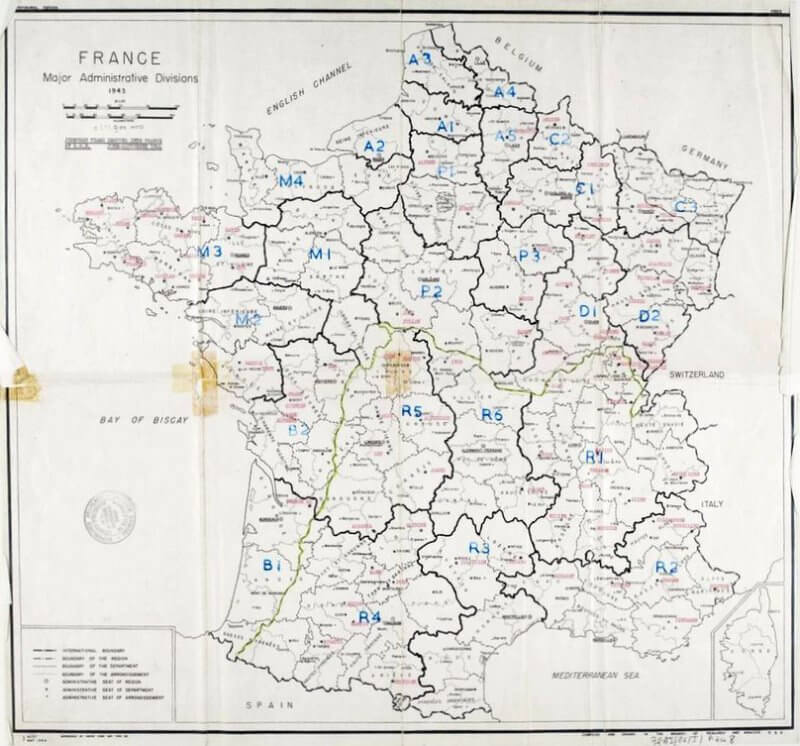
Jedburgh Area Map
| June 5th, 1944 |
| Team Hugh |
| Team Hugh (L. l’Helgouach, W.R. Crawshay, C.C.R. Mersiol) left from Royal Air Force Tempsford, Great Britain. Drop zone: Indre, Châteauroux area. Region: R5, South-West, France. First Jedburgh team to be deployed in support of Operation Overlord. Tasked with linking up with Special Air Service Operation Bulbasket and local Marquis groups to disrupt German communications and troop movements. Worked behind the front to assist Resistance sabotage efforts, receive arms drops, and establish liaison with Allied command in the days immediately following D‑Day. |
| June 6th, 1944 |
| Team Harry |
| Team Harry (Duncan D. Guthrie, P.E. Rousset, R. Couture) left from Royal Air Force Tempsford, Great Britain. Drop zone: Morvan, northwest of Autun. Region: P2, East, France. Team Harry was deployed just 24 hours after D-Day to assist the maquis in Nièvre with sabotage operations aimed at delaying German reinforcements moving toward Normandy. Their mission included coordinating attacks on railway lines and bridges, relaying intelligence to London, and organising supply drops for local resistance units. The region was a key junction for German movements from central France to the northern front. Their mission included organizing sabotage cells, coordinating arms and supply drops, and establishing wireless contact with Allied High Command, laying critical groundwork for sabotage efforts behind German lines. |
| June 8th, 1944 |
| Team Quinine |
| Team Quinine (R. Tommy McPherson, Michel de Bourbon-Parme, Oswald Arthur Brown) left from Royal Air Force Blida, Alegria. Drop zone: Luzettes Plateau, near Aurillac in the Cantal department (southern Massif Central). Region: R4, South-West, France. Team Quinine was one of the earliest teams to be inserted from North Africa into Occupied France. Their mission focused on assisting local Resistance (maquis) in launching sabotage operations against German troop movements toward the Normandy front. Objectives included destroying rail lines, blocking roads, and coordinating supply drops. Operating in difficult terrain, the team also provided communication support and tactical guidance to ensure local actions aligned with Allied strategic plans. Tasked with deep-sabotage operations aimed at disrupting German supply and reinforcement routes, specifically targeting rail lines and communications between Montauban and Brive as part of the wider Overlord and Dragoon strategy. Team Quinine worked in close conjunction with other early-deployed teams such as Team Frederick and Team George. Macpherson and de Bourbon-Parme planted bombs on rail lines and electrical towers and orchestrated the collaboration of local Maquis to impede German armored units advancing from the south. They famously blew up a key bridge, stopping a column of German tanks and forcing them into a river valley. Team Quinine remained operational through July 1944, supporting ongoing sabotage and Resistance mobilization. Their daring and highly effective early campaign significantly delayed German “Das Reich” Armoured divisions attempting to reinforce Normandy. |
| June 8th, 1944 |
| Team Veganin |
| Team Veganin (H. Neil Martin, Gaston Vuchot, Derek Gardner) left from Royal Air force Blida, Algeria. Drop zone: Drôme, at Pact, near Beaurepaire. Region: R1, South-East France. Recruit, train, and equip Maquis cells for sabotage of German communication and transport lines. Despite ground drop challenges and initial disruption of radio containers, Major Manierre and his team recovered essential supplies and successfully linked with Maquis leadership (“Captain René”) in the Drôme region. Replaced and followed on from Team Dodge to stimulate resistance in the Rhône Valley between Avignon and Vienne. |
| June 9th, 1944 |
| Team Ammonia |
| Team Ammonia (MacDonald B. Austin, Raymond Lecompte, Jacob B. Berlin) left from Royal Air force Blida, Algeria. Drop zone: Dordogne. Drop near Sarlat at Saint Nathalene. Region: R5, South-West, France. Inserted to support Resistance forces in southern France ahead of Operation Dragoon launch. Created liaison with Maquis in the Dordogne/Lot region, coordinating sabotage, tracking German movements, and handling arms drops. |
| June 9th, 1944 |
| Team George |
| Team George (P. Cyr, P. Ragueneau, P. Gay) left from Royal Air Force Fairford, Great Britain. Drop zone: Brittany, Redon area. Region: M3, West, France. Operational Area: Loire-Inférieure. Inserted to support the Maquis de la Forêt de Lanvaux south of Rennes. Coordinated arms drops and organized local Resistance units in an ambitious part of Brittany, aiming to disrupt German troop movements toward Normandy. Functioned alongside Odin Sop with Jedburgh Team Frederick, helping lay groundwork for later larger-scale operations in the region |
| July 9th, 1944 |
| Team Gilbert |
| Team Gilbert (C.G. Blathwayt, P. Carron de la Carrière, N. Wood) Left from Royal Air Force Harrington, Great Britain. Drop zone: Scaër, Finistère, near Coadre. Region: M3, West, France. Operational Area: Quimper, Rosporden, Concarneau. Inserted to organize Maquis groups in southern Brittany, especially around Concarneau and Quimper. Assisted in arranging arms drops, training resistance fighters in sabotage (particularly rail and road disruptions), and establishing radio contact with London Headquarters. |
| June 9th, 1944 |
| Team Frederick |
| Team Frederick (A.W. Wise, P. Bloch-Auroch, R.R. Kehoe) left from Royal Air Force Fairford, Great Britain. Drop zone: Brittany, near Guingamp. Region: M3, West, France. Operational Area: Peumerit-Quintin, Côtes du Nord. Team Frederick was tasked with establishing contact with the Maquis of Saint-Marcel, one of the largest Resistance concentrations, about 2,500 fighters, in Brittany. Their objectives included organizing arms drops, disrupting German troop and supply movements toward Normandy, and creating a secure Special Air Service operation base (codename Operation Samwest). The team successfully landed with all equipment and radios. The team endured firefights around June 12th, 1944 to June 18th, 1944, managing to escape amid heavy German reprisals, but continued to operate through July and August, executing effective disruption campaigns. Team Frederick was credited with critically delaying German reinforcements reaching Normandy, aiding the success of Overlord operations. Their sustained presence, covert communications, and Sabotage efforts in Brittany extended into the summer of 1944, contributing to the collapse of German defences on the Western Front. |
| June 12th, 1944 |
| Team Hamish |
| Team Hamish (R.M. Anstett, R. Schmitt, L.J. Waters) left from Royal Air Force Harrington, Great Britain. Drop zone: Bélâbre, Indre. Region: R6, South-West, France. Deployed to assist Team Hugh and local Special Air Service units, focusing on establishing strong Resistance coordination in the Châteauroux region. Tasked with organizing arms drops, liaising with the Ellipses and Hamish circuits, and executing sabotage operations on rail and road communications to hinder German movements following Operation Overlord. |
| June 20th, 1944 |
| Team Ian |
| Team Ian (John Gildee, A. Desfarges, Lucien Bourgoin) left from Royal Air Force Harrington, Great Britain. Drop zone: Vienne, Lussac-les-Châteaux. Region: B2, South-West, France. Deployed to support and organize French Resistance forces in the Vienne region, specifically targeting rail and road communication lines to impede German troop movements. Major Gildee established local coordination networks and organized arms drops alongside Maquis groups in central France. Sergeant Bourgoin was later killed in action during the mission. |
| June 24th, 1944 |
| Team Dodge |
| Team Dodge (Cyrus E. Maniere, L.T. du Rocher) left from Royal Air Force Harrington, Great Britain. Drop zone: Drôme/Isère. Region: R1, South-East, France. Team Veganin Region. Inserted to support the Maquis in the Drôme and Isère regions. Established radio communications and prepared the area for arms and supply drops. Coordinated sabotage efforts against German supply and communication routes in the lead-up to Operation Dragoon. The team was reinforced post-drop by Team Veganin which included radio specialist Sergeant “Ernest” Gardner. Together, they continued Maquis liaison and sabotage actions through July and August 1944. |
| June 29th, 1944 |
| Team Bugatti |
| Team Bugatti (H.W. Fuller, G. de la Roche, M. Guillemont) left from Royal Air Force Algiers, Algeria. Drop zone: Hautes-Pyrénées. Region: R4, South-West, France. Joined local Maquis cells in the Pyrenees to build a fighting force and prepare for larger Allied operations. After an initial communications breakdown, Bugatti raided Lannemezan on July 16th, 1944 to recover a radio set, enabling resupply drops. Successfully ambushed German troop columns, inflicting around 16–20 enemy casualties, with no Jedburgh losses. Sabotage efforts included destroying power-line pylons, rail links, and strategic incursions into Lannemezan and Saint-Bertrand-de-Comminges. As the Normandy and Provence landings progressed, Fuller grew the Maquis forces to 5,000 fighters, enabling widespread sabotage and blocking of German reinforcements. |
| June 30th, 1944 |
| Team Chloroform |
| Team Chloroform (J. Martin, H.D. McIntosh, J. Sassi) left from Royal Air Force Blida, Algeria. Drop zone: Dieulefit, Drôme. Region: R2, South-East, France. Operational area: Vercors, then Hautes-Alpes. Team Chloroform is considered as a Massingham mission, reflecting its dual role in reconstruction and coordination after earlier team insertions were compromised in the Vercors aftermath. The mission aimed at re‑establishing and reinforcing Resistance networks in the Drôme and Hautes‑Alpes, just south of the Vercors region, which had recently suffered severe German reprisal after the Vercors uprising. Tasked with coordinating FFI circuits, organizing arms drops, and rebuilding minimum guerrilla operations in a highly dangerous area following the Vercors defeat. |
| July 8th, 1944 |
| Team Felix |
| Team Felix (J.J. Marchant, J. Souquet, P.M. Calvin) left from Royal Air Force Fairford, Great Britain. Drop zone: Jugon-les-Lacs, Côtes du Nord. Region: M3 West, France. Target: Fred 5 Tasked with reinforcing and coordinating the Maquis de Jugon area, setting up arms drops and sabotage operations as Brittany’s resistance expanded post‑Operation Overlord. The team worked closely with local Resistance on targeting rail lines, road networks, and German coastal communications to hamper retreating forces.“Target Fred 5” was coded as the initial sabotage objective, successfully disrupted suburban transport routes on the night of the drop. The team supported and expanded Maquis participation, enabling Brittany-wide sabotage until autumn 1944 . |
| July 8th, 1944 |
| Team Giles |
| Team Giles (Bernard M.W. Knox, Paul Grall, Gordon H. Tack) left from Royal Air Force Harrington, Great Britain. Dropzone: Finistère, Brittany, around Saint‑Goazec and Spézet. Region M3, West, France. Operational area: Finistère. Tasked with organizing and expanding local Maquis circuits in the Finistère region in close cooperation with the Special Air Service, particularly focusing around Saint‑Goazec and Spézet. The team set up arms drops and coordinated sabotage efforts against German rail and road infrastructure to disrupt reinforcements moving toward Normandy. Part of an Special Air Service‑Jedburgh coordination effort, the team ensured secure wireless communications between Forces Françaises de l’Intérieur units and Allied command |
| July 9th, 1944 |
| Team Francis |
| Team Francis (Colin W. Ogden-Smith, G. le Bourne, A.J. Dallow) left from Royal Air Force Harrington, Great Britain. Drop zone: Finistère, Target Francis 1. Region: M3, West, France. Major Ogden‑Smith landed off-target, separated from comrades for several days before reaching fellow Jedburghs and Maquis contacts. On July 14th, 1944, supply drop met ambush, German forces were alerted, resulting in significant Resistance casualties, including 24 KIA; supplies were lost. On July 29th, 1944, at Kerbozec farm, Germans attacked. Ogden‑Smith and Dallow refused to surrender in a shoot-out; Major Ogden‑Smith and French Resistance comrade Maurice Miodon were killed, while Sergeant Dallow and others escaped. Despite losses, the mission galvanized local Resistance, afterward, 700 Maquis fighters conducted sabotage and ambush operations disrupting German retreat from Lorient. By August 25th, 1944, Quimper was liberated, in part due to their actions. |
| July 11th, 1944 |
| Team Andy |
| Team Andy (R.A. Parkinson, J. Vermeulen, R. Loosmore) left from Royal Air Force Harrington, Great Britain and is flown in by USAAF. Drop zone: Haute-Vienne, Percy 13 target. Region: R5, South-West. Assist the Special Operations Executive Ellipse circuit in organizing Maquis forces across Haute‑Vienne and expand sabotage operations on the four major railway lines converging on Limoges. The team received and followed a structured 10‑point sabotage plan within 48 hours of dropping, detailing priorities for rail, telecommunication, and transport disruptions. Sergeant Loosmore earned the Military Medal and the Croix de Guerre by safeguarding wounded teammates under German fire, maintaining essential communications beyond initial drop zones. |
| July 11th, 1944 |
| Team Gavin |
| Team Gavin (R. Carbuccia, William D. Dreux, Paul Valentini) left from Royal Air Force Harrington, Great Britain and is flown in by USAAF. Drop zone: Ille-et-Vilaine, near Courcité, Mayenne. Region: M3, West, France. Operational area: Ille-et-Vilaine, North of Rennes. Team Guy and Team Gavin were intentionally dropped together to cover both northern and southern sectors of Ille‑et‑Vilaine. The Guy-Gavin tandem was a coordinated effort titled the “Harry 49B” mission to fortify Resistance strength ahead of Brittany-wide actions. Tasked with organizing and training new Forces françaises de l’Intérieur resistance groups in Ille‑et‑Vilaine as part of the coordinated efforts with Jedburgh Team Guy. Both Team Gavin and Guy were dropped on July 11th, 1944, but didn’t make contact with Rennes until early August due to security and geographic challenges. Their mission focused on building local Maquis capability ahead of the Allied push into Brittany. They also coordinated arms drops and sabotage operations targeting German communications and logistics and liaised with Allied Headquarters to direct necessary supply drops to enable sustained guerrilla action. |
| July 11th, 1944 |
| Team Guy |
| Team Guy (A. Duron, A.A. Trofimov, R. Groult) left from Royal Air Force Harrington, Great Britain and is flown by USAAF. Drop zone: Near Courcité (Mayenne), north of Rennes, Ille‑et‑Vilaine, Brittany. Region: M3, West, France. Operational area: Fougerolles-du-Plessis, Combourg. Team Guy and Team Gavin were intentionally dropped together to cover both northern and southern sectors of Ille‑et‑Vilaine. The Guy-Gavin tandem was a coordinated effort titled the “Harry 49B” mission to fortify Resistance strength ahead of Brittany-wide actions. Tasked with organizing and training new Forces françaises de l’Intérieur resistance groups in Ille‑et‑Vilaine as part of the coordinated efforts with Jedburgh Team Gavin. Both Team Gavin and Guy were dropped on July 11th, 1944, but didn’t make contact with Rennes until early August due to security and geographic challenges. Their mission focused on building local Maquis capability ahead of the Allied push into Brittany. They also coordinated arms drops and sabotage operations targeting German communications and logistics and liaised with Allied Headquarters to direct necessary supply drops to enable sustained guerrilla action. |
| August 6th, 1944 |
| Team Hermit |
| Team Hermit (Aaron Bank, D.A. Thompson) left from Royal Air Force Blida, Algeria (Massingham mission) Drop Zone: Near Briançon, Haute‑Alpes Region: R2, South‑East, France. Captain Aaron Bank led Jedburgh “Team Hermit” to link up with Maquis forces in the Hautes‑Alpes region, including coordinated operations with Team Novocaïne under Lieutenant Gennerich. Team Hermit and Team Novocaïne often participated in joint missions, especially key patrols and sabotage operations in support of Maquis activities around Briançon and the Alps. Sergeant Thompson, fluent in French, managed wireless communications and Paraguated arms-drop coordination before re-assigning to Team Novocaïne due to language protocol conflicts. After liberation of Briançon by Allied forces, both the Hermit team and its radio operator were extracted. |
| August 6th, 1944 |
| Team Novocaine |
| Team Novocaine (Charles J. Gennerich, Jean-Yves Pronost, William T. Thompson) left from Royal Air Force Blida, Algeria. Drop zone: Basses-Alpes, near Seyne. Region: R2, South-East. Tasked to jumpstart and support Maquis formations in the Hautes‑Alpes, particularly around Briançon, in coordination with Special Operations Executive/Jedburgh mission “Hermit”. Sergeant Thompson, acting as wireless operator, helped train local Resistance and coordinate sabotage actions against German patrols and communication routes, managing wireless communications for two months until liberation of Briançon. Joined forces with Captain Aaron Bank’s Team Hermit on joint operations, significantly increasing sabotage impact |
| July 15th, 1944 |
| Team Harold |
| Team Harold (V.E. Whitty, P. Jolliet, H. Verlander) left from Royal Air Force Harrington, Great Britain and is flown by USAAF. Drop zone: Vendée, Forêt de l’Absie, 45 kilometres off target. Region: M2, West. Operational Area: Liason for 3 Special Air Service Operation Dickens (Ford). the purpose of Team Harold was to organise Resistance in Vendée, establish radio links with both 3 Special Air Service and London Headquarters, and interdict railway lines connecting Nantes to Poitiers, critical for German reinforcements heading east. As part of coordinated Special Operations Executive and Special Air Service operations in mid‑July, Team Harold worked alongside air and ground components to harass German troop movements and ensure arms drops supported Forces Françaises de l’Intérieur forces in the region. |
| July 17th, 1944 |
| Team Hilary |
| Team Hilary (E. Mautaint, Philip H. Chadbourne, R. Hervouet) left from Royal Air Force Tempsford, Great Britain. Drop zone: Finistère, south of Huelgoat. Region: M3, West. Organize and support the Forces Françaises de l’Intérieur resistance in southern Finistère, sparking sabotage campaigns targeting German rail and road networks.Their mandate included coordinating arms drops, liaising with Maquis circuits, and maintaining critical communications with London Headquarters. Worked alongside allied Jedburgh Team Horace and Team Felix in the Finistère region to build a robust resistance presence ahead of the later Breton campaigns |
| July 17th, 1944 |
| Team Horace |
| Team Horace (J. Summers, G. Leclerq, W. Zielske) left from Royal Air Force Tempsford, Great Britain. Drop zone: Finistère. Region: M3, West. The team organized and strengthened Maquis resistance in Finistère, drawing up sabotage operations for rail and road networks. It coordinated arms drops in collaboration with Jedburgh Team Felix, Team Giles, and Team Hilary. It also maintained a continuous wireless communications with Special Operations Executive Special Force Headquarters, enabling strategic oversight and Allied support. |
| July 18th, 1944 |
| Team Gerald |
| Team Gerald (Stephen J. Knerly, Claude l’Herbette, B.E. Friele) left from Royal Air Force Harwell, Great Britain. Drop zone: Morbihan. Region: M3, West. Operational Area: North of Morbihan. The team is tasked to strengthen and expand the Resistance in Morbihan, especially around southern Brittany. Therfor it cooperated closely with local Forces Françaises de l’Intérieur Maquis, coordinating arms drops, aiding communications, and carrying out sabotage operations aimed at disrupting German infrastructure and communications in the region. |
| July 31st, 1944 |
| Team Packard |
| Team Packard (Aaron Bank, Henri Denis, F. Montfort) left from Blida, Algeria. Drop zone: Lozère, Quincaille site near Barre-des-Cévennes. Region: R3, South-East. Operational Area: Lozère et Gard. Their task is to coordinate and train Maquis groups across Lozère and southern Gard in preparation for Operation Dragoon. Over 3,000 Maquis were organized under Captain Bank’s leadership, thanks to sustained liaison, training, and large-scale arms drops. Guerilla groups executed hundreds of ambushes and sabotage missions, inflicting approximately 1,000 German casualties, crippling regional German movements. |
| July 31st, 1944 |
| Team Roderick |
| Team Roderick (Jean Preziosi, William C. Boggs, Charles Mersereau) left from Great Britain. Drop zone: Doubs. Region: D1, East. The team was deployed to organize and support FFI Resistance cells in the Doubs area near Montbéliard. They coordinated arms and supply drops and guided radio communications for coordination with Allied Headquarters. Among their actiosn was sabotage of German logistics routes to delay enemy movement eastward during Allied advance into eastern France. |
| August 4th, 1944 |
| Team Daniel |
| Team Daniel (K.D. Bennett, Albert P. de Schonen, Ron Brierley) left from Great Britain. Drop zone: Côtes-du-Nord, false target. Region: M3, West. Operational Area: Kerien. The team was assigned to organize and galvanize local Maquis forces along the Brittany coast, focusing on sabotage of rail/port infrastructure ahead of Allied advances. In coordination with Special Operations Executive and Special Air Service initiatives, the team helped establish arms-drop networks, secure arms caches, and disrupt German reinforcements moving toward Normandy. |
| August 4th, 1944 |
| Team Ronald |
| Team Ronald (Shirley R. Trumps, G. Deseilligny, Elmer B. Esch). Drop zone: Finistère, landed on the incorrect Dropzone. Region: M3, West. Jedburgh Team Ronald was inserted into Brittany to work alongside local Maquis units, focusing on sabotage of German communications and transportation links, continuing the Allied resistance momentum following Operation Overlord. |
| August 6th, 1944 |
| Team Collodion/Loch |
| Team Collodion (H. Hall, Henri Marsaudon, Theodore Baumgold) left from Royal Air Force Blida, Algeria. Drop zone: Aveyron. Target: Chenier. Region: R3, South-East. The mission is designed to support and coordinate with Jedburgh Team Novocaïne on the joint Mission Arête targeting Maquis and Resistance activities in Aveyron. Their tasks included setting up wireless communications, orchestrating arms drops, aiding sabotage missions, and establishing liaison with local Maquis cells to amplify Resistance operations in the High‑Alps foothills and regional valleys. Classified under Special Operatiosn Executive/Massingham directives, Collodion (“Loch”) functioned as a regional reinforcement to Arête missions, ensuring wider territorial coverage and resistance effectiveness after mid‑summer drops. |
| August 6th, 1944 |
| Team Douglas I |
| Team Douglas I (R.A. Rubenstein, J. Roblot, J.D. Raven) left from Royal Air Force Keevil, Great Britain. Drop zone: Drôme/Isère. Region: D1, East. The Team is inserted to reinforce Resistance operations in southern Brittany as part of coordinated Jedburgh/Special Operations Executive efforts following early summer missions. They are tasked to establish secure radio links to Special Operations Executive Headquarters in London. They coordinate arms drops for local Maquis networks and direct sabotage operations targeting German transport routes, communications, and rail lines. |
| August 6th, 1944 |
| Team Ivor |
| Team Ivor (J.H. Cox, R. Colin, Lewis F. Goddard) left from Royal Air Force Harrington, Great Britain and is flown by USAAF. Drop zone: Cher, south of St. Amand. Region: R6, South-West. The team’s primary objective was to make contact with local Maquis groups operating along the border of the Cher and Indre departments. Once established, they were to coordinate arms drops, beginning with Operation “Hamish 1 E”, and ensure the secure recovery of all containers. A key task was the rapid setup of wireless communications with Special Forces Headquarters in London. In addition, the team was responsible for organising sabotage operations targeting German rail and road networks, aiming to disrupt enemy movements toward the Loire and the southern front. Within 48 hours of landing, the team successfully recovered all supplies, established radio contact, and began guiding further supply drops for surrounding guerrilla units. Their rapid coordination efforts enabled effective disruption of enemy logistics, contributing to the widening Resistance control over the Berry plateau as German forces began their withdrawal toward the Loire. |
| August 8th, 1944 |
| Team Graham |
| Team Graham (M.G.M. Crosby, P. Gavet) left from Italy by a C47 Dakota. Drop zone: Basses-Alpes. Region: R2, South-East. Team Graham was tasked with reinforcing Resistance efforts in the mountainous terrain of the Basses-Alpes. Their mission involved coordinating sabotage of German troop movements through Alpine passes, establishing radio contact with Allied command, and preparing local Maquis units for future Allied land advances from the south. Operating deep in rugged terrain, the team played a key role in disrupting Axis lines of communication and monitoring enemy withdrawal routes. Although operating in a relatively isolated area, Team Graham succeeded in assisting the local Resistance in maintaining pressure on retreating German units and relaying intelligence during the Allied push north from Provence. Their insertion by aircraft from Italy highlights the logistical complexity of Jedburgh operations in less accessible zones. |
| August 8th, 1944 |
| Team Alec |
| Team Alec (G.G. Thompson, Alain Bordes, John A. White) left in three B-24 Liberators from Ford airfield, Great Britain. Drop zone: Loir-et-Cher. Region: P2, South-West. Operational Area: Vierzon, Orléans. Team Alec was parachuted into central France to support and organise the French Resistance in the Sologne region. Their key tasks included coordinating sabotage operations on railway lines and communication centres, supporting the mobilisation of local Maquis groups, and establishing secure radio communications with London. Operating in cooperation with the Special Air Service, they also assisted with tactical planning and target identification for air-dropped supplies. Their arrival contributed significantly to local resistance capabilities in disrupting German logistics in the heart of France. Team Alec’s insertion alongside Special Air Service elements illustrates the close collaboration between Jedburgh and special forces units. The successful coordination of air and ground operations in this region helped pave the way for the liberation of the Loire Valley. |
| August 9th, 1944 |
| Team Lee |
| Team Lee (Charles E. Brown III, Pierre Angoulvent, M. Pirat) left from Royal Air Force Keevil, Great Britain. Drop zone: Haute-Vienne, DZ Framboise, southwest of Eymoutiers. Region: R5, South-West. Operational Area: Haute-Vienne, Indre. Team Lee was tasked with supporting the Maquis in the Limousin region. Their objectives included organising and training local resistance fighters, establishing reliable wireless communication with London, and coordinating with Allied commands to prepare for sabotage operations aimed at hampering German troop movements. Their presence bolstered resistance morale and operational capability in a strategically vital area near key railway lines used by the Wehrmacht. Team Lee was inserted in tandem with Team Tony, reflecting the strategic importance of the region. The teams played a key role in preparing the area for liberation, and their work contributed directly to the success of subsequent Allied advances. |
| August 10th, 1944 |
| Team James |
| Team James (John K. Singlaub, J. le Bel de Penguilly, Anthony J. Denneau) Left from Royal Air Force Fairford, Great Britain. Drop zone: Corrèze, 3 kilometres from Bonnefond. Region: R5, South-West. Team James was tasked with supporting Maquis units in the Corrèze area. Their primary objectives were to coordinate sabotage operations against German communications and transport networks, establish effective command-and-control links between the resistance and the advancing Allied forces, and prepare the region for liberation. The team played a key role in disrupting German reinforcements and logistics during the Allied advance through southern central France. Their activities significantly contributed to the success of operations in Limousin during August and September 1944. |
| August 10th, 1944 |
| Team Julian |
| Team Julian (H.A. Clutton, J. Vermot, T.S. Menzies) left from Royal Air Force Harrington, Great Britain. Drop zone: Indre-et-Loire, Mascara Vin de Fatma. Region: R5, South-West. Operational Area: North of l’Indre. The team was tasked with coordinating sabotage operations in support of the upcoming Allied advance. Their responsibilities included training local resistance fighters, establishing radio communications with London, and preparing ambushes or disruptions targeting German troop movements and rail infrastructure. |
| August 11th, 1944 |
| Team Aubrey |
| Team Aubrey (G. Marchant, J.-F. Chaigneau, I. Hooker) left from Royal Air Force Harrington, Great Britain and is flown by USAAF. Drop zone: Seine-et-Marne, near Le Plessis-Belleville. Region: P1, North. Operational Area: Seine-et-Marne. The team was assigned to assist the local resistance with coordination of sabotage efforts against German rail and road movements. They were also tasked with setting up reliable radio contact with London, supplying and training maquisards, and providing guidance for future Allied support drops. Their area included key routes used by retreating German forces moving north-east from Paris. Their successful drop and coordination with local forces provided critical support in the effort to sever German lines of retreat and hinder enemy regrouping during the rapid liberation of Paris and surrounding departments. |
| August 12th, 1944 |
| Team Alan |
| Team Alan (S.N. Cannicott, R. Toussaint, R. Clause) left from Royal Air Force Tempsford, Great Britain. Drop zone: Saône-et-Loire, near Saint Gengoux-le-National. Region: R1, South-East. Operational Area: Charolles. The team’s mission was to coordinate with local resistance networks to organise sabotage operations aimed at disrupting German troop movements between Lyon and Dijon. They were to establish reliable wireless communication with London, identify and prepare reception zones for supplies, and advise local maquis commanders on guerrilla tactics during the Allied advance. Their successful landing in a rural area with established resistance enabled effective coordination of several ambushes and railway sabotage actions. The team’s activity supported the containment of German movements during the retreat from southern France. |
| August 12th, 1944 |
| Team Alexander |
| Team Alexander (Stewart J. Alsop, R. de la Tousche, Norman R. Franklin) left from Royal Air Force Tempsford, Great Britain. Drop zone: Forêt St. Giles (intended: Creuse; dropped in Haute-Vienne). Region: R5, South-West. The team was tasked with supporting resistance activity in the central plateau by organising sabotage operations against German logistics, notably rail and road traffic. They were to establish and maintain contact with London via wireless and assist with parachute supply receptions and tactical coordination among local maquis groups. Despite being misdropped, the team quickly adjusted to their new location in the Haute-Vienne and integrated with maquisards in the area. Their work contributed to delaying German reinforcements during the Allied push north from the Mediterranean landings. |
| August 12th, 1944 |
| Team Ephedrin |
| Team Ephedrin (L. Donnart, Lawrence E. Swank, R. Desplechin) left from Blida, Alegria. Drop zone: Savoie, west of Seyne. Region: R2, South-East. The team’s mission was to coordinate with the local maquis in the southern Alpine region to disrupt German troop movements through the mountain passes. This included organising ambushes, securing drop zones for arms and supply deliveries, and relaying intelligence on Axis force dispositions to Allied commands. The mountainous terrain and relative isolation allowed the team to establish an effective partnership with regional resistance. They helped hinder German fallback routes following the Allied advance northward from Operation Dragoon. |
| August 12th, 1944 |
| Team Jacob |
| Team Jacob (Victor A. Gough, Maurice Boissarie, Ken Seymour) left from Great Britain. Drop zone: Vosges, east of Raon-l’Étape near La Petite-Raon. Region: D2, East. The team was tasked with bolstering the maquis in the Vosges, particularly in support of operations to hinder German reinforcements moving toward the Normandy front. Duties included coordinating resistance activity, relaying intelligence on troop movements, and arranging arms drops. The team encountered stiff German counter-insurgency efforts in the region, which led to their eventual compromise. The mission ended tragically. Captain Gough was captured and executed by the Germans at Gaggenau on November 25th, 1944. Boissarie was shot after capture. Seymour was taken prisoner of war. |
| August 13th, 1944 |
| Team Cinnamon |
| Team Cinnamon (Robert Harcourt, Lespinasse Fonsegrive, Jacques Morineau) left from Blida, Algeria. Drop zone: Var, DZ Fantôme near Brue-Auriac. Region: R2, South-East. The team was inserted to support local Resistance groups in Var, particularly to prepare for the Operation Dragoon. Their goals included strengthening sabotage operations against German supply lines, facilitating arms drops, and unifying disparate maquis elements under central coordination. The drop occurred during a coordinated wave of Jedburgh and Office of Strategic Services missions to coincide with the southern France invasion. The mission was part of broader efforts to isolate German forces in the south and hinder their retreat toward the Rhône valley. |
| August 13th, 1944 |
| Team Citroën |
| Team Citroën (John E. Smallwood, F.A. Bailey, Pierre Bloch) left from Royal Air Force Blida, Algeria. Drop zone: Vaucluse. Region: R2, South-East. Team Citroën was deployed to organise, equip, and direct local maquis in the Vaucluse region. Their mission involved setting up communication with London, coordinating sabotage of transport lines and communications, and supporting Operation Dragoon by impeding German troop movements northward from the Mediterranean coast. This drop was part of the broader Allied strategy to cripple Axis reinforcements and supply chains during the liberation of southern France. The Vaucluse region had active Resistance groups, and the team’s role was to professionalise and unify their efforts. |
| August 13th, 1944 |
| Team Minaret |
| Team Minaret (L.C.M. Hartley-Sharpe, P. Cros, John W. Ellis) left from Blida, Algeria. Drop zone: Gard. Region: R2, South-East. Team Minaret was tasked with working alongside French Resistance forces in the Gard region. Their mission was to establish wireless contact with Allied command, coordinate guerrilla activities, and assist in preparing the area for advancing Allied forces after the Operation Dragoon landings. They were to unify Resistance groups, disrupt enemy logistics, and guide Allied forces toward key infrastructure targets. One team member, Pierre Cros, did not deploy. The drop was intended to reinforce an already active Resistance zone and increase operational pressure on German lines of retreat from the Mediterranean coast. |
| August 13th, 1944 |
| Team Monocle |
| Team Monocle (J. Fiardo, Ray H. Foster, Robert J. Anderson) left from Blida, Algeria. Dropzone: Drôme. Region R1, South-East. Operational area: Drôme. Target: Armature. Team Monocle was deployed to the Drôme to strengthen communication between local Resistance groups and Allied command. Their primary task was to establish and operate a secure wireless link, facilitate coordination of sabotage operations against retreating German forces, and support the overall breakout from the Rhône Valley following Operation Dragoon. The region was strategically important due to its road and rail networks. Their operational target was codenamed Armature. The terrain was mountainous, offering natural concealment but also challenges for logistics and radio transmissions. |
| August 13th, 1944 |
| Team Sceptre |
| Team Sceptre (Walter C. Hanna, Jr., François Franceschi, Howard V. Palmer) left from Royal Air Force Blida, Algeria. Drop zone: Var. Region: R2, South-East. Team Sceptre was tasked with assisting Resistance elements in the Var region during the opening phase of Operation Dragoon, the Allied landings in Southern France. Their primary objective was to disrupt German movements, particularly by coordinating railway and road sabotage, and to prepare the area for advancing Allied forces. They were also responsible for intelligence gathering and organising supply drops for local maquis units. The Var was a critical sector for German withdrawal routes, making this a high-priority mission. Coordination with the Forces françaises de l’Intérieur was essential for the mission’s success. |
| August 14th, 1944 |
| Team Anthony |
| Team Anthony (M. Stasse, M.B. Starring, J.L. Bradner) left from Royal Air Force Keevil, Great Britain. Drop zone: Saône‑et‑Loire, near Salornay‑sur‑Guye. Region: D1, East. Operational Area: Part of the Ditcher Circuit. Team Anthony was inserted to support Circuit Ditcher, a Resistance network in the Saône-et-Loire area. Their tasks included coordinating sabotage of German rail traffic and communication lines, facilitating local Resistance actions, and preparing the area for operations in conjunction with Operation Dragoon, the Allied landings in Southern France. They were also to act as liaisons for weapons and supply drops. The team parachuted with support from Royal Air Force airvraft and arrived just as Operation Dragoon commenced. Their region was crucial for disrupting German reinforcements moving northwards from the southern front. |
| August 14th, 1944 |
| Team Augustus |
| Team Augustus (J.H. Bonsall, J. Delviche, R.E. Cote) left from Great Britain. Drop zone: Colonfay sector, 15 kilometres south of Guise, Aisne. Region: A5, North. Team Augustus was tasked with reinforcing local Resistance forces to disrupt German movements north of the Loire. Their focus included the sabotage of railways and communications, rallying local maquisards, and preparing the ground for the advancing Allied forces from Normandy and the south. Coordination of supply drops and intelligence gathering was also part of their remit. The drop occurred during the large-scale coordination of multiple Jedburgh and Special Air Service teams aligned with Operation Dragoon and the breakout from Normandy. The Aisne sector held strategic rail links the Germans relied on for reinforcing their collapsing front. |
| August 14th, 1944 |
| Team Bruce |
| Team Bruce (W.E. Colby, C. Lelong, R. Villebos) left from from Royal Air Force Harrington, Great Britain and were flown by USAAF. Drop zone: Yonne but accidentally dropped near Montargis. Region: P3, East. Team Bruce’s original assignment was to support the Resistance in Yonne by coordinating sabotage and ambushes against retreating German forces. However, due to a navigational error, they were dropped on the village of Montargis, some 70 kilometres to the west. Despite the misdrop, the team adapted quickly, establishing contact with local Resistance and assisting in delaying German withdrawals via road and rail interdiction. |
| August 14th, 1944 |
| Team Jude I |
| Team Jude (W.L.O. Evans, J. Larrieu, A.E. Holdham) left from Royal Air Force Fairford, Great Britain. Drop zone: Loire, southwest of Lyon with the Special Air Service. Region: R1, South-East. Team JUDE was inserted to support Forces Françaises de l’Intérieur efforts in the Loire region. Their tasks included coordinating supply drops, training local maquis units, and preparing ambushes along key withdrawal routes used by retreating German formations. They were also tasked with establishing secure lines of communication with British and American headquarters through encoded wireless transmissions. The team operated closely with elements of the Special Air Service, which had parachuted into nearby zones. Their efforts contributed to hindering German troop movements from central France towards the German frontier. |
| August 15th, 1944 |
| Team Andrew |
| Team Andrew (A. Coombe-Tennant, E. d’Oultrement, F. Harrison) left from Royal Air force Fairfield, Great Britain. Dropzone Ardennes, Region C2, North. Team Andrew was tasked with strengthening Forces Françaises de l’Intérieur operations in the Ardennes by coordinating sabotage against rail and road movements of retreating German forces. They were to establish contact with local resistance leaders, direct Allied supply drops, and gather intelligence on Wehrmacht dispositions near the Belgian frontier. Wireless communications were used to maintain contact with London and assist in timing guerrilla actions with the advance of Patton’s Third Army. Team Andrew’s insertion occurred during a major shift in German troop movements following the Allied breakout from Normandy, making their role in road interdiction and intelligence-gathering critical. |
| August 15th, 1944 |
| Team Basil |
| Team Basil (R. Riviere, T.A. Carew, J.L. Stoyka) left from Royal Air Force Harrington, Great Britain and is flown by USAAF. Drop zone: Doubs. Region: D2, East. Team Basil was inserted to support resistance forces operating in the Doubs department by coordinating with local Forces Françaises de l’Intérieur cells, directing Allied air drops, and sabotaging German communications and logistics during their retreat eastward. Their area was close to the Swiss frontier, making it suitable for exfiltration and discreet resupply. The mission included organising resistance for potential offensive coordination with approaching Allied forces from the south and east. The team’s drop was associated with Target Bob 188A, with aircraft piloted by MR 1733 Stamler. |
| August 15th, 1944 |
| Team Douglas II |
| Team Douglas II (R.A. Rubenstein, Jean Roblot, T. Van Hart) left from Royal Air Force Harrington, Great Britain. Drop zone: Doubs. Region: D1, East. Team Douglas II was deployed to strengthen sabotage efforts in the Jura mountains and Doubs region by guiding Allied air support, distributing arms, and assisting the Forces Françaises de l’Intérieur in the coordination of ambushes against German convoys. Their operation focused on disrupting German withdrawals and reinforcing local control by the French Resistance during the liberation of eastern France. Assigned to Target Bob 200. The aircraft was piloted by MR 2112 Seger. Team Douglas II was a follow-up to the original Team Douglas, which had deployed in August in the Drôme region. |
| August 16th, 1944 |
| Team Chrysler |
| Team Chrysler (C.H. Sell, P. Aussaresses, R.E. Chatten) left from Royal Air Force Blida, Algeria. Drop zone: Ariège, Aude, Pyrénées-Orientales. Region: R4, South-East. Operational Area: Ariège, Aude, Pyr.-Or. Team Chrysler was deployed to assist Resistance forces in the Ariège region in support of broader liberation efforts across southern France. Their objectives included coordinating arms deliveries, providing tactical leadership to local maquisards, and disrupting German withdrawal routes through the Pyrenees and into Spain. The mountainous terrain required careful coordination with local guides and extensive radio communication with Allied command. |
| August 16th, 1944 |
| Team John |
| Team John (D.L. Stern, Maurice de Galbert, D. Gibbs) left from Blida, Algeria. Drop zone: Tarn-et-Garonne. Region: R4, South-West. Team John was assigned to the Pimento circuit, tasked with strengthening the coordination between local maquis elements and Allied commands. Their primary objectives included organising local resistance into cohesive units, preparing sabotage efforts against German lines of retreat, and facilitating supply drops. The team operated in a region where German forces were retreating northwards following Operation Dragoon, and their presence helped hasten the collapse of German control in the area. Their mission contributed to the rapid liberation of key towns in the Tarn-et-Garonne and Tarn departments. |
| August 16th, 1944 |
| Team Mark |
| Team Mark (Joannes Thèvenet, Lucien E. Conein, James J. Carpenter) left from Blida, Algeria. Drop zone: Tarn-et-Garonne. Region: R4, South-West. Team Mark was tasked with coordinating and supporting local maquis units in the Tarn-et-Garonne region during the German withdrawal following Operation Dragoon. Their role involved the unification of disparate resistance groups, aiding in the organisation of ambushes on retreating German columns, and facilitating arms drops. Their efforts were crucial in delaying German movements and aiding advancing Free French forces. |
| August 16th, 1944 |
| Team Martin |
| Team Martin (Thomas A. Mellows, Georges Redonnet, N.E.S. Carey) left from Blida, Algeria. Drop zone: Gers. Region: R4, South-West. The team was tasked with unifying and coordinating resistance activities in the Gers area, a region already partially active but in need of structure and improved communications. They helped consolidate maquis groups under unified command, arranged for supply drops, and relayed intelligence on German troop movements. The team’s work was instrumental in enabling Forces Françaises de l’Intérieur units to harass German convoys retreating north after the launch of Operation Dragoon. |
| August 17th, 1944 |
| Team Miles |
| Team Miles (Everett T. Allen, René Esteve, Arthur Gruen) left from Blida, Algeria. Drop zone: Tarn-et-Garonne. Region: R4, South-West. Team Miles was tasked with coordinating Resistance activities in support of the Allied advance, particularly focused on cutting German retreat lines and communications between Toulouse and Bordeaux. They were to arm and advise local maquis groups, guide them in sabotage, and assist with setting up roadblocks ahead of the Allied approach. The team’s arrival coincided with Operation Dragoon landings on the southern coast, creating multi-directional pressure on retreating German forces. The team liaise with Forces Françaises de l’Intérieur, support and report on French Resistance groups (e.g., Wheelwright/Hilaire networks), and coordinate guerrilla efforts in the Gers and Tarn‑et‑Garonne regions during the Allied southern advance . |
| August 17th, 1944 |
| Team Tony |
| Team Tony (Robert K. Montgomery, Lucien Paris, John E. McGowan) left from Royal Air Force Harrington, Great Britain. Drop zone: Coordinates not specified, dropped with Team Lee. Region: R5, South-West. Team Tony was deployed to assist the Maquis in the Haute-Vienne area. Their mission included coordinating sabotage activities against German transport routes, facilitating arms deliveries, and serving as a liaison between the local resistance and Allied High Command. Alongside Team Lee, they were instrumental in organising resistance cells and preparing the ground for the Allied push through central France. Team Tony operated in close collaboration with Team Lee, forming a coordinated Allied-resistance front in the region. Their operations disrupted German logistics and strengthened resistance infrastructure in advance of the liberation. |
| August 18th, 1944 |
| Team Arthur |
| Team Arthur (C.F. Mynatt, X. Humblet, A.V. Bacik) left from Royal Air Force Tempsford, Great Britain. Drop zone: Côte-d’Or, DZ Imprimerie. Region: D1, East. The team’s primary task was to support Resistance units in harassing retreating German forces, with a focus on disrupting road and rail traffic north of Lyon. They were to coordinate sabotage, deliver weapons and training, relay intelligence on Wehrmacht movements to Allied Headquarters and to support Operation Anicroche. The drop took place shortly before Dijon was liberated in early September, placing the team in a rapidly evolving tactical environment. Part of a multi-team operation with Jedburgh Team Paul on Target Bob 172. Their mission was to coordinate Forces Françaises de l’Intérieur logistics, organizing supply drops, liaising between Resistance cells and London, and ensuring alignment with Allied timelines. Captain Mynatt sustained a spinal fracture during their operation in late August but survived. |
| August 18th, 1944 |
| Team Paul |
| Team Paul (E.H.M. Hood, Michel Vallee, K.J.W. Brown) left from Royal Air Force Tempsford, Great Britain. Drop zone: Côte-d’Or, DZ Anicroche. Region: R1, South-East. Team Paul was tasked with coordinating sabotage operations in support of the advancing Allied front. Their objectives included blowing railway lines, ambushing German troop movements, and providing tactical intelligence to assist the liberation of Dijon. The team was to organise local resistance groups and ensure the delivery and distribution of arms and supplies. Their activities directly supported the Allied push towards the Belfort Gap and were instrumental in cutting off German withdrawal routes east of Dijon. Coordinated with Team Arthur in the Côte‑d’Or region to organize Maquis networks, facilitate Allied supply drops, and provide critical intelligence on German troop movements around August 19th, 1944. |
| August 21st, 1944 |
| Team Benjamin |
| Team Benjamin (H. O’Bryan-Tear, P. Moniez, H. Kaminski) left from Royal Air Force Fairford, Great Britain. Drop zone: Meuse. Region: C1, North. Team Benjamin’s task was to support the local Forces françaises de l’Intérieur units in the Meuse department by coordinating sabotage of transport infrastructure, especially bridges, railroads, and communication lines, to delay German reinforcements moving toward the front. They were also to relay intelligence on enemy troop movements and liaise with American forces advancing from the west, helping to pave the way for liberation efforts in the Meuse–Argonne corridor. Their actions helped disrupt German retreat paths and were timed to coincide with the Allied breakout from Normandy. |
| August 21st, 1944 |
| Team Bernard |
| Team Bernard (J. de W. Waller, E. Nasica, C.M. Bassett) left from Royal Air Force Fairford, Great Britain. Drop zone: Meuse. Region: C1, North. Organize and support Forces Françaises de l’Intérieur groups in the Meuse during the Allies’ push eastward. Their primary tasks involved disrupting German communications and transport, especially targeting rail lines and bridges, to delay enemy reinforcements. |
| August 24th, 1944 |
| Team Alastair |
| Team Alastair (O.H. Brown, R. Karriere, G.N. Smith) left from Royal Air Force Harrington, Great Britain. Dropzone: Vosges. Region D2, East. Team Bernard’s mission was to assist in organising, arming, and leading local Forces Françaises de l’Intérieur elements in the Meuse region. They were instructed to cooperate closely with Allied field commands and disrupt German troop withdrawals by targeting logistical routes and providing radio reports on enemy dispositions. Coordination with nearby Jedburgh teams was vital to ensure interconnected partisan operations. Their deployment occurred just before the Meuse area was overrun by advancing American forces. Their effectiveness depended on rapid coordination with local resistance leaders and advancing Allies. |
| August 24th, 1944 |
| Team Alfred |
| Team Alfred (L.R. MacDonald, J. Herenquel, A.W. Key) left from Great Britain. Dropzone: Oise. Region P1, North. First night’s jump aborted due to high winds; second attempt yielded an excellent landing and rapid equipment recovery by local Françaises de l’Intérieur personnel. Team Alfred’s objective was to organise and equip Forces Françaises de l’Intérieur units in the Oise region in preparation for the final liberation of northern France. Their tasks included harassment of retreating German formations, securing key bridges and road junctions, and establishing wireless communication with London. They were also to relay intelligence on German movements and assist with the coordinated entry of Allied forces into the region. Team Alfred landed just after Paris was liberated. The region saw heavy German withdrawals, giving the team ample opportunity to support Forces Françaises de l’Intérieur sabotage and deny the enemy critical routes. Briefed to gather 15 men and move toward Allied lines if within 65 kilometres of combat, a recognized strategic precaution. On August 26th, 1944, Lieutenant Herenquel contacted local Françaises de l’Intérieur leader Dupont‑Montura, who reported 5,000–6,000 enthusiastic but poorly armed partisans; the team then issued an urgent radio request for arms, reporting 400 armed men in the Compiègne–Clermont area and lack of weapons near Beauvais. |
| August 24th, 1944 |
| Team Arnold |
| Team Arnold (M. de Carville, J.H.F. Monahan, A. de Ville) left from Royal Air Force Tarrant Rushton, Great Britain. Drop zone: Marne, near Épernay. Region: C1, North. Operational Area: Marne. Team Arnold was tasked with supporting Forces Françaises de l’Intérieur operations in the Marne region by supplying arms, establishing radio contact with London, and conducting reconnaissance on German movements in retreat. They were to coordinate sabotage of railways and supply lines critical to the Wehrmacht’s eastern withdrawal routes. Intelligence gathering on German troop concentrations and facilitating the advance of Allied forces into eastern France were also core components of their mission. This drop came during the German collapse in northern France, allowing Team Arnold to work closely with large, motivated Forces Françaises de l’Intérieur groups in a strategically vital area linking Paris to the eastern frontiers. The team assisted Bodington’s Circuit in organizing and supporting local Françaises de l’Intérieur groups in the Marne sector during late summer operations. |
| August 24th, 1944 |
| Team Jeremy |
| Team Jeremy (Geoffrey M. Hallowes, H.C. Giese, R.A. Leney) left from Royal Air Force Blida, Algeria. Drop zone: Haute-Loire. Region: R6, South-Central. eam Jeremy was tasked with reinforcing local maquis in the Haute-Loire to prevent German units from moving north to counter the Allied advance after the breakout from Normandy. Their mission included organising supply drops, strengthening Forces Françaises de l’Intérieur coordination, and harassing German lines of retreat via sabotage of key roads and railways. They were also expected to relay intelligence on German dispositions and facilitate Allied tactical planning in the Auvergne sector. Dropped during a surge of Jedburgh and Office of Strategic Services operations supporting Operation Dragoon and the northern advance, Jeremy operated in a rugged and heavily contested region ideal for guerrilla warfare. Team Jeremy linked up with the celebrated Office of Strategic Services agent Virginia Hall near Le Puy-en-Velay and worked to support and coordinate Forces Françaises de l’Intérieur activities in Haute-Loire. The team focused on organizing Maquis sabotage efforts, arranging arms drops, and maintaining communications lines with both Allied headquarters and local resistance leaders. |
| August 25th, 1944 |
| Team Archibald |
| Team Archibald (Arthur P. du Denning, Francois Costes, Roger L. Pierre) left from Royal Air Force Harrington, Great Britain. Drop zone: Meurthe-et-Moselle. Region: C3, North. Target: Bob 167. Team Archibald was tasked with reinforcing Forces Françaises de l’Intérieur elements in the Lorraine region as German forces withdrew in disarray. Their primary mission was to coordinate guerrilla action along key German withdrawal routes, sabotage enemy communications, and gather intelligence on German rear guard movements. They were also charged with ensuring liaison between advancing Allied units and the local Resistance, smoothing the way for rapid Allied progression through the Vosges. Their arrival coincided with the general collapse of the German position in northern France following Operation Dragoon and the liberation of Paris. Part of coordinated efforts in the Vosges and Lorraine regions supporting the Groupe Lorraine 42 and Special Air Service units in sabotage and communications missions against retreating German forces. The Jedburghs dropped into “Chandernagor” near Leménil‑Mitry to assist in organizing arms reception and act as liaison with Allied Headquarters. Mission focused on establishing radio links, directing airdrops of bombs and weapons, and advising Maquis fighters during heavy skirmishes in late August. |
| August 25th, 1944 |
| Team Cecil |
| Team Cecil (D.J. Nielson, A. Keyser, R. Wilde) left from Royal Air Force Harrington, Great Britain. Drop zone: Aube. Region: P3, East. Target: Diplomat 5D (around Troyes) Team Cecil’s objective was to organise and arm Resistance fighters in the Aube department to support the ongoing Allied advance. Their responsibilities included disrupting German lines of retreat, sabotaging railways and road infrastructure, and relaying intelligence on enemy troop movements. Working in coordination with other Jedburgh and Special Operations Executive teams in neighbouring departments, they provided critical liaison between the Forces Françaises de l’Intérieur and advancing Allied forces. The region was a vital corridor for withdrawing German forces, making Cecil’s sabotage and coordination mission strategically important in late August 1944. David James Nielson organised the defence of four bridges in Aube, allowing American troops to continue their rapid advance, earning the Croix de Guerre with silver gilt star. |
| August 27th, 1944 |
| Team Brian |
| Team Brian (F. Johnston, R. Cretin, N.A. Smith) left from Royal Air Force Harrington, Great Britain. Drop zone: Doubs. Region: D2, East. Team Brian was tasked with reinforcing and organising Forces Françaises de l’Intérieur units in the Doubs region, in preparation for final operations against German forces retreating towards the Vosges. Their mission included disrupting communication lines, coordinating with local Resistance commanders, and supporting Allied airborne and ground units advancing from the south. The team also acted as liaison officers to facilitate the surrender or neutralisation of isolated German units. The team was inserted alongside Special Air Service elements, and their operations coincided with the final collapse of German resistance in the area. The team liaised liaison between Forces Françaises de l’Intérieur circuits (contacting Pascale) and Jedburgh command Headquarters. Conducted sabotage of German lines of communication in the Doubs area to delay enemy movements |
| August 27th, 1944 |
| Team Cedric |
| Team Cedric (D.D. Bazata, L. Lesne, R.C. Floyd) left from Royal Air Force Harrington, Great Britain. Drop zone: Haute-Saône. Region: D2, East. Target: Messenger 35. The objective of Team Cedric was to strengthen Resistance activity in the Haute-Saône, particularly around the area of Vesoul. Their role was to co-ordinate sabotage operations against German lines of retreat, establish radio contact with London, and facilitate supply drops and the integration of Resistance forces into advancing Allied operations. They were also instructed to prepare detailed reports on German troop movements and to assist the Forces Françaises de l’Intérieur in liberating key towns and disrupting German logistics. The team liaised with Forces Françaises de l’Intérieur circuits in Haute‑Saône, organizing arms and supply drops, coordinated sabotage of German lines of communication and ensured rapid intelligence relay to Allied command . |
| August 27th, 1944 |
| Team Masque |
| Team Masque (Nelson E. Guillot, J. Bouvery, Francis M. Poche, Jr.) left from Maison-Blanche, Algeria. Drop zone: Isère, Ardèche. Target: Tandem mission. Team Masque’s assignment was to assist in rebuilding and rearming Resistance elements in Isère after the brutal German reprisals following the Vercors uprising in July. Their mission was to restore communication with London, coordinate airdrops, and help Forces Françaises de l’Intérieur units resume sabotage activities against German convoys retreating through the Alps. They were also tasked with preparing the region for possible Allied operations via the Alpine corridors into Germany. Dropped very late in the campaign, the team’s presence helped stabilise local Forces Françaises de l’Intérieur efforts after the collapse of the Vercors maquis and ensured continued disruption of German withdrawal through southeastern France. |
| August 27th, 1944 |
| Team Norman |
| Team Norman (Konrad C. Dillow, Marc Lautier, Lucien E. Lajeunesse) left from Royal Air Force Harrington, Great Britain. Drop zone: Jura. Region: D1, East. Team Norman was tasked with organising and supplying the Resistance in the Jura mountains to harass retreating German forces. Their key duties included coordinating railway sabotage, disrupting road traffic, and gathering intelligence on German units moving eastward. The team also played a vital liaison role between the local Forces Françaises de l’Intérieur and the advancing Allied forces, ensuring that liberated zones were quickly stabilised and strategically useful. The rugged terrain of the Jura was ideal for guerrilla activity, and the team’s success contributed to severing German escape routes into Alsace and Germany. The team helped set up forward Resistance outposts to disrupt German rear-guard actions as Allied forces advanced in eastern France. |
| August 27th, 1944 |
| Team Willys |
| Team Willys (John C. Montague, G. Marchal, F.A. Cornick) left from Royal Air Force Blida, Algeria. Drop zone: Ardèche. Region: R1, South-East. Team Willys was tasked with strengthening the Forces Françaises de l’Intérieur in the Ardèche to conduct sabotage operations targeting railways, bridges, and retreating German convoys. They were to help organise the coordination of arms deliveries, restore radio contact with Algiers, and relay intelligence to aid the final push of Allied forces through southeastern France. Operating in rugged terrain, the team helped ensure continuous disruption of German movements through the Rhône valley. The team arrived during the final stages of German withdrawal from southern France following the success of Operation Dragoon. They coordinated arms drops, established secure radio communication with Allied Headquarters, and laid groundwork for future Special Air Service and Jedburgh missions in the Rhône–Alps corridor. |
| August 29th, 1944 |
| Team Scion |
| Team Scion (O.P. Grenfell, Roger Gruppo, T. Cain) left from Maison-Blanche, Algeria. Drop zone: Isére. Region: R1, South-East. Target: Tandem Team Scion’s objective was to reorganise and resupply the Resistance in the Isère department, which had suffered heavy losses following the German destruction of the Vercors maquis. The team worked to re-establish communications with Algiers, coordinate arms drops, and assist local Forces Françaises de l’Intérieur groups in resuming guerrilla activity against German forces still withdrawing through the Alps. Their focus included ambushes, infrastructure sabotage, and intelligence gathering to support Allied advances in southeastern France. Operating in an area recently devastated by German operations, the team played a critical role in reviving local resistance capacity during a pivotal moment in the liberation of France. They secured contact with “Commandant Noir” (Gaston Vuchot) and integrated with local Forces Françaises de l’Intérieur forces in the Isère region. Their mission involved organizing partisan groups for sabotage actions against retreating German forces, facilitating supply drops, and coordinating with Jedburgh command for follow-up operations. Part of Team Scion and broader OSS/SOE “Tandem” drops across the Ardèche and Isère regions in late August 1944. Joined local Maquis leadership to prepare for coordinated guerrilla efforts as Allied forces advanced through southeastern France. |
| August 31st, 1944 |
| Team Maurice |
| Team Maurice (Charles M. Carman, Jr., Hubert Reveilhac, Francis J. Cole) left from Royal Air Force Tempsford, Great Britain. Drop zone: Jura. Region: D1, East. Team Maurice was tasked with assisting Forces Françaises de l’Intérieur operations in the Jura mountains, particularly aimed at blocking retreating German forces and preventing the establishment of new defensive lines in the east. The team was to organise and direct Resistance groups, coordinate sabotage on transport routes, and transmit timely intelligence to Allied commands. Operating in mountainous terrain, they also supported the liberation of key towns and road junctions vital for the continued Allied advance toward Alsace. The Jura served as a critical corridor for German withdrawals; the team’s rapid deployment and organisation of Resistance action greatly contributed to disrupting enemy logistics in the region. |
| August 31st, 1944 |
| Team Rupert/Philip |
| Team Rupert/Philip (J. Liberos, Robert A. Lucas, Joseph M. Grgat) left from Royal Air Force Harrington, Great Britain. Drop zone: Vosges. DZ Restaurant (Gaujac) Region: C3, North. Target: Bob 277 Team Rupert/Philip’s mission was to support and strengthen the Forces Françaises de l’Intérieur in the Vosges during the German retreat eastward. Their primary tasks included coordinating sabotage of road and rail networks, gathering intelligence on enemy unit movements, and maintaining contact with Allied headquarters to ensure synchronisation with advancing forces. The team also helped to unify scattered Resistance units and organise supply drops in preparation for the liberation of eastern France. The Vosges were strategically significant as one of the final German fallback lines. The team’s activity helped pave the way for the Allies’ eventual entry into Alsace and Germany.After landing, they linked up with the Offroicourt Maquis, some 100 fighters, helped recover their radio, and guided U.S. Third Army elements as they moved through the region. On September 1st, 1944, Special Forces Headquarters renamed Tema Rupert to Team Philip to align with code reassignments; operations continued uninterrupted. |
| August 31st, 1944 |
| Team Stanley |
| Team Stanley (Oswin E. Craster, Robert Cantais, E. Jack Grinham) left from Royal Air Force Tempsford, Great Britain. Drop zone: Haute-Marne, 25 kilometres South-South-West of Langres. Jumped with two French Aspirant Officers. Region: D1, North. Team Stanley’s objective was to coordinate Resistance efforts in Haute-Marne and neighbouring departments to block German retreat routes into Alsace. They worked to organise sabotage against rail and road infrastructure, assist in the liberation of key towns, and relay tactical intelligence to Allied forces advancing from the west. Their arrival coincided with a broader Allied push through northern Burgundy and the Champagne regions. The team’s area was strategically positioned between Paris and the Vosges, making their coordination with local Forces Françaises de l’Intérieur groups vital for sustaining the Allied advance into eastern France. |
| September 3th, 1944 |
| Team Desmond |
| Team Desmond (William H. Pietsch, L. Gilles Manoury, Robert R. Baird) left from Royal Air Force Harrington, Great Britain. Drop zone: Côte-d’Or, Dropzone: Anicroche. Region: D1, East. Team Desmond was deployed to assist in the continued disruption of German withdrawal through Burgundy. They were instructed to organise Resistance attacks on convoys, coordinate demolition of key bridges and railway lines, and maintain intelligence transmissions to Allied headquarters. Additionally, the team helped to stabilise liberated areas and facilitate supply deliveries to FFI units already engaged in active operations. The insertion included 10 USAAF aircraft carrying Jedburgh Team Desmond and OSS Operational Group Christopher personnel and supplies. As German forces retreated toward the Vosges and Rhine, Desmond’s activities supported the final Allied efforts to cut off escape routes and push the front lines eastward. Team Desmond was placed under OSS Operational Group Christopher’s on-ground command for joint operations in the Poitiers-to-Dijon axis. Their mission is coordinated with the OSS Operational Group “Christopher” to harass and delay retreating German convoys east and west of Dijon, assisting local Forces Françaises de l’Intérieur cells with ambushes and disruption tactics. |
| September 4th, 1944 |
| Team Gregory |
| Team Gregory (K.D. Bennett, Albert P. de Schonen, Ron Brierley) left from Royal Air Force Harrington, Great Britain. Drop zone: Ain, near Gex. Region: D1, East. Team Gregory was tasked with consolidating Forces Françaises de l’Intérieur activity in the Doubs as German forces continued retreating through eastern France. Their key responsibilities were to coordinate sabotage missions targeting roads and railways, organise local maquisards, and transmit real-time intelligence to Allied commands. They also played a liaison role in ensuring the Forces Françaises de l’Intérieur’s tactical actions supported the wider Allied push toward the Rhine. The team entered a region where earlier Jedburgh and Special Air Service teams had laid a foundation for guerrilla activity, allowing Gregory to reinforce and expand existing operations. Operations in coordination with both Team Daniel and Team Gregory in the Besançon area during autumn 1944. |
| September 7th, 1944 |
| Team George II |
| Team George II (P. Cyr, P. Ragueneau, P. Gay) left from Royal Air Force Harrington, Great Britain. Drop zone: Bordeaux, over Pommard. Region: B1, South-West. Target: Percy 8. Team George II was inserted to coordinate Forces Françaises de l’Intérieur activities around the Gironde estuary, especially in the vicinity of Bordeaux, where German resistance was still present in isolated pockets. Their mission involved strengthening maquis operations, preparing resistance networks for final engagements, and assisting in the eventual liberation of the Bordeaux area. They also provided intelligence and liaison support for Allied units advancing northward through southwest France. Late in the campaign, the team focused on consolidating liberated areas, aiding in clearing out German holdouts, and transitioning Resistance units into formal security roles. Team George II operated in conjunction with advancing Allied forces in southwestern France during early September 1944. |
| September 9th, 1944 |
| Team Henry |
| Team Henry (Raymond E. Moore, S. Montcler, Vincent N. Rocca) left from Royal Air Force Harrington, Great Britain. Drop zone: Territoire de Belfort. Region: D2, East. Target: Stockbroker 24. Team Henry was tasked with coordinating Forces Françaises de l’Intérieur efforts in the Territoire de Belfort to block German withdrawal routes into Alsace. Their role included organising sabotage of road and rail infrastructure, uniting scattered Resistance groups, and providing real-time intelligence to Allied forces preparing for the Vosges and Alsace campaigns. The team also prepared the ground for Allied units to cross into German-held Alsace by securing key communication nodes and supply lines. The region was of strategic importance as a gateway to both the Vosges and the Rhine; Team Henry’s presence was critical in denying the Germans a stable rearguard during their eastward retreat. The Team focused on sabotage operations aimed at German supply lines and reinforcement routes in the region, which was of strategic importance for the Allied push into Alsace and Germany. |
| September 10th, 1944 – February 1st, 1945 |
| Team Jude 2 |
| Team Jude 2 (W.L.O. Evans, J. Larrieu, A.E. Holdham) departed from Saint-Genis-Laval, France. Dropzone: Loire. Region R1, South-East. Operational area: Loire. Unlike most Jedburgh teams, Jude 2 was deployed by internal Free French means rather than from the Great Britain or North Africa. The team’s primary mission was to stabilise the region during the transitional period following liberation, working with local Forces Françaises de l’Intérieur to establish order, coordinate remaining resistance networks, and monitor German prisoners and collaborators. They also supported the transformation of Resistance forces into recognised military units under French command. Jude 2 functioned as a continuation and supplement to Team Jude 1, reflecting the ongoing need for trained liaison personnel in areas where German forces had been ousted but political and military stability was not yet secured. The team conducted extended operations supporting continuous coordination between Forces Françaises de l’Intérieur units and Allied command across autumn and winter 1944. Personnel were embedded with local Forces Françaises de l’Intérieur circuits throughout the mission period until February 1945. |
| September 10th, 1944 |
| Team Nicholas |
| Team Nicholas (J.C.C. Maude, Henri Penin, M.A. Whittle) left from Great Britain. Drop zone: Haute-Saône. Region: D2, East. Team Nicholas was deployed to coordinate with local Resistance in the Vosges region as German forces withdrew toward the Rhine. The team’s objectives included organising guerrilla actions to harass enemy movements, gathering intelligence on troop withdrawals, and facilitating Allied entry into mountain passes. In coordination with other Jedburgh and Special Air Service teams operating in the region, they supported sabotage operations and helped consolidate liberated territory along the Franco-German frontier. The first planned Drop zone at Chandernagor was abandoned due to German occupation. A new drop was successfully executed near Pont du Bois between September 10th, 1944 and September 14th, 1944, supporting an Special Air Service reinforcement mission in the Haute-Saône region. The terrain and late deployment meant Nicholas operated in close cooperation with advancing regular Allied forces, especially in preparing the area for the final push into Alsace. Team Nicholas mission was to establish liaison with the 1st French Regiment based in Bussières. Arrange arms and supply drops to support local Resistance activities and to provide wireless communication with Allied command for coordination of guerrilla warfare against retreating German forces. |
| September 10th, 1944 |
| Team Timothy |
| Team Timothy (L. Moutte, Robert G. Mundinger, Robert E. Heyns, Donald A. Spears) left from Royal Air Force Harrington, Great Britain. Drop zone: Jura. Target: Bob 188C. Attached to Mission Sainfoin. Team Timothy was deployed to reinforce the coordination of Resistance activities in the Doubs, where earlier teams had already been operating. Their main tasks included assisting with the final neutralisation of German pockets, facilitating Allied reconnaissance through mountain passes, and supporting the transition from guerrilla warfare to stabilised civil administration. The team also relayed intelligence on German fallback positions in the approaches to Alsace and helped supply maquis units with arms and medical support. Timothy’s deployment came as part of a wider Allied effort to consolidate the eastern front prior to operations into Germany, contributing to the preparation of strategic corridors through the Jura and Vosges ranges. Attached to Sainfoin mission (Orgeat), providing communications and an information service for the advancing U.S. Third Army. Specifically tasked to liaise with “Colonel Maximum” and collaborate with Maquis units in Jura‑Doubs, aiding coordination, air drop controls, and guerrilla actions. Provide wireless communications and deliver critical intelligence for the advancing U.S. Third Army in eastern France. |
| September 11th, 1944 – Late November |
| Team Dudley |
| Team Dudley (John M. Olmstead, Henk Hendrik Brinkgreve, John P. Austin) parachuted from a Short Sterling bomber into eastern Netherlands, near Wierden in Overijssel, a week before Operation Market Garden. Region: The Netherlands. Team Dudley was deployed to coordinate with Dutch resistance forces in the aftermath of Operation Market Garden’s reversal. Their goals included organising sabotage missions on German supply lines, re-establishing secure communications with Allied command, and supporting underground groups to disrupt German holdouts in areas still under occupation. The team also acted as a liaison for upcoming Allied efforts to liberate the Netherlands. Armed and organized Protestant Dutch Resistance in Overijssel, including efforts to secure and defend bridges ahead of the Allied advance. Dropped with containers of weapons, burying them nearby their landing area to equip local fighters. Engaged German forces at a Wafen SS checkpoint, firing a Sten gun to crash through, resulting in German casualties before escaping. Organized approximately 3,500 Resistance members, with readiness to mobilize up to 15,000 within days of the drop. In late November, they attempted to exfiltrate trapped Allied troops from Arnhem in Operation Pegasus II. Major Brinkgreve and John Austin were captured and executed on April 4th, 1945 in Zwolle. Olmsted later escaped and returned to Allied lines via Pegasus II. |
| September 11th, 1944 |
| Team Godfrey |
| Team Godfrey (Ian Forbes, Pierre Laval, Frank A. Hanson) left from Royal Air Force Harrington, Great Britain. Drop Zone: Haute‑Saône region, around Mulhouse/Haut‑Rhin. Region: D1, East Team Godfrey was deployed to support Resistance operations in the Haut-Rhin area during the final stages of the German withdrawal from eastern France. Their key objectives were to help Resistance forces disrupt German logistics along the Rhine corridor, coordinate arms drops, and prepare the region for full Allied entry into Alsace. Operating in heavily fortified territory, they were also tasked with gathering tactical intelligence on German strongpoints and fallback positions near the German border. Due to the proximity of the German frontier, Team Godfrey’s mission was strategically important for enabling the crossing into enemy territory and maintaining pressure on retreating Wehrmacht units. |
| September 15th, 1944 |
| Team Jim |
| Team Jim (Philip W. Donovan, Joseph A. de Francesco, M.F. Heneley) left from Royal Air Force Harrington, Great Britain. Drop Zone: Doubs region Region: D1, East. Target: Bob 188E. Team Jim was tasked with strengthening the Resistance presence in the Ain department near the Swiss border. Their objectives included facilitating final-phase sabotage against retreating German forces, securing key communication routes across the Jura, and coordinating the consolidation of liberated territory. The team worked closely with existing maquis networks to organise arms supplies and maintain order in an area of strategic importance due to its proximity to Switzerland and the Rhône corridor. Team Jim operated at a time when German forces were retreating but still posed a threat through rear-guard actions. The team’s role helped to stabilise the region and maintain pressure on enemy remnants. Assigned to support local Forces Françaises de l’Intérieur groups in the Doubs, Team Jim’s objectives included organizing Maquis units, coordinating supply drops (scored under Target Bob 188E), and establishing radio link-ups between the Resistance and Allied command, assisting the U.S. Third Army push across eastern France. |
| September 17th, 1944 |
| Team Clarence |
| Team Clarence (Arie J. Bestebreurtje, G.M. Verhaeghe, W.W. Benyon) left with the 82nd Airborne Division’s , 505th Parachute Infantry Regiment lead. Drop Zone: Grave–Groesbeek–Nijmegen area. Region: Netherlands. Inserted to support Operation Market Garden, serving directly with the 82nd Airborne Division in the Grave/Nijmegen sector. Acted as liaison between Allied airborne forces and Dutch Resistance, helping gather intelligence and coordinate sabotage efforts during the critical Battle of Arnhem phase. Though their radio set was lost during the drop, communications were maintained via other Jedburgh teams, most notably Team Edward. |
| September 17th, 1944 – September 25th, 1944 |
| Team Claude |
| Team Claude (Carl Alden Scott, Harvey Allan Todd, Jaap Jacobus Groenewoud, M.N.K. Knottenbelt) left with C‑47 departing from Barkston Heath (Lincolnshire), Great Britain, flown with the British 1st Airborne Division during Operation Market Garden. Drop Zone: Near Wolfheze (DZ X), on the northern edge of Arnhem, Region: The Netherlands. Act as liaison between the U.S. 82nd Airborne Division and the British 1st Airborne Division and the Dutch Resistance during the Battle of Arnhem. Kapitein Groenewoud reached the Arnhem bridge with Lieutenant Todd; Todd actively engaged as a sniper defending the bridge. On September 18th, 1944, Kapitein Groenewoud was tragically killed by a sniper while attempting to secure telephone communications. Sergeant Scott assisted in the defense of the drop zone at Oosterbeek when their radio equipment didn’t arrive. Scott survived the battle and evacuation but reportedly drowned during withdrawal operations |
| September 17th, 1944 – September 27th, 1944 |
| Team Daniel II |
| Team Daniel II (R.K. Wilson, Du Bois, G.W. Mason, Lykele Faber, Fokker) left from Royal Air Force Welford, Great Britain. Drop Zone: Near Son, Eindhoven area. Region: The Netherlands. The team was attached to the 101st Airborne Division during Operation Market Garden, acting as liaison between the division’s headquarters and the Dutch Resistance networks. Parachuted on September 17th, 1944, under heavy flak; lost all radio containers but successfully landed. Despite missing radios, Team Daniel II evacuated to Division Command Post and assisted during German attacks on the Son bridge and Headquarters corridor (“Hell’s Highway”). Operated with the 502nd Parachute Infantry Regiment, guiding bridge repairs and providing critical local intelligence throughout the division’s hold of Operation Market Garden lines. Mission ended with their return to Great Britain by September 27th, 1944. |
| September 17th, 1944 – September 28th, 1944 |
| Team Edward |
| Team Edward (Jaap Staal, McCord Sollenberger, R. Mills, André Delvaux, L. Willmott, James R. Billingsley) left in a glider as part of the 82nd Airborne Division. Drop Zone: Near Groesbeek, just south of Nijmegen (Market Garden sector). Region: The Netherlands. Acted as liaison between the Allied airborne 82nd Airborne Division and the 1st Airborne Division and the Dutch Resistance during Operation Market Garden. Supported multiple Resistance sub-teams in the Comet sector, aiding cross-coordination and tactical support. After deployment, their mission continued into Nijmegen and Arnhem, where they provided wireless communications under heavy combat for the embattled British 1st Airborne Division. They also established essential intelligence flow from Dutch Resistance to Allied headquarters. During the withdrawal, they escaped through German lines in a commandeered German staff car, a daring move that brought them to safety via Brussels on September 28th, 1944. |
| September 27th, 1944 |
| Team Frank |
| Team Frank (A. Martelli, I. Isaac, T. Henney) left from Plymouth for a maritime insertion by U-Class Destroyer H.M.S. Urania. Landing Zone: Vendée, Western France, embarked via coastal landing. Region: South‑West France, M2, West. Team Frank was deployed to assist with final operations in the Vendée region, which had been largely liberated but still faced scattered German resistance and logistical instability. Their mission focused on aiding Forces Françaises de l’Intérieur units in rooting out remaining enemy forces, re-establishing order, and facilitating the transition from resistance operations to formal Allied control. They also played a liaison role in coordinating local intelligence with Allied command and supporting French military reorganisation. Intended to support resistance cells around La Rochelle and Saint‑Nazaire, coordinating with Jedburg Team Tony and Team George, alongside Mission Shinole, to disrupt German withdrawal and communications in the Loire–Vendée corridor. After arrival, the team joined local Forces Françaises de l’Intérieur units, helping prepare the newly formed 6th Battalion commanded by Capitaine Lassère and connecting them with the 376th U.S. Infantry Regiment, which was staging in the area by October 4th, 1944. Sergeant Rawson led wireless training and took charge of establishing Forces Françaises de l’Intérieur–Allied communications. Senior leadership initially included Capt. Fenton as liaison officer and assistant commander. |
| September 27th, 1944 |
| Team Raymond |
| Team Raymond (R. de Hosses, H. Cadilhac, W. Adams) left from Plymouth for a maritime insertion by K-Class Destroyer H.M.S. Kelvin. Landing Zone: Vendée, Luzettes plateau near Aurillac. Region: South‑West France. Like Team Frank, Team Raymond was inserted into the Vendée after the main German forces had retreated. Their mission was to assist the French Resistance and local authorities in stabilising the area, support mopping-up operations against isolated German units, and ensure effective coordination between Allied occupation forces and French civil administration. Intelligence collection and maintaining security during the handover of power were also key tasks. Deployed to support Resistance operations in the Vendée post-liberation of La Rochelle and Saint-Nazaire. Coordinated sabotage of German fallback routes and facilitated arms-drops in collaboration with Jedburgh Team Quentin and Team Simon. |
| September 27th, 1944 |
| Team Simon |
| Team Simon (A.W.C. Coomber, Maurice Fouerer, C. Somers) left from Plymouth for a maritime insertion by K-Class Destroyer H.M.S. Kelvin. Drop zone: Vendée. Region: West. Team Simon was one of the final Jedburgh teams inserted into France. Their objective was to aid in the full pacification and stabilisation of the Vendée, an area that had already been mostly liberated but where German remnants and collaborators still posed a threat. The team coordinated with FFI units to secure local authority, assisted in processing prisoners and intelligence, and helped transition resistance fighters into regular military or policing roles. The team established liaison and coordination with Team Tony to support simultaneous Maquis operations in the Loire‑Vendée corridor. |
| September 27th, 1944 |
| Team Quentin |
| Team Quentin (R.S. Fenton, Jean Raux, D. Dawson) left from Plymouth for a maritime insertion by U-Class Destroyer H.M.S. Urania. Landing Zone: Vendée. Region: South-West. Team Quentin was part of the final group of Jedburgh teams sent to the Vendée, where most of the fighting had ended. Their mission focused on reinforcing the organisation of local Resistance units, helping process intelligence on German collaborators, and ensuring a smooth transfer of authority to French civil and military institutions. They also played a role in disarming irregular fighters and coordinating with Allied rear-area commands to stabilise the region. The team works closely with Team Tony, Team Raymond and Team George, as well as the Special Operations Executive missions in the Loire–Vendée sector. Captain Jean Raux also assumed command of the newly formed 6th Forces Françaises de l’Intérieur Battalion, which later collaborated with U.S. infantry advancing in the area. |
| October 3rd, 1944 |
| Team Stanley II |
| Team Stanley II (Arie D. Bestebreurtje, P. Vickery, Willard W. Beynon) Part of Operation Market Garden extension into the Netherlands, inserted early October following the initial airborne operations. Drop Zone: Eastern Netherlands (Market Garden theater) Region: The Netherlands. Team Stanley II was part of the Jedburgh deployment to the Netherlands, likely in support of efforts surrounding or following Operation Market Garden. The team was responsible for coordinating with Dutch Resistance cells, facilitating sabotage of German logistics, and relaying intelligence back to Allied forces. Their presence was aimed at bolstering the internal resistance movement and helping prepare the ground for full liberation by conventional Allied forces. Team Stanley II continued the efforts of the earlier Team Stanley, this time focused in the Low Countries rather than northern France. Their insertion coincided with the intensification of Jedburgh missions into the Netherlands during late 1944. |
| November 17th, 1944 |
| Team Julian II |
| Team Julian II (H.A. Clutton, J. Vermot, T.S. Menzies) left from Royal Air Force Tarrant Rushton and operated in Frédille, Indre. Landing Zone: Haut-Rhin (Alsace region) Region: Eastern France. Team Julian II was inserted late in the campaign to assist French Resistance units operating near the German border in Haut-Rhin. Their mission involved coordinating final sabotage operations against remaining German supply lines, gathering tactical intelligence in advance of Allied crossings into Germany, and helping transition Resistance fighters into regular military units. The team worked in a region of strategic importance, supporting efforts to maintain pressure on German positions along the Rhine. The team was air-landed behind German lines to liaise with local Forces Françaises de l’Intérieur groups supporting the Allied push into Alsace and the Rhine. Their mission involved organizing Resistance sabotage efforts, transmitting intelligence on German defensive positions, and maintaining secure communications with Allied Headquarters. |
Never knew there were so many Jedburgh operations during ww2. Thank you for the information.