
| Page Created |
| March 18th, 2026 |
| Last Updated |
| May 24th, 2026 |
| Great Britain |
 |
| United States |
 |
| Length |
| 48.31 metres |
| Wide |
| 7.07 metres |
| Draft |
| 1.56 metres |
| Displacement |
| 240 tons |
| Propulsion |
| 2 Detroit Diesel 6051 Quad-71 (8 General Motors Diesel Truck Engines) with 1,600 hp on 2 axles. |
| Capacity |
| 200 Troops |
| Armament |
| 4 or 5 20-millimetre Oerlikon anti-aircraft guns |
| Related Pages |
| British Ships U.S. Ships |
| Landing Craft, Infantry (Large) |
| Podcast |
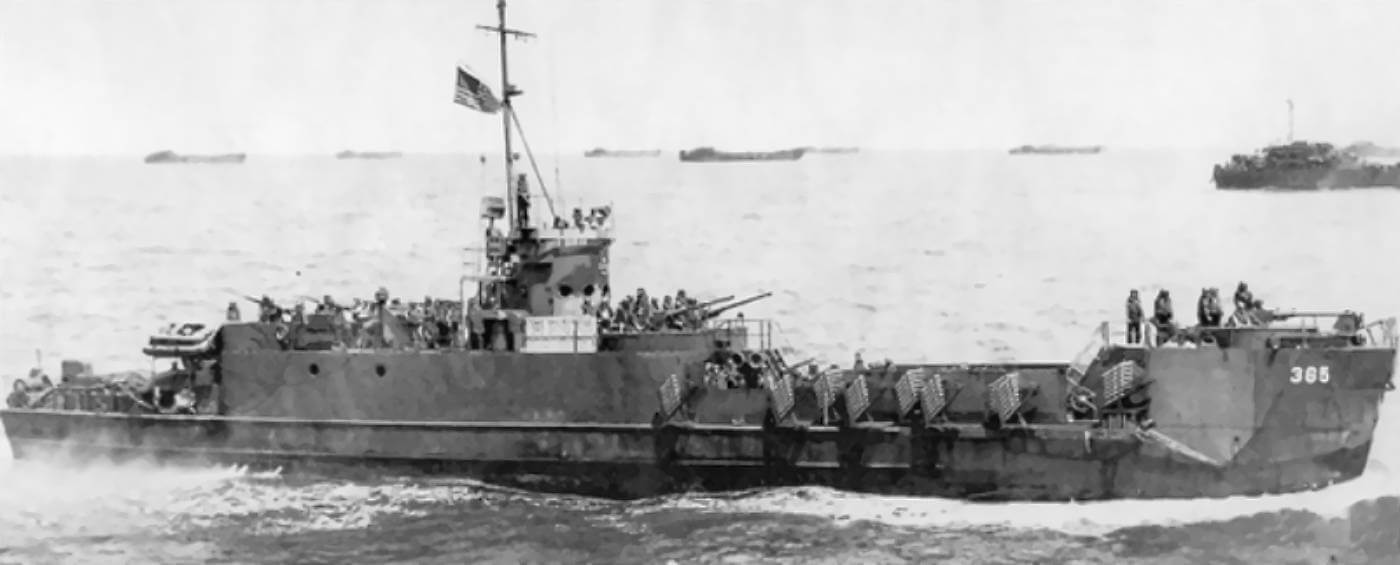
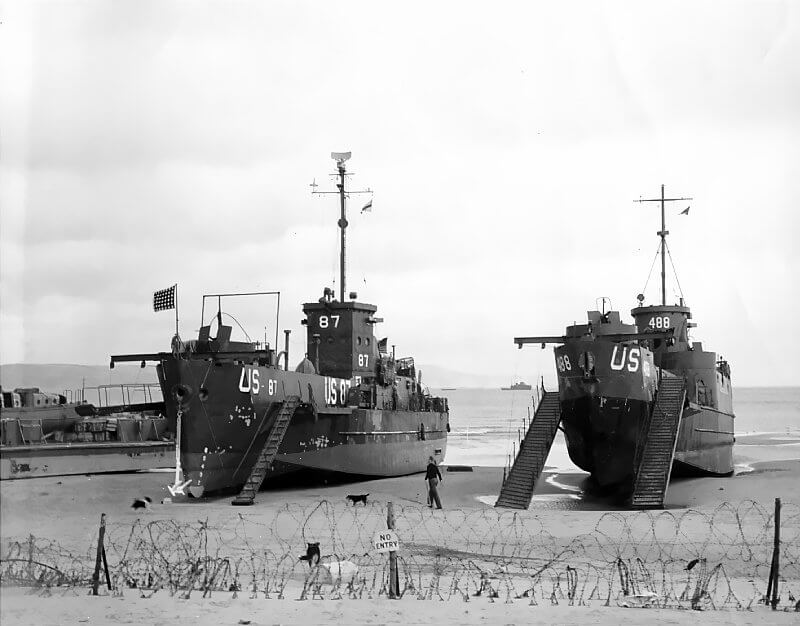
The Landing Craft, Infantry (Large), designated LCI(L), stands among the most consequential amphibious vessels of the Second World War. It emerges from a collaborative effort between Britain and the United States. The British contribute the original raiding concept. American industrial capacity then transforms that concept into a vessel produced on a vast scale. Between 1942 and 1944, 923 LCI(L)s are built across ten United States shipyards. They carry assault infantry onto hostile beaches from North Africa to Okinawa. Their hulls are adapted into gunboats, rocket ships, and mortar platforms. These conversions deliver devastating close-range fire support throughout the Pacific island-hopping campaign. No Allied amphibious operation of any significant scale after mid-1943 is conducted without them.
The LCI(L) fills a critical gap in the Allied order of battle. It is large enough to transport a full infantry company of approximately 200 troops. It is fast enough to maintain station within a 28-kilometre-per-hour convoy. It is seaworthy enough to cross oceans under its own power without escort or assistance. Yet its shallow draught allows it to ground directly upon a hostile shore and discharge troops without intermediate craft. This article presents a comprehensive account of the vessel’s development, design, variants, conversions, operational techniques, and combat service across every theatre of the war.
| The strategic imperative for a seagoing infantry landing craft |
After the fall of France in June 1940, Britain confronts a strategic reality that dominates Allied planning for the next four years. Any counterattack against Hitler’s Fortress Europe must come from the sea. French ports are in German hands. Any invasion force must be deposited directly onto open beaches. The existing inventory of landing craft is wholly inadequate for this task.
The standard British infantry landing craft, the Landing Craft Assault, carries only 31 troops. It must be lowered into the water from a larger Landing Ship Infantry mother ship. This two-stage process is slow and severely limits the scale of initial assault waves. The Americans have their own equivalent. In 1940 it is the Landing Craft, Personnel (Large), the LCP(L), better known as the Eureka boat, built by Andrew Higgins in New Orleans. It carries some thirty-six men. The improved Landing Craft, Vehicle, Personnel, the LCVP, follows in 1942. Both lack the range and seaworthiness for independent ocean crossings. Both must be carried to the beach by a larger ship. The Landing Ship, Tank, then under development, is designed for vehicles. At approximately 10 knots it is too slow to serve as an infantry carrier in a time-critical assault.
What the Allies lack is an intermediate-sized, self-deploying, seagoing vessel. It must carry an entire infantry company across open water. It must land troops directly onto a beach under its own power. It must be producible in the hundreds. No such vessel yet exists.
| Multimedia |



| Design origins and Anglo-American collaboration |
The requirement originates with British Combined Operations Headquarters, at that time under Admiral Lord Louis Mountbatten. The Admiralty draws up specifications for a vessel tentatively designated the Giant Raiding Craft. This is a steel-hulled vessel approximately 46 metres in length, capable of delivering 200 soldiers directly onto beaches up to 370 kilometres from the United Kingdom. The concept is framed as a raiding craft rather than an invasion vessel, partly for political reasons. Characterising it as a raiding craft rather than a landing ship helps secure the interest of the United States Army, which favours small landing craft over large landing ships.
The formal requirement is transmitted to Washington on April 30th, 1942. British steel production is already earmarked for destroyer construction, making domestic building impossible. The project is referred to the United States. The United States Navy Bureau of Ships, known as BuShips, receives the British plans and substantially reworks them for American mass production and broader operational use.
Key BuShips modifications reshape the original concept considerably. The British design provides only ferry-style bench seating, suited to short Channel crossings. BuShips adds sleeping accommodation and galley facilities for longer voyages. A beach-extraction capability is incorporated, using variable-pitch propellers and a stern kedge anchor winch system. Construction is simplified by eliminating curved surfaces wherever possible, enabling mass production in non-traditional shipyards. Additional fuel stowage gives the vessels trans-oceanic range, allowing them to cross the Atlantic without being carried aboard larger ships.
George Lawley and Son of Neponset in Dorchester, Massachusetts, serves as the primary design yard. Their drawings are shared with nine other United States shipyards that will build Landing Craft Infantry, Large vessels. The design is a genuinely joint effort. British Combined Operations defines the operational requirement and initial concept. BuShips develops it into a producible design. American industry then mass-produces it.
Britain separately designs and builds its own variant, the Landing Craft Infantry, Small, designated LCI(S) and known as the Fairmile Type H. This is a wooden-hulled vessel approximately 32 metres in length, carrying 102 troops. The wooden construction avoids further strain on Britain’s limited steel resources.
The pace of development is extraordinary even by wartime standards. The first contracts are signed on June 3rd, 1942, with George Lawley and Sons and New York Shipbuilding Corporation of Camden, New Jersey. The first keel is laid at Bethlehem Steel’s Hingham Shipyard on June 29th, 1942. Production begins across multiple yards on July 7th, 1942. The first vessel is launched in September 1942. The first unit is completed on October 9th, 1942, barely five months after the requirement is transmitted from London.
The improved LCI-351 sub-class follows in swift succession. Its first keel is laid on March 5th, 1943, the vessel is launched on April 8th, 1943, and commissioned on May 14th, 1943. A group of eight Landing Craft Infantry, Large vessels conducts sea trials by crossing from Norfolk, Virginia, to Bermuda in late 1942. The group weathers Force 4 winds during the crossing, demonstrating the type’s ocean-going capability.
The first Landing Craft Infantry, Large vessels enter combat in late 1942 or early 1943. Their exact participation in Operation Torch in November 1942 remains debated in the sources. Some accounts record Royal Navy Landing Craft Infantry, Large vessels sailing from the United Kingdom for North Africa. Others maintain the type is too new to have participated. By July 1943, Landing Craft Infantry, Large vessels are unquestionably in combat at two simultaneous theatres, operating at Sicily in the Mediterranean and in the Solomon Islands in the Pacific.
| Production: shipyards, contracts, and output |
All Landing Craft Infantry, Large vessels are constructed in the United States. Ten shipyards participate, mobilised under wartime emergency shipbuilding contracts.
George Lawley and Son at Neponset in Dorchester, Massachusetts, serves as the primary design yard. Their drawings are shared with all other participating yards. The yard later builds 47 Landing Craft Support, Large Mark 3 vessels. New York Shipbuilding Corporation at Camden, New Jersey, is one of the first two yards under contract, producing hulls LCI-1 through LCI-60, with hulls LCI-49 through LCI-60 cancelled. Consolidated Steel Corporation at Orange, Texas, produces hulls LCI-61 through LCI-96 and additional vessels, employing 20,000 workers at peak production. Bethlehem Steel at Hingham, Massachusetts, lays the first keel on June 29th, 1942, on an emergency yard built across approximately 61 hectares. It produces hulls LCI-97 through LCI-160, with hulls LCI-137 through LCI-160 cancelled. Federal Shipbuilding and Dry Dock at Port Newark, New Jersey, a subsidiary of United States Steel, produces hulls in the LCI-161 through LCI-350 range. Brown Shipbuilding Company at Houston, Texas, produces various hulls including LCI-337 and above, and also builds 61 destroyer escorts. New Jersey Shipbuilding Corporation at Barber in Perth Amboy, New Jersey, produces various hulls including LCI-547 and above. Management of the yard is taken over by Todd Shipyards at the request of the United States Navy. Commercial Iron Works at Portland, Oregon, produces hulls including LCI-725 and LCI-780 and above, and also builds 52 Landing Craft Support, Large Mark 3 vessels. Albina Engine and Machine Works at Portland, Oregon, produces hulls LCI-1013 through LCI-1033, a total of 21 units, and also builds 31 Landing Craft Support, Large Mark 3 vessels. Defoe Shipbuilding Company at Bay City, Michigan, produces hulls including LCI-1077 and above. Operating as a Great Lakes yard, Defoe builds 47 Landing Craft Infantry, Large vessels using an innovative roll-over construction method.
Monthly production reveals a wartime industrial achievement of remarkable speed. Between September and December 1942, yards complete 153 units. September produces 1, October 25, November 59, and December 68. Across 1943, yards complete 305 units. January produces 70, February 47, March 22, April 10, May 3, June 9, July 16, August 22, September 23, October 25, November 28, and December 30. Between January and October 1944, yards complete approximately 465 units. January produces 35, February 34, March 54, April 69, May 78, June 60, July 44, August 36, September 27, and October 26.
Peak monthly output reaches 78 vessels in May 1944, timed to the industrial build-up preceding the Normandy landings. The dramatic production decline in early 1943, falling from 70 vessels per month in January to just 3 in May, reflects the transition from the original LCI-1 sub-class to the improved LCI-351 sub-class. During this transition, 45 hulls under construction are cancelled to accelerate the improved design. Total production reaches 923 Landing Craft Infantry, Large vessels. One source cites a figure of 951, which likely incorporates the 130 Landing Craft Support, Large Mark 3 purpose-built fire support craft constructed on the same hull.
| Lend-Lease allocations and hull numbering |
Two hundred and eleven Landing Craft Infantry, Large vessels are transferred to the Royal Navy under the Lend-Lease programme, drawn primarily from the first sub-class covering hulls LCI-1 through LCI-349. In Royal Navy service these vessels are designated HM LCI(L) followed by their pennant number and generally retain their United States hull numbers. An additional 30 Landing Craft Infantry, Large vessels are transferred to the Soviet Navy under Project Hula at Cold Bay, Alaska, between June and July 1945. These receive the Soviet designation DS, standing for desantiye suda, numbered DS-1 through DS-47 and beyond.
United States Navy hull numbers run from LCI(L)-1 through approximately LCI(L)-1098, with gaps reflecting cancelled hulls. The LCI-1 sub-class encompasses hulls 1 through 349, of which 299 are completed. The LCI-351 sub-class encompasses hull 350 onward. On February 28th, 1949, all remaining Landing Craft Infantry, Large vessels in United States Navy inventory are reclassified as Landing Ship Infantry, Large, designated LSIL.
| Multimedia |
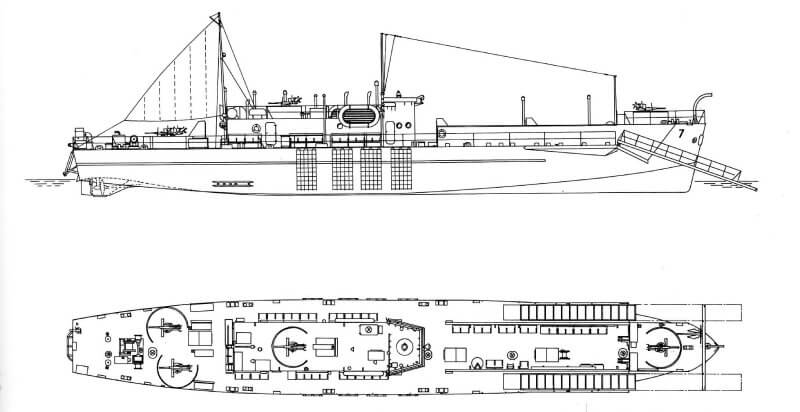
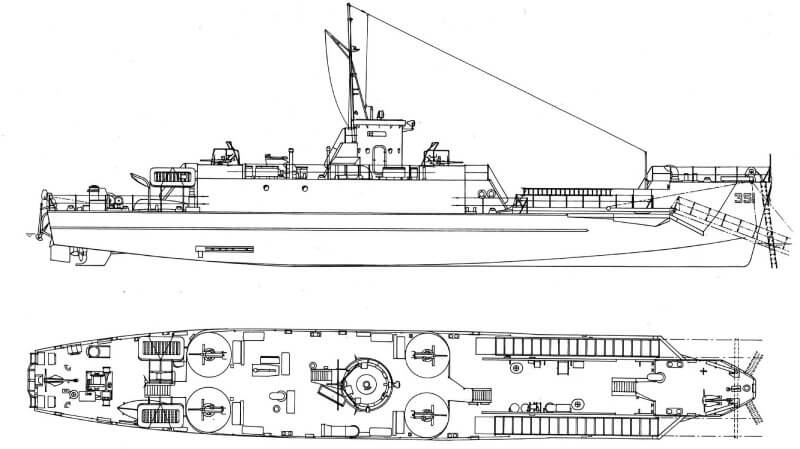
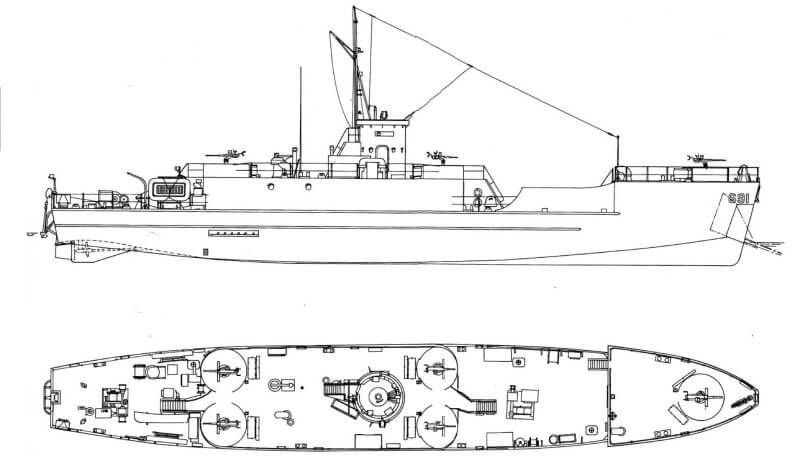
| Design characteristics and performance |
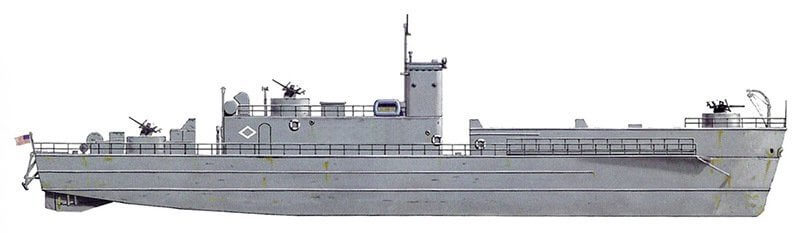
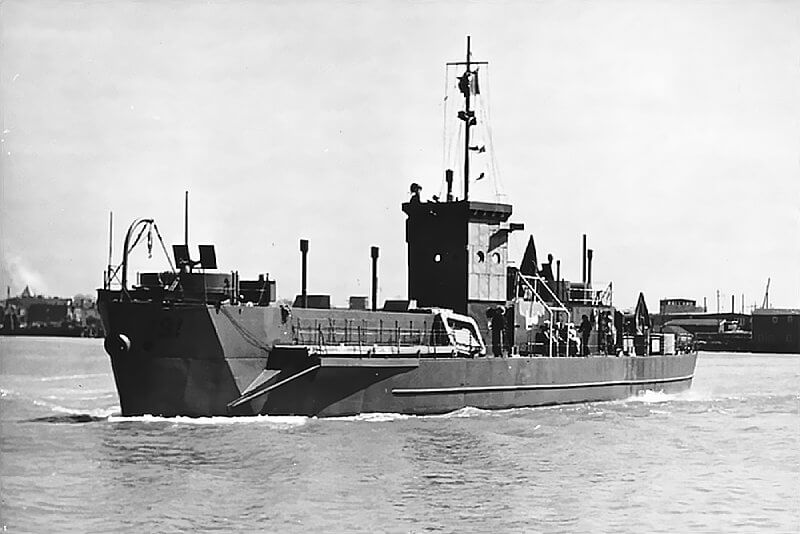
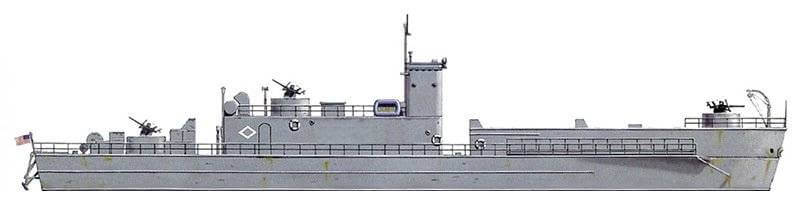
The Landing Craft Infantry, Large measures 48.31 metres in overall length with a beam of 7.09 metres. This produces a relatively long, narrow hull with a beam-to-length ratio of approximately 1:6.9.
Draft varies significantly with loading condition. In light condition, mean draft is 0.95 metres. In landing condition the vessel trims by the stern, with 0.81 metres forward and 1.47 metres aft. This stern-heavy trim is deliberate, allowing the shallow bow to ride up onto a beach. Fully loaded, draft increases to approximately 1.63 metres forward and 1.80 metres aft.
Displacement differs between sub-classes. The LCI(L)-1 class displaces 240 tonnes light and 426 tonnes loaded. The improved LCI(L)-351 class is somewhat lighter at 219 tonnes light and 391 to 395 tonnes loaded.
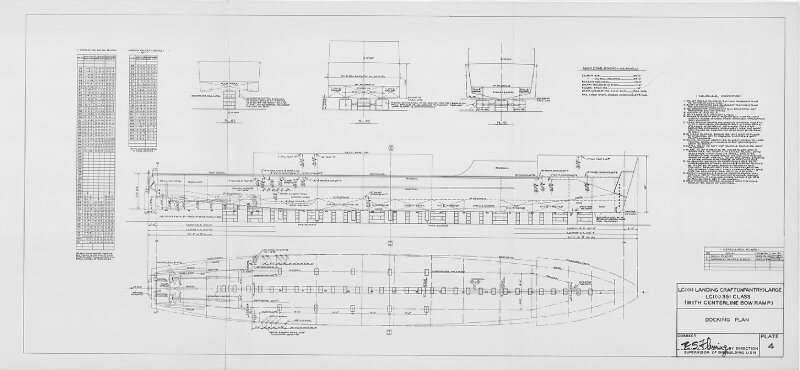
The hull is of all-steel welded construction using mild shipbuilding steel. Hull plating measures approximately 6.35 millimetres on the bottom and 4.76 millimetres on the side shell. The hull is flat-bottomed, deliberately designed without a conventional keel to facilitate beaching on gently sloping beaches. The design landing slope is 1:100, reflecting anticipated use on the flat beaches of northern France. Construction is intentionally simplified with as few curves as possible. This boxy appearance enables non-traditional shipbuilding facilities such as bridge builders and steel fabricators to participate in production.
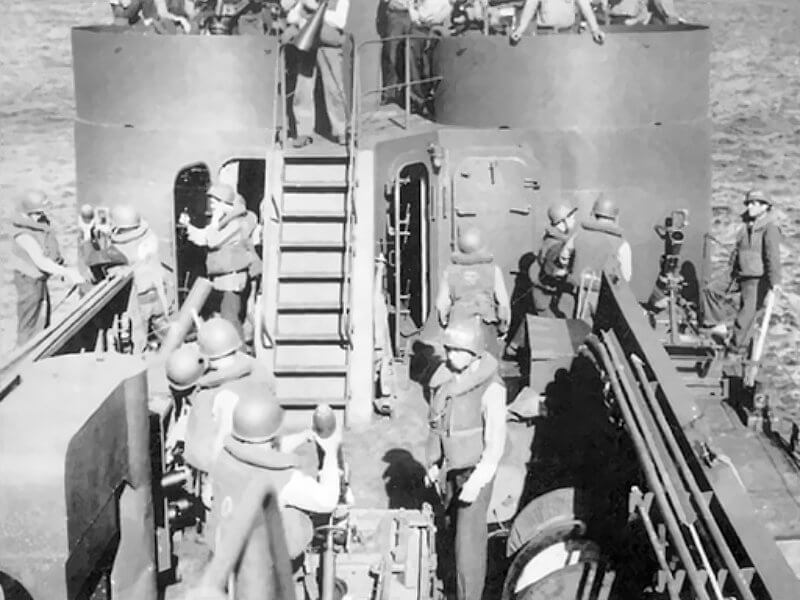
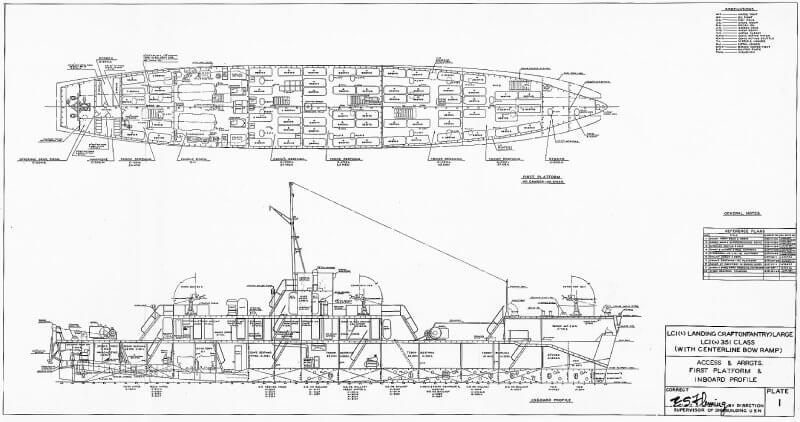
The hull is subdivided by transverse watertight bulkheads into multiple compartments. These comprise the forepeak and chain locker, forward troop compartments to port and starboard, the engine room, after troop and crew compartments, fuel and water tank spaces, and the lazarette and steering gear compartment aft. Protective armour consists of 51-millimetre plastic splinter protection on gun tubs and the conning tower, with 70-millimetre plastic armour around the conning station, wheelhouse, and gun positions.
Three skegs are fitted to the hull bottom aft, providing tunnel protection for the two propellers. The propeller shafts’ final sections are recessed into V-shaped channels in the hull bottom, preventing the propellers from striking the seabed during beaching operations.
The powerplant is standardised across all Landing Craft Infantry, Large production. It consists of two banks of four Detroit Diesel 6-71 inline six-cylinder two-stroke diesel engines, designated the Detroit Diesel 6051 Quad-71 configuration. Each bank of four engines is coupled together via individual drive clutches and drives one propeller shaft through a reduction gear assembly supplied by General Motors Electro-Motive Division, which also furnishes the propeller shafts, propellers, and control units.
Each individual 6-71 engine displaces 1.16 litres per cylinder, with a bore of 108 millimetres and a stroke of 127 millimetres, and is fitted with a Roots-type supercharger for two-stroke air scavenging. Each engine weighs approximately 991 kilograms. Total installed power from all eight engines combined is approximately 1,193 kilowatts. A critical design feature allows any individual engine that fails to be disconnected from its bank via its clutch and repaired whilst the remaining three engines in that bank continue operating, providing vital redundancy.
The vessel has two shafts and two propellers. The propellers are of reversible variable pitch, a pioneering application of this technology in the United States Navy. The propeller shafts spin in one direction only. Ahead or astern operation is achieved by changing the blade pitch. This is essential for beaching and retraction operations, allowing instant transition from forward to reverse thrust without stopping the shafts. Propeller diameter is 1.2 metres.
Two auxiliary Detroit Diesel 2-71 engines drive two 30-kilowatt, 120-volt direct current ship’s service generators, powering all electrical systems when the main engines are not in use. Approximately 9,000 Model 6-71 engines are used in quad configurations on Landing Craft Infantry, Large vessels during the war. Maximum speed is 15.5 to 16 knots, with a maximum continuous speed of 14 knots and an economical cruising speed of 12 knots. Beaching approach speed is reduced to minimum steerage way, typically between 3 and 5 knots for controlled grounding.
Range is dramatically affected by loading condition. Loaded with troops, the Landing Craft Infantry, Large can make 926 kilometres at 15 knots. In ferry and transit mode with extra fuel carried in place of troops, range extends to approximately 7,400 kilometres at 12 knots, sufficient to cross the Atlantic Ocean under its own power. Hundreds of Landing Craft Infantry, Large vessels make this crossing during the war. Fuel capacity is 110 to 130 tonnes of diesel fuel, equivalent to approximately 860 barrels. Lubricating oil capacity is 757 to 908 litres. Fresh water tankage is 36 tonnes.
The Landing Craft Infantry, Large troop landing system is its most distinctive and controversial feature, evolving through three configurations during production.
Design capacity is 188 troops, comprising 6 officers and 182 enlisted men. Early models carry approximately 180 troops. Later models increase capacity to between 200 and 210. Maximum overload capacity reportedly reaches 388, though this figure represents an extreme emergency condition. As an alternative load, the vessel can carry approximately 68 tonnes of cargo in lieu of troops.
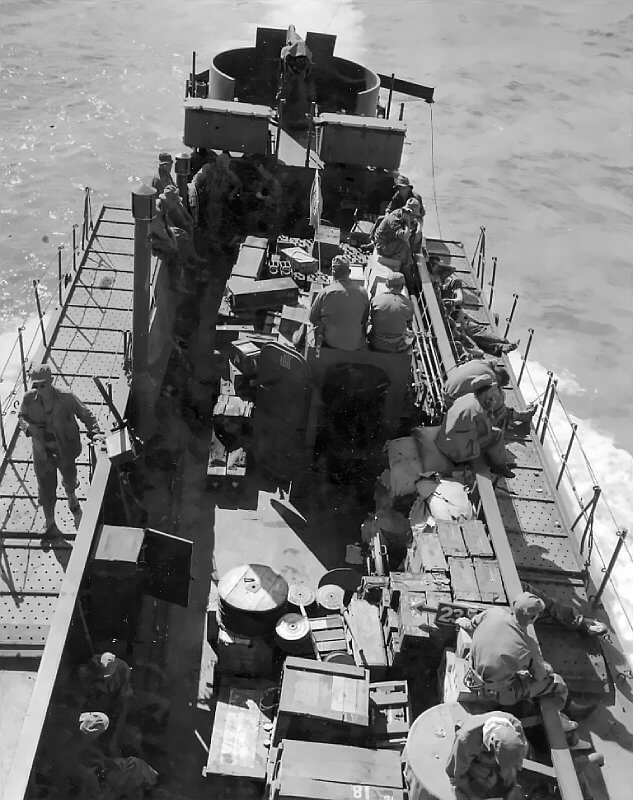
The original British design provides no sleeping accommodation, only ferry-style benches suited to short Channel crossings. All American-built Landing Craft Infantry, Large vessels are fitted with multi-tier pipe-frame canvas bunks in the forward and after troop compartments below decks, typically three to four tiers high. The LCI(L)-351 sub-class introduces better accommodation and larger work areas. A galley is fitted for food preparation on voyages lasting up to 48 hours. Sanitary facilities are provided but minimal for the number of personnel embarked. Habitability is notoriously poor. The flat-bottomed, keel-less hull reacts to every wave and current, making seasickness endemic among troops and crew alike.
The LCI(L)-1 class carries a crew of 3 officers and 21 enlisted men, totalling 24. The LCI(L)-351 class increases this to 4 officers and 24 to 25 enlisted men, totalling 28 to 29. Key positions include the Commanding Officer, typically a United States Naval Reserve Lieutenant or Lieutenant junior grade, the Executive Officer, Engineering Officer, Navigator and Communications Officer, Coxswain, Quartermaster, Signalman, Radioman, Motor Machinist’s Mates, Boatswain’s Mates, Gunner’s Mates, Pharmacist’s Mate, and Ship’s Cook.
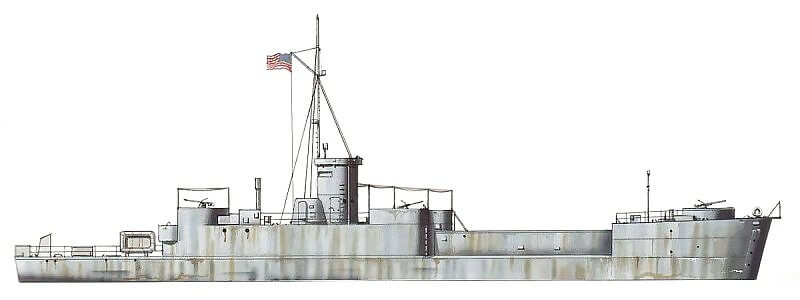
Original armament comprises four or five single 20-millimetre Oerlikon anti-aircraft cannon mounted in round gun tubs with integral splinter shields. Typical positions are one forward on the forecastle, one each to port and starboard forward of the wheelhouse, and one each to port and starboard aft of the wheelhouse. When a fifth gun is fitted, common on the LCI-351 sub-class, it is typically mounted atop the forecastle. Some Landing Craft Infantry, Large vessels also receive two 12.7-millimetre M2 Browning heavy machine guns as the war progresses. Early units carry two 136-kilogram depth charges.
The kedge stern anchor arrangement is one of the Landing Craft Infantry, Large vessel’s most critical operational features. As the vessel makes its final approach toward the beach, the stern anchor is dropped at a calculated distance offshore whilst the craft is still moving forward. The anchor cable, measuring up to 241 metres, pays out as the vessel continues to ground. After troop debarkation, the anchor winch, powered by the auxiliary diesel generators, hauls the vessel stern-first back off the beach. Once the hull is sufficiently afloat, the variable-pitch propellers are engaged in astern. This anchor and winch system, combined with the reversible propellers, gives the Landing Craft Infantry, Large a reliable beach, disembark, retract, and return cycle that is fundamental to its tactical value.
| Multimedia |
| Versions, Conversions and Modifications |
The Landing Craft Infantry, Large is produced in three principal design types, distinguished by conning tower shape and ramp configuration. The Royal Navy applies no formal Mark designations to the Landing Craft Infantry, Large as it does to the Landing Craft Tank. In British service vessels are designated simply as HM LCI(L) followed by the pennant number.
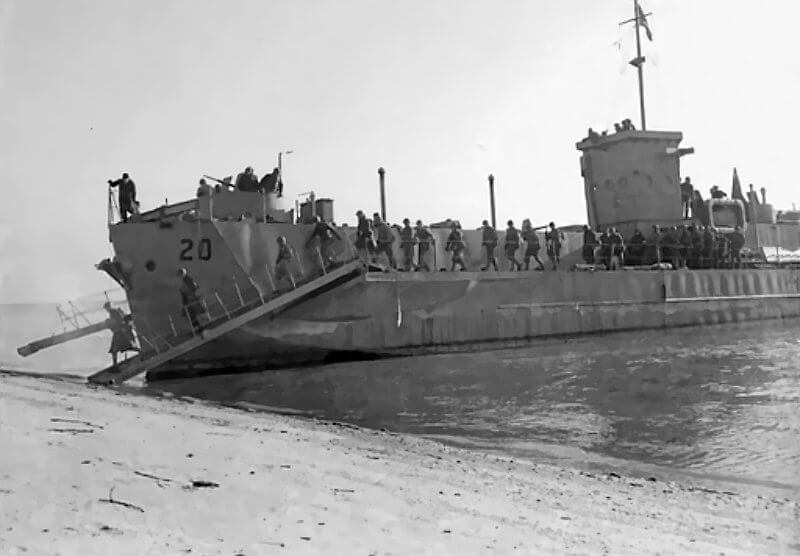
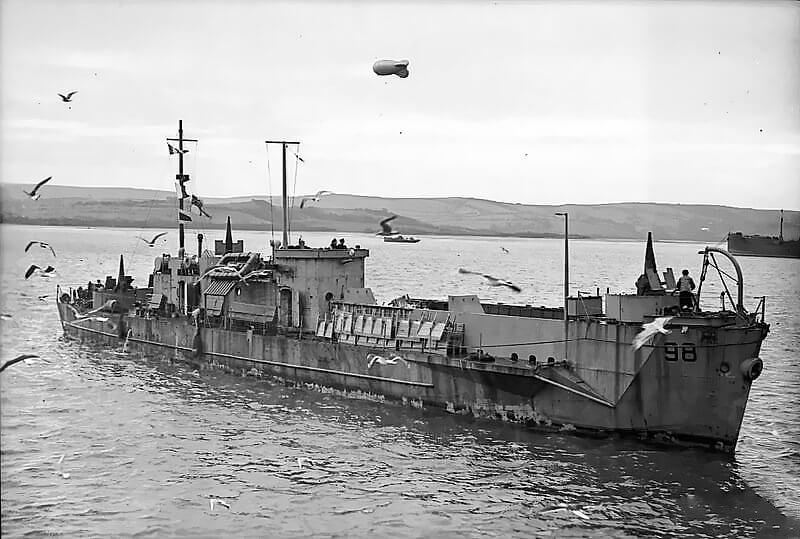
The LCI(L)-1 class, known informally as the Square Conn, Side Ramp type, comprises hull numbers 1 through 350, of which 299 are completed. Forty-five hulls in progress are cancelled to accelerate the improved sub-class. Examples include hulls 49 through 60 cancelled at New York Shipbuilding Corporation and hulls 137 through 160 cancelled at Bethlehem Steel. These vessels feature a square, rectangular, low-profile conning tower and the original twin side-ramp debarkation arrangement. Light displacement is 240 tonnes. Royal Navy-allocated vessels from this class receive a lower bridge per British preference, whilst United States Navy vessels carry a higher bridge.
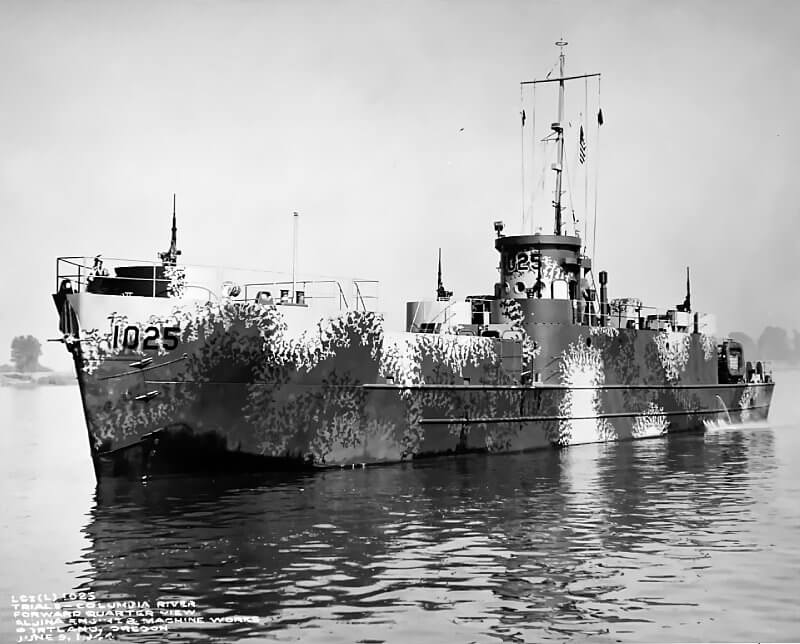
The LCI(L)-351 class, known informally as the Round Conn, Side Ramp type, covers hull numbers 351 through 640, 658 through 690, 708 through 761, 781, 822 through 865, 885 through 1023, and 1034 through 1067. The conning tower is redesigned as a taller, rounded structure. The vessel is approximately 15 centimetres longer and approximately 30 tonnes heavier than the original class. Troop capacity increases to 210. Hatches are enlarged to accept stretcher litters and a fifth 20-millimetre gun is commonly added. Side ramps are retained.
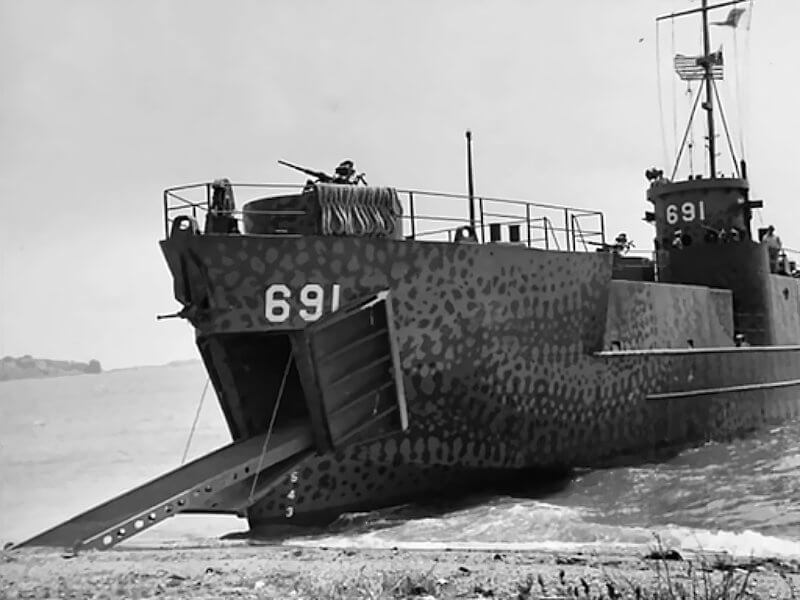
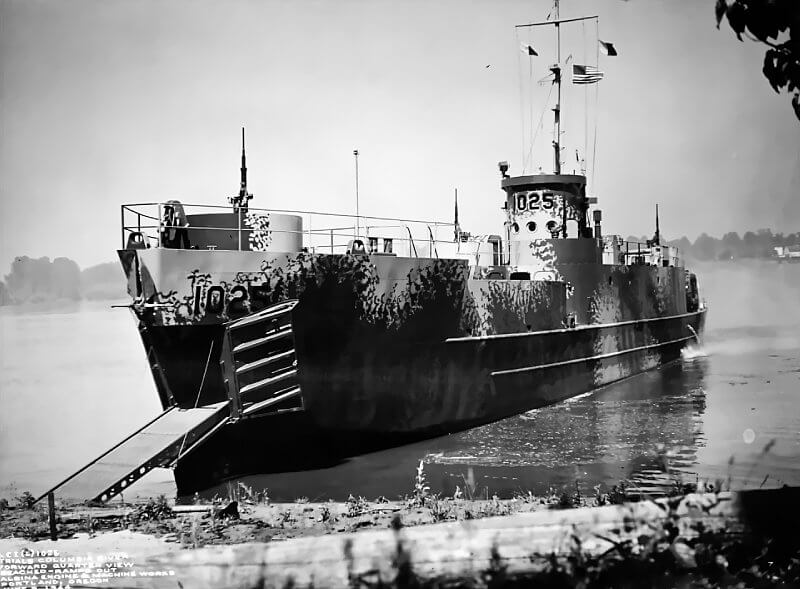
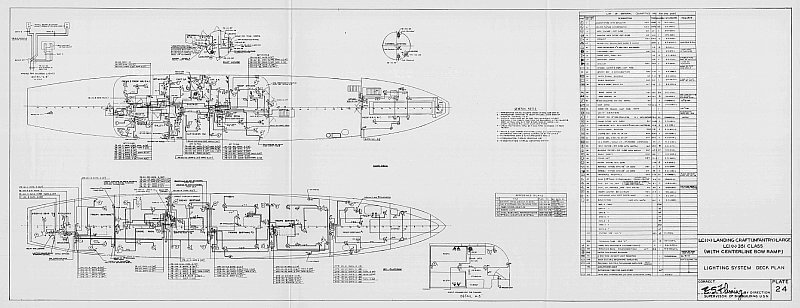
The LCI(L)-641 class, known informally as the Round Conn, Bow Ramp type, includes hull numbers 641 through 657, 691 through 707, 762 through 780, 782 through 821, 866 through 884, 1024 through 1033, and 1068 through 1098. This variant replaces the twin side ramps with a single centre-line bow ramp behind opening bow doors, a significant improvement in troop protection during debarkation. Hull LCI-402 serves as an early experiment with the centre-line bow ramp concept.
Engine fit is standardised across all production. Every Landing Craft Infantry, Large receives the identical eight-engine Detroit Diesel 6-71 Quad arrangement with General Motors Electro-Motive Division reduction gears and variable-pitch propellers. No variation in main propulsion is documented between early and late production.
No Landing Craft Infantry, Large vessels are built in British shipyards. Britain instead designs and builds the Landing Craft Infantry, Small, designated LCI(S) and known as the Fairmile Type H. This is a prefabricated wooden-hulled design measuring approximately 32 metres in length, carrying 102 troops at up to 12.5 knots and crewed by 17 men. The type is disadvantaged by volatile petrol engines and limited armour. Only 39 Landing Craft Infantry, Small vessels participate in the initial D-Day assault.
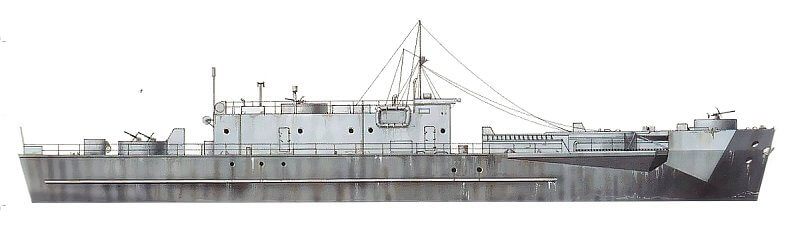
Approximately 219 Landing Craft Infantry, Large vessels are converted to gunboat configuration. The first four conversions involve hulls LCI(L)-21, LCI(L)-22, LCI(L)-23, and LCI(L)-70 from Flotilla Five. These are carried out at Noumea, New Caledonia, between September and October 1943, primarily for anti-barge warfare in the Solomon Islands. The first Landing Craft Infantry, Gunboat combat occurs at Treasury Islands on October 15, 1943. Conversions continue through July 1945, with major conversion sites at Pearl Harbor Navy Yard, San Diego Naval Repair Base, Long Beach Naval Shipyard, and various forward-area facilities.
Armament varies by conversion type. The earliest Noumea conversions receive one 76-millimetre 50-calibre anti-aircraft gun, one 40-millimetre Bofors gun, four 20-millimetre Oerlikon cannon, and six 12.7-millimetre machine guns. Pearl Harbor Type A conversions, completed in December 1943 and including hulls LCI-77 through LCI-82 and LCI-345 through LCI-348, receive two 40-millimetre guns, three 20-millimetre cannon, six 12.7-millimetre machine guns, and ten 114-millimetre Mark 7 rocket launchers. Type B conversions add a third 40-millimetre gun and eight rocket launchers. Type C conversions carried out at San Diego add two Projector Mark 22 systems. Crew complement increases from the standard 24 to approximately 45 to 50 enlisted men and 4 to 5 officers. Landing ramps are removed to save weight and accommodate the additional weapons.
Approximately 61 Landing Craft Infantry, Large vessels are converted to carry 107-millimetre mortars. The first conversion is completed in July 1944 at Pearl Harbor Navy Yard, involving hulls LCI(L)-739, LCI(L)-740, LCI(L)-741, and LCI(L)-742 from Flotilla 14. Each vessel receives three M2 107-millimetre chemical mortars, one forward and two amidships, mounted on specially reinforced platforms filled with a sand and sawdust mixture. The Number 2 crew compartment is converted into a magazine holding 1,200 mortar rounds and fitted with a sprinkler system. A 40-millimetre bow gun is added where weight permits, achieved by removing the forward anchor and winch, saving approximately 4,640 kilograms. The first combat deployment occurs at Peleliu and Angaur on September 15, 1944, with four vessels. By Okinawa, 42 Landing Craft Infantry, Mortar vessels participate, firing 28,000 mortar rounds onto a strip approximately 8.9 kilometres wide and 274 metres deep in the first hour of the assault. The mortar’s range of approximately 2,926 metres exceeds that of the Landing Craft Infantry, Rocket vessel’s rockets and can reach reverse slopes behind hills. United States Army Chemical Mortar Battalion personnel from the 88th, 91st, and 98th Chemical Mortar Battalions initially man the mortars before United States Navy crews are trained.
Landing Craft Infantry, Rocket vessels evolve from early experimental conversions. Hulls LCI(L)-31 and LCI(L)-34 are the first, converted between March and April 1943 aboard the repair ship USS Rigel at Efate in the New Hebrides, under United States Navy Commander Dwight Day at the direction of United States Navy Rear Admiral Daniel Barbey. These two vessels first see combat at Cape Gloucester, New Britain, on December 26, 1943. Armament includes six 127-millimetre rocket launchers fixed to the deck, requiring the ship to be manoeuvred to aim, one 40-millimetre bow gun, four 20-millimetre cannon, and two 12.7-millimetre machine guns. Rocket types evolve from 114-millimetre fin-stabilised barrage rockets with a range of approximately 1,097 metres to 127-millimetre spin-stabilised rockets with a range of approximately 4,572 metres. The latter are first introduced at Iwo Jima in February 1945 by Landing Craft Infantry, Rocket Flotilla Sixteen. Flotilla Sixteen alone comprises 36 Landing Craft Infantry, Rocket vessels, fitted out at Hunter’s Point in San Francisco in November 1944. Crew members must shelter below decks during rocket firing due to blast danger.
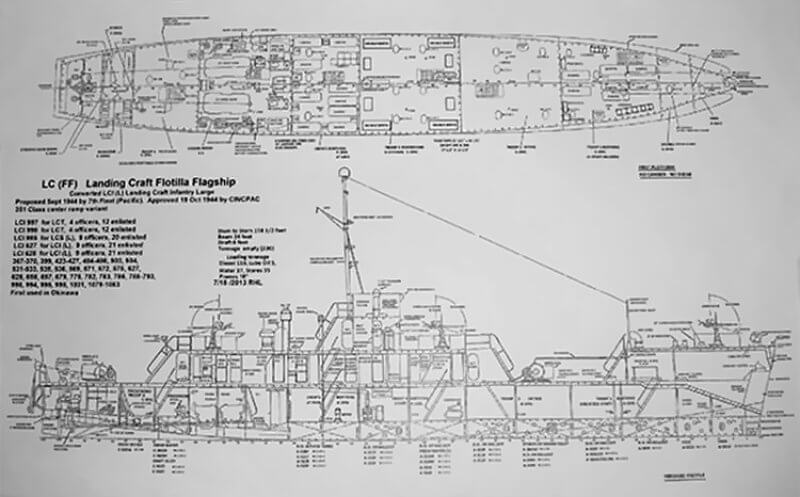
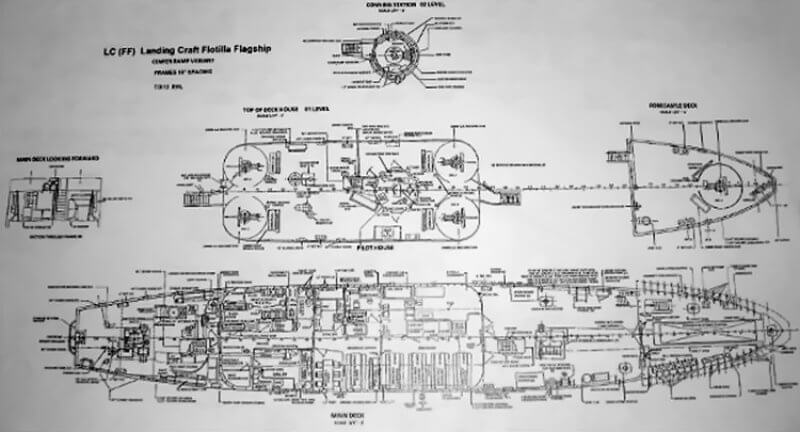
Forty-nine Landing Craft Infantry, Large vessels are converted to flotilla flagships. These receive additional officer quarters, expanded radio and radar equipment, and modified deckhouse arrangements. They see their combat debut at Okinawa but are judged too cramped and too slow for the role. Landing Craft Flotilla Flagship vessels transferred to the Royal Navy are redesignated Landing Craft Headquarters, designated LCH. Some are later redesignated Landing Craft Staff by the Royal Canadian Navy.
Thirty-two Landing Craft Infantry, Large vessels are converted to AMCU-7 class coastal minesweepers. Some vessels serve as Underwater Demolition Team support ships, informally designated LCI(D). Hull LCI-346 is used as a press boat at Iwo Jima, collecting reporters’ dispatches for relay to the communications ship. Additionally, 130 Landing Craft Support, Large Mark 3 fire-support ships are newly built, not converted, on the Landing Craft Infantry hull. These are armed with one 76-millimetre 50-calibre gun, two twin 40-millimetre mounts, multiple 20-millimetre cannon, and ten Mark 7 rocket launchers.
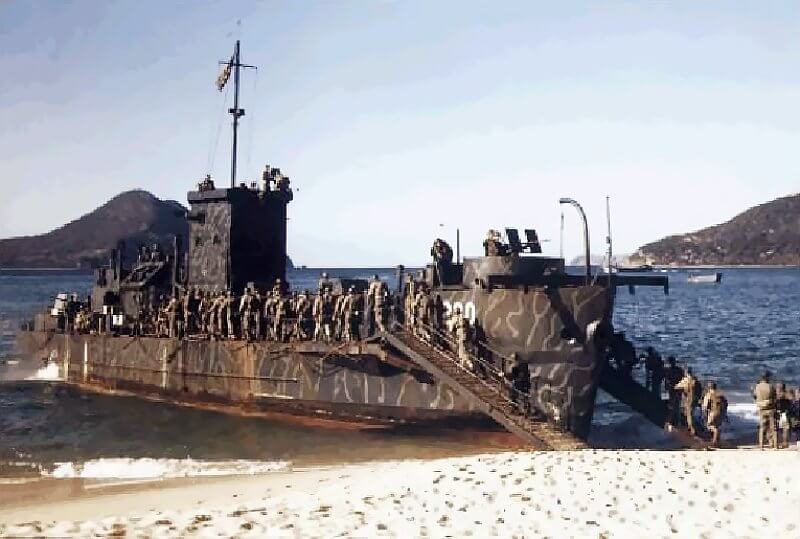
Field modifications are largely ad hoc rather than standardised. Gunboat commanders routinely acquire extra 12.7-millimetre machine guns. When Japanese suicide boats and swimmers begin to appear, weapons are welded to rails at extreme depression angles to fire into the water alongside the hull. Some ships informally add 81-millimetre mortars. Smoke-generation equipment is fitted extensively, as Landing Craft Infantry, Large vessels are used for smoke-laying to obscure invasion fleets. Camouflage paint schemes vary by theatre, with mottled green-brown shallow-water patterns applied for jungle littoral operations and anti-aircraft dazzle patterns used at Okinawa. Deck plating around mortar mounts is reinforced with additional steel. After the war, French Landing Craft Infantry, Large vessels operating in Indochina receive forward-mounted 75-millimetre guns, 40-millimetre Bofors guns, additional 20-millimetre cannon, mortars, and heavy machine guns for riverine operations.
| Multimedia |
| Operational techniques |
The beaching and debarkation procedure is a carefully choreographed sequence. Landing Craft Infantry, Large vessels typically circle in a designated transport area offshore whilst awaiting orders. At Normandy, hull LCI(L)-409 circles for approximately one and a half hours before being directed toward the beach. Some vessels discharge fuel oil overboard to reduce beaching draft. Hull LCI(L)-409 discharges approximately 4,921 litres before the Dragoon landings.
During the final approach, speed is reduced to minimum steerage way. The vessel approaches bow-first, as close to perpendicular to the beach as wind and current allow. As the Landing Craft Infantry, Large enters shallow water on its final run, the stern kedge anchor is dropped at a calculated distance from shore. The cable pays out as the vessel continues forward. Hull LCI(L)-409 at Normandy beaches with approximately 241 metres of cable veered to the stern anchor. The bow then grounds on the beach.
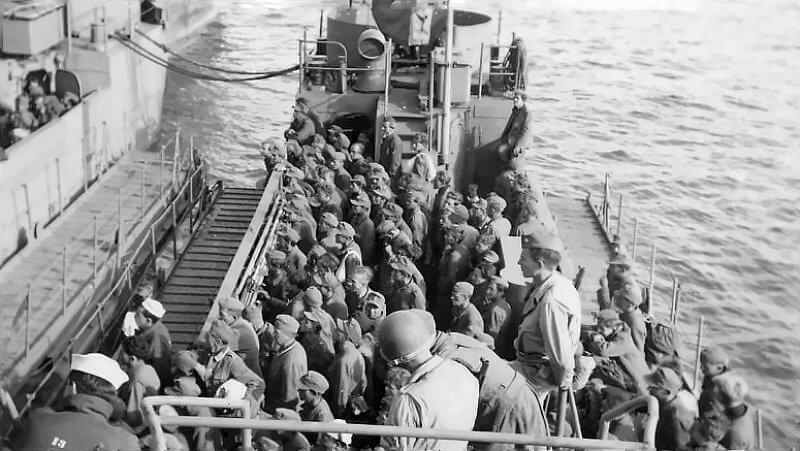
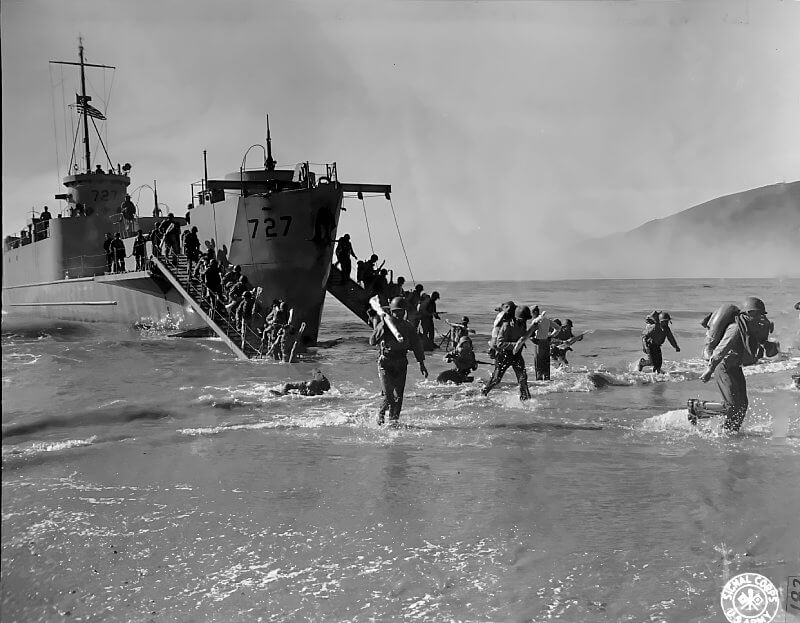
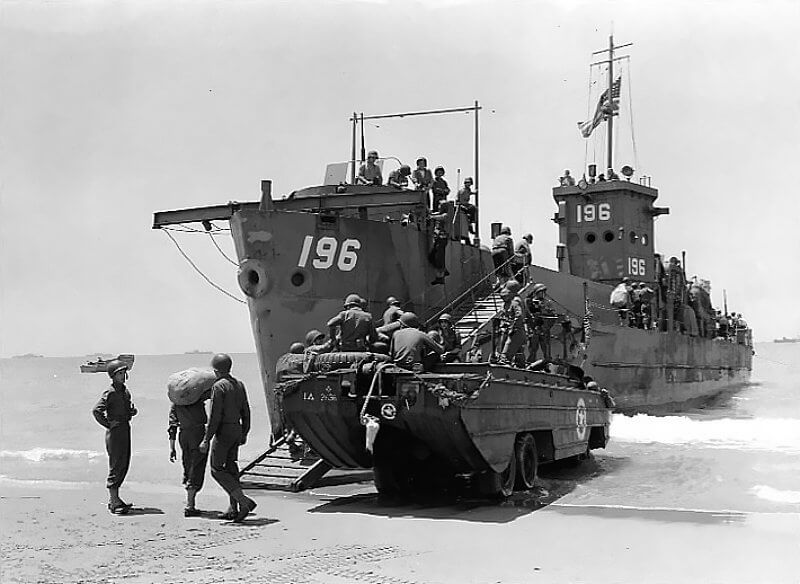
Within approximately two minutes of grounding, the ramps are deployed. On side-ramp vessels, troops descend single file down each ramp, forming two files simultaneously, one to port and one to starboard. On bow-ramp vessels, troops exit through the centre-line ramp after the bow doors swing open. Troops at the base of the ramps step into water ranging from ankle-deep to waist-deep depending on beach gradient. The entire debarkation of approximately 200 troops takes roughly 5 to 10 minutes. Hull LCI(L)-409 debarks 197 men in 5 minutes at Normandy.
After debarkation, the order is given to raise ramps and retract. The anchor winch hauls the vessel stern-first off the beach. The variable-pitch propellers are engaged astern once the hull is sufficiently afloat. If the kedge anchor cable fouls on underwater obstacles or wrecked vessels, the craft can become stranded. This occurs to hull LCI(L)-409 at Normandy, where the cable snags on a sunken Higgins boat.
The exposed ramp debarkation is the Landing Craft Infantry, Large vessel’s gravest tactical weakness. Troops descending single file down narrow, steep ramps are completely exposed to machine-gun, mortar, and artillery fire. The narrow ramps make rapid debarkation impossible. The high bow silhouettes descending soldiers against the sky. This vulnerability is the primary reason Landing Craft Infantry, Large vessels are generally assigned to follow-up waves rather than initial assault waves against defended beaches. Significant exceptions occur at Anzio, Normandy, and across the Pacific. This vulnerability drives the adoption of enclosed bow ramps on later production models and the development of the Landing Craft, Vehicle, Personnel’s broad drop-down bow ramp as the preferred assault-wave debarkation method.
Landing Craft Infantry, Large vessels sail in flotillas of approximately 24 to 36 craft, organised into groups and divisions. Their speed of 14 to 15 knots is a significant tactical advantage over Landing Ship, Tank vessels, which make approximately 10 knots, allowing faster formation movement. In assault operations, Landing Craft Infantry, Large vessels typically arrive after the initial Landing Craft, Vehicle, Personnel and Landing Craft Assault waves, generally between H+90 minutes and H+2 hours, though at some operations they participate earlier. They coordinate with fire-support destroyers and cruisers providing pre-landing bombardment, and with Landing Craft Infantry, Gunboat and Landing Craft Infantry, Rocket vessels leading the assault wave and firing suppressive ordnance.
Mediterranean landings are predominantly night assaults. H-hour at Sicily is approximately 0245 and at Anzio 0200. Night operations cause significant navigational problems and confusion among landing craft. Smoke-laying is a key Landing Craft Infantry, Large role. Dedicated smoke-screening runs obscure invasion fleets from enemy artillery and aircraft, documented extensively at Leyte and Okinawa.
| Operational Use |
| Combat operations: Mediterranean and European theatres |
| Operation Torch, November 1942 |
Whether Landing Craft Infantry, Large vessels participate at Operation Torch is debated across sources. Production data confirms that approximately 26 vessels are completed by the landing date of November 8, 1942. Some accounts record Royal Navy Landing Craft Infantry, Large vessels sailing from the United Kingdom for North Africa. However, multiple authoritative sources state the type is too new to participate meaningfully. If any Landing Craft Infantry, Large vessels are present, their role is marginal.
| Operation Husky, Sicily, July 1943 |
Sicily marks the Landing Craft Infantry, Large vessel’s unambiguous combat debut. Both United States Navy and Royal Navy Landing Craft Infantry, Large vessels participate in large numbers. Landing Craft Infantry, Large Flotilla 1 is among the first deployed. Flotilla 4, under United States Coast Guard Commander Miles H. Imlay, comprises 24 Coast Guard-manned Landing Craft Infantry, Large vessels and operates as part of the JOSS Attack Force at Licata on the western flank of the American sector. British Eastern Naval Task Force Landing Craft Infantry, Large vessels land British Army Eighth Army troops on the southeastern coast. H-hour is approximately 0245 on July 10, 1943.
Severe weather creates extreme conditions, with winds of 45 to 68 kilometres per hour causing widespread seasickness and difficult beaching. Most larger landing craft ground on false beaches 27 to 69 metres from the shoreline. Royal Naval Volunteer Reserve Lieutenant Alec Guinness, the future actor, commands HMS LCI(L)-124, delivering troops near Cape Passero lighthouse. He lands 25 minutes ahead of his flotilla after missing a delay order. Later in the campaign, Landing Craft Infantry, Large vessels are used for leapfrog operations in northern Sicily, carrying troops ahead toward Messina. Landing Craft Infantry, Large vessels also participate in the friendly-fire incident of July 11, 1943, when crews fire on 23 United States Army Air Forces C-47 transport aircraft mistakenly identified as German bombers.
| Operation Avalanche, Salerno, September 1943 |
Landing Craft Infantry, Large Flotilla 4 and other flotillas participate in the Salerno landings. Approximately 96 Landing Craft Infantry, Large vessels are involved, 48 American and 48 British, reflecting roughly equal allocation in the Mediterranean theatre. Conditions are savage. United States Navy Lieutenant William E. Becker of hull LCI(L)-219 describes Salerno as the worst conditions his crew has ever encountered, with up to 50 alerts and eight actual air raids per day. The German introduction of the Hs 293 glide bomb and the Fritz-X guided bomb represents a terrifying new aerial threat. A major storm drives craft ashore, piling a coaster, two Landing Ship, Tank vessels, 23 Landing Craft Tank vessels, and over 50 smaller craft onto the beach. The landing nearly fails, with German counterattacks coming dangerously close to splitting the beachhead before naval gunfire support stabilises the situation.
| Operation Shingle, Anzio, January 1944 |
Landing Craft Infantry, Large vessels play a critical role in the Anzio landings. D-Day is January 22, 1944, with H-hour at 0200, another night assault. At Anzio, some Landing Craft Infantry, Large vessels serve as guide vessels for smaller craft, leading Landing Craft, Vehicle, Personnel and Landing Craft, Mechanised onto the beach. The confined beachhead and small harbour make shipping highly vulnerable, with up to 10 actual air raids and 40 red alerts per day.
Specific losses include hull USS LCI(L)-20, hit by a 227-kilogram bomb dropped by a German Focke-Wulf 190 on D-Day whilst troops are still disembarking. The bomb ruptures fuel oil tanks, covering the engine room with approximately 3,028 litres of burning fuel. Hull USS LCI(L)-32 strikes a mine on January 26, 1944, whilst assisting hull USS LST-422 and sinks. Hull HMS LCI-273 is sunk by German air attack on March 28, 1944, her hull broken in half. Lieutenant Becker observes that the ships lost at Anzio represent a greater ratio to participating vessels than at any other operation.
| Operation Overlord, Normandy, June 1944 |
Approximately 247 to 250 Landing Craft Infantry, Large vessels participate in Operation Neptune, the naval component of Operation Overlord. Of these, approximately 118 are United States Navy and United States Coast Guard vessels, and approximately 130 are Royal Navy vessels including those manned by the Royal Canadian Navy.
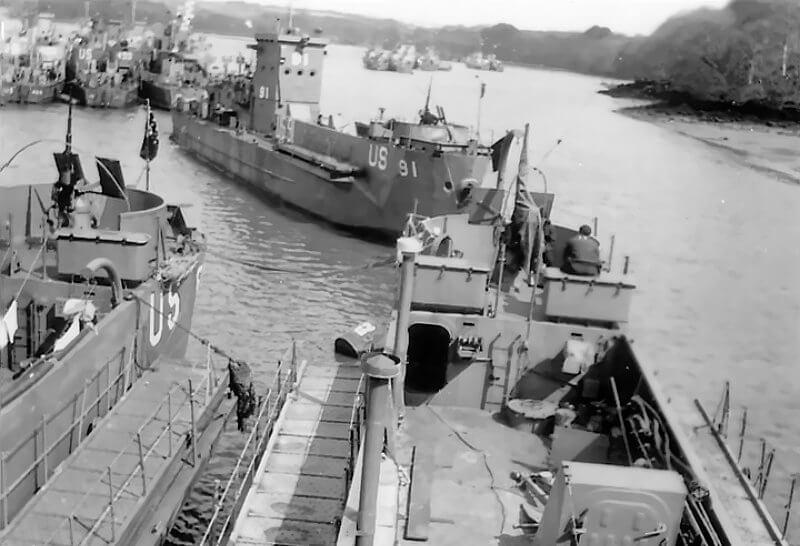
At Omaha Beach, United States Coast Guard Landing Craft Infantry Flotilla 10, under United States Coast Guard Commander Miles Imlay, deploys 24 Landing Craft Infantry, Large vessels. Twelve are Coast Guard-manned, hulls LCI(L)-83 through LCI(L)-94, and twelve are United States Navy-manned, hulls LCI(L)-487 through LCI(L)-498. Additional United States Navy Landing Craft Infantry, Large vessels, including hulls LCI(L)-415, LCI(L)-416, LCI(L)-219, and LCI(L)-232, operate in other assault groups. Landing Craft Infantry, Large vessels generally arrive in follow-up waves beginning approximately H+90 to H+120, between 08:00 and 08:30, after the initial Landing Craft, Vehicle, Personnel assault waves at H-hour at 06:30.
At Utah Beach, 12 Coast Guard-manned Landing Craft Infantry, Large vessels from Flotilla 10, hulls LCI(L)-95, LCI(L)-96, LCI(L)-319 through LCI(L)-326, LCI(L)-349, and LCI(L)-350, plus additional United States Navy and Royal Navy vessels, support Force U.
At Gold Beach, Royal Navy Landing Craft Infantry, Large flotillas land troops of the British Army 50th Northumbrian Infantry Division.
At Juno Beach, the Royal Canadian Navy deploys approximately 30 Landing Craft Infantry, Large vessels organised in three flotillas: the 260th, designated the 1st Canadian Flotilla; the 262nd, designated the 2nd Canadian Flotilla; and the 264th, designated the 3rd Canadian Flotilla. The 262nd Flotilla’s 12 Landing Craft Infantry, Large vessels charge through beach obstacles at approximately 30 kilometres per hour, beaching between 1130 and 1132 on Nan White beach at Bernières-sur-Mer. Five craft sustain damage on the approach, four on the beach, and two coming off. Only hull LCI-306 escapes undamaged. Despite this, all troops are landed safely, including men of the Canadian Army 9th Canadian Infantry Brigade who disembark with bicycles.
At Sword Beach, Royal Navy Landing Craft Infantry, Large flotillas support the British Army 3rd Infantry Division.
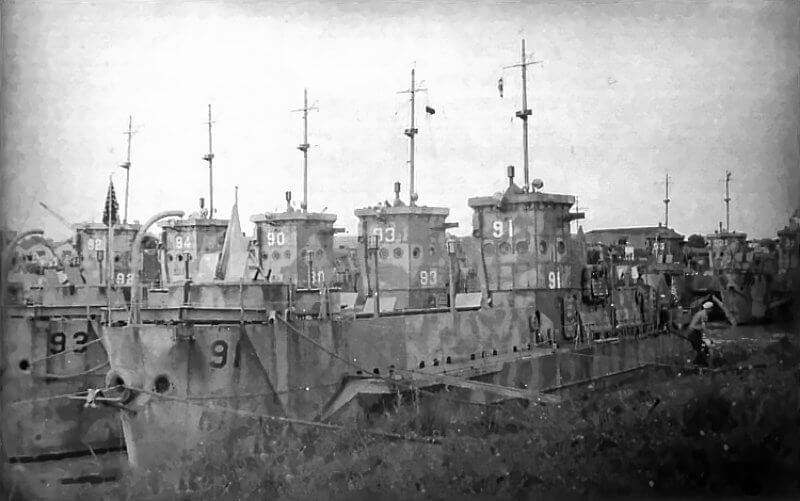
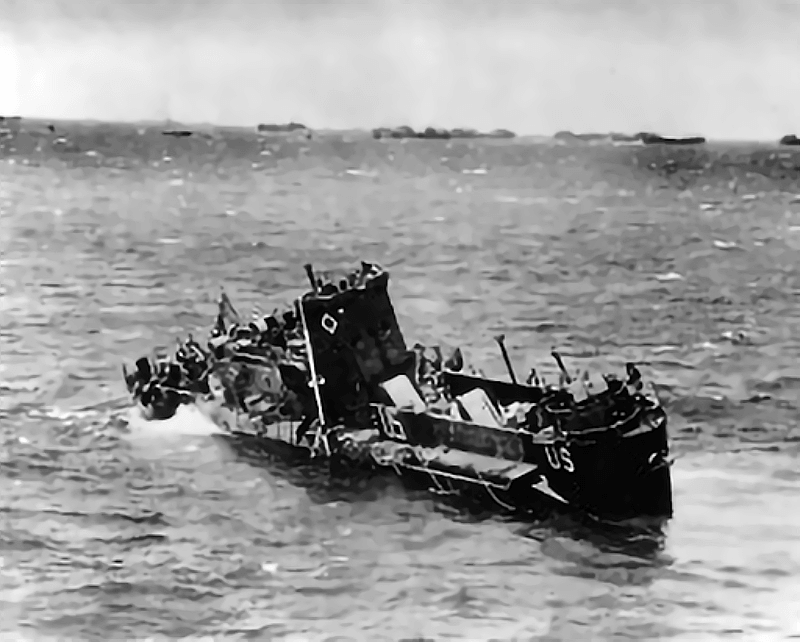
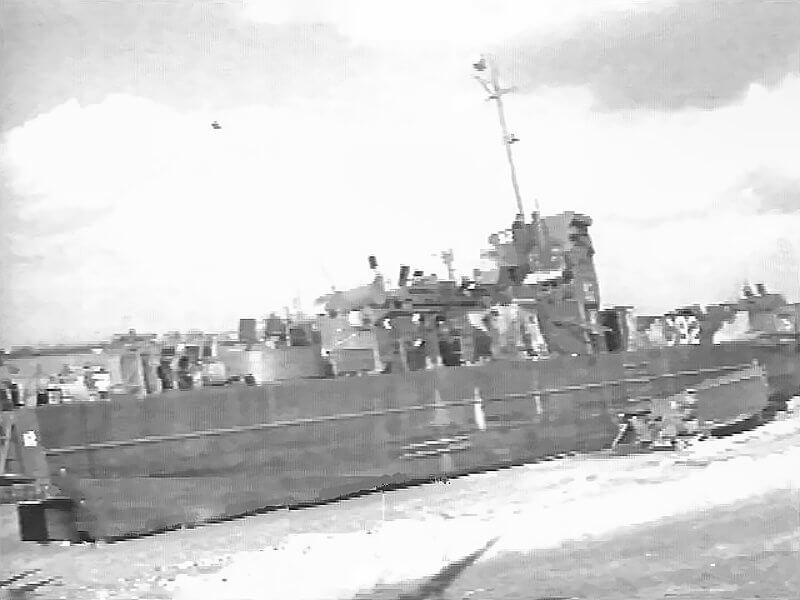
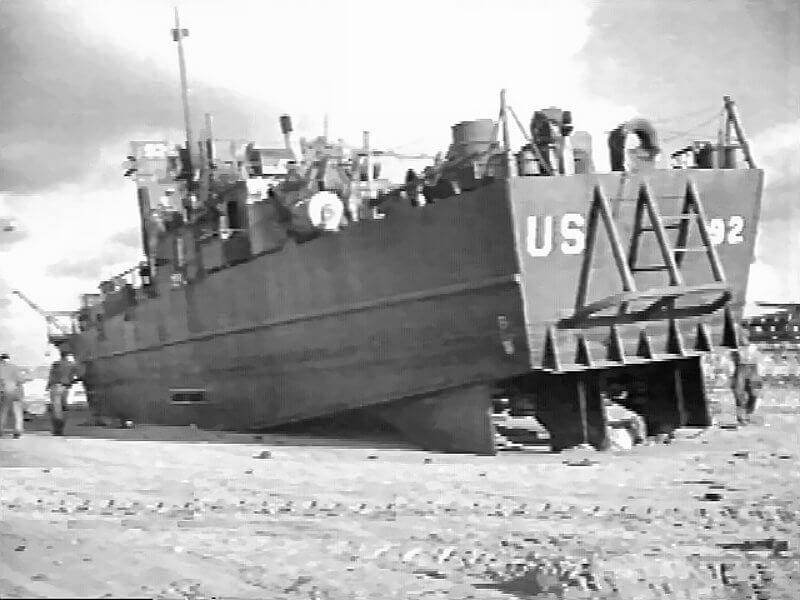
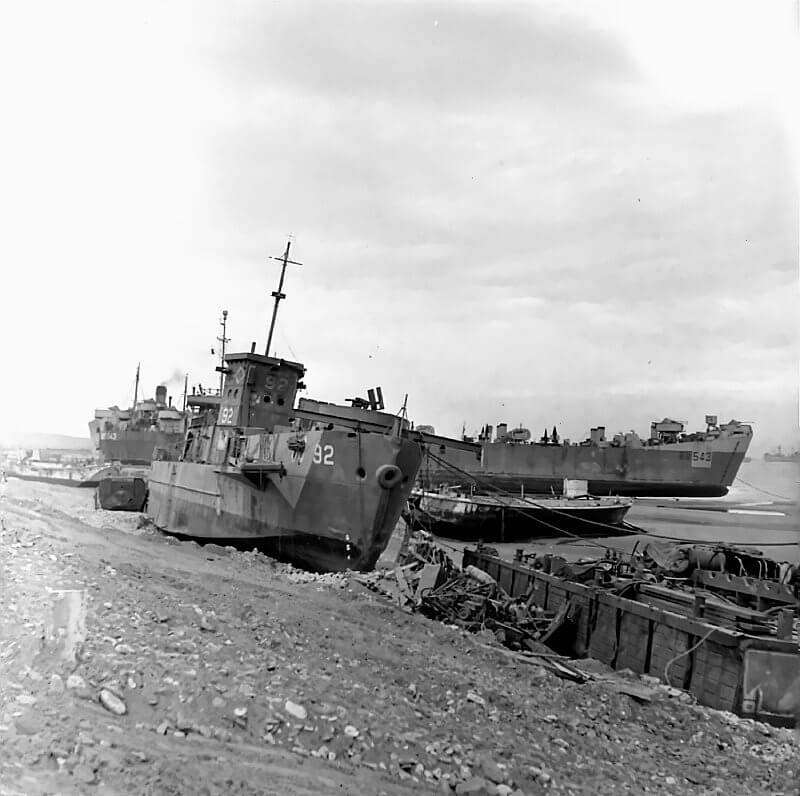
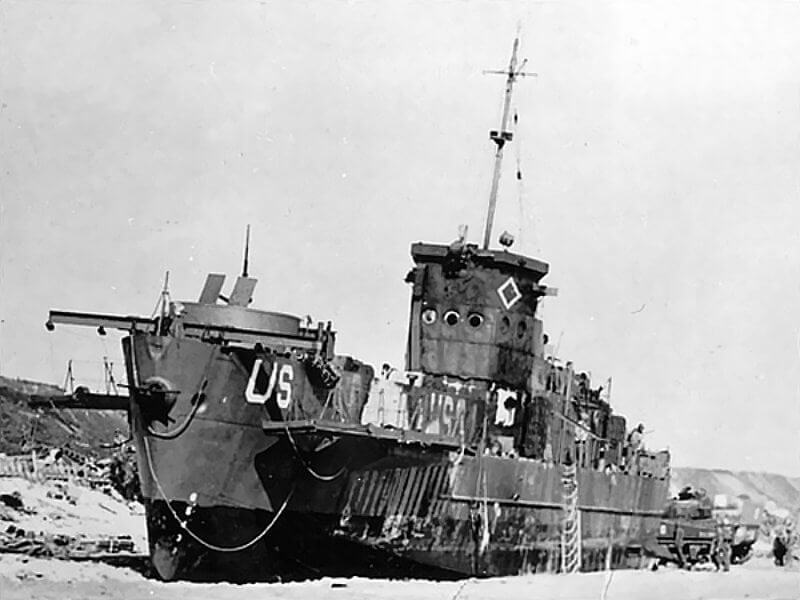
D-Day losses are concentrated at Omaha Beach. Confirmed losses on June 6, 1944, include hull USS LCI(L)-85, a United States Coast Guard vessel commanded by United States Coast Guard Lieutenant junior grade Coit Hendley. It is hit by 88-millimetre artillery fire and mines on Easy Red sector. Fifteen soldiers are killed, approximately 30 are wounded, and four Coast Guard crew members are wounded. The vessel capsizes and sinks after retracting to transfer casualties to USS Samuel Chase. Hull USS LCI(L)-91, a United States Coast Guard vessel commanded by United States Coast Guard Lieutenant junior grade Arend Vyn, is lost to enemy action. Hull USS LCI(L)-92, a United States Coast Guard vessel, strikes a mine. Twenty-five men are killed, including four from the same school in Kansas. United States Navy Photographer’s Mate 3rd Class Seth Shepard writes a firsthand account 19 days later. Hull USS LCI(L)-93, a United States Coast Guard vessel, becomes stranded between the shore and a sandbar and is destroyed by German 88-millimetre artillery. United States Coast Guard Steward’s Mate 2nd Class John Roberts, an African American crewman, loses his leg to an enemy shell. The vessel becomes the subject of United States Navy combat artist Dwight C. Shepler’s painting The Tough Beach. Hull USS LCI(L)-497, a United States Navy vessel, is destroyed by German Teller mines, though all crewmen survive.
Total Landing Craft Infantry, Large losses during the entire Normandy campaign from D-Day through September 1944 amount to 16 vessels, 9 American and 7 British. Hull USS LCI(L)-219 is destroyed by aerial bomb on June 11th, 1944. Her commanding officer, United States Navy Lieutenant Commander Corsi, receives the Navy Cross for extraordinary heroism despite severe shrapnel wounds. Flotilla 10 receives the Navy Unit Commendation for its actions at Omaha Beach. Landing Craft Infantry, Gunboat, Landing Craft Infantry, Rocket, and Landing Craft Infantry, Mortar conversions are not significantly employed at Normandy. Close-in fire support is instead provided by Landing Craft Tank, Rocket vessels, Landing Craft Gun, Large vessels, and Landing Craft Flak variants.
After D-Day, surviving Landing Craft Infantry, Large vessels perform continuous shuttle operations across the English Channel. The Great Storm of June 19th to 20th, 1944, causes widespread damage to landing craft of all types. By early autumn 1944, most surviving United States Navy Landing Craft Infantry, Large vessels are sent home. Flotilla 10 receives replacement vessels and retrains as Flotilla 35 for service in the Pacific.
| Operation Dragoon, Southern France, August 1944 |
Landing Craft Infantry, Large vessels participate extensively in Operation Dragoon, staging from Ajaccio, Corsica. Multiple Landing Craft Infantry, Large vessels that have served throughout the Mediterranean campaign are present, sailing in convoy formation. Landing Craft Infantry, Large vessels fire rockets to detonate land mines ahead of troop waves. Hull LCI(L)-409 beaches on Green Beach at 1338 on August 15, 1944, after an initial approach grounds on a sandbar too far offshore. The operation meets far less resistance than Normandy. Total Allied D-Day losses at Dragoon are just 95 killed and 185 wounded, compared to approximately 4,500 at Normandy. Minimal Landing Craft Infantry, Large losses reflect the weakened German defensive capability in southern France.
| Operation Infatuate, Walcheren Island, November 1st, 1944 |
Landing Craft Infantry, Large hull LCI(L)-269 and other craft participate in the assault on Walcheren Island on November 1st, 1944. Crews consider the intensity of the operation comparable to that of the Normandy landings. Of the 27 craft comprising Support Squadron Eastern Flank, only 7 survive the engagement.
| Pacific theatre |
| Solomon Islands, June to November 1943 |
The first Pacific use of Landing Craft Infantry, Large vessels comes during the New Georgia landings in June 1943. Landing Craft Infantry, Large Flotilla 5, trained at Noumea, delivers second and fourth echelon troops. Hull LCI(L)-70 lands troops on Rendova Island on June 30th, 1943, within artillery range of Munda airstrip. In September 1943, four Landing Craft Infantry, Large vessels, hulls LCI(L)-21, LCI(L)-22, LCI(L)-23, and LCI(L)-70, are sent to Noumea for conversion to the first Landing Craft Infantry, Gunboat configuration. At Bougainville in November 1943, hull LCI(G)-70 becomes part of the force known informally as the Bougainville Navy, performing night anti-barge patrols against Japanese resupply craft. Landing Craft Infantry, Gunboat vessels also operate in the hazardous Saint George Channel between New Ireland and New Britain. Hull LCI(G)-70 later earns a Presidential Unit Citation.
| New Guinea, September 1943 to September 1944 |
Under United States Navy Rear Admiral Daniel E. Barbey’s VII Amphibious Force, Landing Craft Infantry, Large vessels participate in 14 major landings, delivering approximately 300,000 men and 350,000 tonnes of supplies. At Lae on September 4th, 1943, Landing Craft Infantry, Large vessels land the Australian Army 9th Division. Hull USS LCI(L)-339, a Coast Guard-manned vessel, is sunk by Japanese aircraft during this operation, the only Landing Craft Infantry, Large vessel lost in the Pacific during the New Guinea campaign. The commanding officer of the Australian Army 2/23rd Battalion is killed when a bomb strikes the bridge. Landing Craft Infantry, Large vessels subsequently participate at Finschhafen, Saidor, Hollandia, Arawe, Cape Gloucester, the Admiralty Islands, Aitape, Biak, and Morotai. It is under Barbey’s command that United States Navy Commander Dwight Day develops the Landing Craft Infantry, Rocket concept, reasoning that machine guns are insufficient against beach defences and that naval gunfire risks hitting friendly aircraft overhead.
| Gilbert and Marshall Islands, November 1943 to February 1944 |
Landing Craft Infantry, Large vessels are not deployed as close fire support at Tarawa in November 1943. The devastating United States Marine Corps casualties sustained whilst wading ashore without suppressive cover lead United States Navy Rear Admiral Richmond K. Turner to specifically advocate for Landing Craft Infantry, Gunboat vessels in all future island assaults. At Kwajalein between January and February 1944, 12 Landing Craft Infantry, Gunboat fire-support ships designated LCI(FS) participate, including Landing Craft Infantry, Gunboat Flotilla Three. Hull LCI(G)-449 earns a Navy Unit Commendation. Hull LCI(G)-450 runs aground on a reef at Ennubirr Island and her crew rescues approximately 50 soldiers from capsized Landing Vehicle Tracked vessels.
At Eniwetok in February 1944, a tragic friendly-fire incident occurs at Parry Island on February 22nd, 1944. Five-inch shells from American destroyers strike hulls LCI(G)-365, LCI(G)-440, and LCI(G)-442 through smoke and dust. Hull LCI(G)-440 alone suffers 7 killed and 40 wounded. Hull LCI(G)-442 suffers 6 killed and 5 wounded.
| The Marianas, Saipan, Guam, and Tinian, June to August 1944 |
At Saipan on June 15th, 1944, 24 Landing Craft Infantry, Gunboat vessels provide close fire support with 40-millimetre cannon and rockets. Coral reefs prevent gunboats from reaching effective rocket range in some beach sectors. This limitation of the 114-millimetre rocket’s range of approximately 1,097 metres drives the later adoption of 127-millimetre spin-stabilised rockets with a range of approximately 4,572 metres. Hull LCI(G)-468 is sunk on June 17th, 1944, by an aerial torpedo that blows off her bow. At Guam on July 21st, 1944, hundreds of 114-millimetre rockets from Landing Craft Infantry, Gunboat vessels strike the beaches ahead of the assault wave. The commander of Underwater Demolition Team Four reports the Guam Underwater Demolition Team operation as near perfect, crediting Landing Craft Infantry, Gunboat fire support. At Tinian on July 24th, 1944, twelve Landing Craft Infantry, Gunboat vessels lead the assault.
| Philippines, October 1944 to mid-1945 |
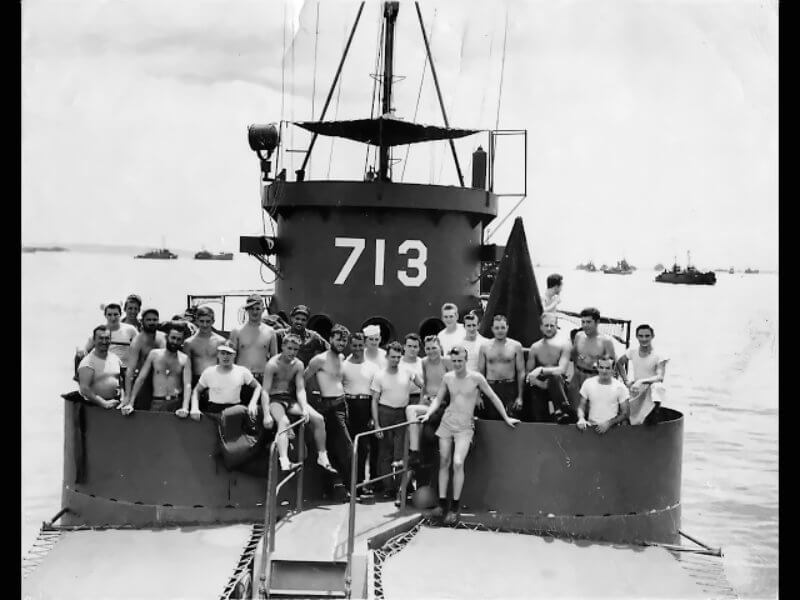
Landing Craft Infantry, Large vessels participate in the Leyte landings in October 1944. Hull LCI(L)-1065 is sunk off Leyte on October 24th, 1944. At Lingayen Gulf in January 1945, the massive invasion force faces kamikaze attacks. Hull LCI(G)-70 is hit by a kamikaze en route to Lingayen Gulf, suffering 6 killed and 9 wounded with her main 76-millimetre gun wrecked, but continues to participate in the landings. Hull LCI(G)-365, a survivor of many earlier actions, is sunk by a Japanese Shinyo suicide boat in Lingayen Gulf on January 10th, 1945. Hull LCI(M)-974 is also sunk by a Shinyo the same day. Landing Craft Infantry, Large vessels perform smoke-screening duties and stand armed guard at night against suicide boats throughout the Philippines campaign. Hull LCI(L)-713 of Flotilla 24 participates at Zamboanga, Mindanao, in March 1945 and at Brunei Bay, Borneo, in June 1945.
| Iwo Jima, February 1945 |
The engagement of February 17th, 1945, is one of the most celebrated small-craft actions in naval history. Landing Craft Infantry, Gunboat Group Eight of Flotilla Three, under United States Navy Lieutenant Commander Willard Nash aboard hull LCI(G)-457, is tasked with providing close fire support for Underwater Demolition Teams 12, 13, 14, and 15 conducting beach reconnaissance two days before the main assault. The group comprises hulls LCI(G)-346, LCI(G)-348, LCI(G)-438, LCI(G)-441, LCI(G)-449, LCI(G)-450, LCI(G)-457, LCI(G)-466, LCI(G)-469, LCI(G)-471, LCI(G)-473, and LCI(G)-474, with hull LC(FF)-627 carrying the Flotilla Commander.
At approximately 1025, seven gunboats advance in line abreast through the destroyer screen, closing to between 914 and 1,372 metres offshore. The Japanese, mistaking the operation for the actual invasion, unleash all available firepower, including 152-millimetre guns from Mount Suribachi. Every gunboat is hit repeatedly over a 75-minute engagement. Despite catastrophic damage, hulls LCI(G)-409, LCI(G)-438, LCI(G)-441, and LCI(G)-471 return to battle. Hull LCI(G)-409 does so with 60 per cent casualties. Hull LCI(G)-474 is abandoned and scuttled by gunfire from USS Capps, hull number DD-550. Total casualties among the gunboats reach 201, representing 30 per cent of all personnel, with 47 killed and approximately 154 wounded. Hull LCI(G)-449 alone suffers 21 killed and 20 wounded.
United States Navy Lieutenant junior grade Rufus G. Herring, commanding hull LCI(G)-449, receives the Medal of Honor. Despite severe wounds, he takes the helm when his ship goes out of control and keeps her in action until the mission is accomplished. Ten other officers commanding Group Eight vessels receive the Navy Cross. The entire Group Eight receives the Presidential Unit Citation. The action carries significant strategic consequence. By provoking the Japanese into revealing their concealed heavy guns, the gunboats provide intelligence that saves Marine lives during the D-Day assault on February 19th, 1945. Landing Craft Infantry, Rocket Flotilla 16 introduces the new 127-millimetre spin-stabilised rocket at Iwo Jima, its range of approximately 4,572 metres solving the reef-distance problem that has plagued earlier operations.
| Okinawa, April to June 1945 |
Multiple Landing Craft Infantry, Gunboat, Landing Craft Infantry, Rocket, Landing Craft Infantry, Mortar, and Landing Craft Support, Large vessels participate in the vast Okinawa campaign. The 49 Landing Craft Flotilla Flagship vessels see their combat debut here. Hull LCI(G)-82 is sunk on April 4th, 1945, by a Japanese Shinyo suicide boat off Nakagusuku Wan during night picket duty, with 8 crewmen killed. The 42 Landing Craft Infantry, Mortar vessels at Okinawa represent the type’s largest single deployment, firing 28,000 mortar rounds in the first hour of the assault alone. Approximately 1,900 kamikaze sorties strike the fleet during the Okinawa campaign. Landing Craft Infantry type vessels on smoke-laying, picket, fire-support, and patrol duties are among the hundreds of ships exposed to this threat.
| Operation Downfall, planned invasion of Japan |
Landing Craft Infantry, Large vessels are explicitly allocated for both Operation Olympic, the planned assault on Kyushu in November 1945, and Operation Coronet, the planned assault on Honshu in spring 1946. The VII Amphibious Force Amphibious Training Command transfers to Subic Bay, Luzon, in March 1945 specifically to prepare for the invasion. Given that the operation is planned at a scale exceeding Normandy, where 248 Landing Craft Infantry, Large vessels participate, hundreds of Landing Craft Infantry type vessels would have been committed. The 30 Landing Craft Infantry, Large vessels transferred to the Soviet Navy under Project Hula form part of the preparations for Soviet entry into the Pacific war.
| Sources |