
| Page Created |
| January 7th, 2026 |
| Last Updated |
| February 3rd, 2026 |
| Germany |
 |
| Additional Information |
| Unit Order of Battle Commanders Operations Equipment Multimedia References Biographies |
| Badge |
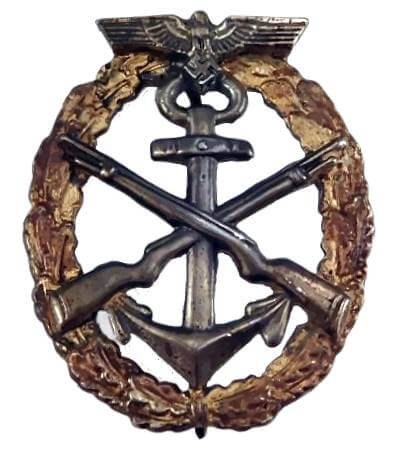 |
| Motto |
| – |
| Founded |
| March 1938 |
| Disbanded |
| May 8th, 1945 |
| Theater of Operations |
| Poland Norway France Channel Islands Finland Soviet Union Germany |
| History Marine-Stoßtrupp-Abteilung |
The Marinestoßtruppkompanie forms in March 1938 at Swinemünde. The unit is commanded by Oberleutnant zur See Wilhelm Henningsen. Henningsen directs the unit’s early development and training at Swinemünde to become a specialised naval infantry unit of the Kriegsmarine. The unit is created as a shock formation for amphibious assaults and pioneer tasks. Its establishment reflects early Kriegsmarine efforts to develop dedicated landing forces during German rearmament.
The Marinestoßtruppkompanie recruits its initial cadre of approximately 250 men in 1938 from within the Kriegsmarine. Selection favours personnel suited for elite shock troop roles rather than conventional naval duties. Physical fitness is a primary requirement. Combat aptitude and technical ability are essential. Engineering skills receive particular emphasis. Some volunteers have prior combat experience. This includes service against Republican forces during the Spanish Civil War.
The selection process produces a force organised for specialised assault tasks. The company consists of two infantry platoons. One engineer platoon is dedicated to pioneer duties. One weapons platoon provides supporting fire. This structure enables the unit to conduct amphibious landings and breakthrough assaults with organic capabilities.
Assault pioneer specialisation forms the doctrinal core of the unit. Training concentrates on combat engineering under fire. Personnel practise obstacle breaching and explosive demolition. Rapid clearance of defended approaches is a central task. This enables follow-on infantry elements to advance without delay. Training differs markedly from that of standard naval ratings.
Close-combat instruction is integrated with pioneer equipment. Personnel train with bangalore torpedoes, flamethrowers, and explosive charges. Mine laying and mine clearance are practised extensively. Training scenarios focus on coastal fortifications and defended beaches. This emphasis establishes the company as the Kriegsmarine’s vanguard for high-risk amphibious landings. Engineering capability becomes the decisive factor in achieving tactical penetration.
The Marinestoßtruppkompanie is organised as an elite naval infantry company with a strength of approximately 250 men. Its structure emphasises shock action for amphibious and assault operations. The company consists of four platoons. Two infantry platoons conduct direct combat tasks. One engineer platoon performs pioneer duties. One weapons platoon provides supporting fire.
The infantry platoons are trained for aggressive manoeuvre and close-quarters combat. Personnel are drawn from Kriegsmarine ranks and instructed in naval infantry tactics. Their primary task is the seizure of beachheads and fortified objectives. Organisation broadly follows adapted Wehrmacht infantry principles. Squad composition prioritises mobility and concentrated firepower suitable for maritime landings and rapid assaults.
The engineer platoon fulfils the role of assault pioneers. Its tasks include obstacle breaching, demolition of fortifications, and construction work under fire. This capability enables the company to penetrate defensive systems during initial landings. Pioneer elements are integral to the company’s doctrine. They ensure routes are cleared for advancing assault elements and follow-on forces.
The weapons platoon provides organic heavy fire support. It is equipped to deliver sustained suppressive fire against enemy positions. Armament likely includes machine guns and light infantry support weapons adapted to a compact unit structure. This internal fire support allows the company to operate independently during early phases of operations. The unit is intended for rapid deployment from vessels such as minesweepers and the pre-dreadnought battleship Schleswig-Holstein. Its role centres on seizing ports and coastal positions. This differentiates it from standard naval shore detachments.
After formation in March 1938, the Marinestoßtruppkompanie begins intensive specialist training at the naval base in Swinemünde. Instruction focuses on shock troop tactics adapted to maritime conditions. Emphasis lies on disembarkation from warships and immediate assaults against fortified coastal objectives. Infantry training is combined with pioneer skills, including demolitions and obstacle clearance. This combination allows rapid neutralisation of beach defences during landings.
The company trains as a cohesive amphibious force of roughly 250 men. Training stresses realism and simulates transitions from ship to shore under fire. These exercises reflect the doctrinal role of securing ports and islands before the arrival of larger formations.
In March 1939, Oberleutnant zur See Henningsen leads the company during its deployment for the occupation of the Memelland. He oversees operational readiness and discipline during this action. By mid-1939, the unit conducts full rehearsals aboard Schleswig-Holstein. Assault waves practise boat landings in preparation for the Westerplatte operation. The unit develops a hybrid identity as assault pioneers capable of operating in flooded and exposed environments. Weapons handling and close-combat skills receive strong emphasis. The company trains for self-sufficiency during initial landing phases without immediate reinforcement. This training phase at Swinemünde proves decisive.
During the invasion of Poland, the company deploys with a strength of approximately 225 Marinesoldaten. The unit embarks aboard the minesweeper M-1. It then transfers to the pre-dreadnought battleship Schleswig-Holstein. On September 1st, 1939, Oberleutnant zur See Henningsen directs the initial landing against the Polish defensive positions at Westerplatte. The operation is conducted under the overall operational command of Vizeadmiral Gustav Kleikamp. 225 men land against Polish positions in the harbour of Danzig from the battleship Schleswig-Holstein, Henningsen remains with the assault elements during the opening phase of the attack. The unit encounters heavy resistance from entrenched defenders. The advance is quickly halted due to severe losses. Thirteen men are killed. Fifty-eight men are seriously wounded. Oberleutnant zur See Wilhelm Henningsen is fatally wounded during the assault.
| Marine-Stoßtrupp-Abteilung |
After Henningsen dies on September 2nd, 1939, command of the surviving elements passes to Oberleutnant Walter Schug. He assumes command during a period of refitting and organisational consolidation. In spring 1940, after the Polish campaign, the Marinestoßtruppkompanie expands to battalion strength. It is redesignated as the Marine-Stoßtrupp-Abteilung. Oberleutnant Schug oversees preparations for expansion and renewed operational employment. The planned structure consists of six companies. This expansion reflects Kriegsmarine recognition of the need for scalable naval shock units. The earlier company structure of infantry, engineers, and weapons platoons forms the organisational foundation. The reorganisation reinforces the role of the unit as assault pioneers. Additional elements specialise in demolitions, fortification breaching, and close-quarters combat. Naval mobility remains a central feature.
Expansion to battalion strength in spring 1940 requires broader recruitment. Recruitment continues from naval personnel trained at Swinemünde. Selection prioritises endurance and technical proficiency in maritime engineering tasks. These qualities support rapid seizure of coastal and harbour objectives. Additional volunteers are accepted into the formation. Transfers arrive from naval pioneer detachments. These measures preserve pioneer specialisation despite rising operational demands. The enlarged unit is intended for more versatile shock operations.
Personnel retention depends on voluntary commitment to hazardous service. Men remain with the unit by choice rather than compulsion. Training cycles reinforce technical proficiency in amphibious engineering tasks. Instruction remains intensive and practical. The secrecy surrounding the unit’s formation limits public recruitment efforts.
By this stage, the assault pioneer role expands beyond purely offensive tasks. Personnel are also trained in the construction of defensive field fortifications. This development reflects adapting wartime requirements. Despite this shift, the primary focus on offensive breaching and shock assault operations is retained.
The leadership structure continues to rely on naval officers trained in artillery and infantry tactics. Platoon leaders are selected from experienced Kriegsmarine personnel. This preserves doctrinal continuity. Emphasis remains on shock assault missions and assault pioneer tasks.
Higher command authority remains within the Kriegsmarine. Operational control is exercised through the Seekriegsleitung. This ensures close coordination with fleet operations. The unit does not operate as an autonomous ground force formation.
By mid-1940, the battalion reaches operational readiness. Elements deploy during the Norwegian campaign. Reinforced platoons operate at Narvik from April 9th, 1940. The unit now conducts operations at a larger scale than before. This marks a transition from company actions to battalion-level commitments. The development aligns with wider Wehrmacht adaptations for combined arms operations. Expansion remains limited by Kriegsmarine manpower constraints compared to Heer formations.
In mid-1940, the Marine-Stoßtrupp-Abteilung redeploys to France during the ongoing Battle of France. The campaign runs from May 10th to June 25th, 1940. The unit participates in ground operations supporting the German advance through the Low Countries into northern France. Its shock troop training and engineering skills are employed for breakthroughs and port security tasks.
Precise details of individual engagements remain limited. The Abteilung operates in line with Kriegsmarine objectives to secure coastal areas. It also supports preparatory measures for potential amphibious operations. After the Franco-German armistice on June 22nd, 1940, the unit is withdrawn from France.
By the end of June 1940, elements of the battalion are airlifted to the Channel Islands. The unit secures key objectives during the occupation with minimal resistance. The unit now shifts from active campaigning to garrison responsibilities.
Marine-Stoßtrupp-Abteilung elements, deployed at roughly battalion strength, establish initial defensive positions. Preparations focus on protection against possible Royal Navy raids. Fortification and coastal defence tasks dominate daily activity. In March 1941, Heer units relieve the Abteilung from its occupation role.
| Marine-Artillerie-Abteilung 531 |
The Marine-Artillerie-Abteilung 531 is formed in December 1941 at Ostluga, north-east of Narwa. It is created from the Marine-Stoßtrupp-Abteilung. The unit is subordinated to the Seekommandant “R”, later redesignated Seekommandant Estland. The unit shifts its focus from assault infantry tasks to coastal artillery and defensive infantry roles. It operates under the control of Kriegsmarine coastal battery commands. This transition reflects changing operational requirements on the Eastern Front.
The unit deploys to the northern sector of the Eastern Front. Its main area of operations lies along the coast north of Narva in Estonia. There it supports Heeresgruppe Nord in static defensive operations against repeated Soviet attacks. The role centres on holding prepared positions rather than offensive action.
Engineer and pioneer expertise becomes central to daily operations. Personnel construct field fortifications and reinforced firing positions. Obstacles and minefields are emplaced to block enemy advances. Work is carried out under severe winter conditions. Supply shortages complicate both combat and construction tasks. Despite these constraints, the unit contributes significantly to the coastal defensive system in the Narva sector.
From late 1941 through 1944, Marine-Artillerie-Abteilung 531 conducts prolonged holding actions around the Oranienbaum and Peterhof sectors. This Soviet bridgehead lies west of Leningrad. The Abteilung operates as part of the coastal defence forces supporting Heeresgruppe Nord. In 1943 the Abteilung expands to five batteries.
The unit employs sustained artillery fire against Soviet positions. Batteries deliver barrages to disrupt troop movements and assembly areas. Infantry elements conduct local counterattacks to contain penetration attempts. These actions aim to prevent a Soviet breakout toward the German rear.
Fighting remains intense and attritional throughout this period. The Abteilung helps stabilise the Leningrad Front during repeated Soviet offensives. In early 1944, major Soviet breakthroughs force the German withdrawal from the Oranienbaum sector.
In July 1944 the Abteilung is committed in the Mitau area. During the afternoon of July 29th, 1944, it occupies positions north-west of Mitau and prepares for defence. Contact with Latvian units deployed to the south is established later that afternoon. At the opening of the Soviet attack at 04.00, the Latvian formations on the southern flank abandon the Hauptkampflinie in panic. They are halted only in the town centre of Mitau. A front gap approximately 500 metres wide opens between Kampfgruppe Du Plessie on the south-western edge of Mitau and the Abteilung.
The enemy exploits this gap and penetrates the outer districts of Mitau. German reserves counter-attack, drive the enemy back, and reoccupy the former Latvian Hauptkampflinie. Despite this, Soviet forces succeed in breaking into the Hauptkampflinie and pushing towards the town perimeter. This penetration is sealed off but cannot be eliminated. Due to heavy losses, and as Soviet forces also advance from the south-west, the Kampfkommandant Mitau orders the Hauptkampflinie withdrawn to the edge of the town.
At 18.20 on July 29th, 1944, the enemy launches a renewed assault on Mitau following heavy artillery preparation. The attack is repulsed along the entire front. By nightfall the defensive line at the town edge remains firmly in German hands. The Abteilung reorganises its positions for defence. Fighting activity on both sides decreases during the evening.
During the night of July 30th to July 31st, 1944, strong Soviet reconnaissance detachments attempt to infiltrate the town. Soviet units also assemble for a renewed attack. At dawn the enemy has encircled Mitau from the north, west, and south-west. At 04.00 on July 31st, 1944, a major assault begins. Concentrated Soviet infantry attacks break through from the south into the sector of Kampfgruppe Du Plessie and enter the town. A strong enemy spearhead turns north-west inside the town centre and breaks into the Abteilung’s positions from the rear.
The left wing of the Abteilung, consisting of 4. Kompanie and elements of 3. Kompanie, becomes encircled. Under the command of Oberleutnant (MA) Vollerthun, the surrounded troops break out of the encirclement. They rejoin the main body of the Abteilung positioned further north. At 09.00, the Abteilung launches a counter-attack after a short preparation. Two Sturmgeschütze provide support. After extremely heavy fighting, the enemy is expelled from the town. The old Hauptkampflinie at the town edge is reoccupied. Due to severe losses, the position can only be held by integrating scattered Latvian and German infantrymen.
On August 1st, 1944, the enemy renews pressure with strong forces. The newly regained positions are subjected to continuous artillery fire. At 01.00 the Kampfkommandant orders Mitau to be evacuated. The withdrawal is conducted behind the river Aa. The main body and rear guards cross the river by boat without interference. New defensive positions are immediately occupied on the northern bank. All bridges over the river are demolished.
In the following days the Abteilung establishes its defensive positions without enemy interference. On August 4th, 1944, it receives orders to occupy positions west of the town. The task is to serve as a reception line for German units fighting in the rear of Soviet forces. The Abteilung crosses the Aa again and occupies the assigned positions. As the isolated German troops re-establish contact elsewhere, the Abteilung withdraws during the same night to the northern bank of the Aa. Combat activity remains limited. Both river crossings take place largely without enemy interference.
On August 7th, 1944, the Abteilung is withdrawn for a new commitment on the Narwa front. It marches on foot to the railway station at Cenas for transport. In November 1944 the Abteilung is committed during the fighting at Sworbe on Oesel. On December 5th, 1944, it is transferred to Gotenhafen. It is placed under the command of the Seekommandant Westpreußen.