
| Page Created |
| January 4th, 2026 |
| Last Updated |
| January 4th, 2026 |
| Germany |
 |
| Additional Information |
| Unit Order of Battle Commanders Operations Equipment Multimedia References Biographies |
| Badge |
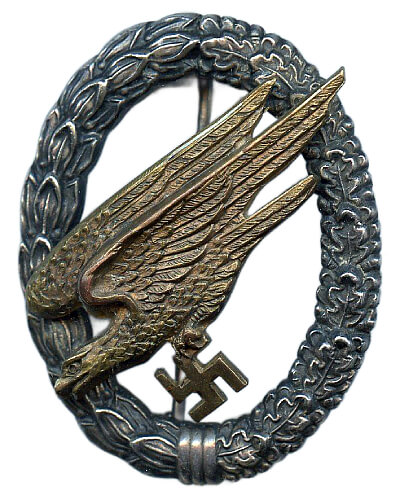 |
| Motto |
| – |
| Founded |
| November 2nd, 1939 |
| Disbanded |
| May 1942 |
| Theater of Operations |
| Belgium Crete Soviet Union |
| History Luftlande-Sturm-Regiment 1 |
On November 2nd, 1939, the Versuchsabteilung Friedrichshafen is formed in Hildesheim under the command of Hauptmann Koch. Its cadre consists of the 1. Kompanie of Fallschirmjäger-Regiment 1, the Fallschirmjäger-Pionierzug of II Battalion, Fallschirmjäger-Regiment 1, and personnel from the troop glider command. The unit has a strength of approximately 500 men. From November 1939 onward, its task is the preparation and execution of airborne assault operations using DFS 230 troop gliders. Shortly after November 2nd, 1939, the unit is renamed Sturm-Abteilung Koch.
On May 10th, 1940, at the start of the Western Campaign, Sturm-Abteilung Koch is divided into assault groups and deployed in Belgium and the Netherlands. On May 10th, 1940, at 04:20, Sturmgruppe Granit lands by glider on Fort Eben-Emael in Belgium. Within ten minutes, ten Belgian gun positions and installations are destroyed using shaped charges. The group holds the fortress until German Army units arrive later on May 10th, 1940, and into May 11th, 1940. Losses amount to six killed and twenty wounded.
On May 10th, 1940, at 04:15, Sturmgruppe Beton reaches the Albert Canal bridge at Vroenhoven near Maastricht under heavy anti-aircraft and machine-gun fire. Of eleven gliders launched that day, one is forced to land early near Hottdorf and another crashes after being hit, seriously wounding three men. The bridge is secured, and held until 20:40 the same day, when advancing German Army units relieve the group. The unit then withdraws to Maastricht. Losses amount to seven killed and twenty-four wounded.
On May 10th, 1940, at 04:35, Sturmgruppe Eisen lands at the Albert Canal bridge at Canne. During the glider approach, the bridge is destroyed by remote detonation. One glider is shot down by a direct anti-aircraft hit, with six men surviving the crash. Throughout the day, the group clears and secures the surrounding area for advancing German Army units. During the fighting, Leutnant Schächter, the group commander, is killed by a head wound, and command passes to Leutnant Meissner. Several counterattacks are repelled during the day. At approximately 22:30, elements of Infanterie-Regiment 151 and Pionier-Bataillon 51 reach the bridge. On May 11th, 1940, at 14:00, the group withdraws to Maastricht. Losses amount to twenty-two killed and twenty-six wounded.
On May 10th, 1940, at 04:20, Sturmgruppe Stahl lands near the Albert Canal bridge at Veldwezelt. By 04:35, the bridge is captured and demolition charges are removed. Belgian forces withdraw approximately 500 metres to the southwest and engage the bridge with rapid-fire guns, which are silenced by Stuka dive-bombers later that day. The bridge is held against repeated counterattacks until 21:30, when German Army units relieve the group. The unit then withdraws to Maastricht. Losses amount to eight killed, sixteen seriously wounded, and sixteen lightly wounded.
In the autumn of 1940, following these operations, Sturm-Abteilung Koch is expanded into the Luftlande-Sturm-Regiment and renamed Luftlande-Sturm-Regiment 1. By late 1940, the regiment consists of four battalions. I Battalion is stationed in Hildesheim, II Battalion in Quedlinburg, III Battalion in Halberstadt, and IV Battalion in Helmstedt. The regiment remains subordinate to the 7. Flieger-Division. In January 1941, command passes to XI. Fliegerkorps.
At the end of April 1941, the regiment is transported by rail to the Romanian–Bulgarian border. From late April to early May 1941, it marches through Bulgaria into Greece and assembles in the Athens area. In mid-May 1941, the regiment moves to Megara airfield, while II Battalion deploys to Tanagra airfield. Preparations are made for the airborne assault on Crete.
On May 20th, 1941, at approximately 07:00, the regiment launches as the first assault wave in the Battle of Crete. At around 07:15, I Battalion lands west of Maleme airfield and south of the village of Maleme. On the same day, the 1. and 2. Kompanie are dropped near Chania in support of Fallschirmjäger-Regiment 3. II, III, and IV Battalions jump by parachute on both sides of Maleme airfield. Heavy defensive fire during the landings, causes severe casualties. III Battalion, landing directly into camouflaged British positions, is almost completely destroyed. II Battalion, tasked with flank protection near Kastelli, is largely annihilated. None of the regiment’s objectives are achieved that day.
On the morning of May 21st, 1941, I Battalion captures Height 107 with support from elements of the 7. and 9. Kompanie. Later that day, IV Battalion captures Maleme airfield. At approximately 14:00, the regiment is reinforced by an ad-hoc battalion formed from parachute troops left behind in Greece. Oberst Ramcke jumps with this battalion and assumes command of the regiment. Later, the first transport aircraft of 5. Gebirgs-Division land on Maleme airfield.
On May 23rd, 1941, the regiment advances eastward from Maleme via Pyrgos and links up with Fallschirmjäger-Regiment 3 south-west of Chania. After heavy fighting, the regiment captures Chania together with Fallschirmjäger-Regiment 3 and elements of 5. Gebirgs-Division. On May 27th, 1941, the battle for western Crete ends. During the fighting from May 20th to May 27th, 1941, the regiment suffers more than 700 killed and missing. In June 1941, the remnants of the regiment return to Germany.
After June 1941, the regiment is replenished in Germany but is soon redeployed in fragments to the Eastern Front. In December 1941, the regimental staff and reinforced I Battalion move by air and rail to the Vyazma sector of the central Eastern Front. In December 1941, the regimental commander assumes command of Kampfgruppe Meindl near Yukhnov and prevents a Soviet breakthrough of the 4th Army front. From December 1941 to March 1942, I Battalion defends the encircled airfield at Shaikovka. In April 1942, I Battalion is relieved, and by early May 1942 it returns to Germany.
On September 27th, 1941, II Battalion deploys by air from Goslar via Königsberg and Pskov to Mga, southeast of Leningrad. From September 27th to October 6th, 1941, it attacks and contains a Soviet bridgehead on the Neva near Petrushkino. On October 7, 1941, the battalion is relieved. On October 11th, 1941, it occupies new defensive positions near Wyborgskaya. On November 12th, 1941, it moves to Schlüsselburg at the mouth of the Neva and holds positions there until November 18th, 1941. On November 19th, 1941, the battalion is withdrawn due to heavy losses. By November 30th, 1941, it moves by rail back to Germany, reaching Goslar on December 4th, 1941.
At the end of 1941, III Battalion, reduced to two companies after Crete, is attached to the 6. Infanterie-Division near Rzhev. From late 1941 to early 1942, it fights defensive battles near Sobakino. In mid-April 1942, the battalion is withdrawn and returns to Germany.
Between November and December 1941, IV Battalion deploys by rail with Fallschirmjäger-Regiment 2 to the area east of Stalino. From late 1941 to mid-March 1942, it fights heavy defensive battles near Charzysk on the Mius River. In mid-March 1942, the battalion is transferred to the Volkhov Front north of Lake Ilmen and holds its positions for several weeks. In July 1942, the remnants return to Germany. In early 1943, the battalion is used to form II Battalion, Fallschirmjäger-Regiment 6.
In May 1942, the Luftwaffe High Command orders the formation of Fallschirmjäger-Regiment 5. From May 1942 onward, the remaining elements of the former Luftlande-Sturm-Regiment are absorbed into this new regiment, ending the independent existence of the original unit.