
| Page Created |
| January 4th, 2026 |
| Last Updated |
| January 4th, 2026 |
| Germany |
 |
| Additional Information |
| Unit Order of Battle Commanders Operations Equipment Multimedia References Biographies |
| Badge |
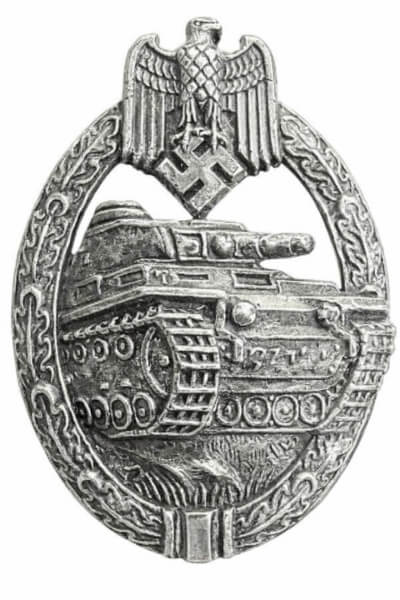 |
| Motto |
| – |
| Founded |
| July 1943 |
| Disbanded |
| May 8th, 1945 |
| Theater of Operations |
| Sicily Italy Poland Germany |
| History Fallschirm-Panzer-Division “Hermann Göring” |
The Fallschirm-Panzer-Division “Hermann Göring” of the German Luftwaffe is formed in July 1943 through the redesignation of the Panzer-Division Hermann Göring. In mid-June 1943, the division is shipped to Sicily in anticipation of an Allied invasion. On July 10th, 1943, the Allies launch Operation Husky. While most Italian units collapse or surrender, the division fights at Gela and Priolo. Under heavy Allied pressure supported by air and naval fire, it withdraws toward Messina. During Operation Lehrgang, the German evacuation of Sicily, the division forms part of the rearguard and is among the last formations to cross to the Italian mainland.
After the Italian armistice in early September 1943, the division participates in the disarmament of nearby Italian units. Following the Allied landing at Salerno on September 9th, 1943, the division is committed to counter the beachhead. After intense fighting, it withdraws first to the Volturno–Termoli Line and later to the Gustav Line, where it is eventually pulled out of combat to rest and refit. In mid-September 1943, the division is redeployed to the Volturno sector north of Naples, in the Santa Maria–Capua–Caserta area, to reorganise.
As Allied forces advance toward Monte Cassino, elements of the division assist in evacuating the monastery’s art treasures to Rome.
When the United States Army landed at Anzio and Nettuno on January 22, 1944, the German forces were taken by surprise. However, because the Allied commander hesitated to advance rapidly toward Rome, the German command gained valuable time to react and organise a counter-offensive.
Units of the division were among the first German forces to establish a security ring around the Allied landing area. From February to April 1944, the division fought in the Cisterna area, along the Rapido River, and near Minturno, attempting to contain and reduce the beachhead.
In mid-March 1944, General Gustav-Adolf von Zangen, commanding the LXXXVII Army Corps, orders elements of the division to conduct anti-partisan operations. Between February and April 1944, it fights at Cisterna, along the Rio Rapido, and near Minturno. The immediate trigger is an attack on members of the division on March 8th, 1944. This leads to the massacres at Monte Morello and Vallucciole between March 10th and March 13th, 1944. In April 1944, the division is withdrawn from fighting in Tuscany in order to be reorganised and refitted. Preparations were made to transfer the formation to France to counter the expected Allied invasion of Western Europe.
During this period, elements of the division are responsible for multiple war crimes against civilians, including massacres at Monte San Giulia, Villaminozzo, Monte Falterona, Valdarno, Cavriglia, Castelnuovo dei Sabbioni, and Civitella in Val di Chiana between April 18th and April 20th, 1944.
On April 25th, 1944, a transport carrying twenty-one new Jagdpanzer IV tank destroyers for the III Battalion of the division’s Fallschirm-Panzer-Regiment departs from a German Army ordnance depot. These vehicles are intended to strengthen the division’s anti-tank capability ahead of its anticipated redeployment.
Between May 4th, 1944, and May 5th, 1944, the division’s reconnaissance detachment takes part in an operation involving approximately 2,000 men against Italian partisan forces in the area near Fivizzano. The operation is conducted under the command of Oberst Kurt Almers, commander of Festungsbrigade 135 of the German Army. During this action, a firefight with partisans leads directly to the Mommio massacre.
By early May 1944, the division is positioned southeast of Pisa, earmarked for transfer to southern France. However, the Allied offensive against Rome, which began on May 12th, 1944, nullified the plans to transfer the division to France. Instead, the Fallschirm-Panzer-Division Hermann Göring was once again committed in the Nettuno sector against Allied forces advancing from the Anzio beachhead. Vastly outnumbered, on May 23rd, 1944, it receives orders to move south of Rome. The request to march only at night is denied, leading to severe losses from Allied air attacks. By the time it reaches its assembly area, the division has lost roughly 20 percent of its heavy weapons, 30 percent of its transport, most of its artillery, and the majority of its tanks.
The division fights near Valmontone, temporarily halting an Allied advance toward Artena, but a subsequent counterattack fails. On June 1st, 1944, heavy Allied attacks inflict devastating losses, particularly on Panzergrenadier-Regiment 2. By June 2nd and June 3rd, 1944, the division is reduced to a fraction of its original strength and can offer only delaying resistance.
From June 4th, 1944, the withdrawal continues through Rome, which is declared an open city to avoid its destruction, and proceeds northward toward Florence and the Arno defensive line. American forces enter Rome on June 6th, 1944.
After reaching the Arezzo area, the division is repeatedly attacked by partisan groups. Following the killing of division personnel in the vicinity of three villages, the Civitella massacre takes place on June 29th, 1944, in Val di Chiana, Cornia, and San Pancrazio.
In the wider Arezzo region, the guard company of the XVIII Panzerkorps of the German Army and the divisional headquarters agrees upon a planned retaliatory action in response to partisan attacks. The operation against partisans and the local civilian population begins on July 4th, 1944, and becomes known as the Cavriglia massacre. These actions continue until July 11th, 1944.
On July 15th, 1944, the division is withdrawn from the front south of Florence and prepared for transport to the Eastern Front, marking the end of its combat deployment in central Italy.
In July 1944, it is redesignated Fallschirm-Panzer-Division 1 “Hermann Göring”, while parts are withdrawn from the division to assist in the formation of a sister formation, the Fallschirm-Panzergrenadier-Division 2 “Hermann Göring”, which is being assembled in the Radom area. Most of the division’s supply troops and a number of staff officers are also transferred. These personnel are intended to form part of the headquarters and support structure of the Fallschirm-Panzerkorps “Hermann Göring”, under which the two sister divisions are to be united.
On July 26th, 1944, a transport carrying twenty-one new Jagdpanzer IV tank destroyers for the division’s parachute tank destroyer unit departs from a German Army ordnance depot. These vehicles are intended to strengthen the division’s anti-tank capability as it prepares for its next operational deployment.
At the end of July 1944, the division reaches the Vistula front and is immediately committed to combat. Together with three other armoured divisions of the German Army, it engages Soviet forces in the Wołomin and Radzymin area during the Battle of Warsaw. In these operations, the division participates in the destruction of the 3rd Tank Corps of the Red Army. During the fighting on July 29th, 1944, Hauptmann Heinz Göring, a nephew of Hermann Göring, is killed in action.
In early August 1944, the division’s Fallschirm-Panzer-Feldersatz-Bataillon is deployed as a reserve during the Warsaw Uprising. In support of counter-insurgency operations, twelve tanks, equivalent to company strength, are detached from the division and assigned to Einsatzgruppe Reinefarth. These armoured elements are employed in combat operations against Polish insurgent forces within the city.
From October 1944, it forms part of the newly created Fallschirm-Panzerkorps “Hermann Göring”. The Fallschirm-Panzer-Division 1 “Hermann Göring”, together with its sister Division, the Fallschirm-Panzergrenadier-Division 2 “Hermann Göring”, is placed under the command of this newly formed corps, consolidating the armoured and mechanised formations bearing the Hermann Göring designation under a single higher headquarters.
At the beginning of October 1944, the Hermann Göring Parachute Panzer Corps is transferred to the East Prussia–Courland region in an attempt to halt the Soviet offensive, which has already encircled Army Group North and is driving deeper into East Prussia. The corps becomes engaged in heavy defensive fighting near Gumbinnen during the Gumbinnen–Goldap Operation. When the Soviet offensive loses momentum at the end of November 1944, the corps withdraws to prepared and fortified defensive lines.
During the Battle of East Prussia in early 1945, the Fallschirm-Panzer-Division 1 “Hermann Göring”, together with the remnants of the German 4. Armee, is encircled in the Heiligenbeil Pocket. In February 1945, the Panzergrenadier-Division “Großdeutschland” is subordinated to the corps in an effort to strengthen the shrinking defensive force.
After several unsuccessful breakout attempts, the remaining strength of the corps, approximately 6,000 men, is evacuated by sea to Swinemünde in Pomerania in February 1945. Following the landing, the corps is immediately ordered to defend the Oder–Neisse line against renewed Soviet attacks in mid-March 1945. To reinforce the formation, the Panzergrenadier-Division “Brandenburg” is attached to the corps.
In April 1945, the remnants of the corps are transferred to Silesia. After heavy fighting, they are pushed back into Saxony. Despite their weakened state, elements of the Fallschirm-Panzer-Division 1 “Hermann Göring” achieve local successes against the 2nd Polish Army in mid to late April 1945. These include victories in the fighting around Bautzen and the destruction of the 1st Polish Infantry Division near Königsbrück.
At the beginning of May 1945, the Panzer Corps is deployed in the area around Dresden. As the situation collapses, the remnants of the corps attempt to break through westward to surrender to American forces advancing along the Elbe River. This attempt fails. The corps is encircled south of Dresden and surrenders to the Soviet Army on May 8th, 1945.
Following the surrender, the troops of the corps are taken into Soviet captivity. As members of the Luftwaffe, and because of their involvement in atrocities on the Eastern Front, they are classified by the Soviet authorities in the same category as Waffen-SS and police units and are imprisoned in Soviet labour camps.