
| Page Created |
| January 5th, 2026 |
| Last Updated |
| January 5th, 2026 |
| Germany |
 |
| Additional Information |
| Unit Order of Battle Commanders Operations Equipment Multimedia References Biographies |
| Badge |
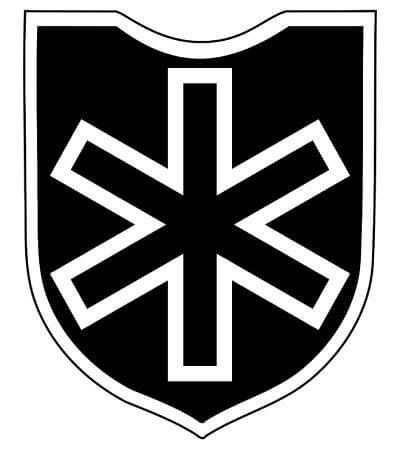 |
| Motto |
| – |
| Founded |
| February 28th, 1941 |
| Disbanded |
| May 8th, 1945 |
| Theater of Operations |
| Soviet Union Finland |
| History 6. SS-Gebirgs-Division “Nord” |
The SS-Kampfgruppe Nord forms on February 28th, 1941, in the Salla area. It is created from the staff of the Commander of the Waffen-SS in Norway. Its core comes from SS-Totenkopfregimenter 6 and 7. The division is well equipped but barely trained for the extreme conditions north of the Arctic Circle. General Nikolaus von Falkenhorst strongly doubts its operational capabilities.
In June 1941 the Kampfgruppe deploys to the high north. Its mission is an advance through Finland into the Soviet Union. When fighting begins in northern Soviet Union, the unit enters combat on July 1st, 1941. It prepares to take part in Unternehmen Polarfuchs. This operation forms a subsidiary phase of Operation Barbarossa. During the fighting around Salla the division loses 300 killed and 400 wounded within a few days. The battles at Salla are widely regarded as a disaster. Dense forests and heavy mist cause complete unit disorientation. When enemy forces are actually encountered, most troops withdraw. Combat cohesion collapses under these conditions. The Kampfgruppe is effectively destroyed. Large elements fall into enemy captivity. The unit is withdrawn from further combat operations.
In September 1941 the formation is reorganised as SS-Division Nord. The missing divisional elements are raised at the Wildflecken training area. In December 1941 SS-Infanterie-Regiment 9 leaves the divisional structure.
In the spring of 1942 the division deploys to the Kiestinki sector. It operates between Lake Pya and Lake Top. In the summer of 1942 the division converts into a mountain division. After the arrival of the Wildflecken formations, the unit is redesignated SS-Gebirgs-Division Nord in September 1942.
The division then conducts positional warfare in the Karelian forest. Operations continue in the Kiestinki area under severe terrain conditions. On October 22nd, 1943, the unit is redesignated during Waffen-SS renumbering. It becomes 6. SS-Gebirgs-Division “Nord”.
When the Soviet summer offensive begins in 1944, the division manages to hold its positions. It remains in place until withdrawal becomes unavoidable. This withdrawal follows the separate armistice between Finland and the Soviet Union. The 6. SS-Gebirgs-Division “Nord” then forms the rearguard during Unternehmen Birch. This operation covers the German withdrawal from Finland. It withdraws through Sofprog, Lamsa, Kuusamo, Rovaniemi, and Kaukonen. The route follows the Swedish border towards Heiligskogen. From there the division marches back to the Lingen Fjord. The withdrawal continues via Lund, Narvik, and Fauske to Mo. From September to November 1944 the division marches 1,600 kilometres.
At Mo the division loads onto rail transport. It moves south to Oslo. The division then transfers to Denmark. It is rebuilt there and brought back up to strength. Most replacements are Volksdeutsche. They are ethnic Germans with only brief military training. Combat experience among these reinforcements is limited.
The division is originally intended to take part in the Ardennes offensive. It only manages to assemble in Aarhus on December 20th, 1944. By this time the Ardennes fighting has already begun several days earlier. The division is therefore redirected. Its new destination becomes the Vosges region in France.
On January 2nd, 1945, part of the division attacks. The force consists of the SS-Gebirgsjäger-Regiment 12 “Michael Gaißmair” and the Schwere Panzer-Abteilung 506. They operate alongside the 361. Volksgrenadier-Division. Their opponent is the United States 45th Infantry Division. Six days of heavy fighting follow in the town of Wingen. The attacks achieve no success. Most German forces involved are killed or captured.
On January 16th, 1945, the SS-Gebirgsjäger-Regiment 11 “Reinhard Heydrich” encircles six companies of the United States 157th Infantry Regiment. The American troops surrender. A total of 482 soldiers are taken prisoner. The 6. SS-Gebirgs-Division “Nord” continues attacking for four more days. Strong American resistance forces the division onto the defensive.
After Unternehmen Nordwind the division remains on the Western Front. Further fighting takes place against American forces near Trier. In April 1945 the 6. SS-Gebirgs-Division “Nord” is withdrawn from the front line. It is held back as a reserve formation. The division withdraws to Melch. Upon arrival, the full division deploys in the Bärenthal area. It later operates in the Trier sector.
From early March 1945 the division moves towards Simmern. During this movement SS-Gebirgsjäger-Regiment 11 “Reinhard Heydrich” is detached. It operates independently from the main formation. The remaining divisional elements deploy at Brodenbach on the Moselle. The division then withdraws to the Rhine. It is committed again during defensive operations. A further withdrawal follows through Idstein. The route passes through the Taunus to Friedberg in the Büdinger Forest. In May 1945 the remaining elements surrender to American forces in Austria.
I would not list a SS unit as a special force. They committed terrible war crimes.