
| Page Created |
| January 3rd, 2026 |
| Last Updated |
| January 3rd, 2026 |
| Germany |
 |
| Additional Information |
| Unit Order of Battle Commanders Operations Equipment Multimedia References Biographies |
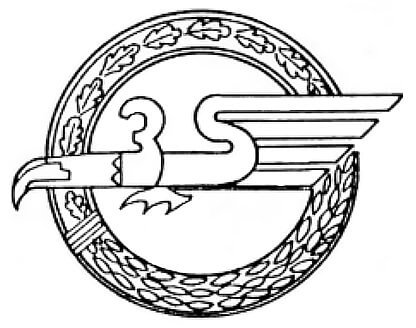
| Badge |
 |
| Motto |
| – |
| Founded |
| October 1943 |
| Disbanded |
| April 15th, 1945 |
| Theater of Operations |
| France Belgium The Netherlands Germany |
| History 3. Fallschirmjäger-Division |
The 3. Fallschirmjäger-Division forms in France from October 1943 onward in the Reims area. Personnel come primarily from the 1. Fallschirmjäger-Division and the 2. Fallschirmjäger-Division. Additional manpower arrives from the 1. Fallschirmjäger-Ersatz- und Ausbildungs-Regiment south of Paris, the Luftwaffe Unteroffizierschule, and the XII. Flieger-Ersatz-Bataillon.
At the beginning of February 1944, the division, still under formation, transfers to Brittany. It deploys to the Mons-d’Arrée highlands and the towns of Carhaix, Châteauneuf, and Quimper. The divisional command post is established at Huelgoat. The division continues its formation while securing the Mons-d’Arrée area against possible enemy airborne landings.
By May 1944, the division receives weapons and equipment. These remain incomplete and in some cases inadequate. There is a severe shortage of MG 42 machine guns and anti-tank weapons. Motor vehicle availability reaches only forty percent of authorised strength. Training nevertheless progresses as planned. Most soldiers complete three- to four-week parachute courses at Lyon and Wittstock. The division is the last German Fallschirmjäger division trained for airborne operations.
After the Allied invasion of Normandy begins on June 6th, 1944, the division transfers to the Cotentin Peninsula. It assembles in the Avranches area. Its mission is to drive Allied forces northward and retake the coast. An advance detachment reaches the Avranches area on June 8, 1944. From June 10, 1944, this detachment advances northeast from the Saint-Lô area.
The division deploys near the Cerisy Forest on both sides of the Bayeux road. Its front lies northeast of Pointe Herbert and Caumont. Areas southwest of this line serve as the assembly zone for the main body. On June 14th, 1944, strong American forces attack along the Bayeux–Saint-Lô road. The attack strikes the assembly area, which is held only by the advance detachment. The division repels the assault. American forces suffer heavy losses.
On June 16th, 1944, Allied fighter-bombers destroy the divisional command post near La Chapelle-du-Fest. The headquarters relocates to Condé-sur-Vire. On June 17th, 1944, the remainder of the division reaches the assembly area. From June 18th, 1944, the entire division is deployed along the front.
The defensive line arcs northeast of Saint-Lô. It runs from Villiers-Fossard, six kilometres east of Saint-Lô, through Couvains and Saint-Germain-d’Elle to the Torigny-sur-Vire–Caumont-l’Éventé road. The frontage measures approximately twenty-four kilometres. This width allows only thin defensive coverage.
In the following weeks, American forces conduct reconnaissance and limited holding attacks. These actions cause daily casualties. On June 25th, 1944, the division launches a limited counterattack to relieve threatened neighbouring sectors. American forces repel the attack. The division suffers significant losses.
On July 11th, 1944, the American offensive against Saint-Lô begins. The division incurs heavy casualties. On July 18th, 1944, American units break through the positions of the 352. Infanterie-Division on the left. They enter Saint-Lô. The 3. Fallschirmjäger-Division withdraws to positions south of the Bayeux–Saint-Lô road. It now faces north and northeast.
On July 25th, 1944, heavy American bombing precedes a breakthrough south of the division. United States forces break through the positions of the 5. Fallschirmjäger-Division. At the same time, strong American attacks penetrate the 3. Fallschirmjäger Division southeast of Saint-Lô. Continuous pressure forces withdrawal into the Vire–Saint-Pois–Tinchebray area. The division then retreats eastward via Flers. Fighting continues on both sides of Putanges. The division withdraws toward the area northwest of Argentan.
In mid-August 1944, the division becomes encircled southeast of Falaise. Other elements of the II. Fallschirm-Korps and the 7. Armee are also trapped. On August 19th, 1944, the division attacks eastward to break out. The breakout succeeds between Trun and Chambois. The division retreats northeast via Vimoutiers, Bernay, Brionne, Elbeuf, and Saint-Pierre-lès-Elbeuf to the Seine.
After crossing the Seine at the end of August 1944, the remnants assemble near Rouen. Despite heavy losses, they deploy in early September 1944 as rear guard for the 5. Armee and 7. Armee. They cover the withdrawal line Crévecœur-le-Grand, Montdidier, Ham, and Saint-Quentin.
In early September 1944, the division is again encircled near Mons in Belgium. Most of the remaining force is captured. Only small groups escape. These remnants retreat via Charleroi, Nivelles, and Wavre to Maastricht. They continue to Aachen. In mid-September 1944, they are relieved from the front. They regroup east of Köln in the Leverkusen, Burscheid, and Opladen area.
On September 17th, 1944, Allied airborne landings in the Netherlands force immediate redeployment. The bulk of the reassembled troops form Kampfgruppe 3. Fallschirmjäger-Division. The formation deploys under II. Fallschirm-Korps southeast of Nijmegen. Smaller elements move to the Hengelo, Almelo, and Oldenzaal area for reorganisation.
On September 17th, 1944, the Kampfgruppe transfers to the area southeast of Kleve. It comes under command of the 406. Infanterie-Division. On September 18th and September 19th, 1944, it attacks north of the Kleve–Nijmegen road. The operation clears small groups of American airborne troops. On September 20th, 1944, the Kampfgruppe advances with Kampfgruppe 5. Fallschirmjäger-Division on its left. It captures the high ground northwest of Wyler.
In the following weeks, the Kampfgruppe, now subordinated to the 84. Infanterie-Division, holds the Wyler area. Repeated American attacks are repelled. At the beginning of November 1944, the Kampfgruppe withdraws from the 84. Infanterie-Division. It transfers to the Netherlands to re-form the 3. Fallschirmjäger-Division.
Luftwaffe ground personnel from Luftwaffen-Feld-Regimenter 22, 51, and 53 reinforce the division. Between November 24th and November 30th, 1944, the division transfers to the Düren area. It relieves the 12. Volksgrenadier-Division and the 47. Volksgrenadier-Division in the Lamersdorf, Luchem, Langerwehe, Jüngersdorf, and Merode sector. Heavy fighting begins immediately.
On December 1st, 1944, Lucherberg is lost. On December 4, 1944, Luchem falls. On December 10th, 1944, the US First Army launches a major offensive between Aldenhoven and the Hürtgen Forest. Near Echtz, American forces penetrate deeply. The breach cannot be sealed. Echtz falls on December 12th, 1944.
After withdrawal and reorganisation, the division repels further attacks from December 13th to December 15th, 1944. It holds a reduced bridgehead from Hoven through Mariaweiler to Gürzenich. From December 13th, 1944, the reintroduced 47. Volksgrenadier-Division relieves the division. Without rest, the division marches on foot to the Eifel.
The division assembles near Stadtkyll, Ormont, and Hallschlag. It prepares for the Ardennes Offensive. It comes under command of I. SS-Panzerkorps. On December 16th, 1944, the offensive begins. The division breaks through American positions between Losheimer Graben and Manderfeld. It penetrates the front of V US Corps.
Progress remains slow due to strong resistance and difficult terrain. Fallschirmjäger-Regiment 5 advances on the right flank. It moves from Frauenkron via Losheimer Graben toward Neuhaus. It reaches the southern edge of Büllingen on December 19th, 1944. Fallschirmjäger-Regiment 9 attacks in the centre. It advances from Hallschlag via Losheim, Lanzerath, Buchholz, and Honsfeld toward Möderscheid. It reaches the outskirts of Schoppen on December 19th, 1944.
Fallschirmjäger-Regiment 8 advances on the left flank. It attacks from Ormont via Berterath, Holzheim, Wereth, and Heppenbach. It captures Amel on December 20th, 1944. By the end of December 1944, the division reaches the Malmedy–Saint-Vith road near Ligneuville. Progress remains slow and costly.
Further attacks westward fail. In early January 1945, the division assumes defensive positions along the Faymonville, Amel, and Born line. On January 13th, 1945, strong American forces advance from Malmedy toward Bütgenbach and from Saint-Vith toward Manderfeld. The division withdraws east to avoid encirclement.
Heavy fighting occurs around Schoppen from January 15th to January 22nd, 1945. By the end of January 1945, the division retreats to the border area on both sides of Losheim. In early February 1945, it occupies Westwall positions. It repels several tank attacks between February 1st and February 9th, 1945, along the Berk, Frauenkron, and Hallschlag line.
After February 10th, 1945, increasing pressure forces withdrawal. The division establishes a new defensive line in the Stadtkyll, Lissendorf, and Birgel area. It holds this line until mid-February. In the second half of February 1945, the division transfers via Dollendorf, Ahrhütte, Marmagen, and Münstereifel. It moves to the Westwall near Nideggen, Abenden, Blens, Hausen, and Heimbach.
The division defends this sector until the end of February 1945. From early March 1945, it fights heavy defensive battles near Wollersheim, Vlatten, and Berg. On March 3rd, 1945, it withdraws via Bürvenich, Zülpich, and Sinzenich. On March 4th and March 5th, 1945, it retreats along the Euskirchen, Kuchenheim, and Stotzheim line toward Rheinbach and Meckenheim.
Near Bad Godesberg, the division establishes a bridgehead west of the Rhine. It cannot prevent Allied forces from reaching the river. Between March 8th and March 10th, 1945, large parts of the division are captured. Remaining elements cross the Rhine near Ahrweiler, Remagen, and Neuwied.
Under Oberst Becker, the remnants establish defensive positions in the Siebengebirge in mid-March 1945. They hold the Aegidienberg, Asbach, and Mehren line. They also defend the Ölberg, Oberpleis, Uckerath, and Wissen sector until the end of March. In early April 1945, they repel several American attacks along the Siegburg and Troisdorf line.
The division now numbers approximately three battalions. Several Volkssturm units are attached. From April 10th to April 14th, 1945, the remnants withdraw along the Köln-Mülheim to Bensberg line. They continue via Leverkusen, Voiswinkel, and Bechen to Burscheid. On April 15th, 1945, the remaining elements of the 3. Fallschirmjäger-Division surrender.