

| French Defences and Defence Strategy |
| Order of Battle |
Groupe d’Armées n°1 (GA1) Nord / Belgique
- 1re Armée
- 1re Division d’Infanterie
- 2e Division d’Infanterie Nord-Africaine
- 3e Division d’Infanterie Motorisée
- 4e Division d’Infanterie
- 12e Division d’Infanterie Motorisée
- 15e Division d’Infanterie Motorisée
- 25e Division d’Infanterie Motorisée
- 1re Division Légère Mécanique
- 2e Division Légère Mécanique
- 3e Division Légère Mécanique
- 7e Armée
- 4e Division d’Infanterie
- 21e Division d’Infanterie
- 60e Division d’Infanterie
- 68e Division d’Infanterie
- 1re Division Légère de Cavalerie
- 2e Division Légère de Cavalerie
- Groupe d’Armées n°2 (GA2) Ligne Maginot
- 2e Armée (secteur Sedan – Montmédy)
- 3e Division d’Infanterie Nord-Africaine
- 41e Division d’Infanterie
- 55e Division d’Infanterie
- 71e Division d’Infanterie
- 1re Division d’Infanterie de Forteresse
- 3e Division d’Infanterie de Forteresse
- 3e Armée (secteur Metz)
- 6e Division d’Infanterie de Forteresse
- 7e Division d’Infanterie de Forteresse
- 8e Division d’Infanterie de Forteresse
- 42e Division d’Infanterie
- 51e Division d’Infanterie
- 4e Armée (secteur Sarre)
- 9e Division d’Infanterie de Forteresse
- 10e Division d’Infanterie de Forteresse
- 21e Division d’Infanterie
- 43e Division d’Infanterie
- 52e Division d’Infanterie
- 5e Armée (secteur Alsace du Nord – Haguenau)
- 11e Division d’Infanterie de Forteresse
- 12e Division d’Infanterie de Forteresse
- 24e Division d’Infanterie
- 28e Division d’Infanterie
- 62e Division d’Infanterie
- 8e Armée (secteur Alsace du Sud – Rhin)
- 13e Division d’Infanterie de Forteresse
- 14e Division d’Infanterie de Forteresse
- 54e Division d’Infanterie
- 57e Division d’Infanterie
- 63e Division d’Infanterie
- 2e Armée (secteur Sedan – Montmédy)
| Introduction |
In the interwar period, France adopts a defensive military strategy. The aim is to avoid another catastrophe like 1914 to 1918. The losses of the First World War shape all planning. French leaders conclude that a continuous defensive front is essential. Permanent fortifications become the foundation of national defence. The centrepiece is the Maginot Line. These works are intended to deter and delay a German attack. They are designed to buy time for full mobilisation.
French planners expect any invasion to bypass the fortifications. An attack is likely to pass through neutral Belgium or Switzerland. Such a move may deter Germany or widen the conflict diplomatically. The fortifications also protect vital regions. Alsace and Lorraine hold major industrial value. Manpower economy is another concern. France has a smaller population than Germany. Static defences reduce the need for large standing forces. In theory, the lines delay an enemy for two to three weeks. This window allows reserves to mobilise. France then prepares a counter-offensive. The goal is to fight on foreign soil and spare French territory.
This doctrine is deeply influenced by the First World War. French military thought emphasises prepared positions and firepower. Philippe Pétain promotes static defence as the safest option. Political realities reinforce this view. Britain and the United States hesitate to guarantee support in the 1920s. France feels increasingly isolated. National survival appears to depend on internal strength.
The strategy does not envisage passive defence alone. Fortifications act as a shield. Field armies form the manoeuvre element. As Germany advances around the fortifications, French forces move forward. Together with the British Expeditionary Force, they advance into Belgium. This follows the Dyle Plan. The intention is to establish a continuous front linked to the Maginot Line.
This concept becomes known as the methodical battle. Operations proceed step by step. Speed and deep manoeuvre are not prioritised. Commanders assume warfare has not changed fundamentally since 1918. Events in 1940 expose the flaw. French doctrine proves unsuited to rapid mobile warfare.
| French Defences and Defence Strategy |
France formally launches its fortification programme during the mid-1920’s. This follows years of strategic debate after the First World War. In the immediate post-war period, Marshal Ferdinand Foch favours an offensive posture. He supports pressure on Germany through occupation of the Rhineland. By the mid-1920s, this view loses influence.
Marshal Philippe Pétain’s concept gains support. He argues that permanent defences offer the best security. Between 1922 and 1927, his ideas increasingly shape policy. In 1925, War Minister Paul Painlevé establishes the Commission de Défense des Frontières. Its task is to study frontier defence requirements.
In 1927, this work leads to the creation of Commission d’Organisation des Régions Fortifiées. The Commission d’Organisation des Régions Fortifiées becomes responsible for design and construction. Commission d’Organisation des Régions Fortifiées identifies three priority fortified regions. The Metz region protects the Briey–Thionville industrial basin. The Lauter region in Alsace guards the traditional invasion route toward Strasbourg. The Belfort region secures the Belfort Gap near Switzerland. These areas later form the strongest sections of the Maginot Line.
Political backing proves essential. France faces economic pressure in the late 1920’s. Concerns about German recovery remain strong. André Maginot, a First World War veteran, becomes War Minister in 1929. He champions the fortification project. In January 1930, he addresses parliament. He argues that preventing violation of French territory is imperative.
His advocacy secures funding. Parliament approves an initial allocation of three billion francs. This occurs despite the emerging Great Depression. Construction of major ouvrages begins in 1930. Early sites include Rochonvillers, Hackenberg, Simserhof, and Hochwald. These lie in the north-eastern sectors. Completion is expected within five years.
Maginot dies in 1932. He does not see the project finished. His successor, Édouard Daladier, continues the programme without interruption. By 1935, the core Maginot Line is largely operational. Further works continue until 1938 and 1939. After 1934, lighter defences extend northward toward Flanders. These consist mainly of small bunkers near Lille and the Channel approaches.
Total expenditure reaches between three and five billion francs. This represents a vast national investment. Critics later argue that resources divert from tanks and aircraft. At the time, fortifications are seen as indispensable.
Alpine defences develop in parallel but progress more slowly. Surveys begin between 1925 and 1927. Initial plans are drawn by General Degoutte. General Fillonneau later revises them. Construction in the Alps starts between 1928 and 1931. Ouvrage Rimplas begins in late 1928. It becomes the first Maginot ouvrage started anywhere.
Mountain construction presents severe difficulties. Sites lie at high altitude. Access is limited. Building seasons are short. Several planned high-level forts remain unfinished by 1940. Despite this, key Alpine positions become usable. Major passes receive effective coverage. Ouvrage Cap Martin near Menton is battle-ready by 1932.
The fortification effort remains active until the eve of war. After fighting begins in 1939, emergency construction accelerates. Military labour units build fieldworks and blockhouses. Many projects remain incomplete by May 1940.
On the eve of invasion, France possesses a powerful but uneven system. The Maginot Line is strongest in the industrial northeast. It is weaker in the Ardennes. Alpine defences are solid but limited. Northern sectors lack depth and continuity. French leaders believe these measures, combined with British support and an advance into Belgium, will halt Germany. This belief proves mistaken. The fortifications do not fail where they stand. The enemy bypasses them and exploits gaps, especially in the Ardennes, where defences remain thin and troops inexperienced.
| Order of Battle |
By May 10th, 1940, as the German invasion begins, the Armée française deploys the majority of its forces along the metropolitan front. The deployment follows a structure of army groups and field armies. These formations integrate with fortified sectors and planned manoeuvre zones. The layout reflects the French defensive concept in full execution.
The 1er Groupe d’Armées operates under Général d’Armée Gaston Billotte. It controls the northern sector of the front, extending from the English Channel southward to the junction with the Ligne Maginot. Its mission is twofold: to defend north-eastern France and to advance into Belgium once Germany attacks. The army group coordinates closely with the British Expeditionary Force and the Armée belge. Together, these forces form the Allied left wing.
The 1re Armée deploys under Général Georges Blanchard. It occupies the central axis of the Belgian front and is positioned to advance rapidly to the Dyle River line. This movement forms the core of the Allied Plan Dyle. The army fields a high proportion of first-line units. Its most notable formation is the Corps de Cavalerie under Général René Prioux, comprising the 2e and 3e Divisions Légères Mécaniques. These motorised cavalry divisions represent France’s most modern mobile formations. They engage German armoured forces in the opening tank battles near Hannut. The infantry component includes the 1re Division d’Infanterie Motorisée, the 1re Division Marocaine, the 2e Division d’Infanterie Nord-Africaine, and the 15e Division d’Infanterie Motorisée. These units form the backbone of the Dyle defensive position.
The 2e Armée operates under Général Charles Huntzinger. It occupies the critical hinge sector between the northern field armies and the Ligne Maginot, covering the Ardennes forest and the Meuse crossings around Sedan. Fortress troops man fixed positions, while reserve infantry divisions hold the river line. The 55e and 71e Divisions d’Infanterie defend the Sedan sector. Both are Catégorie B divisions composed largely of older reservists. The 2e and 5e Divisions Légères de Cavalerie screen the Ardennes approaches and are tasked with reconnaissance and delay. German armoured columns overrun them rapidly. The 1re and 3e Divisions d’Infanterie Coloniale are held in reserve. The army’s mission is to delay any enemy advance through the Ardennes and to link the Ligne Maginot at Montmédy with the mobile forces further north. This sector becomes the main axis of the German breakthrough. Despite determined resistance, the Meuse line collapses at Sedan.
The 7e Armée is commanded by Général Henri Giraud and forms the extreme left of the French deployment. Initially held in reserve, it advances rapidly northward once hostilities begin. Its objective is to reach the Breda area in the Netherlands in accordance with Plan Breda. The army includes the 1re Division Légère Mécanique and the 25e Division d’Infanterie Motorisée. The 9e Division d’Infanterie Motorisée operates within its IIe Corps. Standard infantry divisions, including the 21e, 60e, and 68e Divisions d’Infanterie, are Série B formations assigned to secondary coastal sectors. The northward thrust leaves the army poorly positioned when the German breakthrough occurs further south. The 7e Armée is forced to withdraw toward the Channel and later joins the defence of the Dunkirk perimeter.
The 9e Armée operates under Général André Corap and deploys between the 2e Armée and the Belgian Ardennes. Its sector covers the Meuse crossings between Dinant and Monthermé. The army is weak and thinly spread, consisting largely of reserve formations. The 61e and 102e Divisions d’Infanterie de Forteresse man fixed positions. The 4e Division d’Infanterie Nord-Africaine occupies parts of the river line. The 1re and 4e Divisions Légères de Cavalerie provide forward screening. Infantry divisions including the 18e and 22e are dispersed across the sector. The 102e Division d’Infanterie de Forteresse mans the fortified Ardennes sector near Montmédy and the flanks of Sedan. The army’s mission is delay rather than defence in depth. It lacks sufficient artillery and adequate reserves.
The 1er Groupe d’Armées coordinates allied forces on its left. The British Expeditionary Force fields ten divisions. The Armée belge deploys approximately 22 divisions. These forces align along the Dyle front alongside French units. Behind the front, France holds an armoured reserve comprising several Divisions Cuirassées. The 1re and 2e Divisions Cuirassées are positioned south of the Ardennes and committed piecemeal after the breakthrough. Their counterattacks fail to restore the situation.
The 2e Groupe d’Armées operates under Général André-Gaston Prételat. It controls the central and largest portion of the Ligne Maginot, covering a front extending from east of Sedan to Strasbourg across Lorraine and western Alsace.
The 3e Armée deploys under Général Charles Condé and mans the northern sectors of the Ligne Maginot, including the regions of Montmédy, Longuyon, and Metz. The army includes fortress infantry divisions and specialist units occupying the major ouvrages. Colonial units reinforce the sector. The British 51st (Highland) Division is temporarily attached. The sector is heavily fortified and sees limited combat during the German advance. Many units surrender only after the armistice of June 1940.
The 4e Armée operates under Général Édouard Réquin and covers the central Ligne Maginot, including Verdun, Stenay, and the Moselle sector, where some of the strongest fortifications are located. The army includes the 11e, 20e, and 52e Divisions d’Infanterie alongside fortress infantry dominating the line. The 1re Division de Grenadiers Polonais serves north of Strasbourg. The army holds its positions throughout the campaign. German forces bypass the sector, and capitulation comes only after the collapse of France.
The 5e Armée operates under Général Victor Bourret and defends southern Alsace and the Rhine sector, with its front extending toward the Basel bend of the river. The 24e, 31e, and 62e Divisions d’Infanterie defend the Colmar Gap, reinforced by fortress divisions formed in late 1939. Fortifications in this sector are lighter than those further north, with the Rhine providing a significant natural obstacle along much of the front.stacle. The army remains largely static. Its mission is containment rather than manoeuvre.
| Major Defensive Lines and Fortification Systems |
By 1940, France establishes a layered system of defensive lines along its mainland frontiers. These lines reflect interwar doctrine and the strategic assumptions of the Haut Commandement.
The primary French fortification system lies along the eastern frontier with Germany and becomes known as the Ligne Maginot. It extends from the Swiss border in the south toward the Ardennes in the north, running from the Rhine in Alsace northwestward through the Vosges. Coverage weakens progressively toward the Ardennes. The fortifications do not extend to the English Channel and effectively end near Luxembourg. Belgian political objections prevent any extension along the Franco-Belgian border. Belgium fears strategic abandonment behind a French defensive wall. Northern France consequently relies on lighter field defences.
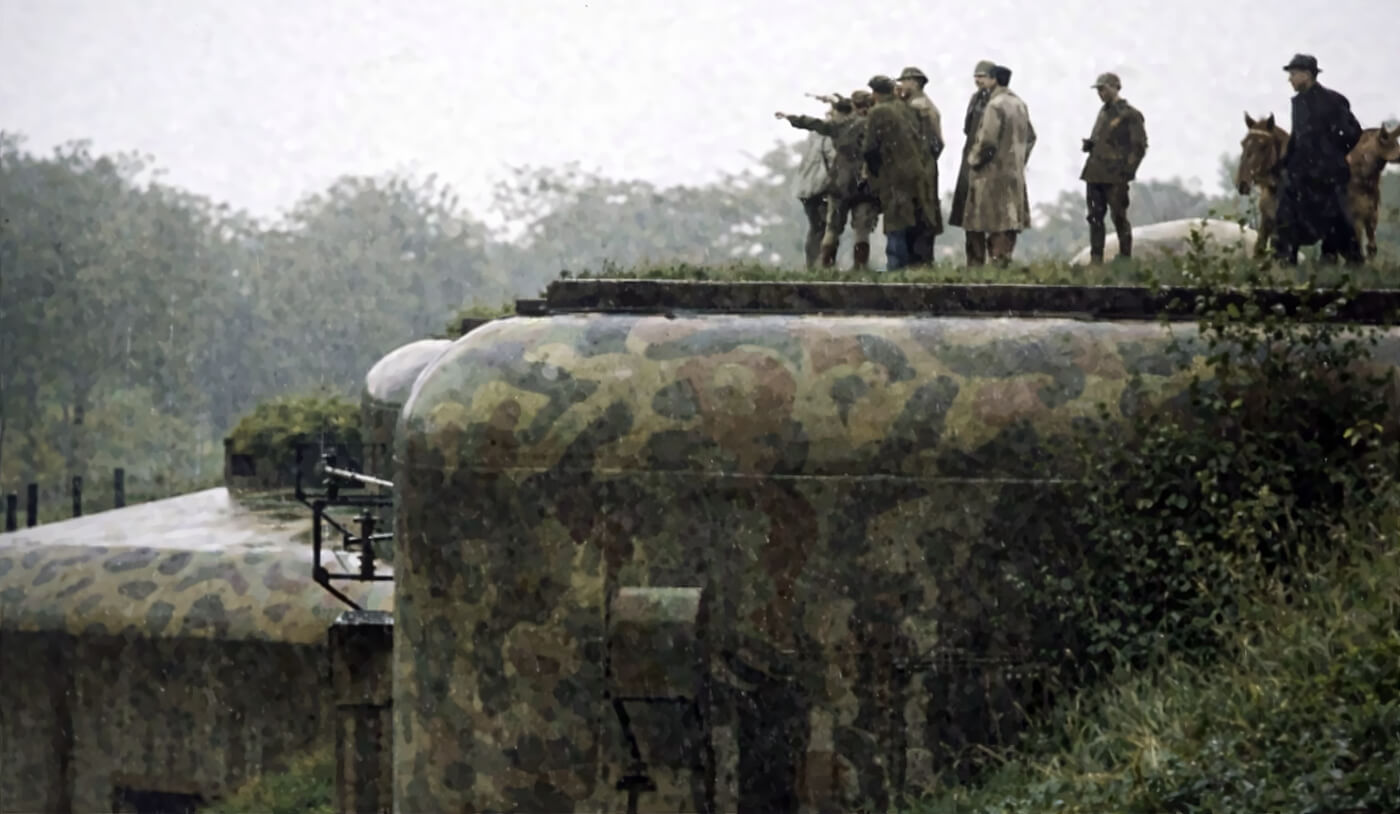
Construction of the Ligne Maginot begins around 1929. By 1935, the main sectors are operational. Additional works continue until 1938. The line consists of large permanent fortresses, the ouvrages, linked by smaller bunkers, tunnels, and surface obstacles forming a dense belt of concrete and steel. Major forts mount heavy artillery in armoured turrets. Secondary bunkers support them with infantry and anti-tank weapons. Deep underground galleries house troops, ammunition, power plants, and command facilities. The Ligne Maginot is designed to block a direct German assault and to force any invasion onto secondary routes, thereby relieving pressure on France’s main field armies. In this limited role the system succeeds. In 1940, German forces bypass the strongest sectors entirely by invading through the Low Countries.
France also fortifies its southeastern frontier with Italy in a system commonly referred to as the Ligne Alpine. It runs from the Mediterranean coast near Menton to the Swiss border. The terrain channels any attack into narrow passes, and defence consequently focuses on key mountain routes. Fortifications guard the principal Alpine corridors, including the Little Saint Bernard, Mont Cenis, Montgenèvre, and Col de Larche passes. Defences also cover approaches to Nice through mountain valleys and along the coastal road. Early plans for a continuous wall prove too costly. France instead builds defence in depth, with strong positions near the frontier and secondary positions covering the valleys further to the rear. The Alpine ouvrages resemble Maginot forts in concept but are smaller and adapted to rock and altitude. Many are built directly into mountainsides. Underground accommodation and power systems are standard features. Large gun turrets are rare, with artillery instead firing from protected casemates. Infantry bunkers dominate the narrow approaches. By 1940, these defences operate under Général René Olry. When Italy enters the war in June 1940, Italian attacks fail to penetrate the mountain passes, and no Italian forces reach southeastern France.
Along the Belgian frontier, permanent defences are limited. French planning assumes that any major fighting will take place on Belgian soil. A Maginot-style line is therefore absent from this sector, and Belgian neutrality after 1936 prevents any joint construction. During the late 1930s, France adds lighter works including blockhouses and pillboxes. The Secteur Fortifié des Flandres covers the Lille and Dunkirk area, where approximately 200 small concrete positions are constructed. Plans also exist to flood low ground near Dunkirk. Further east, scattered defences appear near Lille and along the Scheldt. Older nineteenth-century forts are reused and supplemented by new small bunkers. Construction continues until 1940. These defences lack depth and continuity and are intended to delay rather than stop a major attack. This weakness proves decisive in May 1940, when German forces break through the Ardennes, cross the Meuse, and collapse the northern flank.
France also prepares limited internal lines. Work begins on the Ligne Chauvineau north of Paris in early 1940, intended to shield the capital should the front break. The line consists of bunkers and anti-tank obstacles following forests and river lines between the Oise and the Marne. Construction remains incomplete and the line sees little combat. Plans for a réduit breton exist on paper but are never realised. Coastal defences protect the major ports through naval batteries and older forts, though these are not integrated into the main defensive system.