
| Page Created |
| December 8th, 2025 |
| Last Updated |
| December 12th, 2025 |
| The United States |
 |
| Length |
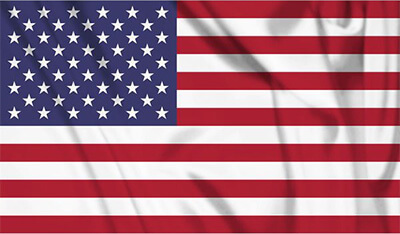
| 3.2 metres |
| Wide |
| 1.52 metres |
| Height |
| 1.8 metres |
| Weight |
| 1,700 kilograms 2,300 kilograms (loaded) |
| Propulsion |
| Studebaker Model 6-170 Champion petrol engine |
| Armour |
| – |
| Armament |
| – |
| History Studebaker M29 “Weasel” |
The Studebaker M29 Weasel originates in 1942 from a concept known as Project Plough. Project Plough is proposed in 1942 as an unconventional operational concept by Geoffrey N. Pyke. He presents the idea to the British government during a period of strategic uncertainty. The concept attracts the attention of Lord Louis Mountbatten, Chief of Combined Operations.
Pyke is invited to join Mountbatten’s staff. He submits a detailed fifty-four page memorandum. The paper proposes a fast-moving, winter-trained strike force using light tracked vehicles to operate deep inside snow-covered enemy territory, particularly in Norway and Romania. The aim is to disrupt German industry and tie down large occupation forces. These operations rely on rapid movement across deep snow.
Winston S. Churchill views the proposal as bold and imaginative. He presents the concept to Franklin D. Roosevelt and George C. Marshall during a planning conference in London. Pyke argues that a force of one thousand men can operate independently in winter terrain. He refers to this formation as a North American Force. The unit relies on small tracked vehicles for mobility. Its purpose is to disrupt German occupation forces. Pyke claims it can tie down large enemy formations in remote regions.
Operational assessment later determines that Project Plough is not feasible. The plan offers no realistic recovery or withdrawal option. It effectively becomes a one-way mission. Despite this, the concept directly inspires the formation of a unique combined force. This unit becomes known as the First Special Service Force. It brings together American and Canadian personnel for specialised operations in extreme conditions.
A critical operational problem then emerges. The force requires a lightweight tracked vehicle for extreme terrain. It must move over deep snow, mud, and muskeg. It must carry supplies and evacuate wounded. It must operate reliably in Arctic conditions. No Allied vehicle meets these demands at this stage of the war.
Pyke travels to the United States in April 1942 with officers from British Combined Operations. The purpose is to study the design of an over-snow vehicle for Project Plough. From the outset, relations prove strained. Geoffrey N. Pyke feels uneasy around military officers. Many of them regard him as an unconventional figure. American military and civilian officials attempt to exclude him from key meetings. They classify the sessions as secret and restrict attendance to cleared personnel. Pyke holds no such clearance.
The idea proposes a lightweight tracked vehicle for snow and ice warfare. The requirement comes from the First Special Service Force, which prepares for winter operations against distant targets such as Norway. Pyke complicates matters further through his own demands. He insists on a detailed scientific investigation into the nature of snow. He argues in favour of the Archimedes screw rather than tracked propulsion. He also proposes that research should take place in Canada or the Soviet Union. He believes both regions offer deeper experience with extreme snow conditions. American officials react badly to any suggestion of Soviet involvement. They show no objection to Canadian participation. They seek technical advice from the Bombardier Company in Quebec. In the end, however, responsibility passes to the Studebaker Corporation of South Bend, Indiana. The exact reason for selecting Studebaker remains unclear. The firm has not built tracked vehicles since the First World War. Its wartime output focuses mainly on conventional automobiles and trucks.
In mid-1942, Studebaker receives a contract to build a prototype designated Cargo Carrier, Light, T-15, later reclassified as the M28. The design must launch amphibiously from a ship. It must be capable of parachute delivery from a Avro Lancaster. It must reach at least 32 kilometres per hour. It must achieve a range of 400 kilometres. It must carry a payload of 1,814 kilograms. Ground pressure must remain below 6.9 kilopascals to allow movement over snow, mud, and soft ground without sinking.
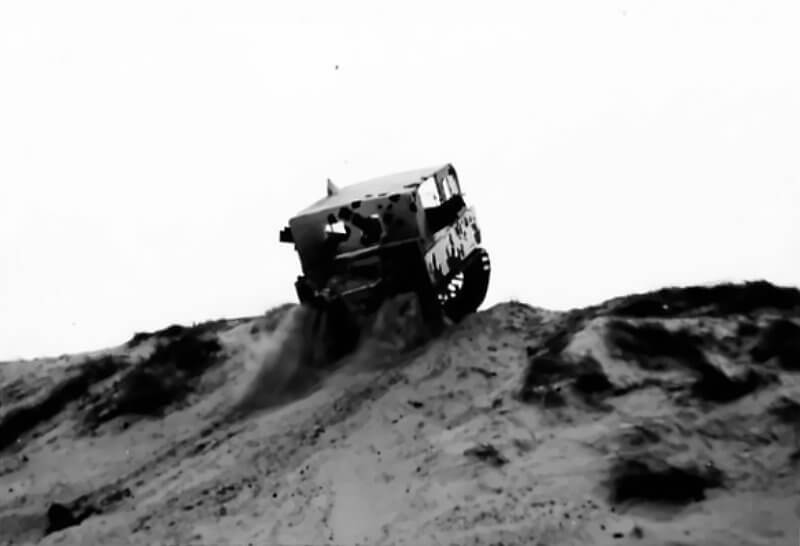
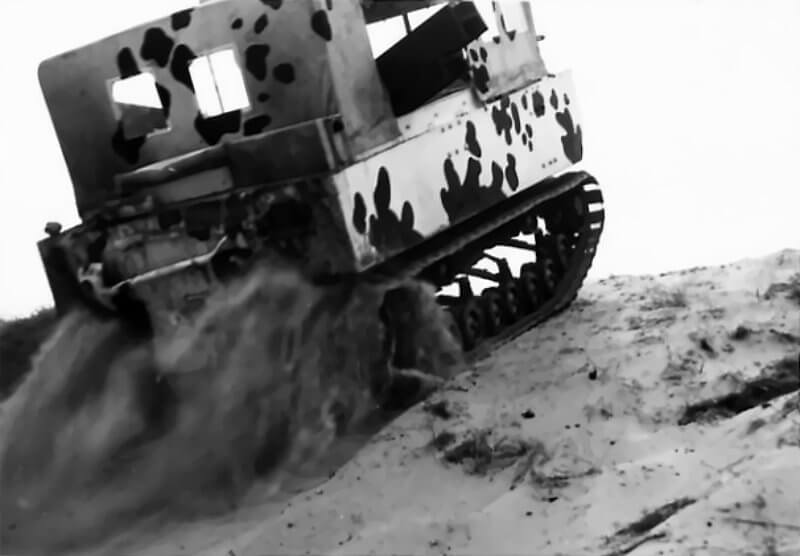
Early trials take place in the summer of 1942 on the sand dunes of Lake Michigan. Further testing follows in the Rocky Mountains. The prototype fails to meet key performance thresholds. Top speed reaches only 24 kilometres per hour. Maximum climb angle reaches just 15 degrees. Operational range falls to roughly one third of the requirement. The fundamental layout is retained, but the vehicle undergoes extensive redesign. Engineers move the engine from the rear to the front. This improves weight balance and clearance at the rear. The drive system is reversed by swapping the sprockets and idler wheels. The driving force now applies from the rear. The cargo compartment is enlarged to seat three passengers behind the driver. Suspension capacity doubles from four to eight small bogie wheels per side. Traction improves across snow, sand, and soft ground. The design enters standard service as the M28. Production exceeds seven hundred vehicles. Prototype work begins early in 1942. Production vehicles appear later that year and continue into early 1943.
Development of the next design begins during 1943. The new vehicle first carries the designation T24. It later enters service as the M29. The M29 adopts a box-shaped hull. The idler wheel mounts low at the front. The drive sprocket shifts to the rear. Each side carries four suspension units. These units mount on the ends of transverse leaf springs. Each spring bolts firmly beneath the hull. Each end works independently.
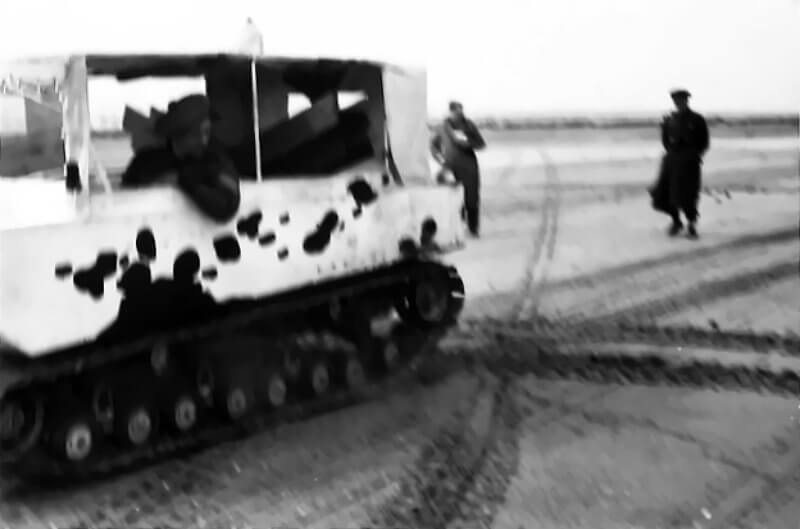
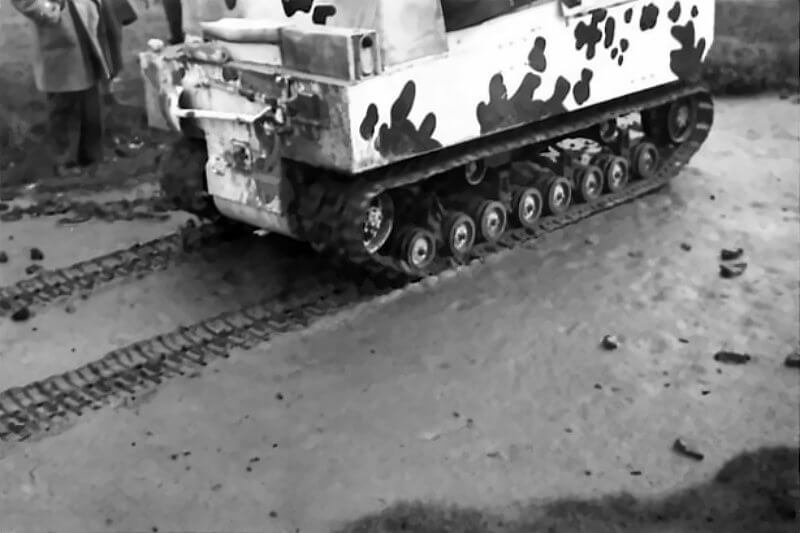
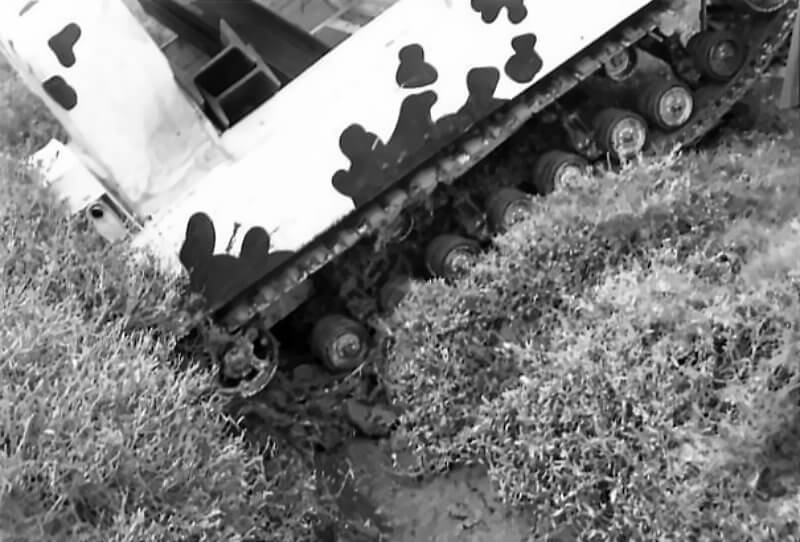
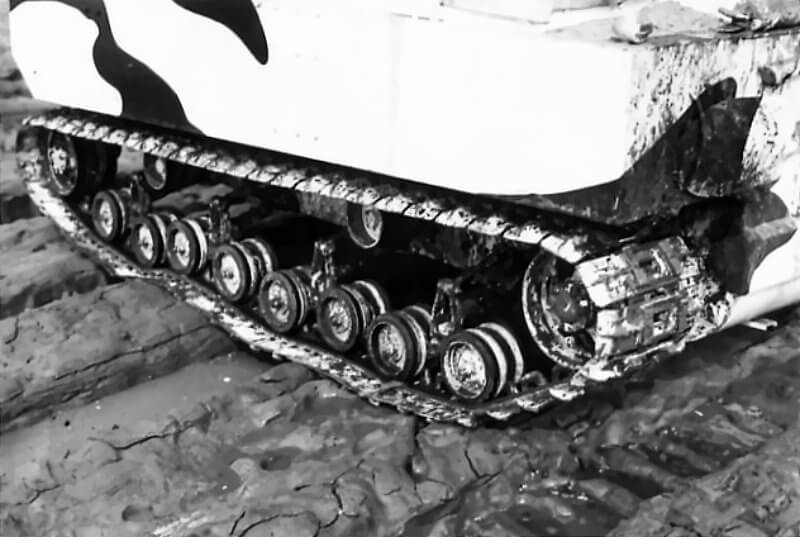
The tracks consist of continuous rubber belts. Steel bridging plates link the belts. Wire rope cables run within the rubber structure. Early production vehicles use 38-centimetre wide tracks. Later models adopt wider 51-centimetre tracks to reduce ground pressure. The powerplant is the Studebaker Model 6-170 six-cylinder engine. Output reaches 75 brake horsepower. The engine sits to the right of the driver beneath a light steel cover. Drive passes through a three-speed synchromesh gearbox with reverse. A two-ratio transfer case follows. A Clark combined steering and differential unit transmits power to the final drive.
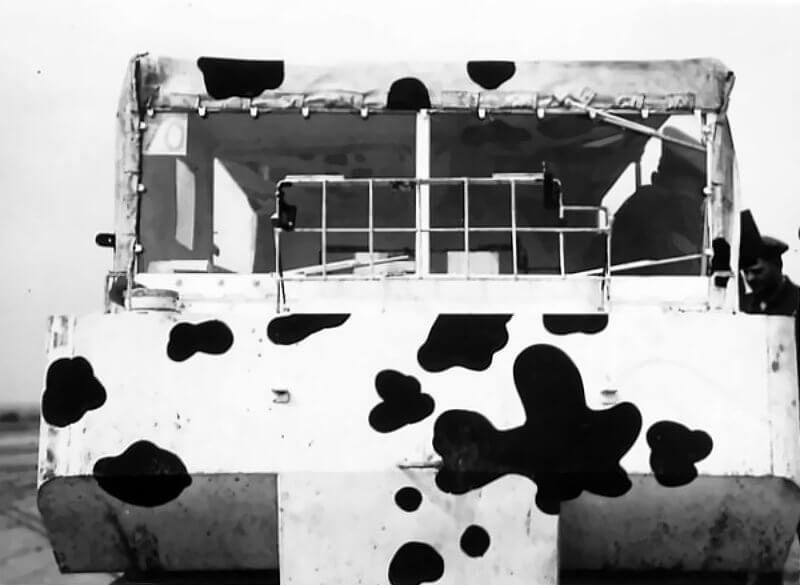
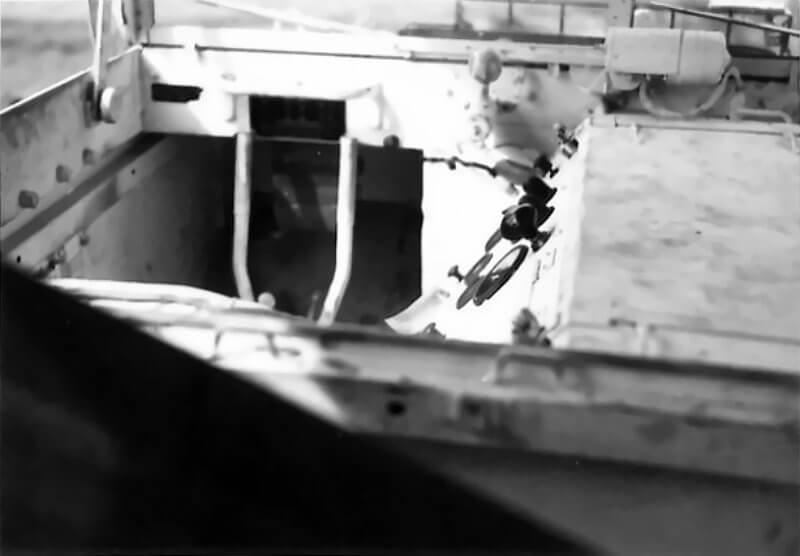
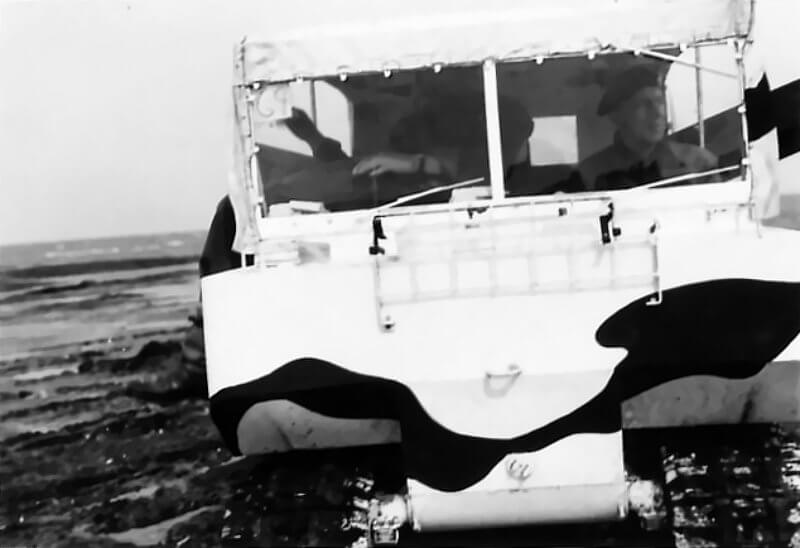
A folding windscreen mounts at the front, similar to that of a Jeep. Weather protection comes from a canvas tilt with side screens and a rear window. Seating exists for the driver and one passenger behind him on the left side. The cargo compartment sits alongside this seat. It accepts up to half a tonne of supplies. Large items such as motorcycles cannot be carried. If no cargo is loaded, two additional seats can be fitted in the rear compartment.
The United States Army accepts the Weasel into service during 1943. This takes place before Project Plough is fully abandoned as an operational concept. Studebaker produces 523 vehicles during 1943 and 2,951 during 1944. The original Norway snow warfare mission is cancelled. The Weasel still enters operational service in other theatres of war.
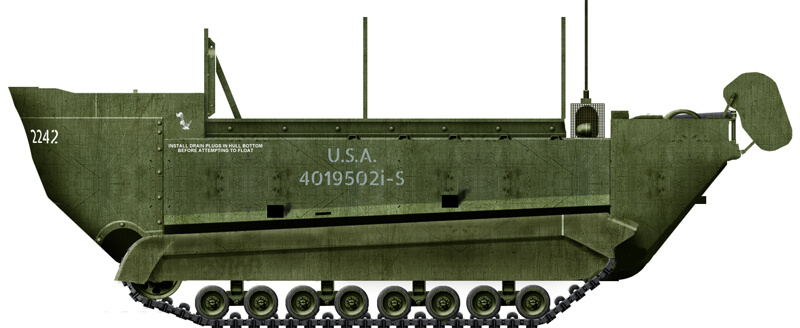
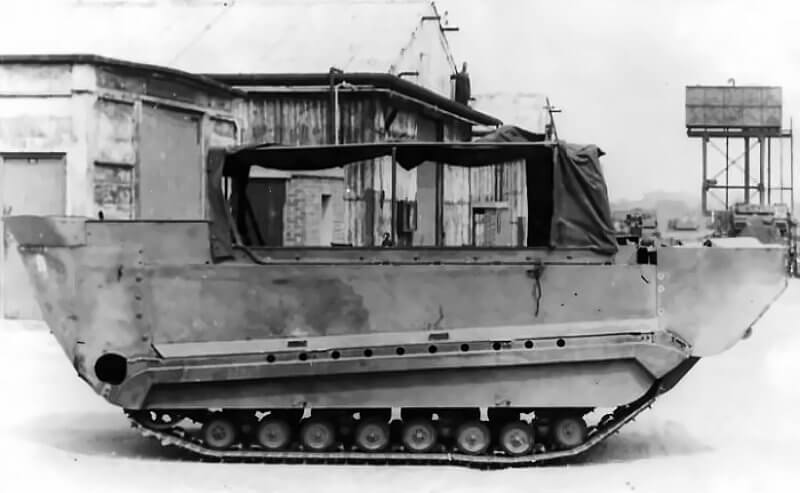
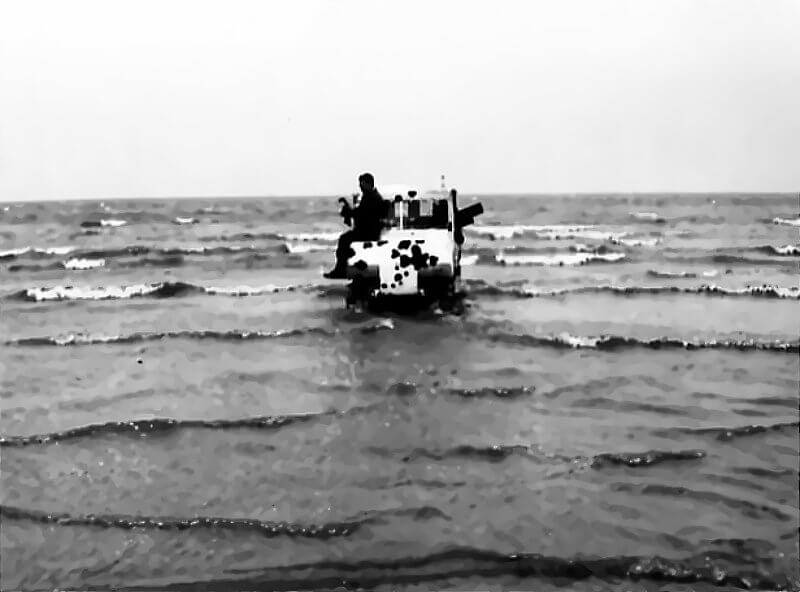
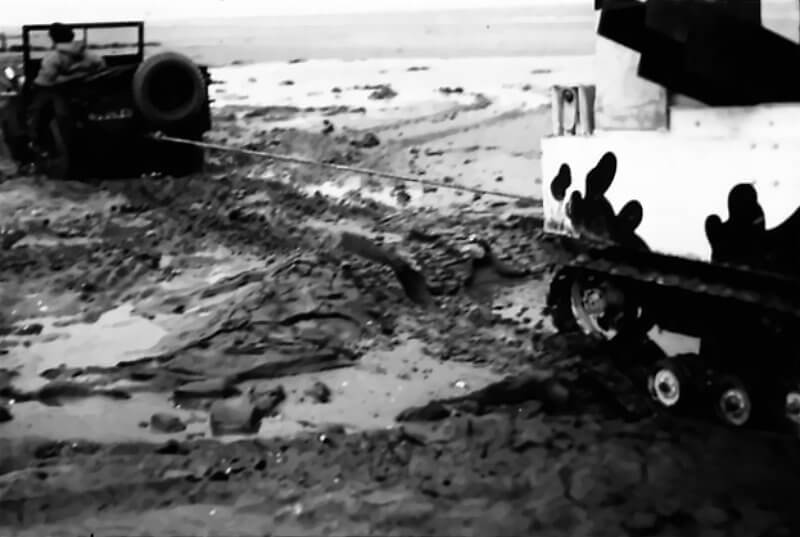
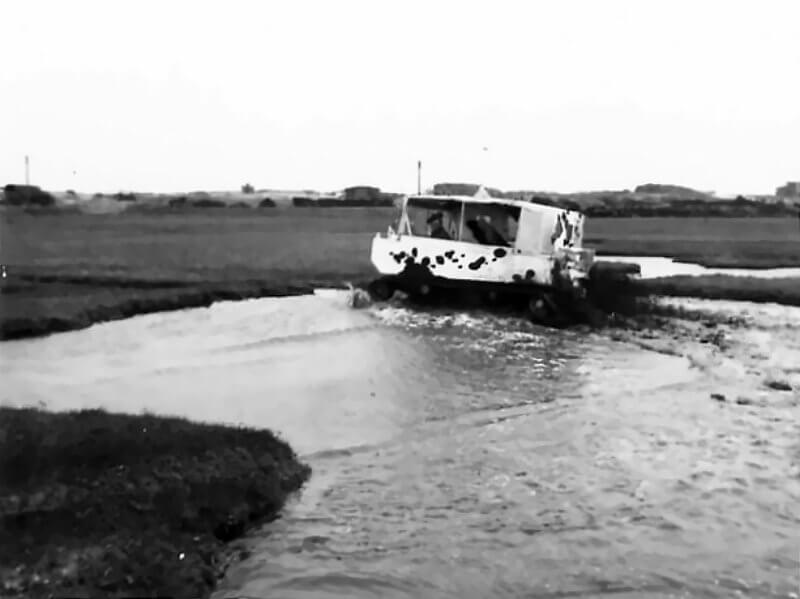
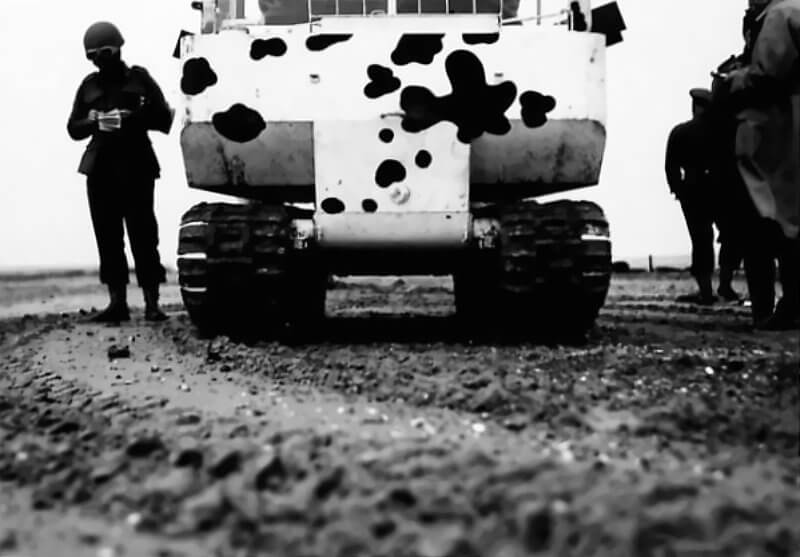
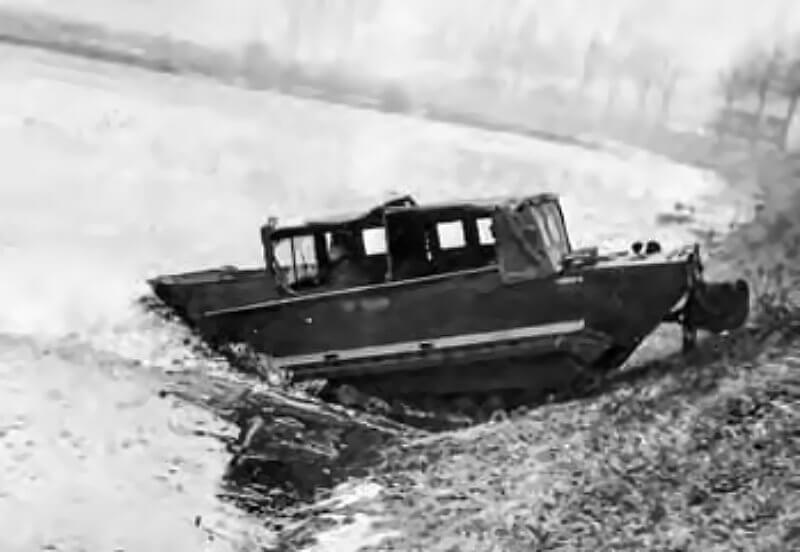
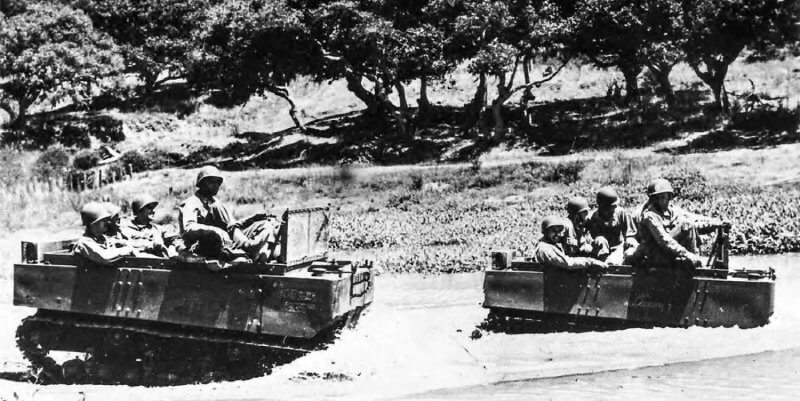
The M29C is the true amphibious version, although it also carries the name Weasel. Mechanically it remains identical to the M29. The main difference lies in the addition of buoyancy tanks. These take the form of extensions fitted at the front and rear of the hull. The front section forms a rounded bow with an almost boat-like shape. At the top sits a hinged trim vane, also called the surf guard. This folds back when it is not required. The entire bow attachment is watertight. A secure access panel sits on the upper surface. This allows a limited amount of stowage inside the tank.
One of the most visible external features is the small powered capstan. This unit is driven from a power take-off connected to the engine. Mild steel valances cover the upper run of the suspension. These deflect the flow of water while afloat. This increases swimming speed to almost six kilometres per hour. The valances hinge upwards when required. This allows access for maintenance on the suspension units.
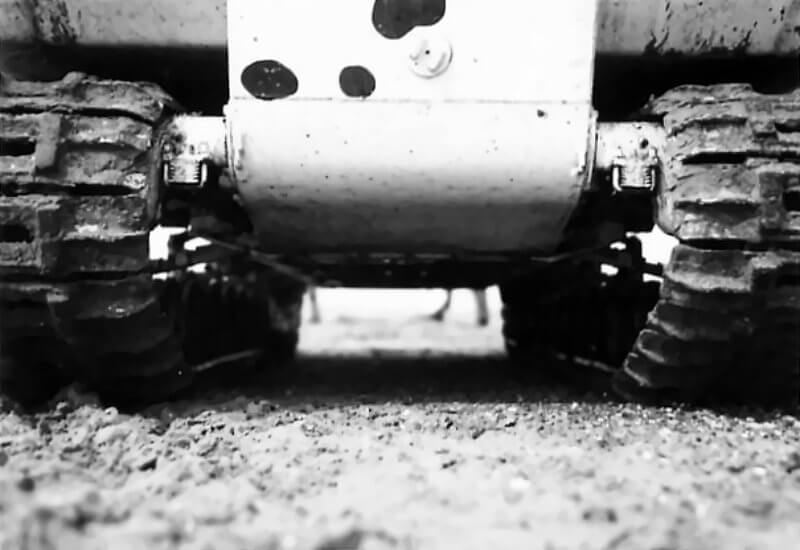
At the rear sits a square-ended watertight buoyancy tank. Its lower edge slopes inward beneath the rear of the vehicle. A towing hook mounts on its outer face. Two linked rudders hang from the rear edge. These fold upward when not in use. They steer the vehicle while afloat. Control passes through cables connected to the driver’s position. A small toggle control in front of the driver operates the rudders. The rear buoyancy tank contains no access panel. Internal stowage is therefore not possible. Brackets on the upper surface allow two pioneer tools to be carried externally. By 1945, production of the M29C exceeds 10,600 vehicles out of a total of 15,123 Weasels built.
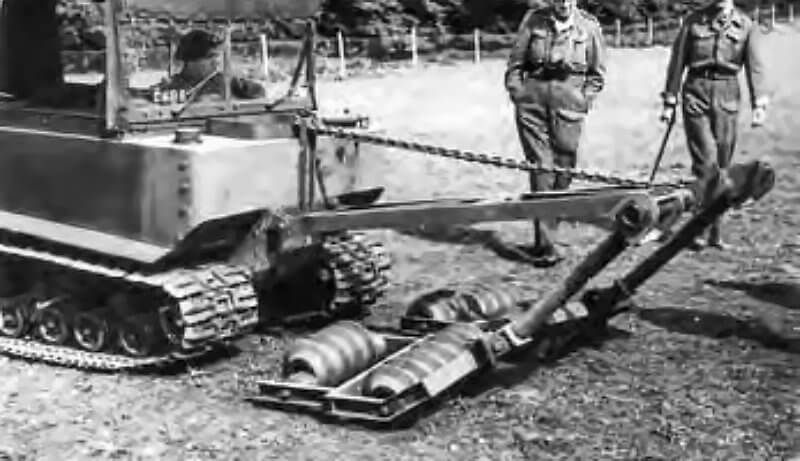
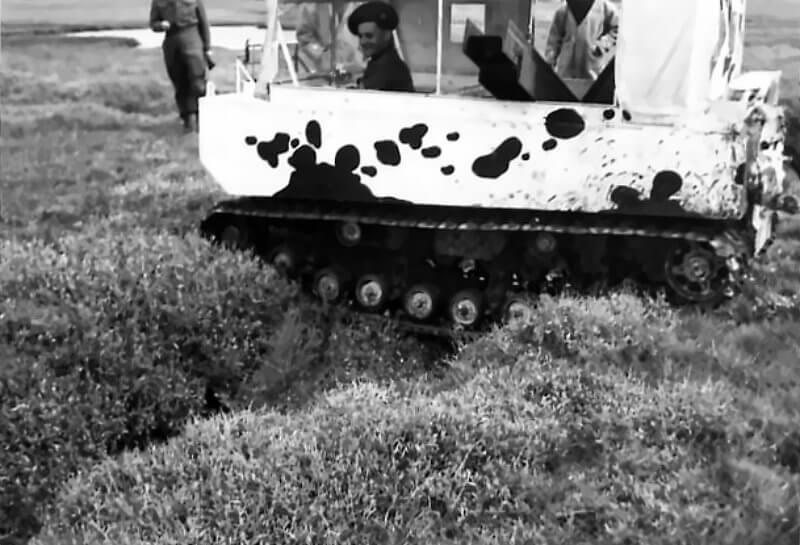
The British 79th Armoured Division test the M29 Weasel at their F Wing in Gheel, Belgium. The task of F Wing is to investigate new mine-clearing devices for specialised warfare. At least two systems are tested on the basic M29 Weasel. One is a lightweight mine-clearing plough. It resembles a scaled-down version of tank-mounted ploughs. The second system consists of clustered Centipede rollers. It carries the name Rodent. It is pushed ahead of the vehicle. It is designed to detonate German Schu anti-personnel mines. As far as records show, neither system enters active service.
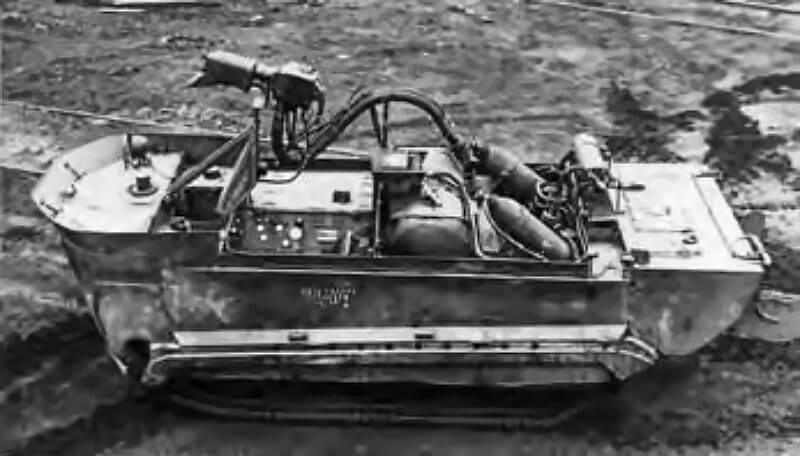
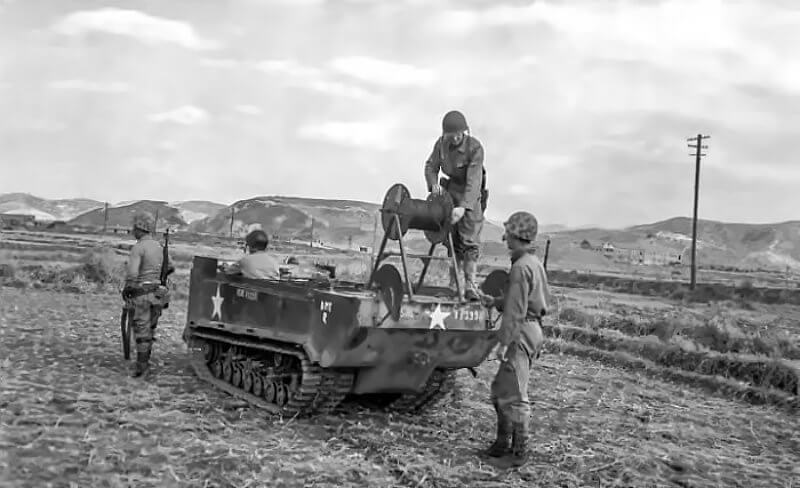
The British Army also employs Weasels as signal line layers in suitable terrain. The vehicle proves well suited for this role in mud and flooded ground. One M29C undergoes further experimental adaptation. The work is carried out by the Royal Electrical and Mechanical Engineers. This vehicle mounts a Wasp flamethrower. The result is an unusual configuration. The flame projector fires forward above the driver’s head. The flame fuel tank occupies the space normally used for passengers. The gunner sits on top of the fuel tank. His position lies behind the projector and remains highly exposed.
| Multimedia |
| Technical Characteristics |
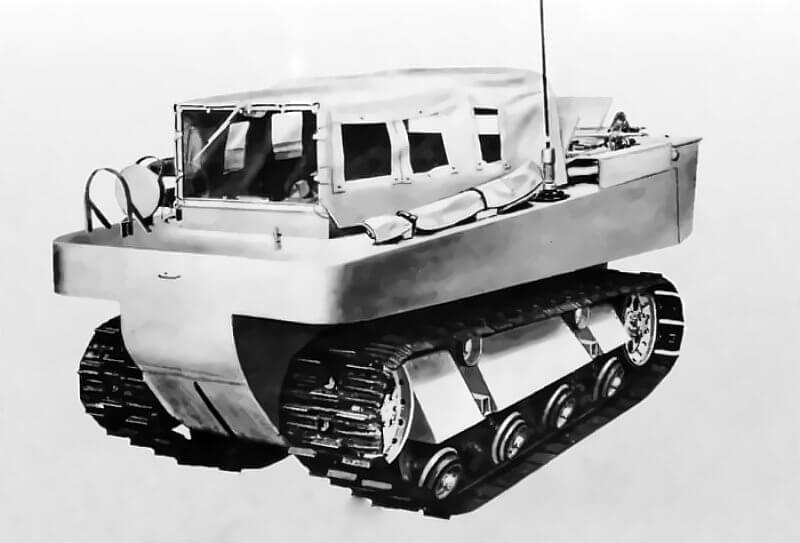
The M29 Weasel is very light and remains under two tonnes in weight. Ground pressure stays extremely low on all surfaces. This allows movement across snow, sand, mud, and marshland. Power comes from the Studebaker Model 6-170 Champion petrol engine. The unit is a flathead six-cylinder design. Displacement measures 2.8 litres. Output reaches 70 horsepower. Drive passes through a single-plate clutch. A three-speed manual gearbox transmits power. A two-speed planetary final drive multiplies torque at the tracks.
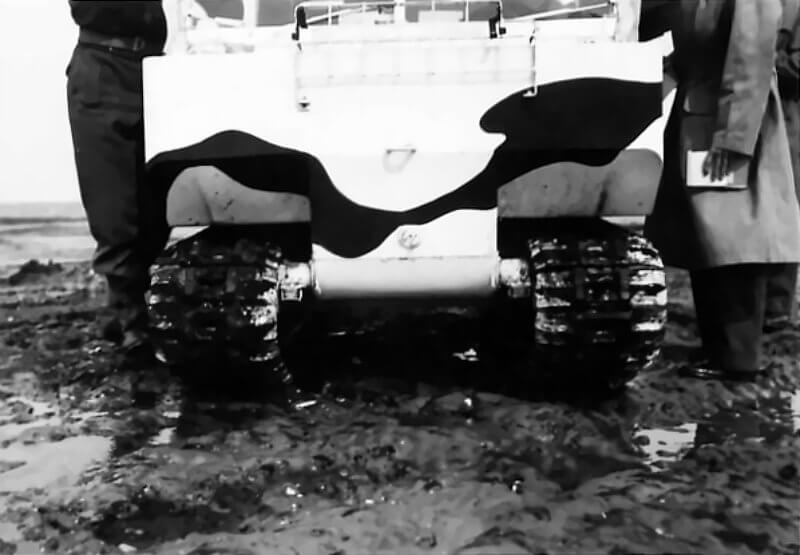
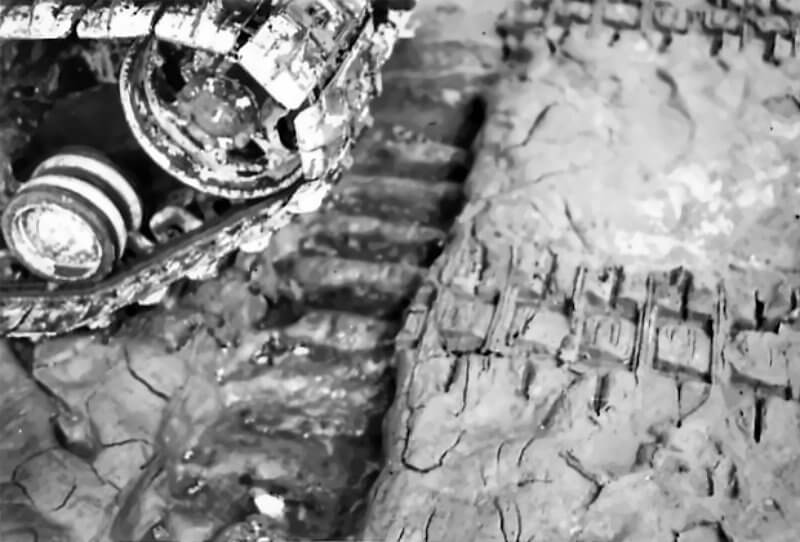
Early production vehicles use 38-centimetre wide rubber tracks of Kégresse pattern. These generate ground pressure of roughly 2.1 pounds per square inch. Later vehicles receive wider 51-centimetre tracks. Ground pressure drops to about 1.7 pounds per square inch. Vehicle length measures about 3.2 metres. Width measures 1.52 metres. Height remains just under 1.8 metres. Combat-loaded weight reaches approximately 1,700 kilograms. Crew strength totals four. This includes the driver and three passengers or load positions. Payload capacity is about 550 kilograms.
Maximum road speed reaches approximately 58 kilometres per hour. Operational range approaches 265 kilometres on full fuel tanks. The vehicle remains unarmoured in all standard versions. Even so, it can wade shallow water in its basic configuration. Freeboard on the standard model remains very limited. Later amphibious modifications greatly improve flotation and water handling.
The Weasel uses flexible Kégresse-type tracks made from rubber bands with metal grousers. These distribute weight across a wide contact area. The suspension consists of bogie wheels mounted on leaf springs. Two return rollers support the upper track run on each side. Steering relies on a controlled differential within the transmission. The driver slows one track to turn the vehicle. Early production places the drive sprocket at the front. On the M29 pattern the sprocket moves to the rear and the idler moves forward. The engine shifts to the front right of the hull. These changes greatly improve climbing ability and side-slope stability.
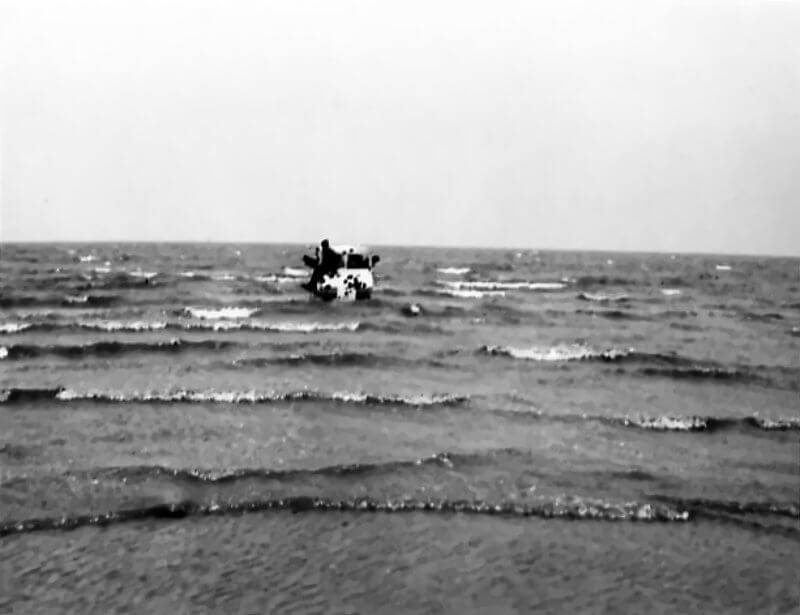
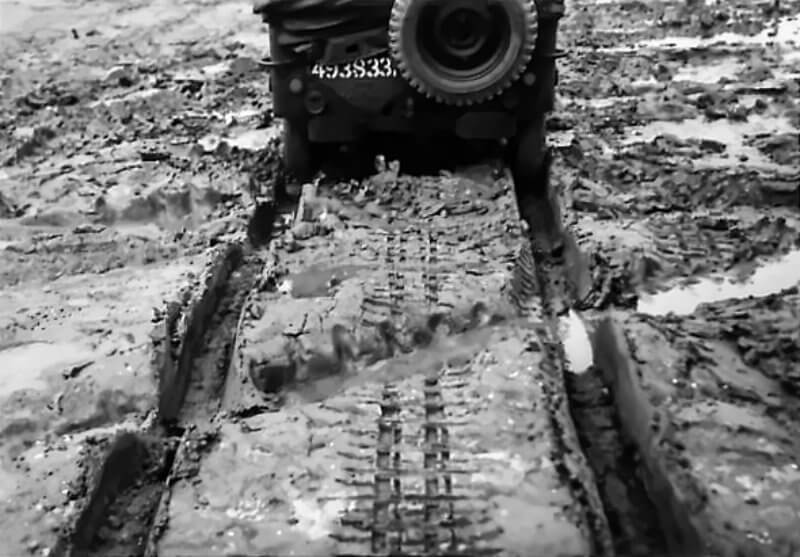
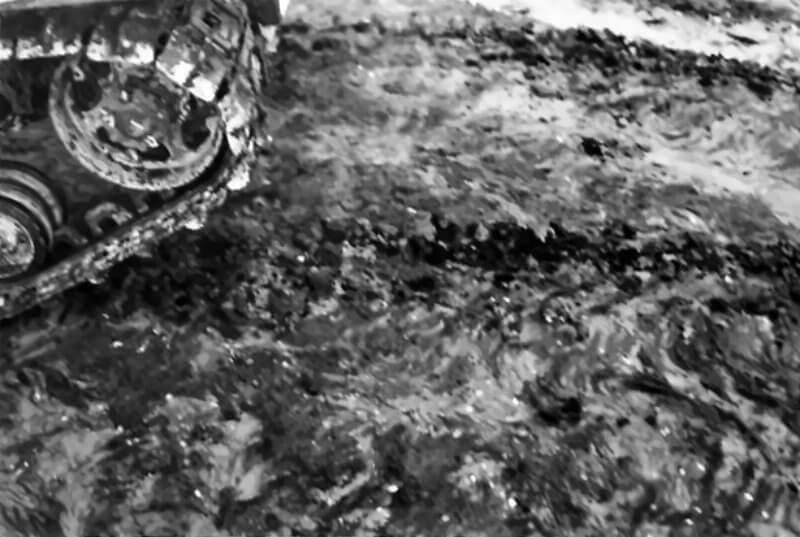
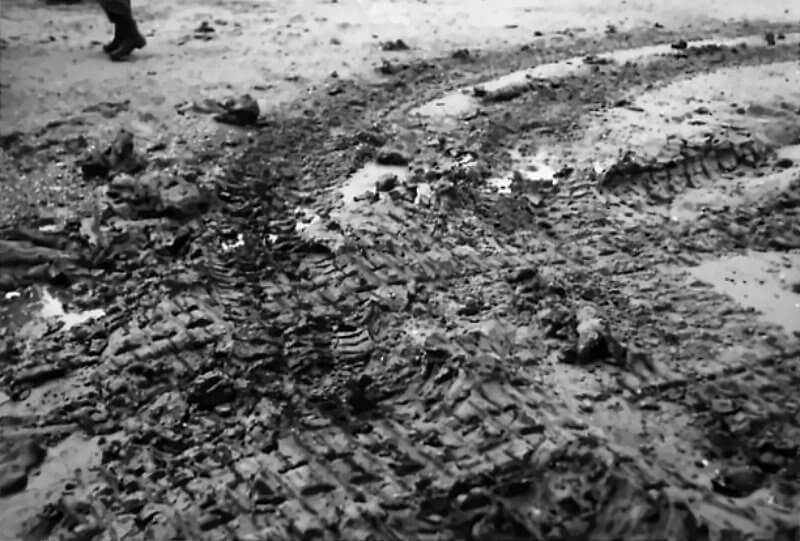
Ground pressure remains exceptionally low. At a gross weight exceeding 1.6 tonnes, it still averages close to two pounds per square inch. This is far lower than the pressure of a man’s footprint. For amphibious use, the M29C receives sealed buoyancy tanks welded into the bow and stern decks. Twin rudders control heading in water. A hand-operated capstan mounts on the front deck to assist recovery during landing. The electrical system is prewired for radio installation. Sets such as the SCR-506, SCR-508, and SCR-510 fit on the rear deck. This allows use as a command or relay vehicle. The combination of light structure, flexible tracks, and simple powertrain allows the Weasel to cross deep snow, swamp, and soft sand that defeat wheeled vehicles.
| Multimedia |
| Operational Use |
The Weasel enters combat service across every major theatre of the Second World War.
| Aleutian Islands |
Its first operational use occurs with the First Special Service Force in the Aleutian Islands. In August 1943 it lands on Kiska Island after the Japanese evacuation. This marks the Weasel’s first combat deployment. American and Canadian mountain troops then train with the vehicle during the winter of 1943. Training takes place at Camp Hale. The 10th Mountain Division conducts extensive cold-weather exercises using the Weasel for transport and supply.
| Operation Husky |
In the Mediterranean, Weasels go ashore during Operation Husky in late 1943. They then move into Italian service with American mountain and infantry units. The 10th Mountain Division continues to rely on them for supply and reconnaissance in broken terrain. Their small size allows movement along narrow tracks. During operations in the Apennines, Allied troops use Weasels to support the assault on Monte La Difesa. The position is otherwise inaccessible to conventional vehicles.
| Northwest Europe |
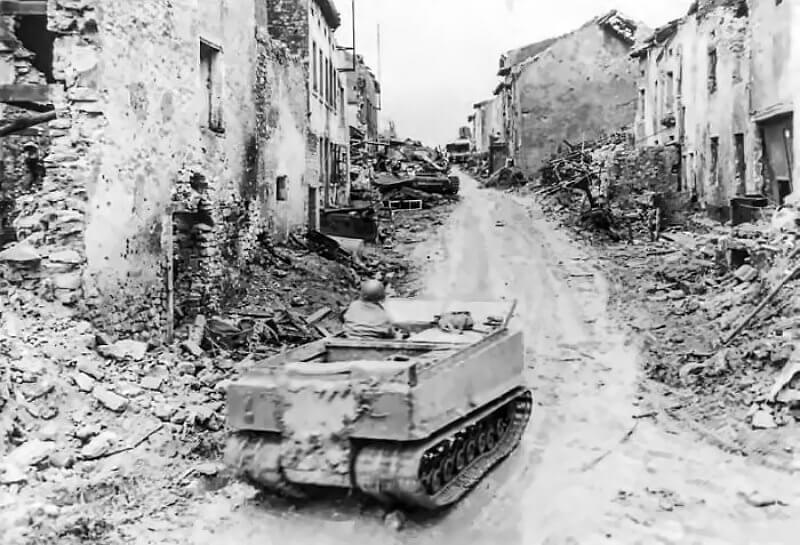
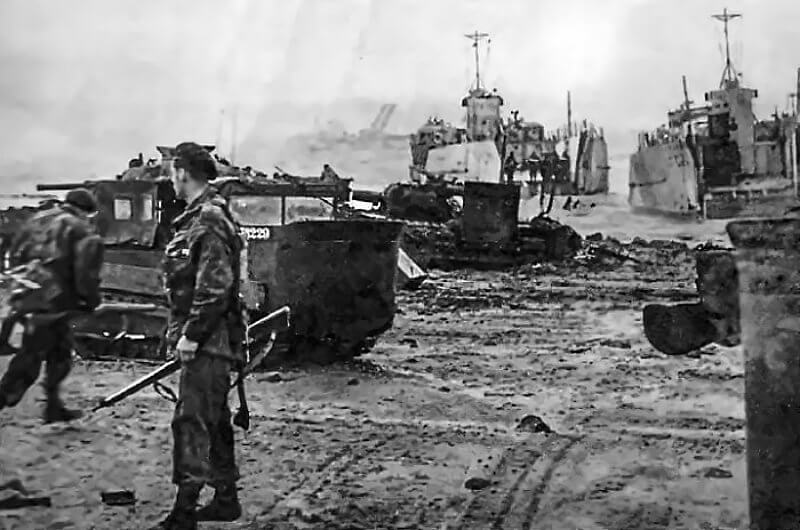
In Northwest Europe, Weasels take part in the Normandy landings on June 6th, 1944. They operate among the amphibious vehicle groups during the early assault phase. During the breakout from Normandy they haul ammunition to frontline infantry. They carry prisoners to the rear. After vehicle serial number 4104 they receive a stretcher kit. This allows evacuation of wounded from terrain inaccessible to jeeps. Engineers employ them to lay telephone cables using deck-mounted reel systems. Signal units use them as mobile radio platforms. The British 79th Armoured Division and Canadian formations make heavy use of Water Weasels in the flooded ground of the Scheldt Estuary in late 1944. In this campaign they operate alongside Alligators, DUKW’s, Buffaloes, and other amphibious vehicles. In deep mud and shallow water the Weasel remains one of the few reliable transport platforms.
| Pacific |
In the Pacific Theatre, the United States Marine Corps deploys Weasels on multiple islands. They see prominent use on Iwo Jima and Okinawa in 1945. Marines use them to tow artillery pieces and supply trailers across volcanic sand and deep mud. A 1945 Marine report notes that the Weasel lacks seaworthiness. It states that the vehicle remains of exceptional value once ashore. Its speed, manoeuvrability, and hauling capacity exceed those of wheeled transport in these conditions. By the end of 1945 every Marine division from the second to the fifth operates some Weasels.
Beyond cargo transport, the Weasel serves in many secondary roles. Units use it as a snow and mud ambulance. It reaches forward positions beyond the limits of wheeled vehicles. Signals units operate it as a mobile command post. It also lays communication lines under fire. Its extremely low ground pressure allows passage through many minefields without detonating anti-tank mines. Some units mount machine guns or portable mine-clearing gear on the cargo deck.
Field experience also reveals serious limitations. In the summer of 1944 American troops report frequent overheating on hard roads. An August 1944 report from the 87th Chemical Mortar Battalion records recurring radiator boil-over. The same report notes frequent loss of track plates during long road moves. The unit concludes that the vehicle is designed primarily for arctic conditions. It states that efficiency and mobility decline sharply on paved surfaces in warm climates.
| Post War |
After the war, large numbers of Weasels enter civilian and expedition service. Many are sold as surplus. Expedition teams adopt them for polar and alpine travel. The British North Greenland Expedition uses them between 1952 and 1954. The United States Navy deploys them to Antarctica during Operation Highjump in 1946. France employs M29C’s in the Mekong and Red River deltas during the Indochina War from 1956. Canada uses them for Arctic sovereignty patrols. Civilian agencies adopt them for rescue and transport in snow regions. Ski resorts convert many for piste work. In 1960, organisers borrow twenty-five M29C’s for the Winter Olympics at Squaw Valley. The vehicle thus enters a brief moment of international display. This contrasts with its steady and often uncelebrated service across global battlefields long after the Norwegian mission fades from memory.
| Multimedia |
| Sources |