
| Page Created |
| July 14th, 2025 |
| Last Updated |
| October 29th, 2025 |
| The United States |
 |
| Related Pages |
| Project Scam Dukw Landing Craft, Assault U.S. Army Rangers Operation Overlord Operation Neptune Omaha Beach Omaha Beach, Provisional Ranger Group Omaha Beach, PRG, Force A, Pointe du Hoc Omaha Beach, PRG, Force B Omaha Beach, PRG, Force C Provisional Ranger Group, Assault on the Maisy Battery |
| June 6th, 1944 |
| Omaha Beach, Provisional Ranger Group, Force C |
| Podcast |
| Objectives |
- Primary mission (conditional plan)
- Force C’s mission depended on the success signal from Force A (Lieutenant Colonel James E. Rudder) at Pointe du Hoc.
- If Force A succeeded:
- A pre-arranged signal rocket was to be fired from the Pointe by H + 30 minutes (half an hour after the first landings).
- On receiving that signal, Force C would divert from its planned Dog Green Beach landing and instead land at Pointe du Hoc at H + 60 minutes.
- Its mission in that case was to reinforce and resupply Force A, assist in eliminating any remaining German resistance between Pointe du Hoc and the sluice gate east of Grandcamp-les-Bains, and to prepare defensive positions against counter-attack until relieved by the 116th Regimental Combat Team.
- If Force A failed to signal success by H + 30 minutes:
- Force C was to follow its original plan and land at Dog Green Beach (Vierville-sur-Mer) at H + 60 minutes, behind the assault companies of the 116th Regimental Combat Team, 29th Infantry Division.
- From there, the Rangers were to advance overland approximately 6.5 kilometres west, capture the Pointe du Hoc area from the rear, and link up with Force A.
- Along the way, they were to neutralise German strongpoints between Vierville and Grandcamp-les-Bains, secure the Grandcamp road, and be prepared to repel counter-attacks from the west.
- Secondary and follow-on objectives
- Support the 1st Battalion, 116th Regimental Combat Team in clearing Dog Green, Dog White, and Dog Red sectors.
- Clear the coastal corridor westward from Vierville towards Pointe du Hoc.
- Establish a continuous defensive line along the cliffs to block German counter-attacks from the direction of Grandcamp and Maisy.
- Once relieved, regroup and prepare for operations further inland towards Grandcamp-les-Bains, Maisy, and Osmanville.
| Operational Area |
| Allied Forces | ||||
 |
- 5th Raider Battalion
- 2nd Raider Battalion
- Company A
- Company B
- Ranger Cannon Company
| Axis Forces |
| 352. Infantrie-Division |
 |
- Grenadier-Regiment 914
- I Bataillon (I./914)
- II Bataillon (II./914)
- Grenadier-Regiment 915
- I Bataillon (I./915)
- II Bataillon (II./915)
- Grenadier-Regiment 916
- I Bataillon (I./916)
- II Bataillon (II./916)
- Artillerie Regiment 352
- I Bataillon (I./352) 3 batteries of 105-millimetre leFH 18/40
- II Bataillon (II./352) 3 batteries of 105-millimetre leFH 18/40
- III Bataillon (III./352) 3 batteries of 105-millimetre leFH 18/40
- IV./352 with batteries of 150-millimetre sFH 18
- Panzerjäger-Abteilung 352
- Kompanie
- Kompanie
- Kompanie
- Pionier-Bataillon 352
- Divisions-Füsilier-Bataillon 352
- Nachrichten-Abteilung 352
- Feld-Ersatz-Bataillon 352
- Heeres-Küsten-Batterie Maisy (H.K.B. 6./1716 and 8./1716)
- Batterie 6: Four 105-millimetre leFH 414(f) French howitzers
- Batterie 8: Four 100-millimetre Czech guns (K.14/19) in open pits
- Heeres-Küsten-Batterie Pointe du Hoc (H.K.B. 2./1261)
- Six 155-millimetre GPF-T (French) naval guns
- Heeres-Küsten-Batterie Trevieres / Formigny
| 716. Infantrie-Division |
 |
- Grenadier-Regiment 726
- I Bataillon (I./726)
- II Bataillon (II./726)
- Grenadier-Regiment 736
- I Bataillon (I./736)
- II Bataillon (II./736)
- III Bataillon (III./736)
- Artillerie-Regiment 1716
- I Bataillon (I./1716): 100-millimetre Czech field guns
- II Bataillon (II./1716): 105-millimetre leFH 18 German howitzers
- III Bataillon (III./1716): 150-millimetre sFH 414(f) French heavy howitzers
- IV Bataillon: Mixed coastal defence guns and anti-tank weapons
- Panzerjäger-Bataillon 716
- Pioneer-Bataillon 716
- Nachrichten Bataillon 716
- Feld-Ersatz-Bataillon 716
- Heeres-Küsten-Batterie Longues-sur-Mer (H.K.B. 2./1260)
- Heeres-Küsten-Batterie Mont-Fleury (H.K.B. 1./1260)
- H.K.B. Wn61 / Wn60 (Colleville-sur-Mer sector)
| Reserve Units |
- Ost-Bataillon 439 (Ukrainian)
- attached to 716. Infantrie-Division
- Ost-Bataillon 642 (Georgian/Russian)
- attached to 352. Infantrie-Division
- Ost-Bataillon 630
- uncertain but possibly attached to 716. Infantrie-Division
| June 6th, 1944 |
Force C, commanded by Major Max Schneider, consists of the 5th Ranger Battalion, Companies A and B of the 2nd Ranger Battalion and the Ranger Cannon Platoon. The force is scheduled to land at H plus 60 minutes. Their mission depends on whether Force A succeeds in its assault on Pointe du Hoc.
If Force A signals success by H plus 30 minutes, Force C will redirect from Dog Green to Pointe du Hoc and land at H plus 60. Their objective is to support Force A, eliminate any remaining German positions between Pointe du Hoc and the sluice gate, and prepare to repel counterattacks. They will also cover the advance of the 1st Battalion, 116th Regimental Combat Team. Once the infantry battalion arrives, the Ranger Group is placed under its command.
If no success signal is received by H plus 30 minutes, Force C follows the original plan. They will land at Dog Green at H plus 60 minutes. From there, they advance rapidly overland, moving approximately 6.5 kilometres west. Their objective is Pointe du Hoc, approached from the east. On arrival, they are to secure the battery. They will eliminate surrounding German positions up to the sluice gate. Once secured, the Rangers are to reorganise and defend the area. They hold the position until relieved by the 1st Battalion, 116th Regimental Combat Team, after which they come under its command.
The sluice gate lies roughly 2,300 metres west of Pointe du Hoc. It is positioned where the coastal road crosses the Ruisseau de Fontaine-Sainte-Marie. The Germans use this waterway to flood the nearby fields, forming a natural barrier. The feature is clearly marked on Allied maps and serves as a key reference point for coordination and further movement inland.
| Channel Crossing |
Due to its size, Force C is divided into three Landing Craft, Assault flotillas. Companies A and B of the 2nd Ranger Battalion travel aboard H.M.S. Prince Charles and are assigned to LCA Flotilla 501. Companies A and F of the 5th Ranger Battalion, along with much of their headquarters company, embark on H.M.S. Prince Leopold and are delivered by LCA Flotilla 504. The remaining 5th Ranger Battalion sail aboard H.M.S. Prince Baudouin and land via LCA Flotilla 507.
At 05:30 the 5th Ranger Battalion loads into Landing Craft Assault from H.M.S. Prince Leopold and H.M.S. Prince Baudouin. They begin the sixteen-kilometre run to the coast of France. Morale is high. The weather is cloudy, and the sea runs choppy.
The LCA flotillas of Ranger Force C leave their ships around 06:15, about 18 kilometres from shore. The Landing Craft Assault of Companies A and B, with Battalion Headquarters Detachment, of the 2nd Ranger Battalion rendezvous with the 5th Ranger Bataillon. Heavy seas cause widespread seasickness during the run in. Many men stand up to ease the sickness and watch the bombardment ashore. The sea is rough. Many Rangers become seasick. The Royal Navy notes that the swell is heavy enough to unnerve even seasoned sailors.
| Plan 1 or 2, June 6th, 1944 |
As said earlier, Force C has two alternate plans. If Colonel James Rudder’s Force A lands successfully and neutralises the guns at Pointe du Hoc, then Force C is to follow and land at the same location. If, however, no confirmation arrives by H+30 minutes, then Force C is to divert to Dog Green Beach, landing behind the 116th Regimental Combat Team and advancing westward overland towards Pointe du Hoc.
Aboard H.M.S. Prince Charles, Royal Navy Lieutenant R. D. Turnbull waits for the codeword “Crowbar” from Motor Launch ML 304, signalling that Force A has landed. Expected around H-Hour, 06:30, the message arrives late, at 07:09. Turnbull hopes to receive the second codeword, “Bingo,” confirming the destruction of the guns. This should have come by 07:00 hours. He delays a few minutes longer, hoping a success message might still be received.
Lieutenant Colonel Schneider, meanwhile, hears the transmission of the codeword “Splash” to LCT 413. This order, issued by Rudder, releases the Swan DUKW’s into the water. Schneider attempts to make contact with Rudder by radio but fails. Each Ranger company carries an SCR-300 walkie-talkie. As backup, Royal Navy landing craft have their own radios. However, most of Force A’s SCR-300 sets are damaged by seawater either en route or during the landing.
Rudder is expected to send the message “Praise the Lord” to Schneider around H-Hour to confirm the landing at Pointe du Hoc. No such message reaches Schneider. Another codeword, “Tilt,” is to be transmitted if the assault fails or if Rudder opts to redirect Force C to Dog Green Beach.
An unintelligible message was received at 07:15; the only recognisable word was “Charlie.” The SCR-284 was set up but failed to contact either Force A or the headquarters ship H.M.S. Prince Charles. Radio communications aboard the guide craft ML 163 also failed.” This unintelligible transmission lends credence to the theory that Rudder attempted contact, but the signal was garbled or lost. Given that Schneider was near the edge of the SCR-300’s effective range, the communication failure is entirely plausible.
Faced with confusion and silence from Force A, Turnbull and Schneider conclude that the Pointe du Hoc landing has not succeeded. At 07:15, they jointly decide to execute Plan 2 and divert Ranger Force C to Dog Green Beach. Although they do not know it at the time, the fifteen-minute delay in reaching this decision spares them from heavier losses. Dog Green Beach remains under fierce fire earlier in the hour.
| The Way in, June 6th, 1944 |
As said, sea conditions are poor, with heavy swell and a following sea. Station-keeping proves difficult due to these sea conditions. Despite this, formation discipline remains steady. Around 07:00, all three flotillas arrive at point “Queenie” off Omaha Beach. They wait there until 07:15, when Schneider and Turnbull give the order to proceed to Dog Green. Motor Launch ML 163 moves to the front of the formation to guide the landing.
About eight kilometres from shore, one Landing Craft, Assault ships so much water it drops out of formation. On board are the 1st Platoon and part of Company F headquarters. These men do not land with the battalion. They later transfer to a passing Landing Craft Tank and reach the Saint Laurent-sur-Mer beach exit at 09:00.
LCA Flotilla 501, carrying the A and B Company, 2nd Ranger Battalion, leads the advance. Flotillas 504 and 507, bearing the 5th Ranger Battalion, follow at four-minute intervals. At a distance of roughly 1,200 metres from shore, the flotillas deploy from column into line-abreast formation, preparing to land amidst heavy resistance.
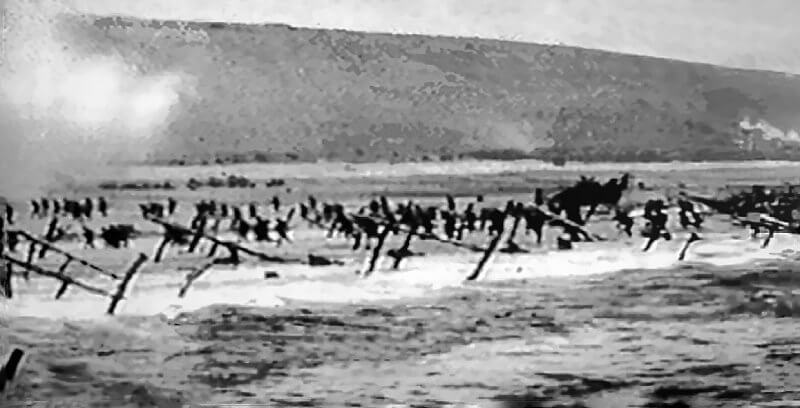
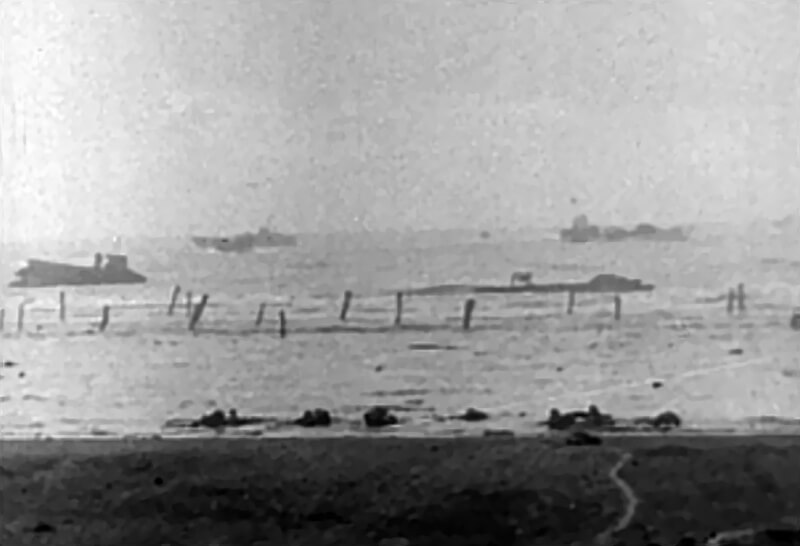
The beach is heavily protected. Underwater obstacles include steel elements, hedgehogs, and tetrahedra, many armed with Teller mines. Mortar and artillery shells burst among these barriers. Small-arms fire sweeps the shoreline.
A sea wall, 1.2 metres high, runs across the beach about seventy metres from the water’s edge. American troops take cover behind it. A thick pall of smoke hangs over the rising ground behind the beach. Naval bombardment has set fire to the vegetation covering the slope.
| 2nd Ranger Battalion’s Landing, June 6th, 1944 |
Six Landing Craft, Assault of the 2nd Ranger Battalion make up the first wave at H+70. From left to right these are: Battalion Headquarters LCA, two Landing Craft, Assault of Company B, two Landing Craft, Assault of Company A, and the Headquarters group LCA.
At 07:35, as Flotilla 501 nears the beach, German mortar fire begins. LCA 401, carrying 2nd Platoon of B Company, is struck. A direct hit blows off its bow. The coxswain is killed. The platoon leader, Lieutenant Bob Fitzsimmons is killed instantly. Sergeant Major Rubenstein orders the men to abandon ship. Rangers are thrown into the sea, swimming ninety metres to shore. At least five die. Several are wounded.
Despite increasing fire, the coxswains steer skilfully through the beach obstacles. The surviving Landing Craft, Assault of Flotilla 501 land between 07:40 and 07:52. Enemy machine-gun fire pours into the open ramps. Casualties are immediate. Survivors dive through bullets into the sea. Some wade ashore as they did in training; others swim under water before sprinting across the 90-metre beach to the seawall. Technician Fifth Grade Ray of Company A stands upright, calmly judging the shifting crossfire. He steps aside from the spurts of sand as bursts track towards him. Later in the day he again stands upright, firing his BAR from the hip, killing several Germans.
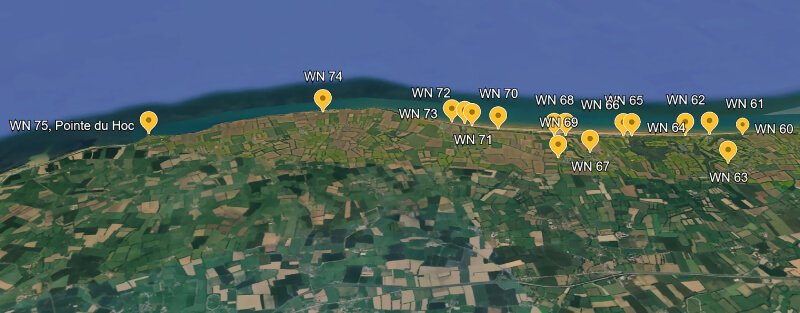
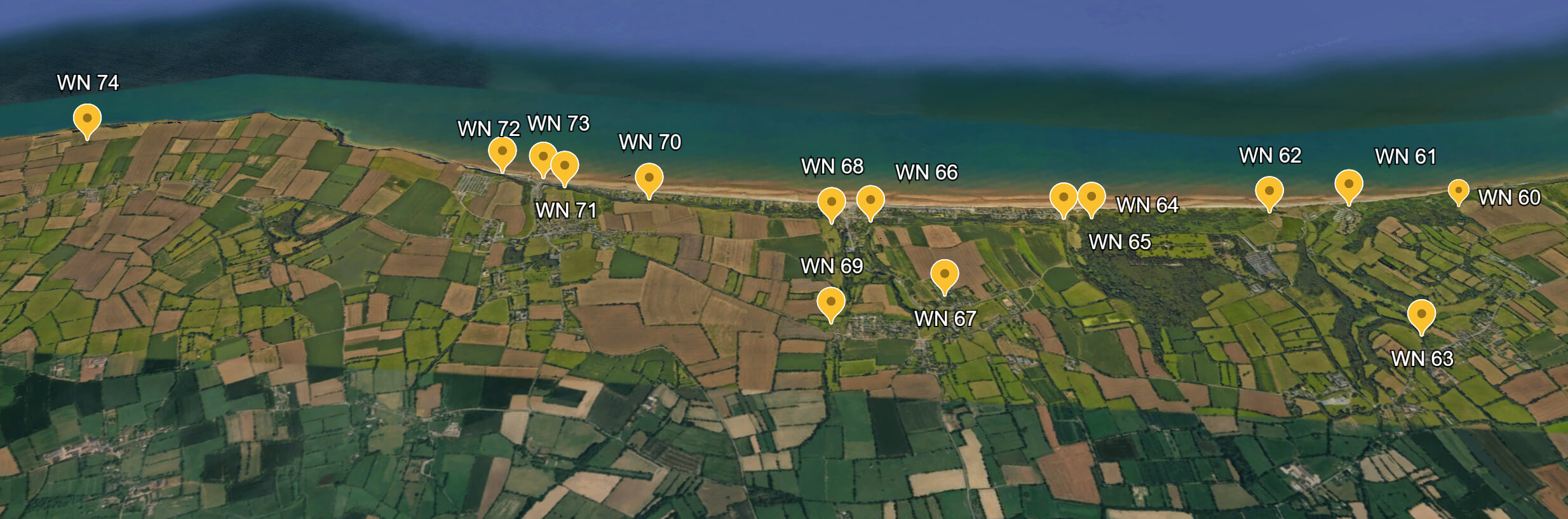
German defences at Widerstandnest 70, just inland from the beach, include machine guns and mortars. The defence nest is manned by fewer than a platoon but positioned above seaside villas. Mortars and machine guns sweep the beach, pinning the Rangers in place.
Captain Edgar Arnold loses his weapon when a bullet destroys his carbine. Lieutenant Robert Brice is shot in the head and killed. Only 27 men from Baker Company reach the seawall. Some are scattered farther along the beach, having swum ashore off course.
A Company lands to the east, near several M4A1 Duplex Drive tanks of B Company, 743rd Tank Battalion. Several tanks are knocked out by a German 88-millimetre gun in Widerstandnest 72. Lieutenant Stan White attempts to direct tank fire. At one tank, he gets no reply. At another, the commander engages the enemy machine-gun nest. The tank is then struck by the 88-millimetre gun. White is concussed and later recovers in hospital.
Captain Joe Rafferty reaches the beach. Seeing men hiding behind obstacles offshore, he wades back, shouting for them to move forward. He is hit in the legs, falls, and is killed by a shot to the head.
Lieutenant Bob Edlin leads 1st Platoon. His Landing Craft, Assault runs aground on a sandbar 70 metres out. He pleads with the British coxswain to go further. The man replies, in tears, that he cannot, but will land with them. Fourteen of the thirty-four Rangers reach the shingle. Edlin is wounded returning to the beach but is saved by Sergeant Bill Klaus, who drags him to cover. With all officers wounded or dead, Platoon Sergeant Bill White assumes command.
Realising they have landed too far east, the remnants of the 2nd Ranger Battalion turn west along the seawall. They move under fire, then cross the beach road and begin ascending the bluffs in a south-westerly direction. Their objective remains Pointe du Hoc. The terrain on the slopes, although steep, offers better cover than the open beach. Shell craters and grass fires from the naval bombardment conceal their movement. Some 35 men of Company A reach the sea wall.
| 2nd Ranger Battalion assault up the Bluff |
By 08:00, less than half of Companies A and B have reached the sea wall. Battalion Headquarters Detachment also suffers heavy losses. The first officer off the Landing Craft, Assault is hit by mortar fragments. Survivors assist the medical detachment in treating the wounded on the beach. With most command post equipment lost in the surf, the men take up rifles and help clear snipers from the area.A few tanks, firing at German positions, are scattered along the beach. The Rangers see no other infantry and believe they are alone. Less than 400 metres left, the 5th Ranger Battalion starts landing on a crowded beach.
Rangers of Company A advance first as individuals, then as small teams. The company reorganises under senior NCOs. Every officer has fallen on the beach. The company will remain without officers until D+2.
Within minutes of reaching the wall and under cover from smoke and damaged buildings, Sergeant White leads fewer than a dozen men across the promenade road. They find cover in shrubs around the ruined villas lining this part of the beach flat. They begin climbing the bluffs. Others from B Company follow. Roughly fifteen men reach the top in the first attempt. They destroy the machine gun that killed Rafferty and begin clearing trenches. A machine-gun section of Company D, 116th Regimental Combat Team, joins them. Groups led by Sergeants Fuda and James also ascend the bluff. James directs fire from supporting tanks. The three Sherman DD tanks silence troublesome positions on the flanks. Sergeant James climbs the hill alone and returning to urge men to follow.
Two Rangers of Company A reach the crest. They find trenches with two or three machine guns just beyond. Six more Rangers soon join them. As they investigate, Germans emerge from dugouts and open fire. The defenders wait too long. The lead Rangers are already within twenty metres, and more parties climb behind.
Working in twos and threes, the Rangers storm the emplacements. They kill several Germans and capture six prisoners. Only three Rangers are casualties. Company B then comes up, having abandoned its attempt at Vierville exit.
Captain Arnold gathers eighteen Rangers of Company B near Vierville draw and turns right. They hug the base of the slope and move several hundred metres toward Vierville draw. Their aim is to climb that exit as originally planned. Heavy fire forces them to withdraw. They reach the villas and contact tanks from the 743rd Tank Battalion. Sergeant Rubenstein is sent to get tank support but is shot in the throat. Believed dead, he lies in shock before reviving, asking a tank crewman for a cigarette, and calmly rejoining Arnold.
This action takes place between 08:00 and 08:30. It widens the penetration on Dog White and secures the right flank of the main advance eastward. By 08:30, Widerstandsnest 70 is largely cleared. To the left, the 5th Ranger Battalion appears on the bluff top. The two companies of the 2nd Battalion joins them for the inland advance. The German strongpoint is overcome by a handful of determined Rangers. It has taken them just under seventy-five minutes from landing to reach this point. Men from Company D, 116th Infantry Regiment, also join the assault.
With both companies of the 2nd Ranger Battailon depleted, Force C releases them from their mission of leading the 5th Ranger Battalion. C Company, 2nd Ranger Battailon joins them on the bluffs of Vierville. Captain Edgar Arnold of B Company assumes command of the composite force and organises the remnants into one understrength company. This composite unit moves in reserve behind the 5th Ranger Battalion.
| 5th Rangers Battalion on Dog White, June 6th, 1944 |
The 5th Ranger Battalion follows behind the 2nd Ranger Battalion in two waves. LCA Flotilla 504, commanded by Lieutenant J. M. F. Cassidy Royal Navy Volunteer Reserves, brings in the first wave. It departs H.M.S. Prince Leopold before dawn, carrying Companies A, B, and E, along with half the battalion headquarters. The almost 20 kilometres passage through choppy seas leaves many Rangers seasick.
As navigation launch ML 163 departs around 07:15, German mortar fire begins targeting the flotilla 1,200 metres from shore. From their craft, Schneider and Cassidy witness the devastating fire engulfing Dog Green Beach, where Company A, 116th Regimental Combat Team, is being destroyed. A radio message from the Beachmaster reports that Dog White Beach is clear. Schneider and Cassidy agree to divert east, where there is less resistance. The landing point lies about 730 metres east of Exit D-1, their original target, Dog Green, because enemy fire there is too heavy. The area near the draw is a deadly kill-zone where Able Company, 116th Regimental Caombat Team, suffers catastrophic losses earlier.
Flotilla 504 holds position, watching Flotilla 501 struggle under fire. Lieutenant Cassidy decides to land to the left of 501, using the smoke from burning grass to shield the landing. This smoke is the result of naval bombardment and now drifts over the beach and bluffs.
At 80 metres from shore, the seven Landing Craft, Assault fan out. The coxswains skilfully steer through mines, Belgian Gates, hedgehogs, and tetrahedra. All seven craft reach the beach without loss. The Rangers wade ashore in knee-deep water.
The after-action report notes that the first wave lands at 08:00. They cross the beach in good order and reach the sea wall with only light casualties. There they reorganise under cover of the wall and prepare to advance inland.
| Flotilla 507 and the Second Wave, June 6th, 1944 |
LCA Flotilla 507, commanded by Lieutenant E. H. West Royal Navy Volunteer Reserves, follows behind. It carries Companies C, D, and F, and the other half of battalion headquarters. About eight kilometres from shore, LCA 578, carrying 1st Platoon and part of F Company Headquarters, begins taking on water. The engine compartment floods. The coxswain proposes turning back, but Captain William Runge insists they continue.
Water rises chest-high inside the Landing Craft, Assault, forcing the Rangers to transfer to LCT-88. This group reaches the beach later in the morning. The remaining six Landing Craft, Assault proceed to shore.
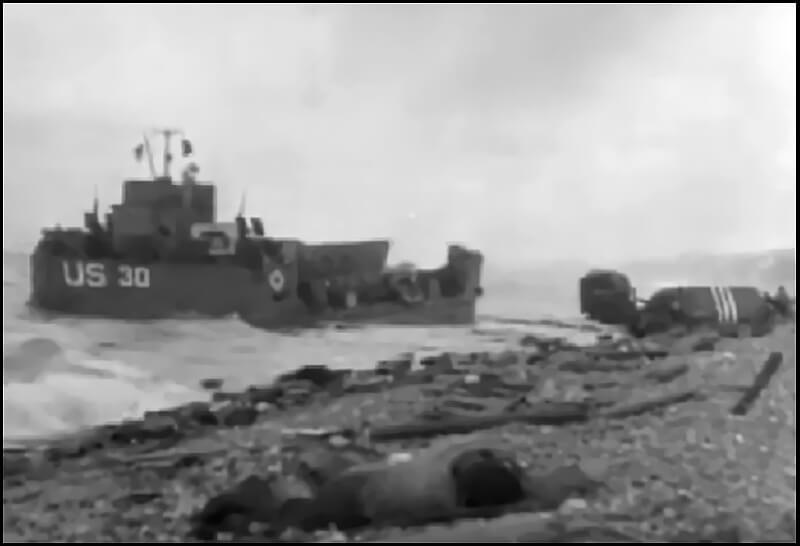
Half a kilometre from the beach, the formation splits so each craft can navigate the obstacles. Despite the danger, all six Landing Craft, Assault make it ashore by 08:05. Artillery crashes along the water’s edge. Bodies lie scattered across the beach, from the surf line to the sea wall. An Landing Craft, Infantry touches down ahead. Men start down the side ramps, then a violent explosion strikes the starboard ramp. A direct artillery hit ignites a flame-thrower. Fire engulfs the ship, sweeping across the deck in seconds.
The Ranger craft land within a line of stone breakwaters. The massive blocks absorb some of the blast and give them a brief measure of protection amid the chaos. The Rangers disembark in less than half a metre of water.
Flotilla 507 faces less fire than the others. This is partly because two Landing Craft, Infantry (Large) draw most of the enemy fire. One of these, LCI(L) 91, lands around 07:40. It strikes an obstacle fitted with a Teller mine. The explosion disables the starboard ramp. As troops disembark via the port side, an 88-millimetre shell hits the well deck, igniting the fuel tanks. The vessel bursts into flames. Just before Flotilla 507 arrives, LCI(L) 91 becomes a blazing wreck. Three Landing Craft, Assault from Flotilla 507 land in its smoke plume, which offers partial cover.
As the tide rises, many obstacles are now submerged. One Landing Craft, Assault, strikes a Teller mine, which fortunately detaches and sinks without detonating. The Rangers continue landing under intermittent fire.
Thanks to the delay and decision to land east, the 5th Ranger Battalion suffer minimal losses. This area is less fortified than the Vierville draw. Natural features like wooden breakwaters along the sea wall provide some cover.
On the beach, the Rangers encounter elements of C Company, 116th Regimental Combat Team. This unit was scheduled to land on Dog Green, but lands on Dog White instead. The mistake spares many lives.
Only four or five casualties are recorded during the landing while 450 men of the battalion get across the beach and up to the sea wall. One platoon from F Company, however, lands far to the east near the Saint Laurent draw. This area is heavily defended. The platoon attempts to move west to rejoin the battalion but is pinned down by artillery and machine-gun fire. They remain cut off until later.
| Colonel, we are counting on the Rangers to lead the way, June 6th, 1944 |
The 5th Ranger Battalion reorganise behind the seawall. Sergeants and lieutenants sort their men for the next phase of the operation. The terrain looks nothing like the maps or the sand-table models. The sea wall ahead is made of logs, standing barely a metre high. But the assigned beach was supposed to have a stone wall. Confusion sets in. Where are they? They cannot be right of Vierville, cliffs would block the view, with the Pointe et Raz de la Percée beyond. That means we must be left of the planned landing point.
A stocky officer approaches Sergeant Richard Hathaway, smoking a cigar. He asks, “What outfit is this?” Hathaway, preparing a bangalore torpedo, replies, “We’re the Rangers.” The officer says, “Let’s get off this beach.” Hathaway shouts, “As soon as we blow this fucking wire!” He then realises the man is a brigadier general.
The stocky officer is Brigadier General Norman Cota, assistant divisional commander of the 29th Infantry Division. He landed around 07:45 and has been urging the 116th Regimental Combat Team to move off the beach. Seeing the Rangers, he tells them, “We’re getting murdered down here. Let’s get murdered up there.”
General Cota appears, walking calmly down the beach. Captain John Raaen spots him, noting his composure and authority as he shouts orders and encouragement to the men sheltering behind the sea wall. Raaen runs over, salutes, and reports the situation. He tells Cota that the 5th Rangers have landed intact both here and about two hundred metres to the east, and that the battalion is proceeding by platoon infiltration toward its objectives. Cota listens briefly, then turns to the nearby troops and calls out, “You men are Rangers… I know you won’t let me down.” With that, he strides off toward Colonel Schneider.
General Cota then meets Easy Company. Mistaking his rank, Captain Luther tells him to stop interfering. Cota tells him to advance. Luther refuses, saying he’ll deal with his men himself.
At the Ranger Headquarters, Cota speaks with Lieutenant Colonel Schneider. General Cota approaches and calls out, “Are you Colonel Schneider of the Rangers?”
“Yes, Sir!” Schneider replies. Cota wastes no time. “Colonel, you’re going to have to lead the way. We’re bogged down. We’ve got to get these men off this god-damned beach.”
With that, the Rangers are ordered to take the lead. The battalion is to assault straight up the bluffs, advancing by platoons. It is a difficult order to execute, men are scattered across the sand, some out of earshot. Others, seeing movement ahead, act on instinct. Trained as Rangers, they know that hesitation means death. Standing still is not an option. They move and fire, pushing upward through smoke and chaos.
| The Assault up the Bluffs, June 6th, 1944 |
Lieutenant Colonel Schneider returns to his staff. Sergeant Herb Epstein asks why he was standing in the open under fire. Schneider replies, “Well, he was standing and I wasn’t going to be lying down there!”
Schneider orders the advance. Captain Whittington of B Company orders Lieutenant Pepper to place a Bangalore torpedo beneath the double-apron barbed wire fence along the sea wall. Private Fred Rogers crawled forward and detonated it, blowing a gap within minutes.
Scouts went through first, with Whittington following. The hillside was thick with smoke. Someone shouted for gas masks, and the men began the climb, stumbling upward through fumes and chaos, struggling to breathe behind the rubber masks. More bangalore torpedoes blow four gaps in the wire, three single, one double. At the signal “Tally Ho!”, the 5th Ranger Battalion scramble over the wall and begin climbing.
Smoke from the fires shields the advance but causes confusion. The bluffs are steep, the ground slick. The climb becomes a crawl. In one case, a lieutenant starts with a full platoon but reaches the top with only two men.
As said, Captain Whittington is one of the first to the summit. With Private Carl Weist, he flanks a machine-gun nest and kills its three-man crew. The battalion loses only eight men in the climb. Most of the Rangers reach the top by 08:30. Schneider now decides to regroup. Smoke has scattered the formations. He sends runners to restore order.
Survivors of the 2nd Ranger Battalion, now leaderless, join the 5th Ranger Battalion. Captain Arnold takes command of a provisional company formed from them. They help clear out Widerstandnest 71 on the eastern edge of Vierville draw, capturing six Germans.
At 09:10, the U.S.S. Ancon receives a message from the Rangers that the tide is rising rapidly, beach obstacles remain in place, and a demolition squad is urgently needed.
At the same time, C Company of the 116th Regimental Combat Team climbs the bluffs. Together with the Rangers, they clear German defences between Widerstandnest 70 and Widerstandnest 71.
Between 08:00 and 09:00, about 600 men leave Dog White. Company C, 116th Regimental Combat Team followed by most of the Ranger Force C, elements Headquarters and Companies B, F, G of the 116th Regimental Combat Team. Last to follow are the engineers of the 121st Combat Battalion.
They reach the crest in small groups and bunch in the first fields beyond. Order breaks down as later arrivals intermingle. Reorganisation is slow. Snipers, long-range machine-gun fire, and brief shelling from 8.8-centimentre guns add confusion. Progress inland stalls for two hours.
After 09:00, the main command party of the 116th Regimental Combat Team climbs the bluff. They find Rangers and infantry scattered across the fields, with forward elements near the coastal highway. Their communications section has landed on another beach. The only working radio belongs to a tank battalion liaison officer. Colonel Canham is cut off. He has no contact with his battalion headquarters and no knowledge of the exits. He can only assume the rest of the regiment is advancing to assembly areas.
At 09:28, the U.S.S. Ancon receives a message from the Rangers that enemy gunfire is covering Exits D and G, and a German battery positioned behind Dog Green is hindering the landings.
| Multimedia |
| A Company, 5th Ranger Battalion, June 6th, 1944 |
Once reaching the sea wall Lieutenant Charles H. Parker of A Company, orders his men to blow the wire along the sea wall. Parker calls for Bangalores to be brought forward. The order is immediately taken up by Rangers James Gabaree and Richard Hathaway. Working quickly but with precision, they connect one tubular section of explosive to another. The process takes steady hands, each joint secured to ensure the charge will run its full length beneath the obstacle. The final assembly forms a long explosive tube, designed to clear a path through the German wire.
Crawling forward under enemy observation, they push the Bangalore torpedoes into position at the base of the wire. Gabaree sets the fuse and dives away from the charge. The explosion throws him into the air and slams him back onto the sand. For a moment he lies dazed, but the urgency of the situation drives him to his feet. His own life, and those of the men following him, depend on clearing the beach.
The blast tears open a narrow gap in the wire, just wide enough for a man to crawl through. Parker immediately leads A Company forward, guiding them through the breach under enemy fire ahead of the main body. They rush across the scrub and begin climbing the bluff, hand over hand, using narrow paths and fissures in the slope. Thick smoke from explosions forces many to wear gas masks. Visibility is poor, and confusion spreads. Contact between platoons and sections is soon lost as small groups come under fire.
Parker leads his company, still largely intact, across the open fields above the cliffs. They advance through heavy machine-gun and sniper fire from German positions inland. Parker feels sniper bullets cutting through his pack as he lies in the open field. He sees First Lieutenant William Moody struck in the head and badly wounded. A moment later, Technician Fifth Grade William Fox is hit by a bullet that passes through his shoulder and severs his spine. Fox dies where he falls.
Lieutenant Parker wears an invasion vest, designed to carry ammunition, grenades, and rations. It proves awkward in battle. As bullets tear into the fabric, he struggles to remove it. After a desperate effort, he succeeds, leaving the vest and all its gear behind in the field. He now carries only his pistol as he continues the advance.
Keeping low, Parker leads his men through drainage ditches and hedgerows. The company advances in single file towards Vierville-sur-Mer. Unknown to Parker, an incident halts the rear of the column. One of his platoon leaders, Lieutenant Suchier, is wounded, possibly in the hand or ankle, perhaps both. The men stop to tend him, breaking the column. Parker, unaware of the split, continues forward with only twenty-six men, not realising that half his company has fallen behind.
The narrow country roads are lined with high hedgerows, forming green tunnels ideal for ambush. Parker decides to leave the road and move across open ground. Several sharp engagements follow as the Rangers press inland. In one clash they capture around twenty German prisoners. The Rangers now find themselves almost equal in number to their captives. They debate what to do. Killing them is not an option, and taking them along would slow the advance. Parker orders them disarmed and released.
Later, the group is ambushed on a sunken road between two hedgerows. Germans throw grenades from behind the foliage. Rangers react instantly, snatching the grenades and hurling them back before detonation. The explosions kill the Germans who had thrown them. The men press on through the fields, fighting through scattered resistance as they approach Vierville.
As Company A advances inland, the terrain presents new challenges. The fields are divided by high earthen embankments covered in dense vegetation, standing about one to one and a half metres tall and equally deep. These ancient hedgerows, shaped by centuries of farming, create narrow, sunken lanes. Overhanging branches form a canopy, offering perfect concealment for German snipers and machine guns. Fire sweeps across the approaches, and Rangers witness men being torn apart as they attempt to move forward. The intensity of the shelling forces many to discard their equipment, keeping only weapons and ammunition to continue the advance.
The company progresses through drainage ditches to avoid open ground. Staying low, they follow the ditches toward a nearby château. Sniper fire continues throughout the movement. By mid-afternoon, around 14.00, Lieutenant Parker and his men reach their first rendezvous point and begin a systematic search. In the short distance covered since the beach, they are estimated to have taken twelve prisoners and killed roughly the same number of enemy troops.
At 17:10, a German report from the 2. Batallion, Grenadier Regiment 915, records that enemy forces have bypassed their position near Château Colleville and broken through to the south. It also notes that wounded men can no longer be evacuated. Parker’s small detachment has effectively cut the German rear positions off from their forward elements. Their engagement of enemy groups moving toward the coast contributes to the mistaken German belief that the entire area has fallen to the attackers, rather than just a small group of Rangers occupying scattered farm buildings.
At the rendezvous point near a French farmhouse, the Rangers take stock. From the seventy-two men who landed on the beach, only twenty-six remain together. Exhausted and dehydrated, they search the outbuildings and barns within the château grounds. The property appears abandoned, though it has clearly been an active dairy farm only a day before. Parker assumes that other Ranger elements have already passed through and decides not to delay. Within minutes, he orders his men to move out and continue the advance inland.
As Company A advances inland from the beach, progress is marked by a series of short, sharp engagements. During the movement towards Pointe du Hoc, a German soldier suddenly appears with his weapon raised. A Ranger reacts instantly and shoots him at close range, killing him on the spot. The skirmish illustrates the speed and violence of the fighting that morning, where hesitation often means death.
The company continues to encounter small enemy groups along the narrow country roads. German troops use the hedgerows and ditches for cover, forcing the Rangers into repeated exchanges of fire. During these clashes, about twenty prisoners are taken. With the number of prisoners nearly equalling their own, the Rangers disarm them and release them rather than risk being slowed down. This decision proves practical and may have influenced further German surrenders in the area once word spreads that captives are not harmed.
Lieutenant Charles H. Parker studies his map and directs his reduced force along a dirt road leading towards Englesqueville. The route then joins the main highway to Au Guay and Pointe du Hoc. As the men check their strength, they find three missing: Staff Sergeant William Scott, Private First Class Henry Santos, and Private First Class George Chiatello. The unit is now roughly two and a half kilometres inland, sixteen kilometres from its final objective, and down to twenty-three men.
Near Englesqueville, the Rangers encounter two German soldiers on bicycles at a bend in the road. One escapes into a nearby house, prompting a grenade attack that fails to produce a result. Continuing through the village, the company enters tighter lanes bordered by hedgerows, ideal for ambush. Parker reinforces the lead element as the column comes under fire once again.
Enemy troops attempt to outflank the Rangers through adjacent fields. Realising the prisoners are hindering movement, Parker orders them released within a nearby farm before continuing the advance. The company breaks contact and moves quickly through the fields under intermittent fire. Kalar is wounded during the exchange, but the unit maintains its momentum. Parker’s decision to release the prisoners and change direction allows A Company to outpace the enemy and preserve its fighting strength.
After a long and difficult approach, Parker’s small detachment finally reaches the defensive perimeter of the 2nd Ranger Battalion south of the Grandcamp–Vierville road at about 21:00. The men are exhausted but intact. Still believing the rest of the 5th Ranger Battalion to be close behind, Lieutenant Parker reports to Colonel Rudder and informs him that reinforcements are on the way.
| Vierville, June 6th, 1944 |
Meanwhile, as the rest of the Rangers encounter minefields atop the bluff, Schneider switches to column formation. Captain Whittington’s B Company leads. Lieutenant Bernard Pepper’s 1st Platoon takes point. They meet small German groups along the way.
Near the Vierville–Grandcamp road, the Rangers take fire from Vierville-sur-Mer. German artillery begins falling on the rear companies. E and C Companies try to advance south but meet entrenched resistance. Attempts to call in supporting fire fail, the enemy is too close. At 10:43 Forrce C reaches the eastern edge of Vierville-sur-Mer. Sniper fire is heavy. Two positions are destroyed in buildings. Patrols search house by house while the column moves cautiously.
At 11:00, Hauptmann Berthy’s 7. Kompanie, Grenadier-Regiment 916 begins a counterattack. Composed of Germans and Turkmen conscripts, it advances directly into the Rangers’ path.
Lieutenant Pepper’s men come under fire in a wheat field. He flanks and destroys the German position. Facing heavy mortar fire, Whittington orders a withdrawal to the road. The Rangers decide to go through Vierville rather than around it.
B Company enters Vierville at midday. The rest follow by 14:00. C Company of the 116th Regimental Combat Team, had passed through earlier, clearing the way. Radio contact cannot be established with higher command.
Outside the village, Captain Whittington and Sergeant Thornhill take cover. Brigadier General Cota arrives again, urging them forward. When challenged, he insists there are no snipers. Moments later, a round lands nearby. Cota concedes, “Well, there may be one!”
| Advance and holding Vierville, June 6th, 1944 |
Once Vierville is secured, Schneider pushes three companies west to Pointe du Hoc. The Rangers form up on the coastal road leading towards Pointe du Hoc. They take up approach march formation and resume the advance.
The plan is straightforward. The force is to follow the coastal road until the junction to the Pointe. From there, they execute a flanking move and launch a frontal assault on the enemy. The order of march places Captain Whittington’s B Company leads in the lead as point. A and C Companies follow in support. Elements of the 116th Infantry Regiment form the main body. Four tanks are placed under direct Ranger control for fire support.
The Rangers advance toward the main road and encounter scattered German police and machine-gun positions. Each time they try to outflank one post, another opens fire from a new direction, delaying progress and costing valuable time. Colonel Schneider eventually abandons attempts to envelop the enemy guns and orders the column to bypass south of Vierville. The Rangers move along the coastal road through the town.
By now the afternoon is well advanced. The weather is moderate and cool for early June. The men are grateful for it. A hot day would have drained them completely. With all the running and fighting already done, they know they would never have been able to sustain the attack in the heat. They reach the hamlet of Gruchy around 17:00 but are stopped by German small-arms fire.
2nd Platoon, B Company, 5th Rangers Battalion, comes under a heavy artillery barrage. Ranger Banning is killed instantly, and Sergeant Walker McIlwain’s left forearm is shattered. Despite the wound, he continues to fight alongside the others for several hours until they finally force him to seek medical help.
Colonel Charles Canham, commander of the 116th Regimental Combat Team arrives with only 150 men left from his regiment. 2nd Platoon, around seven men, a major, a captain, and several enlisted Rangers, reach the 116th Regimental Combat Team’s command post, properly established according to plan, while most of Canham’s troops remain pinned on the beaches under fire. The Rangers are quickly assigned as his command post guard. For a time, it seems to Canham that they are the only effective troops in the sector. Facing the prospect of a German counterattack along a seven-kilometre front, Canham’s available strength largely consists of the 5th Ranger Battalion, men technically outside his command. They should already have been moving toward Pointe du Hoc, but instead are holding the line inland, securing Vierville.
He orders the Rangers to hold his right flank at Vierville. Unaware of the situation at Pointe du Hoc, and with few reinforcements yet landed, he fears a strong German counterattack could drive the assault back into the sea. By keeping the Rangers in a defensive role at Vierville, he inadvertently prevents the planned relief of the Pointe du Hoc force, leaving them isolated.
At 19:35 5th Ranger battalion reaches the western outskirts of Vierville. A perimeter defence is organised. The 116th Regimental Combat Team has not advanced on the left and no contact is made. An observation post is set up in a shed at the village edge.
At the same time, German radio reports describe heavy local fighting around Colleville and Vierville. According to the message, elements of Grenadier-Regiment 914 report that the enemy has broken through the obstacle belt at Pointe du Hoc and pushed slightly westward.
Captain Raaen receives orders from Major Sullivan to move around a field and draw enemy fire. The aim is to expose the German machine-gun positions and give the rest of the battalion room to advance onto the plateau. Raaen carries out the order, sprinting in a zigzag pattern across seventy to ninety metres of open ground under fire. Reaching the far side, he dives into a ditch, landing beside the body of a dead German soldier.
Around 22:00, Grenadier-Regiment 916 reports that elements of the Pionier-Bataillon 352 are engaged in hand-to-hand fighting in Vierville. During the action, they have recovered from a fallen American officer an extensive set of operational orders belonging to the U.S. V Army Corps.
German focus shifts elsewhere. Divisional commander General Kraiss believes the real threat lies at Saint Laurent, Colleville, and Asnelles. Forward observers at Pointe-et-Raz-de-la-Percée report the Vierville draw is blocked. German reserves move east. Even Berthy’s 7. Kompanie is diverted toward Saint Laurent.
The Rangers of Force C dig in while the battered remnants of Force B, under Captain Goranson, join them around 22:00. Of the 192 Rangers of the 2nd Rangers Battalion who landed that morning on Omaha Beach, only 80 remain combat-effective.
As darkness settles, other Rangers regroup and search the abandoned trenches. Two men from A Company observe Germans emerging from their dugouts to reoccupy positions after the bombardment. Acting in pairs and small groups, the Rangers clear each post in turn, killing several defenders and capturing six prisoners.
| Ranger Cannon Company |
As the Ranger Cannon Company reaches the beach, chaos mixes with organisation. Naval Beach Masters signal with flags, attempting to maintain order amid smoke, debris, and sporadic fire. Bodies, damaged vehicles, and scattered equipment litter the sand. Communications have broken down completely. It is impossible to advance towards the Vierville draw as planned.
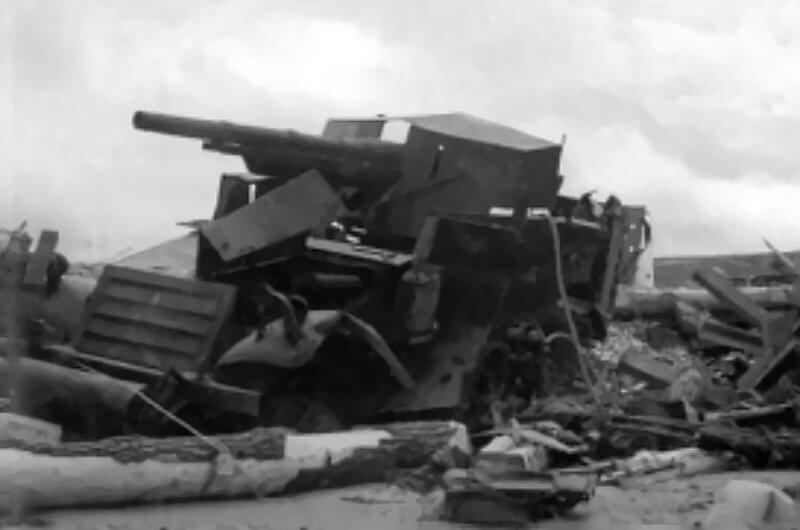
Lieutenant Kennard orders his men to blow a gap through the German concertina wire running alongside the gravel road between the sea wall and the anti-tank ditch. In trying to get the half-tracks over the beach wall and onto the road, one burns out its clutch. The other is struck by an explosive and catches fire. Kennard loses two Rangers to intermittent enemy fire.
Kennard later provides a detailed description of the terrain. Along the high-water mark lies a fifteen-metre strip of shingle composed of small rounded stones about five centimetres in diameter, forming a ridge that slopes sharply toward the sea. This treacherous ground hampers vehicle movement.
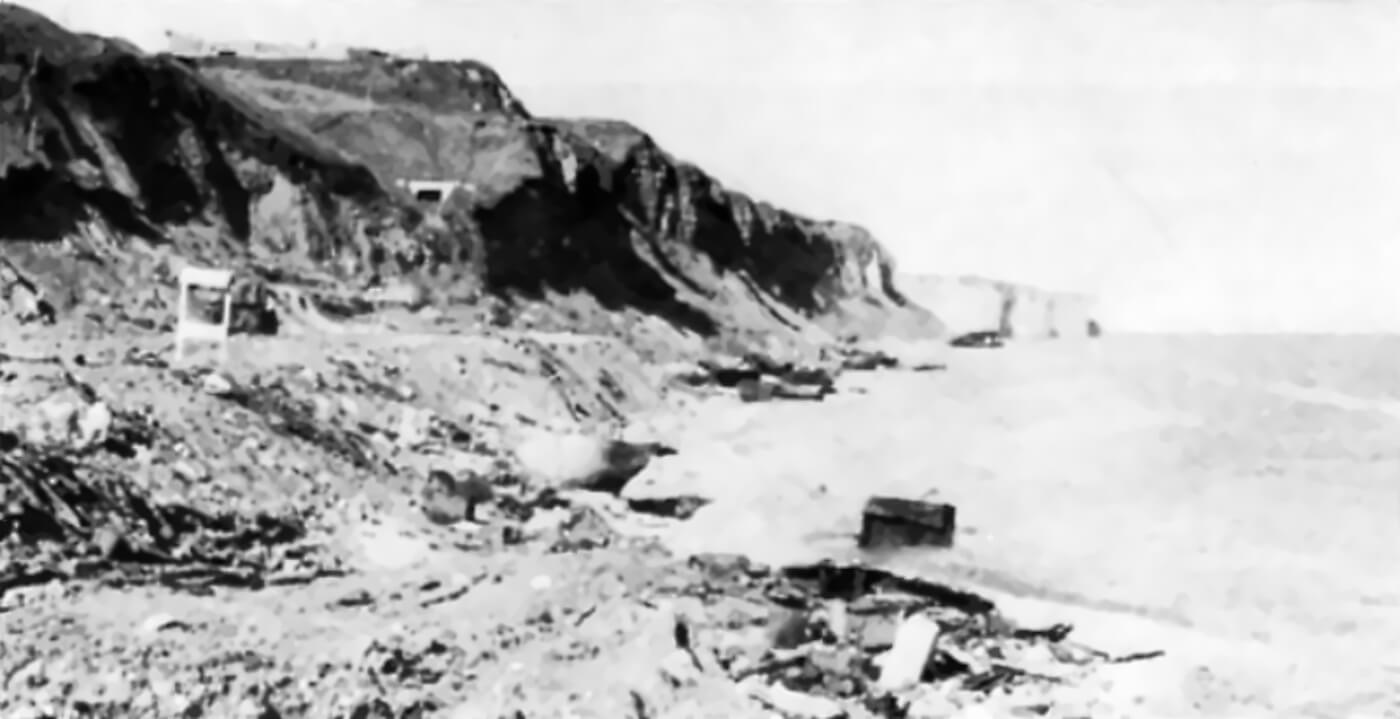
During the advance, Lieutenant Kennard encounters part of a 5th Ranger Battalion platoon, including a lieutenant, and joins them in assaulting positions on the escarpment. Together they push halfway up the slope, reaching a large concrete emplacement built into the cliff face. The structure resembles a bunker, its forward side cut away to face the water. It appears designed for a heavy mortar rather than a gun, providing wide lateral fields of fire. Only a direct naval hit from offshore could have destroyed such a fortification.
By the end of the action, Kennard’s detachment suffers no further casualties. They capture several prisoners and secure the position. No enemy aircraft appear overhead, and no naval vessels are visible close inshore. The surviving Rangers consolidate their ground amid the wreckage of the beach, one of the few organised footholds established in the western sectors of Omaha that morning.
The 5th Ranger Battalion platoon Lieutenant Kennard encountered was from F Company, landing near Saint-Laurent-sur-Mer, comes under intense artillery and machine-gun fire. Several patrols are sent out to make contact with the battalion but fail to locate friendly units. Attempting to move west along the beach toward Vierville-sur-Mer, the platoon advances about 550 metres before being struck by concentrated artillery fire, suffering eight casualties. Facing a superior enemy force and unable to move further, the men dig in and remain pinned down as darkness falls.
The next morning, Lieutenant Kennard and his cannon platoon, about eight men strong, joined by half a platoon from the 5th Ranger Battalion, attack a trench system through a narrow gully leading up to the German trench system on the bluff. Moving through thick barbed wire, they reach the enemy positions and force several defenders to surrender. Around nine or ten o’clock they enter the trenches and begin collecting weapons and valuables from the prisoners, piling them on a blanket. Kennard takes his first Luger pistol, a mark of pride among infantrymen who have fought at close quarters.
Soon afterwards, ten or fifteen soldiers from the 116th Regimental Combat Team arrive and attempt to take control of the prisoners. The Rangers, having done the fighting, order them to return to their unit. They collect all German papers for intelligence purposes and question one prisoner who shows them the entrance to a hidden tunnel. The entrance lies about ninety metres from the cliff edge. Inside, the Rangers find banded rolls of money and other stored equipment. The position is well built, with stairways cut into the bluff and natural protection from artillery fire.
In total, they capture around forty prisoners. The action is sharp but not prolonged. Both sides exchange fire from opposing trenches until the Germans surrender. After escorting the prisoners to the beach, an American officer, learning that the men are Rangers, provides an assault craft. They embark and move west along the coast in the landing craft, heading towards Pointe du Hoc where they become reinformements for the suffering Force A.
| Multimedia |
| Counterattack on Vierville, June 7th, 1944 |
Around 05:30, a German probing attack from 916. Grenadier-Regiment hits B Company, 121st Engineers, 29th Infantry Division, at the Ormel farm. The isolated company holds its ground.
At 05:35 the Gleaves-Class destroyer U.S.S. Ellyson is ordered to relieve U.S.S Harding in the bombardment force. She complies and by 07:00 establishes visual communications with the Ranger Shore Fire Control Party. At 08:00 voice radio contact is also secured.
Around 06:00 the American commanders gather in Vierville. Colonel Canham commander of the 116th Regimental Combat Team, Lieutenant Colonel Metcalfe of the 1st Battalion, 116th Regimental Combat Team, and Colonel Schneider of the Rangers attend. The western flank has been quiet overnight. Therefor, Colonel Canham agrees to send a relief column to Pointe du Hoc.
Task Force Metcalfe forms. It includes the 5th Ranger Battalion, the surviving three companies of the 2nd Ranger Battalion, 1st Battalion of the 116th, 116th Regimental Combat Team, and six M4 Sherman tanks from the 743rd Tank Battalion. The 2nd Ranger Battalion numbers only eighty men. The 1st Battalion, 116th Regimental Combat Team, has around 130, this is mainly Charlie Company under Captain Bert Hawks. The 5th Ranger Battalion companies have a combined strength of 400 men. The force leaves Vierville between 07:30 and 08:00. The Force moves out as infantry–tank teams. The twenty surviving men of Company A, 2nd Ranger Battalion, forms the point. They advance directly down the Grandcamp road toward Pointe du Hoc.
Meanwhile, Captain John Raaen leads a four-man patrol north of the coastal road to clear remaining German troops. With the Battalion Sergeant Major, the Supply Sergeant, and a rifleman, he drives off a few stragglers, then continues alone down the Vierville exit road to the 29th Infantry Division headquarters. The others return to the advancing column of Rangers, infantry, and tanks heading toward Pointe du Hoc.
Reporting to General Gerhardt, Raaen explains the Rangers’ situation and requests ammunition and food. Gerhardt instructs Lieutenant Shay to take Raaen down to the beach to collect supplies. With an engineering sergeant, they de-waterproof a jeep, load it with mortar and machine-gun ammunition, and start back toward Vierville. The road is eerily quiet, with no gunfire. At a crossroads near Saint-Pierre-du-Mont, Raaen chooses the right-hand fork after finding signs of earlier fighting on both routes.
As they proceed, snipers open fire several times. A bullet knocks Raaen’s helmet into his lap. When machine-gun fire pins them in an open stretch without cover, they crawl under a low hedgerow about a metre high. Lying flat, they pull the jeep over themselves for about thirty metres, dragging it forward out of sight until the hedges grow taller.
Soon they reach the rear of the 5th Ranger column, distributing ammunition and food to the men and giving rides to the walking wounded. Then the jeep runs out of fuel, its tank punctured by bullets during the firefight. They push it into a farmyard at Saint-Pierre-du-Mont and continue on foot to rejoin Major Sullivan.
Captain Raaen learns that all previous plans have changed. A German counterattack has struck the Ranger column as it began to move out, supported by tree-burst artillery fire which Raaen later believes came from Maisy. The enemy assault, about a company in strength, is spotted near the road. Seeing nearby tanks from the 743rd Tank Battalion standing idle, Raaen climbs onto one and bangs on the turret to get the commander’s attention. Pointing out the attack 180 metres to the south, he urges the tankers to engage. They open up with machine guns, beating back the German force, though the commander refuses to use cannon fire for fear of hitting friendly troops.
At 09:18 the U.S.S. Ellyson anchors four kilometres north of Pointe du Hoc, awaiting further orders from the fire control party. At 09:29 a Ranger observation post directs her to engage German light gun positions in trees, 730 metres west of Pointe du Hoc.
By 09:52, after firing 100 rounds, the shore fire control party reports the mission successful. A minute later a German shore battery near the target opens fire on the destroyer. The shells fall short. Ellyson returns fire immediately and by 09:59 her salvos straddle the enemy position.
Meanwhile, around 09:00, the main body of 916. Grenadier-Regiment attacks Vierville following the probing attacks earlier that morning. The incident forces a difficult decision. Colonel Schneider must choose whether to halt the advance or recall the units already past the ambush point. He decides to let the forward elements continue toward Pointe du Hoc while ordering the rest of the force to pull back and regroup. Colonel Canham orders A, B, E, and F companies of the 5th Ranger Battalion, to stay in Vierville. This reduces the relief column of Force Metcalfe to Pointe du Hoc to roughly 400 men.
The four companies of the 5th Ranger Battalion at Vierville-sur-Mer are tasked with improving the beachhead. Company B renews the attack to the southwest from the western edge of Vierville-sur-Mer. Progress is limited, but several machine gun nests and many snipers are destroyed. At the same time, a platoon of Company A and a platoon of Company F, supported by four tanks of the 743rd Tank Battalion, attack south from the town. They clear enemy snipers, machine gun nests, and several combat patrols. Around 25 Germans are killed and 85 are taken prisoner.
By 10:00, the German Grenadier-Regiment pushes to the north edge of the village. At 10:22 the U.S.S. Ellyson fires sixteen additional rounds before ceasing fire on orders from the shore party, to allow American infantry and tanks to move in. In total 124 rounds of 127-millimetre anti-aircraft common ammunition are expended. The Rangers also inflict heavy casualties on them, halting the advance by 10:30. At 11:30 the American flag is raised over the captured position.
A small American force, supported by tanks, relieves B Company at the farm. The Germans try again at 14:00 with a company-sized attack. E Company, 5th Ranger Battalion, stops it. After this, German pressure on Vierville fades.
| Relieve Task Force Metcalfe, June 7th, 1944 |
Task Force Metcalfe’s column encounters harassing sniper fire but continues forward. Consisting of one company of the 116th Regimental Combat Teamthat that had been re-formed from survivors, joined by two Ranger companies and the remnants of the 2nd Ranger Battalion, reorganised into a provisional Ranger company under Captain Arnold. Together, they amounted to roughly a battalion-strength force under Lieutenant Colonel Metcalf of the 29th Infantry Division, with Major Sullivan as his executive officer.
Six and a half kilometres are cleared quickly. The point checks every building along the route, flushing out and killing snipers. Communication with the tanks is poor, limited to physical contact, but the armour gives strong support. Their fire suppresses stubborn resistance.
Prisoners later state they are astonished by this advance. They describe it as a “crazy” attack, sweeping through several prepared defence lines on both sides of the road.
Behind the Rangers, the 834th Engineer Aviation Battalion advances to prepare an airstrip east of Saint-Pierre-du-Mont. They do clear out remaining bunkers and strongpoints surpassed by the Task Force. After which the 834th Engineer Aviation Battalion completes Emergency Landing Strip A-1 one day later on June 8th, 1944, at 18:00.
By 11:00, the Rangers reach Saint-Pierre-du-Mont. The situation is tense. A recent company-sized German counterattack and several smaller clashes in Vierville have left the men anxious. They are five miles from Vierville, isolated from the main force, and fear being surrounded or attacked again.
The group pushes along the road toward Grandcamp when they encounter a large crater blocking the route, likely caused by a mine. The obstacle prevents tank movement, leaving the armour scattered around the town. Captain Arnold of Company B sends a runner for a dozer tank to clear a path through the shell holes so the tanks can pass. Concerned about another counterattack, Major Sullivan instructs Captain Raaen to inspect the tank positions to ensure they are properly sited for night defence.
Raaen finds the tanks well placed and returns toward the crater, but a sudden artillery barrage explodes about 180 metres ahead, bursting in the trees and showering deadly fragments. Troops from the 116th Regimental Combat Team panic and begin falling back through the crater. Raaen, recognising some of his Rangers among them, calls out their names and manages to halt the retreat. With the help of a few officers, he restores order and re-forms the line short of the shelling zone.
Beyond Saint-Pierre-du-Mont, the Task Force runs into German resistance near the hamlet of Le Guay. The tanks, halted earlier by a bomb crater, are called forward. With skilful manoeuvring, they reach the front. The fighting here is limited to small arms, as enemy artillery is not striking the immediate position. The tanks fire on a fortified house covering the junction. A direct hit reduces it to rubble. Only machine-gun fire from the right flank continues.
Communication with the armour is difficult. The crews remain buttoned up. Captain Arnold moves to the front and hammers on a turret with his carbine to attract attention. Bullets pass close, branches snap, and rounds strike the tanks. Arnold escapes unscathed, though his carbine is pierced through the muzzle. The tanks then fire into the flank defences. Several belts of 12.7-millimetre rounds are expended. Ranger automatics and rifle fire add to the enemy toll. German resistance falters, but an 8.8-centimetre battery delivers the most intense bombardment yet. The supporting tanks fall back under pressure.
At the edge of Le Guay, the point runs into an ambush. A German squad with 4 machine guns fires from prepared positions. Seven Rangers in a forward patrol are isolated by the earlier shellfire. The Rangers destroy one position and capture twelve prisoners. Two men are killed and three wounded. Technician Fifth Grade Ray, the standing BAR gunner of Company A, distinguishes himself again, despite being slightly wounded. The German bombardment leaves the countryside cratered and devastated. When the barrage ends, the five surviving men rejoin the Force Metclafe with their prisoners.
French civilians indicate the shelling may originate from Maisy or Criqueville. Shore Fire Control Party 3 contacts U.S.S. McCook, which relays the request to U.S.S. Texas. However the U.S.S. Texas is too far east and assigns the H.M.S. Glasgow to fire on Maisy. At 13:00, the H.M.S. Glasgow opens fire. This stops the shelling on the Americans.
Under orders, the Force then withdraws to Sainte-Marie-du-Mont. Here they prepare defensive positions against a counterattack. The force halts 730 metres short of Pointe du Hoc. A perimeter is established with outposts and strongpoints. Combat and reconnaissance patrols probe for enemy and friendly forces. Exhaustion is evident. The day’s action has drained the men, though they have forced the enemy back.
Meanwhile, German artillery continues, hitting the 1st Battalion, 116th Regimental Combat Team and causing 30–40 casualties, nearly a third of the force. Losses reduce their strength, but progress continues. A town and the main coastal road are cleared. German forces fall back, though the mission remains incomplete. Concern grows for the fate of the Ranger companies isolated on the Pointe.
At this point, no contact has been made with Rudder’s Rangers. Task Force Metcalfe scans the coast for signals but sees none. Believing the force at Pointe du Hoc has been wiped out, the column requests naval gunfire on the point. The Navy refuses. They notify Metcalfe that Rudder is still in contact with warships offshore. This is the first confirmation the Rangers receive that Rudder’s men are still alive and on Pointe du Hoc.
After this confirmation, a final push to Pointe du Hoc is planned for the afternoon but fails to materialise. At Vierville concerns grow about a renewed German counterattack. Colonel Canham requests the tanks to return to the village. The Shermans withdraw from Saint-Pierre-du-Mont before evening.
Later that evening a fresh German assault takes place on Vierville. Company E, holding the eastern sector, repels a determined German counterattack of roughly company strength. The Germans suffer heavy casualties and by the end of the day, the German 916. Grenadier-Regiment does not function as a cohesive fighting force anymore and withdraws the next day.
However, during the afternoon, fighting continues around Vierville-sur-Mer. At Saint-Pierre-du-Mont, an officer from the 29th Infantry Division approaches the Rangers. He reports that Vierville has fallen to a German counterattack and that enemy armour is advancing toward the rear of the 5th Ranger Battalion.
The information is false. Its source remains unknown. However, Task Force Metcalfe accepts it as credible. This reinforces the decision to halt the advance on Pointe du Hoc. Instead, the Rangers focus on setting up a defensive perimeter around Saint-Pierre-du-Mont.
Radio contact with 116th Regimental Combat Team Headquarters in Vierville is unreliable. Captains Raaen and Wise decide one of them must verify the situation. They flip a coin. Raaen loses and sets off on foot toward Vierville.
Along the road, Captain Raaen meets an officer from the 116th Regimental Combat Team, calmly pedalling a bicycle in the opposite direction. His relaxed demeanour contradicts the claim of German tanks approaching. He informs Raaen that the 175th Infantry Regiment, the third unit of the 29th Infantry Division, has landed and is moving through Vierville with tank support. He expects the regiment to reach the Rangers’ forward positions within a few hours.
This is the first solid proof Captain Raaen receives that the invasion is progressing. Yet the support never materialises. The 175th Infantry Battalion is diverted south off the Vierville–Grandcamp road toward the Bayeux–Isigny highway. The Rangers at Saint-Pierre-du-Mont receive no reinforcements that day.
By 16:00 D Company of the 81st Chemical Weapons Battalion reaches Vierville-sur-Mer. There, the commanding officer of the 116th Infantry, 29th Infantry Division, orders the company to provide supporting fire for the defensive perimeter.
At this point, elements of the 81st Chemical Weapons Battalion become attached to the Rangers. In the words of Captain John Raaen, they effectively serve as the Rangers’ artillery unit, delivering direct and indirect fire in support of Ranger operations inland from Omaha Beach.
| Setting up For the Night, June 7th, 1944 |
By 19:00, elements of the 116th Regimental Combat Team move into the eastern half of the sector around Saint-Pierre-du-Mont. The Rangers shift right and defend the remaining half.
That evening, supplies arrive. The two surviving M3 75-millimetre GMC half-tracks from the Ranger Cannon Company reach the front. They finally join the main Ranger force during the evening. The half-tracks provide limited firepower but prove invaluable for hauling ammunition and rations from Omaha Beach to the front.
Task Force Metcalfe establishes defensive positions in two fields near Saint-Pierre-du-Mont. At 20:00 hours, German artillery fire resumes. Shore Fire Control Party 3 contacts the U.S.S. McCook, which engages suspected guns at Criqueville. Later on, the H.M.S. Glasgow joins in. Their fire silences the German battery for the night.
The Rangers remain in place, defending the flank of the Omaha beachhead, frustrated in their goal of reaching Pointe du Hoc, but firm in their stand at Saint-Pierre-du-Mont. The men relax slightly but continue to strengthen their night defences. Captain Raaen decides to send out a patrol to confirm whether Pointe du Hoc still holds and whether the 2nd Ranger Battalion remains there. Sergeant Moody and Corporal McKissick, both from the 5th Battalion, volunteer for the task.
That night, they move through German lines during a firefight, the second night the 2nd Ranger Battalion has been isolated under repeated counterattacks. The patrol initially overruns Colonel Rudder’s command post in the darkness but quickly finds it again. Moody briefs Rudder on the situation inland, including the presence of friendly tanks.
Before returning, Moody, a mortar man by trade, locates a reel of wire and lays it along the route back to Saint-Pierre-du-Mont. The line establishes direct telephone communication between Rudder’s command post and Raaen’s position. Both Moody and McKissick later receive the Distinguished Service Cross for their bravery and ingenuity in completing the mission under fire.
During the night, German snipers infiltrate back into Vierville-sur-Mer where the remainder of the 5th Ranger Battalion is helping to secure the perimeter. Ranger Company B sweeps the town again and clears it of enemy troops.
By the close of the day, the Rangers have taken around 150 prisoners and killed 80 Germans. Ranger losses for the day total 40 killed or wounded.
| Final Relief of Pointe du Hoc, June 8th, 1944 |
At 01:00, orders arrive for the 116th Regimental Combat Team and three companies of the 5th Ranger Battalion in Vierville-sur-Mer to prepare for a move to Pointe du Hoc at 06:00. That morning, the situation is more stable. The German attacks on Vierville have been repelled. American reinforcements continue to land in the area. The 29th Infantry Division now has all three of its regiments ashore. The 175th Infantry Regiment has arrived overnight and prepares to push west.
The 116th Regimental Combat Team is ordered to advance along the Vierville–Grandcamp road. Their objectives include Pointe du Hoc, Grandcamp, and Maisy, with the ultimate goal of reaching Isigny. The 175th Infantry Battalion is tasked to advance in parallel along the Bayeux–Isigny road, a mission originally meant for the 115th Infantry Regiment. But following the German counterattacks one day earlier, the 115th Infantry Regiment is retained south of Vierville to form a defensive screen.
Meanwhile, naval fire support is still active in support of the Rangers. The U.S.S. Harding is patrolling off Pointe du Hoc at battle stations. Enemy aircraft are reported, and the ship searches slowly for visible targets. At 05:35, U.S.S. Ellyson is ordered to relieve U.S.S. Harding within the bombarding force. By 07:00, The U.S.S. Ellyson establishes visual contact with the Ranger Shore Fire Control Party and voice radio contact by 08:00.
At 07:40, the destroyer U.S.S. Shubrick locates the German battery at Maisy–La Martinière firing from the eastern side of the Carentan Estuary. The ship opens fire, silencing the battery. However, at 0820 hours the German guns resume and land two shells close to U.S.S. Shubrick’s hull. The destroyer immediately responds with another 25-minute bombardment, forcing the position silent once more.
At 07:45, Benson Class Destroyer U.S.S. Barton opens fire on a chateau along the Grandcamp–Vierville road, under direction of the Shore Fire Control Party. The Château de Saint-Pierre-du-Mont stands midway between the hamlet of Au Guay and Saint-Pierre-du-Mont. Its upper floors serve as an ideal German observation post overlooking Pointe du Hoc and the coastline beyond. In a small grove of trees to the north, a machine-gun position covers the approach.
The U.S.S. Barton engages both targets with repeated salvos. A total of 185 five-inch shells strike the area. At the same time, a formation of Thunderbolts strafes the grove, suppressing enemy fire. The Shore Fire Control Party reports friendly Ranger units at ground level nearby, so once the machine-gun position is destroyed, the ship shifts its fire to the chateau’s upper floors. When snipers are spotted, the U.S.S. Barton adjusts its fire once more.
At 06:30, the remaining elements of Force C, three companies of the 5th Rangers Battalion, leave Vierville. They march with two battalions of the 116th Regimental Combat Team and sixteen tanks of the 743rd Tank Battalion. The force reaches Saint-Pierre-du-Mont around 08:15. German resistance is minimal. Much of the area has been cleared by engineers constructing the emergency airstrip east of the village. The German 352. Infantrie-Division has already withdrawn after its failed assault on Vierville the previous evening.
Force C stands by to allow the 3rd Battalion, 116th Regimental Combat Team to pass through their position. At this point the men who became separated on the beach rejoin the force. At 09:00, with Company B as point, the 2nd Ranger Battalion elements of Force C turn right at the road junction in Saint Marie-du-Mont to take a new route towards Pointe du Hoc.
At 09:18, The U.S,.S. Ellyson anchors 3.6 kilometres north of Pointe du Hoc awaiting instructions. At 09:29, a Ranger observation post issues orders to engage German light-gun positions hidden among trees on the cliff edge, about 730 metres west of Pointe du Hoc. The machine-gun position delivers enfilade fire along the beach and across the approaches to the Pointe, making it a priority target.
The U.S,.S. Ellyson opens fire, and by 09:52, after expending 100 five-inch shells, the Shore Fire Control Party reports the mission complete. At 09:53, a nearby German shore battery begins returning fire, its shells falling short. The U.S,.S. Ellyson responds immediately, drenching the position with high-explosive fire, and by 09:59 the enemy battery falls silent.
At 09:00, one platoon of Company A, Companies C and D, one platoon of Company F of the 5th Ranger Battalion and the remainder of Companies A, B, and C of the 2nd Ranger Battalion, advance on Pointe du Hoc. Their aim is to assist the three companies already engaged there. They meet no resistance and by 10:00, Colonel Metcalfe and several Ranger officers reach Rudder’s command post. The relief is complete.
At 10:22, the U.S,.S. Ellyson fires sixteen more rounds before ceasing fire on orders from the Shore Fire Control Party to allow infantry and a supporting tank to advance. In total, 124 five-inch shells are expended. At 11:30, the American flag is raised over the captured position.
| Friendly Fire Incident, June 8th, 1944 |
But confusion soon erupts. German positions near the western Flak bunker are still active. The 3rd Battalion, 116th Regimental Combat Team, decides to eliminate them. They mount an attack from the south with five tanks from the 743rd Tank Battalion.
The plan is rushed. The maps are inaccurate. The infantry and tanks veer into the western perimeter of the 2nd Rangers’ lines. The Rangers, short on American ammunition, are using captured German weapons. The sound of MG 34’s and MG 42’s, unfamiliar to many US troops, causes panic. The MG 42’s rapid rate of fire sounds like a chainsaw, earning it the nickname “Hitler’s buzz saw.”
Mistaking the Rangers for Germans, the infantry opens fire. Mortars follow. Lieutenant Eikner, at Rudder’s Headquarters, monitors the tank radio net. He orders a ceasefire and ignites a coloured smoke grenade to mark the command post. Some tanks stop. Others, misreading the signal, resume firing.
Several Rangers attempt to move an American flag into the tanks’ line of sight. Explosions from nearby tank rounds knock them down. Three tanks strike mines on the edge of the strongpoint. The fire finally subsides.
A patrol from Fox Company races to the tanks. One Ranger lieutenant sprints from cover, climbs a tank, bangs on the turret, and points a pistol at the tank commander. The shelling ends.
The misfire kills two Rangers and wounds four more. The firefight lasts for over thirty minutes.
| Aftermath |
The 2nd Ranger Battalion’s Shore Fire Control Party at Pointe du Hoc is still engaged, exchanging fire with German positions. Captain Harwood, the forward observer, has been killed, and Lieutenant Norton, the naval gunfire liaison officer, is wounded and evacuated. Coker offers his unit’s fire support to the 2nd Rangers Battalion, but they decline, their own positions already secured and no further fire missions required.
By late morning, the relief of Pointe du Hoc is complete. Force A is joined by the remainder of the 2nd Ranger Battalion at about 12:00 which has been held up near Saint Pierre-du-Mont during the action of the 116th Regimental Combat Team. B Company of the 2nd Ranger Battalion is ordered to sweep the coastline eastward from Pointe du Hoc to Pointe to Raz de la Percée. The area is already being cleared by Army Air Forces engineers building Emergency Landing Strip A-1. Most German positions are abandoned. However, the company captures several prisoners without loss and returns to the Pointe once the mission is complete.
During the four-hour reorganisation of the Battalion that follows, intelligence personnel search the still-burning German observation post at Pointe du Hoc. They recover a considerable amount of material, including the German Naval Pennant Code. This is transmitted to U.S.S. Ancon offshore.
Across the battalion, seventy-seven Rangers are killed in action. A further 152 are wounded, many seriously. Another thirty-eight are listed as missing in the days that follow. Some are presumed dead, their bodies never recovered from the shattered cliffs and cratered fields. Men listed as missing start to appear. Some have fought alongside other units of the 116th Regimental Combat Team. Others have filtered back after two days in enemy territory. All companies have suffered gravely. Officers are missing or dead. Dozens of Rangers are gone from each company. Yet reinforcements from stragglers and recovered men begin to fill the ranks again.
| Sources |